 by Tom Gurney
Tom Gurney BSc (Hons) is an art history expert with over 20 years experience
Published on June 19, 2020 / Updated on October 14, 2023
Email: tomgurney1@gmail.com / Phone: +44 7429 011000
Victory of Constantine at the Battle of the Milvian Bridge: Introduction
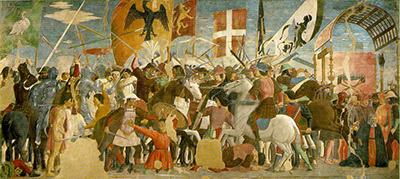
A small cross held at arm’s length decides the outcome of Piero della Francesca’s battle. Constantine rides in from the left among close ranks of cavalry, while the riders on the right break away by a river. Above the emperor flies a much larger emblem, a dark eagle on a yellow banner. It is the little cross, however, that leads the advance. The fresco occupies the lowest painted register of the right-hand wall of the Bacci Chapel, as seen from the nave facing the high altar of San Francesco in Arezzo. Piero painted it as part of his fifteenth-century History of the True Cross. [1] [2] [3]
At a Glance
- ArtistPiero della Francesca
- MediumWall fresco
- DateMid-fifteenth century, within the Arezzo cycle dated 1452–1466 by the Museums of Arezzo [1]
- LocationLowest painted register of the right-hand wall, Bacci Chapel, Basilica of San Francesco, Arezzo, viewed facing the high altar from the nave [2] [3]
- SubjectConstantine’s victory under the sign of the cross, conventionally identified with the Battle of the Milvian Bridge of 312 [2] [4]
This work across Piero della Francesca’s career
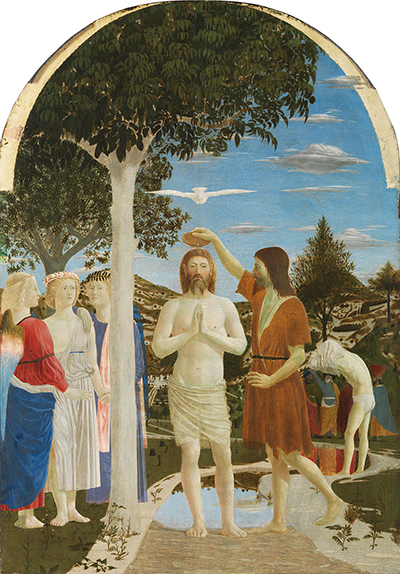
The Baptism of Christ
Probably about 1437–45The History of the True Cross
Mid-fifteenth centuryVictory of Constantine (current article)
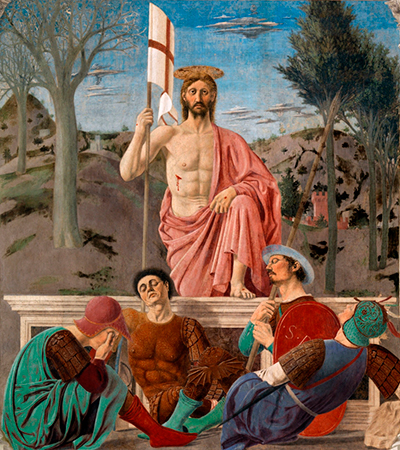
Mid-fifteenth century, Bacci ChapelThe Resurrection
About 1458–68 (Opificio)The Flagellation of Christ
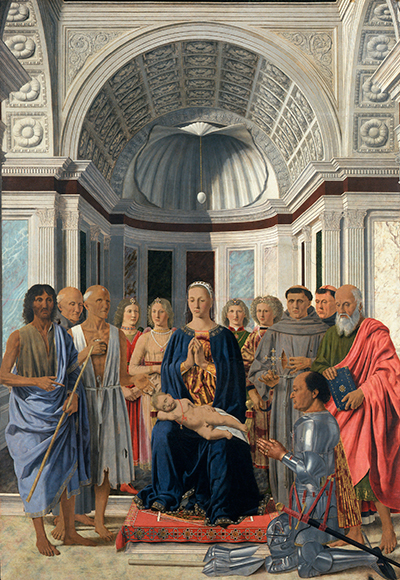
1459–60 (GNDM)The Montefeltro Altarpiece
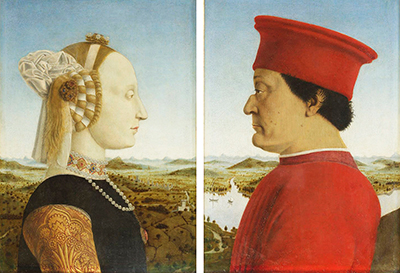
About 1472–74 (Brera)The Duke and Duchess of Urbino
About 1473–75 (Uffizi)The Nativity
Early 1480s (National Gallery)Contents
- The advance and the rout
- Why it is called the Battle of the Milvian Bridge
- The Danube and a fifteenth-century parallel
- What survives on the wall
- The two battles in the Bacci Chapel
- Annotated details
The advance and the rout
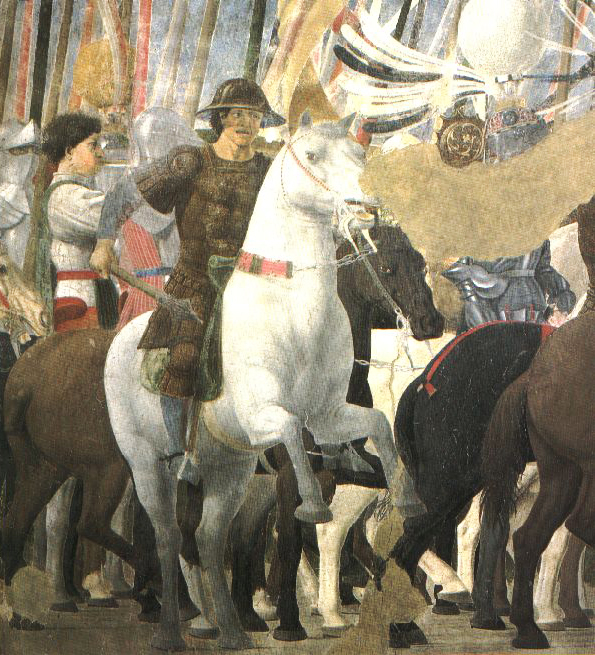
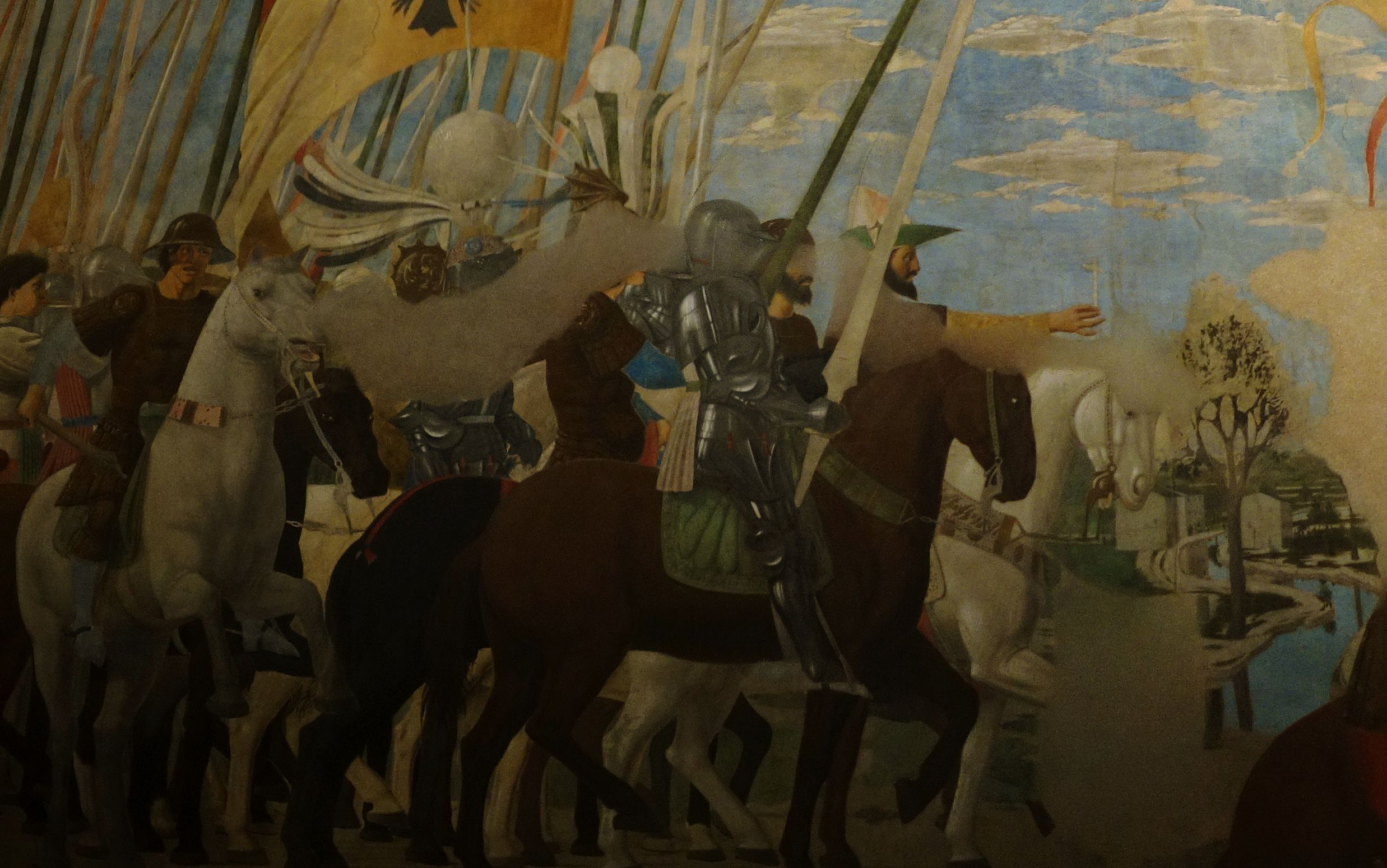
Start with Constantine’s face, seen in profile beneath a brimmed hat. His gaze and outstretched arm carry the eye from the crowded cavalry into a patch of relatively open sky. The fine, pale lines of the cross are easy to miss there. The arm stays almost level, even as lance shafts behind and above it rise through the picture at different angles. The gesture is calm enough to hold the scene together. It also tells the viewer where the force behind the advance is meant to come from. [2] [5]
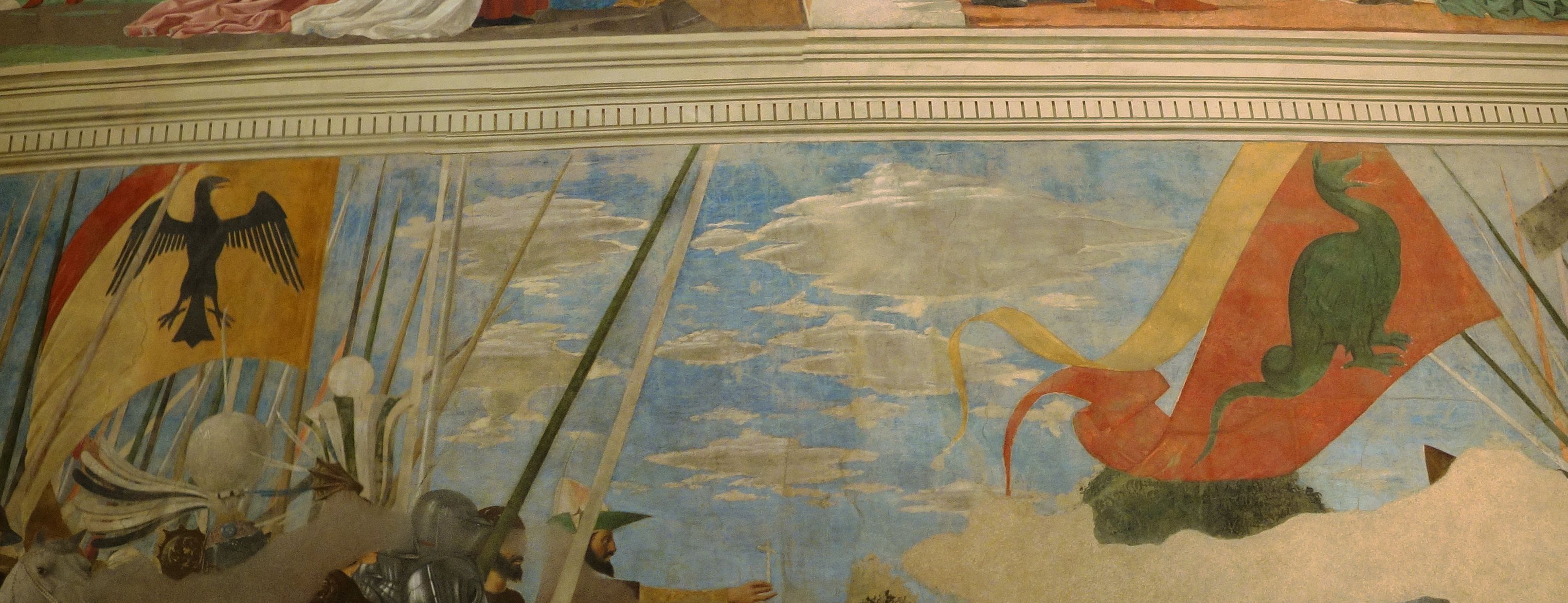
The cavalry has its own rhythm. The white and brown horses overlap closely, their legs repeating the motion of a walk across the foreground. Piero varies the pace within that pattern. At the left a pale horse seen almost head-on raises its front legs and breaks the succession of animals in profile. The feathers and ridges of the soldiers’ headgear and the highlights that run across their armour distinguish individual riders without breaking up the formation. Above them the yellow eagle banner occupies a broad area of the sky. Its scale gives the army an imperial identity, while Constantine’s much smaller cross singles him out within it. [2] [5]
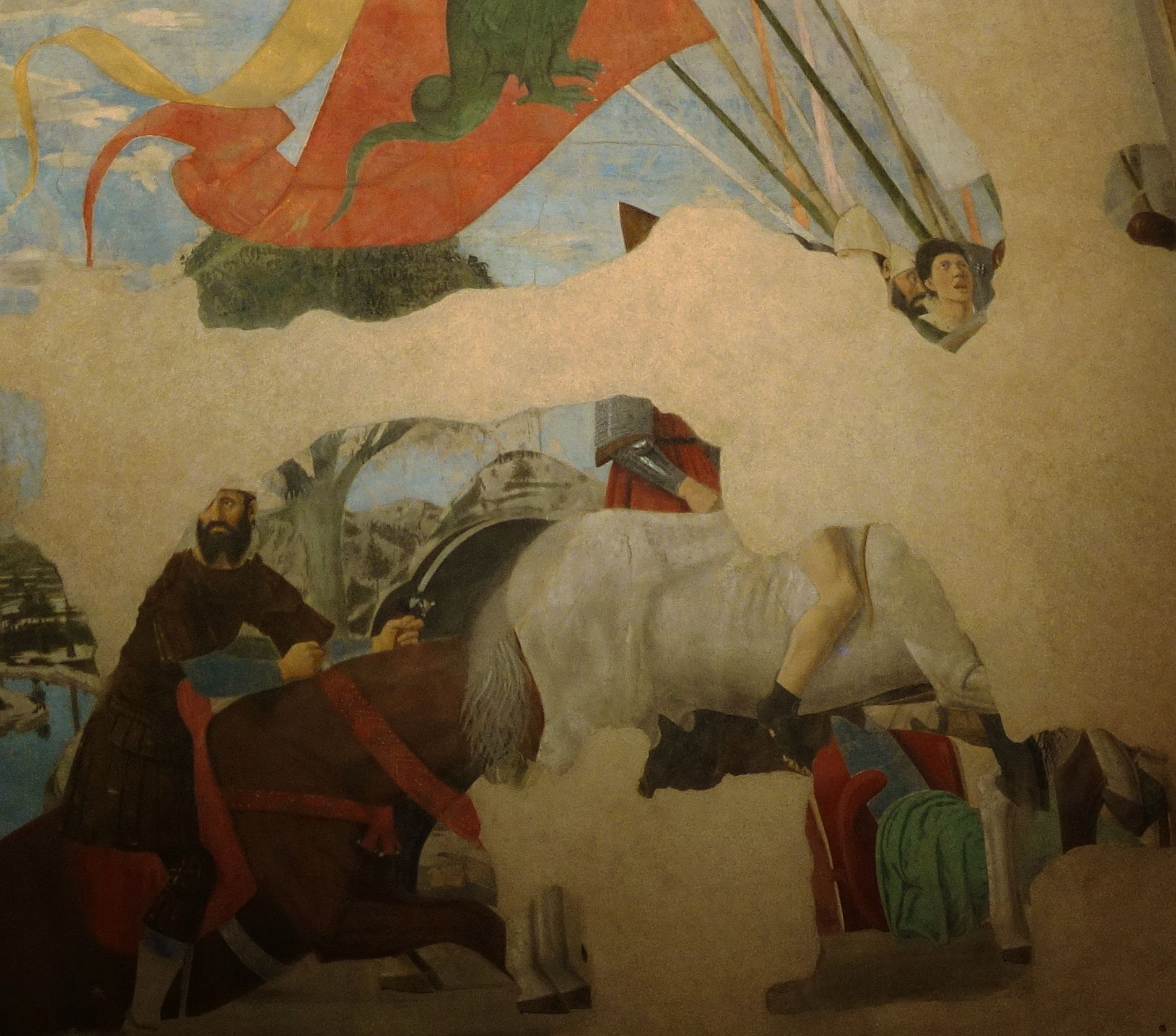
The red standard towards the right, bearing a green dragon, helps locate the opposing force even where losses interrupt the figures beneath it. Its trailing end curls above the river landscape. Down among the fugitives, a bearded rider turns to look back while his mount carries him away from the advancing ranks. Elsewhere the angles of the horses and the slanting shafts upset the direction established on the left. The picture’s action is apparent even where the outlines become fragmentary. One side can move together. The other has lost that ability. [2] [5]
The space between the groups does some of the storytelling. Follow the river back from the confusion in the foreground and the landscape opens out into trees and buildings that diminish in scale. The quieter water and distant architecture make the foreground horses feel especially close. Piero lets the army advance across the width of the wall while the landscape draws the eye back into depth. The two movements meet near the emperor’s extended hand. From farther away, where the cross itself is hard to make out, the opposed directions of the cavalry still carry much of the narrative. [5]
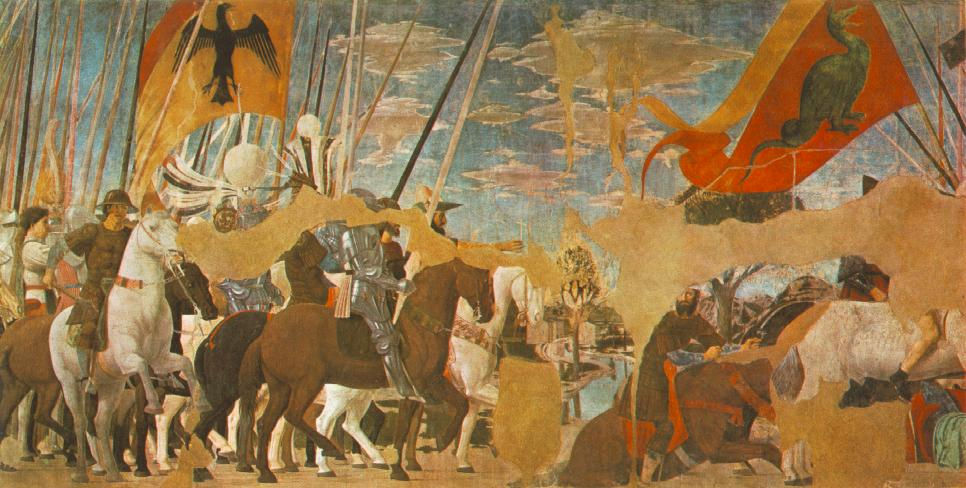
The Battle of Constantine traditionally identified with the Milvian Bridge, Bacci Chapel. Image source. Public domain. Resized only; native appearance preserved.
Why it is called the Battle of the Milvian Bridge
On 28 October 312, Constantine defeated his imperial rival Maxentius near the Milvian Bridge outside Rome. Maxentius drowned in the Tiber during the defeat. The early Christian authors who told the story also gave the victory a religious meaning. Lactantius describes a dream in which Constantine was told to mark his soldiers’ shields with a heavenly sign. Eusebius, writing in praise of Constantine, relates a sign of light in the daytime sky followed by a dream and the making of an imperial standard. He likens the drowning of Maxentius and his men to the destruction of Pharaoh’s forces in the Red Sea. The accounts give different forms to the sign that preceded the victory. [2] [6] [7]
There is a long history of identifying Piero’s subject with that battle. In his sixteenth-century life of the painter, Giorgio Vasari recognised the flight and drowning of Maxentius and admired the foreshortening of the horses. The Museums of Arezzo’s fresco guide likewise calls the scene Constantine’s victory over Maxentius and locates the remains it associates with the defeated ruler by the river. A close look at the surviving paint gives a more limited description. The troops are fleeing by water, and part of a hat and torso survive where the guide places Maxentius. A viewer would struggle to trace a drowning or identify the crossing as the Milvian Bridge from the visible remains alone. Vasari preserves an early reading of the picture. Damage to the wall makes some details of that reading difficult to test today. [2] [5] [4]
Annotated Details from Victory of Constantine at the Battle of the Milvian Bridge
The numbered points identify visible features discussed in this article. Return from each detail to the numbered overview. Right wall of the Bacci Chapel in San Francesco, Arezzo, as seen from the nave facing the altar. Spike. Image source. CC BY-SA 4.0. The numbered overview and detail crops are adaptations under CC BY-SA 4.0.
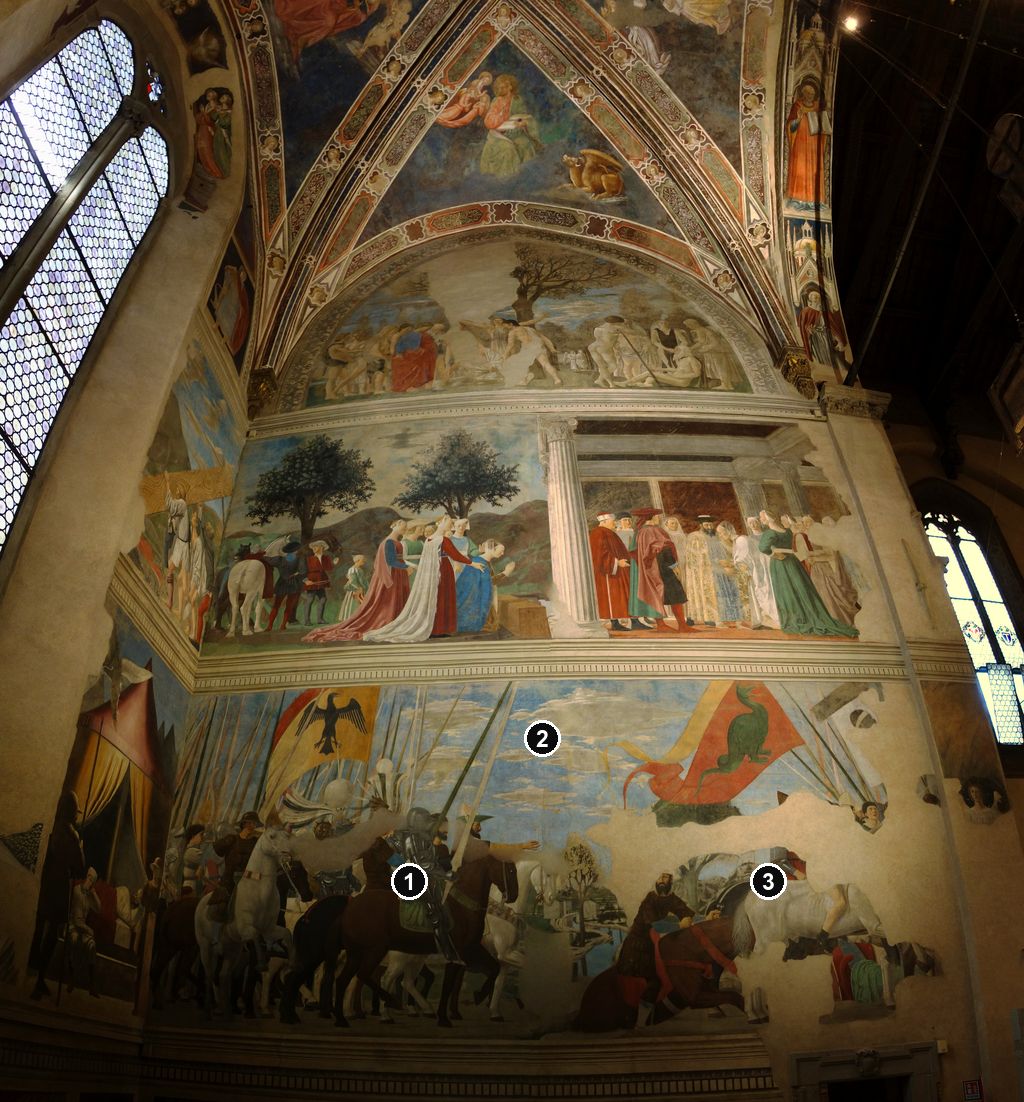
Details from VICTORY OF CONSTANTINE AT THE BATTLE OF THE MILVIAN BRIDGE
Compare the cropped details with the source images above. Notice how their colours, shapes and positions contribute to the larger compositions.
The clustered horsemen
A cluster of horses packs the left of the surviving scene. The angled weapons continue that group into the strip of sky above.
Banners and weapons
Coloured pennants stand out near the lances. Their colour and diagonals make the change in direction across the wall legible.
Gaps on the right
Paint losses interrupt the scattered forms of the figures and horses moving away. The wider view keeps those missing passages in context.
The Danube and a fifteenth-century parallel
The medieval Golden Legend, the main literary source for the chapel cycle, itself circulated an account of Constantine defeating an invading army on the Danube under the sign of the cross. In that version an angel rouses Constantine at night, he sees the sign, and a cross is carried at the head of his force. The opponents turn and flee. The tradition also recounts the victory over Maxentius in a version that gives particular weight to the rival’s death at a bridge. The Danube account offers a close match for the action that survives on Piero’s wall, especially the way the enemy gives ground before the cross. Frank Büttner and Maurizio Calvesi have argued for that reading, and Visit Arezzo acknowledges the possibility that the fleeing ruler is a leader of the Danube invaders. [1] [8] [9] [10] [11]
The same scholars have connected the picture with the relief of Belgrade in 1456, when forces led by János Hunyadi and joined by the Franciscan friar Giovanni da Capestrano defeated the Ottoman siege. Calvesi draws attention to accounts of Capestrano advancing under the sign of the cross and to a depiction of the friar carrying a cross standard as his enemies flee. That comparison gives the Danube reading a particular resonance in a Franciscan church. It remains a comparison across time. The literary question is which version of Constantine’s victory Piero used. The historical question is whether the fresco invited fifteenth-century viewers to think of Belgrade or of a wider struggle with the Ottomans. Each requires its own evidence. [9] [10]
Constantine’s features offer another link with the fifteenth century. His pointed beard, sharp profile and distinctive hat recall Pisanello’s medal of the Byzantine emperor John VIII Palaeologus, made in connection with John’s presence in Italy around the Council of Ferrara and Florence in 1438–39. The medal shows John in profile on one side and on horseback near a cross on the other. Piero’s ruler can thus evoke a recent emperor of the eastern Roman world while still playing the part of Constantine. The resemblance helps explain why the fresco has been read in the light of Byzantine appeals for help and the fall of Constantinople in 1453. It leaves open the choice between the Tiber and Danube stories, since the figure carrying the cross is Constantine in both. [10] [12] [13]
The date at which Piero devised the scene also affects which topical comparisons are possible. Monica Centanni and Alessandra Pedersoli place its conception around the siege of Constantinople in 1452–53. In their reading, the ancient emperor’s victory could evoke hopes for the defence of the city by Constantine XI, John VIII’s brother and successor. A composition devised at that point would precede the relief of Belgrade. The rival proposals underline how much turns on the disputed timing of this particular fresco within the longer Arezzo project. [9] [10] [14]
What survives on the wall
Broad, irregular gaps cut across the centre and right half of the fresco, interrupting riders, horses and landscape. Their pale surfaces can momentarily look like part of the composition in a small reproduction, especially where they meet the patchy sky. The late nineteenth-century photograph in Italy’s national photographic collections gives a historical comparison for the mural’s condition. An earlier watercolour by Johann Anton Ramboux shows more of the composition and helped Aby Warburg study the horsemen and their headgear. The copy has its own choices of line and colour. It can clarify how scholars have read the damaged scene, while the wall and historical photographs remain essential checks on which details survive. [5] [15] [16]
The long restoration campaign for the Arezzo cycle concluded in 2000 and generated a linked archive to document the paintings and their treatment. The Italian Ministry of Culture announced a further maintenance campaign in 2024 encompassing the cycle, the chapel’s painted crucifix and its central window. That scope reflects how closely a painted wall’s preservation depends on the building that houses it. [17] [18] [19] The wall itself still gives the most direct account of what a visitor can see here. The cavalry on the left and the upper flags read readily, while the fleeing group asks the eye to connect fragments. This uneven survival matters in weighing interpretations, particularly when they depend on the precise fate of a rider in the river. [2] [5] [17]
The two battles in the Bacci Chapel
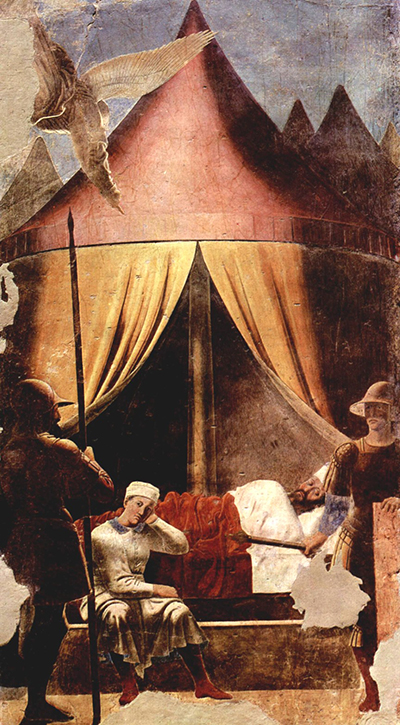
On the back wall, in the lower scene immediately to the right of the chapel’s central window, Dream of Constantine shows the emperor asleep in his tent as an angel brings the sign. The adjoining walls make the change of scale apparent. The dream is concentrated in an illuminated tent, with comparatively few figures. The wide daylit fresco carries the sign across a landscape in the midst of two armies. The little cross that came to the emperor while he slept has become a public gesture. [1] [2]
Look across to the lowest painted register of the left-hand wall for the Battle between Heraclius and Chosroes. There the figures close on one another, fallen bodies crowd the ground, and weapons cut across the space between combatants. In the legend Heraclius’s victory makes possible the return of the sacred wood to Jerusalem. Constantine holds a sign of the Cross before the relic’s recovery. Facing one another at the same height, the scenes show military victory at two different points in the story of the Cross. They also give the visitor two very different ways of recognising the moment when a battle is decided. [1] [2] [3]
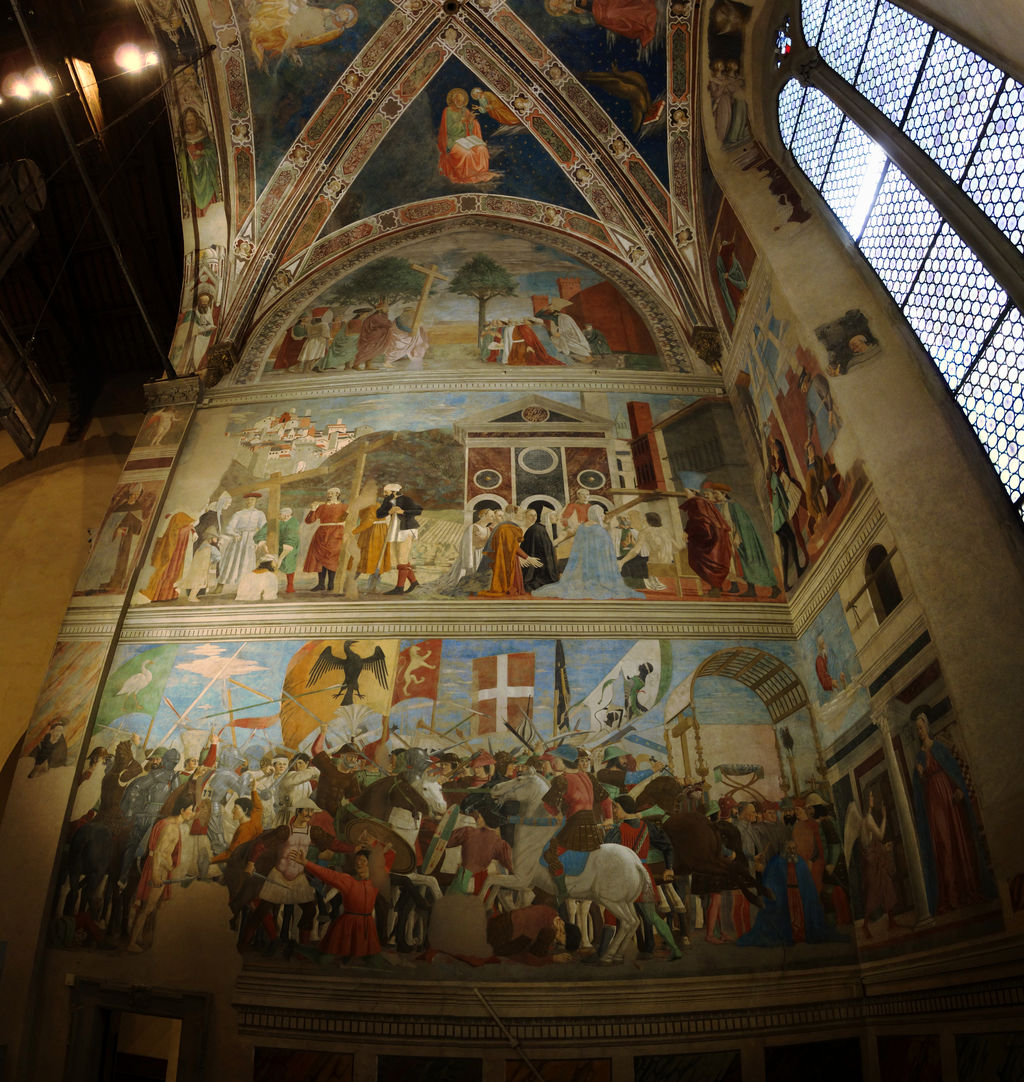
Left wall of the Bacci Chapel in San Francesco, Arezzo, as seen from the nave facing the altar. Spike. Image source. CC BY-SA 4.0. Resized from the source. This reproduction uses CC BY-SA 4.0.
Browse the artworks
Compare Piero’s frescoes, panels and manuscript figures. The list includes ensembles and separately identifiable panels or scenes. Dates are approximate where the sources differ.
| Name | Date | Medium and source |
|---|---|---|
| The Baptism of Christ | Probably c. 1437–45 | Panel painting Catalogue. |
| The Flagellation of Christ | 1459–60 (GNDM) | Panel painting Catalogue. |
| The History of the True Cross | Mid-fifteenth century | Wall painting Catalogue. |
| Dream of Constantine | Mid-fifteenth century | Wall painting Catalogue. |
| The Duke and Duchess of Urbino | About 1473–75 (Uffizi) | Panel painting Catalogue. |
| The Resurrection | About 1458–68 (Opificio) | Wall painting Catalogue. |
| Brera Madonna | About 1472–74 | Panel painting Catalogue. |
| Annunciation at Arezzo | Mid-fifteenth century | Wall painting Catalogue. |
| Madonna del Parto | About 1450–65 (Monterchi) | Wall painting Catalogue. |
| Polyptych of the Misericordia | Commissioned 1445 | Panel painting Catalogue. |
| The Nativity | Early 1480s (National Gallery) | Panel painting Catalogue. |
| Madonna di Senigallia | About 1474–75 (GNDM) | Panel painting Catalogue. |
| Death of Adam | Mid-fifteenth century | Wall painting Catalogue. |
| Queen of Sheba | Mid-fifteenth century | Wall painting Catalogue. |
| Victory of Constantine | Mid-fifteenth century | Wall painting Catalogue. |
| Battle between Heraclius and Chosroes | Mid-fifteenth century | Wall painting Catalogue. |
| Saint Mary Magdalen | Wall painting Catalogue. | |
| The Augustinian Polyptych | 1454–69 | Panel painting Catalogue. |
| Polyptych of Perugia | About 1467–69 (GNU) | Panel painting Catalogue. |
| Perugia Annunciation | About 1468–70 (national catalogue) | Panel painting Catalogue. |
| St Francis and St Elizabeth | About 1467–69 (GNU) | Panel painting Catalogue. |
| Stigmatisation of St Francis | About 1468–70 (national catalogue) | Panel painting Catalogue. |
| An Augustinian Nun (Saint Monica) | 1454–69 | Panel painting Catalogue. |
| Augustinian Saint | 1454–69 | Panel painting Catalogue. |
| Saint Michael | 1454–69 | Panel painting Catalogue. |
| Saint Nicholas of Tolentino | 1454–69 | Panel painting Catalogue. |
| Saint John the Evangelist | 1454–69 | Panel painting Catalogue. |
| Virgin and Child Enthroned with Four Angels | About 1460–70 (Clark) | Panel painting Catalogue. |
| Portrait of Sigismondo Pandolfo Malatesta | About 1450–51, often proposed. Louvre catalogue range 1450–75. | Panel painting Catalogue. |
| Sigismondo before St Sigismund | 1451 | Wall painting Catalogue. |
| St Jerome and a Donor | 1460s (Accademia); about 1450 also proposed | Panel painting Catalogue. |
| St Jerome in Penitence | 1450, dated on the panel | Panel painting Catalogue. |
| Saint Julian | About 1455–60, often proposed | Wall painting Catalogue. |
| Saint Augustine | 1454–69 | Panel painting Catalogue. |
| Saint Apollonia | 1454–69 | Panel painting Catalogue. |
| Crucifixion from the Augustinian Polyptych | 1454–69 | Panel painting Catalogue. |
| Saint Louis of Toulouse | Wall painting Catalogue. | |
| Burial of the Wood | Mid-fifteenth century | Wall painting Catalogue. |
| Discovery and Proof of the True Cross | Mid-fifteenth century | Wall painting Catalogue. |
| Exaltation of the Cross | Mid-fifteenth century | Wall painting Catalogue. |
| Saint Anthony Raises a Child | About 1467–69 (GNU) | Panel painting Catalogue. |
| Saint Elizabeth Revives a Child | About 1467–69 (GNU) | Panel painting Catalogue. |
| Hercules | About 1470 | Wall painting Catalogue. |
| Portrait of a Boy (possibly Guidobaldo da Montefeltro) | Panel painting Catalogue. | |
| De prospectiva pingendi, Reggio Emilia witness (figures) | Manuscript diagrams Catalogue. | |
| The Interrogation of Judas | Mid-fifteenth century | Wall painting Catalogue. |
| Two prophets, Bacci Chapel | Mid-fifteenth century | Wall painting Catalogue. |
| Saint Clare of Assisi, upper predella | About 1467–69 (GNU) | Panel painting Catalogue. |
| Saint Agatha, upper predella | About 1467–69 (GNU) | Panel painting Catalogue. |
| Lost centre of the Augustinian Polyptych | 1454–69 | Lost panel or panels Catalogue. |
Frequently Asked Questions
Vasari and the Museums of Arezzo identify Constantine’s opponent as Maxentius. The medieval legend also recounts another victory on the Danube, where an enemy army takes flight before the sign of the cross. The retreat in the fresco fits that episode, and losses in the paint make the identification of the rider by the river difficult to settle from the wall alone. [2] [4] [8] [10]
Discussion
Look again at the images and ideas explored in Victory of Constantine at the Battle of the Milvian Bridge. These editorial prompts invite your observations.
Reader Insights
Follow the lances from left to right. At what point does their direction begin to make the troops look as if they have lost formation?
Compare Constantine’s outstretched arm with the raised weapons in the Heraclius fresco. Where does each painting ask you to look first for the outcome of the fighting?
If you compare the fresco with Ramboux’s watercolour, which details can you confirm on the wall and which depend on the copy?
Join the Conversation
Share a detail, comparison or question about Victory of Constantine at the Battle of the Milvian Bridge below.
References
- Museums of Arezzo, Frescoes by Piero della Francesca, on the Bacci Chapel, the cycle’s dates and thematic arrangement. View source.
- Museums of Arezzo, Legend of the True Cross. Frescoes by Piero della Francesca, episodes 4, 5, 8 and 9. View source.
- Italian Ministry of Culture, Arezzo, Chiesa di San Francesco, Disfatta e morte di Cosroe, Bacci Chapel photographic record. View source.
- Giorgio Vasari, Life of Piero della Francesca, translated by Gaston du C. de Vere, Fordham University Internet History Sourcebooks. View source.
- Piero della Francesca, Victory of Constantine, photograph of the surviving fresco in Arezzo, reproduced by Wikimedia Commons. View source.
- Lactantius, On the Deaths of the Persecutors, 44.3–6, extract in J. Stevenson, ed., A New Eusebius, revised by W. H. C. Frend, p. 320. View source.
- Eusebius of Caesarea, Life of Constantine, book I, chapters 28–31 and 38, translated by Ernest Cushing Richardson. View source.
- Jacobus de Voragine, The Invention of the Holy Cross, The Golden Legend, English translation by William Caxton. View source.
- Frank Büttner, Das Thema der ‘Konstantinschlacht’ Piero della Francescas, Mitteilungen des Kunsthistorischen Institutes in Florenz 36, nos. 1–2 (1992), pp. 23–40. View source.
- Maurizio Calvesi, La Flagellazione nel quadro storico del convegno di Mantova e dei progetti di Mattia Corvino, in Piero della Francesca and His Legacy, National Gallery of Art (1995), pp. 114–125, especially notes 28–29. View source.
- Visit Arezzo, Guide to “The Legend of the True Cross” by Piero della Francesca, episode 6. View source.
- Musée des Beaux-Arts de Lyon, Medal of John VIII Palaeologus, Pisanello. View source.
- Alison Harpur, Studies in Visual Culture and the Council of Ferrara-Florence (1438–1445), University College London (2023), chapter 6. View source.
- Monica Centanni and Alessandra Pedersoli, Costantino XI Paleologo vs Maometto II. Nota sulla cronologia della Battaglia di Costantino contro Massenzio, La Rivista di Engramma 52 (2006). View source.
- Istituto Centrale per il Catalogo e la Documentazione, Arezzo – Basilica di S. Francesco, coro, la battaglia di Costantino e Massenzio, late nineteenth-century photographic print, MPI133047. View source.
- Marco Jalla, Copy, Style, and Art Historians Scrutiny, Artl@s Bulletin 13, no. 2 (2024), article 4, on Ramboux’s copy and Warburg’s use of it. View source.
- Stefano Casciu, Giuseppe A. Centauro and Massimo Chimenti, The Archival Documentation System. The Computerized Heart of the Restored “History of the True Cross” by Piero della Francesca, in GraDoc, ICCROM (2000), pp. 208–220. View source.
- Direzione regionale Musei nazionali Toscana, Basilica di San Francesco, site and conservation history. View source.
- Direzione generale Musei, Ad Arezzo visite al cantiere di manutenzione della “Leggenda della Vera Croce” di Piero della Francesca, scope of the 2024 works. View source.