 by Tom Gurney
Tom Gurney BSc (Hons) is an art history expert with over 20 years experience
Published on June 19, 2020 / Updated on October 14, 2023
Email: tomgurney1@gmail.com / Phone: +44 7429 011000
Piero della Francesca: Biography and Timeline: Introduction
In 1432, the painter Antonio d’Anghiari acknowledged a debt of 56 florins to Benedetto, the father of Piero della Francesca. The sum covered money advanced for work on an altarpiece and wages owed to Piero. The document puts the young painter to work for a local master on a major commission for the Franciscans in his home town. Seven years later, a Florentine payment record places him with Domenico Veneziano on a mural cycle. By 1451 he was signing and dating a fresco for the lord of Rimini. The altarpiece that occasioned the first record was abandoned, the Florentine cycle is lost, and the mural at Rimini survives. The paper trail tells a story that the surviving pictures alone could never give us. [1] [2] [3]
Piero was born in Borgo San Sepolcro, now Sansepolcro, in the Upper Tiber Valley. He worked for confraternities, religious orders, ruling families and the papacy, and returned repeatedly to the town where he had learnt his trade. He died there on 12 October 1492. His mathematical manuscripts belong to the same life as his paintings, and his ties to the court of Urbino help explain why both found an audience there. The guide to Piero della Francesca introduces his painting. The documents below follow the course of his career and the people who paid for, handled and preserved his work. [1] [3] [4] [5]
At a Glance
- BirthPiero was born in Borgo San Sepolcro, now Sansepolcro, in the early fifteenth century. His exact birth year is uncertain. [1] [4] [5]
- Early workHis name appears in a 1432 record concerning a Franciscan altarpiece and a 1439 record linked to Domenico Veneziano at Sant’Egidio in Florence. [2] [3]
- Signed worksA panel of Saint Jerome carries the year 1450, and the Rimini fresco of Sigismondo Malatesta carries the year 1451. [6] [7]
- Major mural cyclePiero took over the decoration of the Bacci Chapel after Bicci di Lorenzo’s death in 1452. The Arezzo cycle was complete by 1466. [8] [9]
- Written workThree mathematical treatises survive, alongside a copy of Archimedes largely in Piero’s hand. [10] [11]
- DeathPiero died in Sansepolcro on 12 October 1492. [4] [6]
Piero della Francesca in context
Italian Early Renaissance
Piero’s fifteenth-century contextEarly Netherlandish painting
Comparative painting traditions in the fifteenth centuryDomenico Veneziano
Worked with Piero in 1439; died 1461Leon Battista Alberti
Active across Piero’s career; died 1472Piero della Francesca
Recorded in the 1430s; died 1492Andrea Mantegna
Born c. 1431; lived beyond the period shownThe Baptism of Christ
Probably about 1437–45The History of the True Cross
Mid-fifteenth centuryThe Resurrection
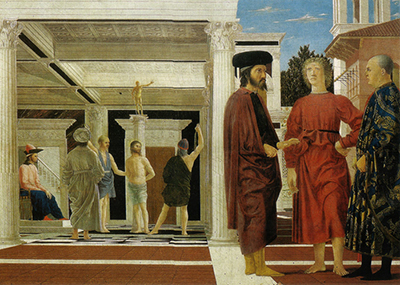
About 1458–68 (Opificio)The Flagellation of Christ
1459–60 (GNDM)The Montefeltro Altarpiece
About 1472–74 (Brera)The Duke and Duchess of Urbino
About 1473–75 (Uffizi)The Nativity
Early 1480s (National Gallery)Contents
- Birth and family in Borgo San Sepolcro
- 1432–39: The workshop and Florence
- 1445: The confraternity of the Misericordia
- The 1440s and early 1450s: Ferrara, Ancona and Rimini
- 1452–66: Arezzo and the years of overlapping commissions
- 1467–75: Religious houses, Urbino and commissions at home
- The mathematical manuscripts and the Urbino library
- The 1480s to 1492: A family painting and the last records
- How later generations came to know Piero
Birth and family in Borgo San Sepolcro
The exact year of Piero’s birth remains uncertain. The Museo Civico in Sansepolcro gives 1416 or 1417 and the National Gallery’s artist profile gives about 1415–20. James R. Banker, whose research has brought many of the local records into print, favours about 1412, the year used by the Museo Poldi Pezzoli for its 2024 exhibition. The National Gallery’s later exhibition announcement uses an earlier estimate, about 1407–11. The surviving evidence includes notarial records about the family, which help establish when Piero’s parents probably married and where he fitted among their children. A year given in a catalogue heading is an estimate built from evidence of this kind. No baptismal record has been found that would settle the question. [3] [4] [5] [12] [13] [14]
His father was Benedetto di Piero, who made his living in the leather trade. His mother, Romana, came from nearby Monterchi. The name Piero di Benedetto in documents simply means Piero, son of Benedetto. Vasari later explained Piero’s familiar surname with a story in which his father died before he was born, leaving his mother to bring him up. The 1432 debt record alone establishes Benedetto’s presence well into his son’s working life. Piero also used a name tied to his home town. On the signed painting of Saint Jerome now in Berlin, the wording identifies him as Piero of Borgo San Sepolcro. Ronald Lightbown also points out that a form of the surname was recorded for Piero’s grandfather in 1390. The artist could identify himself through his father, his family or the town whose name appears on his work. [1] [12] [6] [15]
The Borgo of his youth was a prosperous town with religious houses and a market for ambitious painting. Under the Malatesta early in Piero’s life, it passed through papal rule before coming under Florence in 1441. Its churches already contained objects that gave a local painter precedents for large devotional ensembles. The abbey held a polyptych by the Sienese painter Niccolò di Segna. The Franciscans wanted an altarpiece painted on both faces for their high altar, with different images visible to the congregation and to the friars in the choir. A commission like that required carpentry, preparation, gilding and painting, as well as agreement on what each audience would see. Sansepolcro gave Piero a way into this work before a surviving record places him in Florence. [1] [2] [3]
Four stages of Piero della Francesca’s career
These periods group related developments; painting, travel and local work overlap across their boundaries.
Work in Sansepolcro and Florence
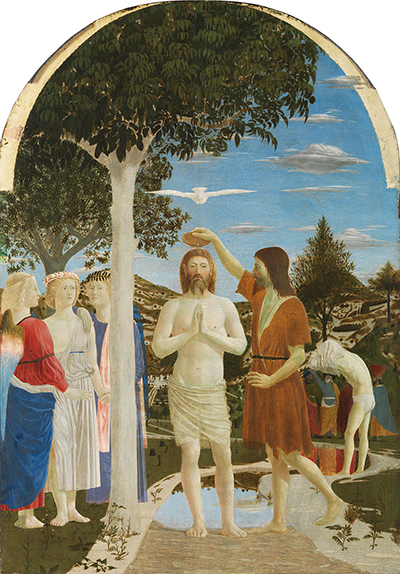
Records place Piero in his hometown and then in Florence with Domenico Veneziano. In the Baptism he sets a public sacred event among shallow water, pale light and a recognisably Tuscan landscape. [16]
Commissions for chapels and civic spaces
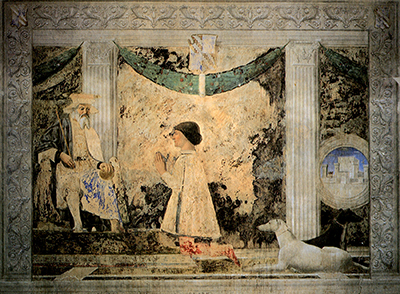
Piero combined work in his hometown with commissions elsewhere in central Italy. In Rimini, an architectural room binds the kneeling ruler and his patron saint within the same measured space. [7]
Work associated with the Montefeltro court
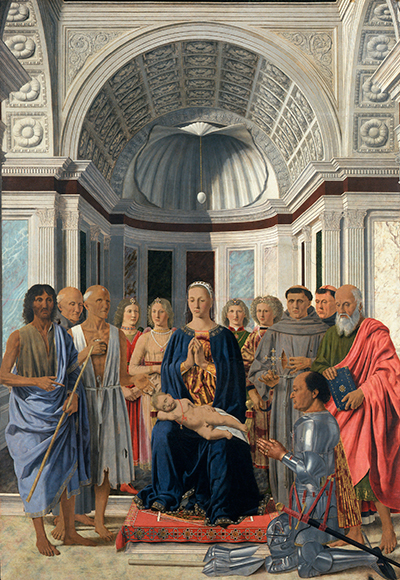
The Montefeltro altarpiece sets a ruler in armour beside saints and angels. The foreshortened vault, hanging egg and reflections give the chapel-like interior different depths. [17]
Late painting and writings
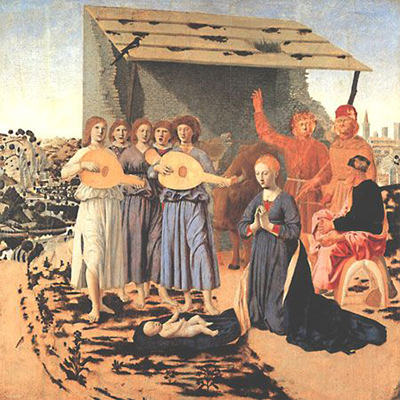
Piero worked in oil on the Nativity, using a softly lit setting for the miraculous event. His writings circulated in manuscript and explain how to represent measured solid forms. [18]
1432–39: The workshop and Florence
The Franciscan altarpiece began before Piero’s involvement. The original undertaking went to the painter Antonio d’Anghiari, and the record of 1432 establishes that Piero both worked for Antonio and was owed wages. His father had also advanced money towards the materials. We can place Piero within the business of the commission, where a painter’s time, materials and credit mattered. The record leaves the division of the preparation and painting between the two men far less clear. [2]
This early project stopped short of the commission the friars had envisaged. In 1437 they made a fresh agreement with the Sienese painter Sassetta, who worked on a new altarpiece in Siena and brought it to Sansepolcro, where it was installed in 1444. Its two faces presented different programmes. One included the Virgin and Child and saints, while the other showed Francis in glory surrounded by scenes from his life. Several of the Francis scenes are now in London. Their scale can be deceptive when encountered singly in a gallery. Their original arrangement accommodated movement and changing sightlines in a church, something Piero would have to consider when he won large commissions of his own. Sassetta’s surviving panels belong to the replacement project. [2]
The altarpiece was only one kind of work a painter could do. In 1436 the papal administration paid Antonio and Piero for painting coats of arms above Sansepolcro’s four gates and on six banners for its towers. The record names both men as painters and again involves Benedetto on Piero’s behalf. The work advertised who held the town in full view of people passing through the gates. It takes Piero’s early career from the interior of a church to the public face of the town. [19]
In September 1439, a payment connected with Domenico Veneziano reached Piero while the two were working together in Florence. The work was a cycle in the choir of Sant’Egidio, the church of the hospital of Santa Maria Nuova. The entry associates Piero with Domenico at a particular time and place. The project continued across several hands and years. The parts that can be assigned from later testimony tell us about the work of Domenico, Andrea del Castagno and Alesso Baldovinetti. No passage of surviving painting can now be placed beside an early panel and securely identified as Piero’s contribution to the cycle. [1] [3] [4] [20]
Florence offered access to Masaccio’s murals, the sculpture of Donatello and developments in architecture associated with Brunelleschi. These encounters help place Piero’s interest in heavy, solid figures and convincingly measured settings. The payment entry tells us less about how long he had been in Florence or which works exerted the strongest pull. A shared commission also had practical consequences. Working in a choir meant fitting figures to existing walls, planning what could be seen from below, and dividing the work into passages manageable on wet plaster. Those problems returned on a larger scale in Arezzo. [1] [3] [20]
The Baptism of Christ, probably painted about 1437–45, offers a glimpse of what Piero was able to do in these years. The panel came from the church of San Giovanni Battista at Sansepolcro and formed the centre of an altarpiece completed with other panels by Matteo di Giovanni. John’s arm stretches over Christ’s head while a thin line of water falls from a shallow vessel. The dove, Christ’s folded hands and his feet in the stream draw the eye down the middle, while the bodies on either side keep the scene from looking stiff. The pale tree trunk is substantial enough to pull the eye left, and tiny marks in the distance give the valley depth. The dated Florentine payment falls within the painting’s estimated range. The panel shows how assured Piero was as an early painter, while the two dates leave the exact sequence open. [16]
1445: The confraternity of the Misericordia
Piero’s name appears on a list of citizens eligible for Sansepolcro’s communal council in 1442. His family were also longstanding supporters of the local confraternity of the Misericordia. Lightbown traces a gift back to Piero’s grandfather and identifies Benedetto as a former treasurer. In 1445 the lay confraternity of the Misericordia commissioned the Polyptych of the Misericordia for its church, which also served its hospital. It offered 150 florins with a third in advance and anticipated completion within three years. The last recorded payment came in 1462. That gap matters because the altarpiece is often described as an early work, although its surviving panels belong to a project that overlapped with some of Piero’s best documented middle years. The commission fixes the beginning of an obligation. It leaves the order in which he painted the surviving parts open to study. [3] [12] [21] [22]
The commission called for a gold ground, a costly and familiar feature of Italian altarpieces. Against that gold, the central Virgin spreads her cloak over two groups of kneeling people. Seen across a room, the cloak forms an enveloping curve with an interior dark enough to set off the heads gathered beneath it. The Virgin’s larger size makes the protection of this small human company immediately legible. A confraternity that cared for people in need could recognise a version of its own communal life in the group. The densely packed figures belong to a painted space of their own even though the gold offers no deep landscape or built room. [21] [22]
The confraternity reserved the right to change its choice of saints, and Saint Bernardino in the finished altarpiece was canonised only in 1450. A record from 1454 shows members of the Pichi family putting pressure on Piero to return to the commission. The lower row of narrative panels, known as the predella, also appears to involve other hands. Bertelli names the Camaldolese artist Giuliano Amadei for the predella and some small elements. Lightbown’s reconstruction identifies a Florentine hand for the predella without specifying Amadei. The right to revise the saints, the effort to get Piero back to work and the signs of other painters’ involvement all show how the finished altarpiece could diverge from the job as it stood in 1445. [3] [12] [22]
The 1440s and early 1450s: Ferrara, Ancona and Rimini
One of the least visible episodes of Piero’s career took place at Ferrara. He worked there for the Este, and sources record murals in their castle and for the church of Sant’Andrea. The paintings are lost. Bertelli discusses copies made long afterwards that may give some idea of the battle painting in the castle, including groups of horsemen and fluttering standards. Even if the copies preserve something of Piero’s arrangement, they are at several removes from the original. His work in Ferrara gives him a place among the artists employed by the Este before the securely dated fresco at Rimini. [1] [3]
Two kinds of evidence survive from 1450. In March, in Ancona, Piero witnessed the will of Simona di Feliciano. The notarial record securely puts him in the city on a particular day. It supplies no picture that can be attached to the visit. His small Saint Jerome in Penitence in Berlin carries a painted inscription naming Piero of Borgo and giving the year 1450. The Gemäldegalerie connects it with the documented stay in Ancona and names a local official, Gerolamo Ferretti, as a possible patron. A later painting in Ferretti’s burial chapel appears to look back to Piero’s composition. The will proves Piero’s presence in the city, the inscription proves the year of the panel, and the painting in the chapel supplies circumstantial evidence about its first owner. [6] [23]
The following year, in Rimini, Piero signed and dated his fresco of Sigismondo Pandolfo Malatesta praying before Saint Sigismund. Sigismondo was converting the Franciscan church of San Francesco into the monument now called the Tempio Malatestiano. At the Tempio Piero’s work belongs in a setting shaped by several people and arts, from Leon Battista Alberti’s classical exterior to the sculpture and marble decoration inside. Carlo Bertelli suggests that the painter’s connection to Sigismondo’s court may have owed something to a fellow townsman, Jacopo degli Anastagi. That gives a plausible route by which Piero’s reputation could have reached the court. The fresco itself is firmer evidence of what came of the relationship. [3] [7]
Piero shows Sigismondo wearing a richly patterned garment and kneeling before his enthroned namesake. Two dogs lie behind him, and a glimpse of Castel Sismondo appears in a round opening. The kneeling figure is particular enough to identify a man and the fortress particular enough to locate his power. The quiet encounter between patron and saint gives the scene the decorum of prayer even as the profile, dress and building project authority. The Louvre’s portrait of Sigismondo is a separate object, a small painted panel in which the same man’s profile carries the likeness on its own. The dated fresco fixes the Rimini episode, while each likeness belongs to its own setting and purpose. [3] [7] [24]
1452–66: Arezzo and the years of overlapping commissions
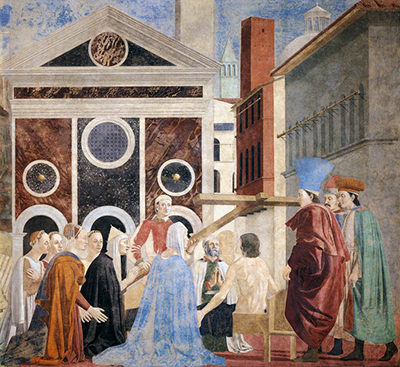
At San Francesco in Arezzo, the Bacci family held rights in the main chapel and had commissioned Bicci di Lorenzo to decorate it. Bicci died in 1452, leaving work in the vault and upper areas. Piero inherited a chapel already partly painted and took responsibility for much of what remained. Museums in Arezzo give 1452–66 as the working range for The History of the True Cross. The first date marks Bicci’s death, and a December 1466 contract for a banner for the Annunziata confraternity refers to Piero’s work in San Francesco as complete. Within that period, the exact sequence and timing of some scenes are debated. [3] [12] [8] [9]
The story derives principally from the Golden Legend, the widely circulated collection of saints’ lives and religious narratives. Piero had to distribute its episodes across facing walls and around a window, taking account of the proportions of the chapel and the distance of the spectator. The reader of a manuscript can turn a page to find out what happens next. An onlooker in the chapel has to turn their head and look up or across. Piero could exploit those movements. Two battle scenes occupy opposing parts of the lower register despite being set centuries apart. Their affinities in subject and scale help orient a viewer before every incident has been identified. [8] [9]
In the Dream of Constantine, the wall of the tent becomes visible by the light that accompanies the angel. The outline of the conical roof and the distribution of bright touches let the spectator grasp the whole situation from the chapel floor, then pick out a sentry and the positions of the men within. In The Queen of Sheba, open ground gives way to columns and a pavement as the story moves from the Queen’s recognition of the sacred wood to her reception by Solomon. The scene uses the change of setting to move between episodes on the same painted surface. These works required control of intervals much larger than those in the Berlin Saint Jerome, and an understanding of what could remain clear at a distance. [8]
During the same period Piero accepted another obligation at home. The October 1454 agreement for the high altar of Sant’Agostino in Sansepolcro allowed eight years for the commission. Even that allowance proved optimistic. A 1459 will records a patron’s contributions, including a piece of land valued at about 39 florins and a further 100 florins as part of the painter’s fee. Angelo di Giovanni di Simone also records what he spent on having the wooden support made. His account gives a rare view of an altarpiece as a sequence of transactions involving a patron, separate expenditure on woodwork and a painter who could take some compensation in property. By 1469 the Augustinian Polyptych was complete. [13] [25] [26]
Piero also worked for Pope Pius II in Rome. A payment in April 1459 records 150 gold florins for paintings in a papal chamber. A subsequent entry concerns gold leaf used for decoration in the palace. The commission illustrates the risk of judging a career solely by surviving paintings. Papal employment is a substantial episode that we can establish through accounts even though the work cannot be visited or read alongside the murals in Arezzo. Rome offered access to ancient architecture and to a scholarly network in which Greek geometrical works were circulating in Latin. One study of Piero’s copy of Archimedes compares textual corrections with those in a manuscript owned by the papal notary Francesco dal Borgo, Piero’s cousin. Its authors place the copy before 1468, probably in 1458–59, around the time of the papal commission. Their dating would put Piero’s study of Archimedes well before the final Urbino dedications. [1] [3] [27]
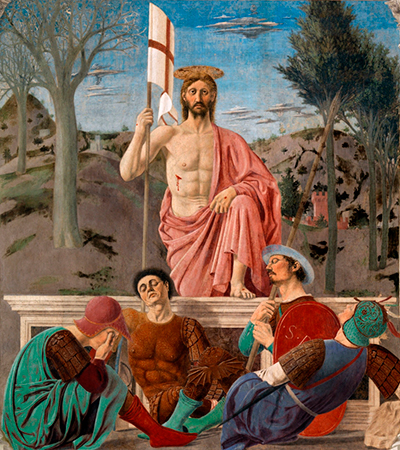
Other works from these years show Piero’s changing relationship with Sansepolcro. The Resurrection, dated to about 1460 by the Museo Civico, occupied the seat of municipal government. Christ plants a foot on the edge of the tomb and looks out over the sleeping guards. The tomb is the subject embedded in the town’s name, the Holy Sepulchre. The Opificio delle Pietre Dure, which worked on the mural’s conservation, links it to civic patronage around 1468 and suggests that it could first have stood near the platform from which magistrates addressed the public. The conservation team identifies the surviving mural as a painting moved with part of its masonry. Its precise date and first position remain open, but its association with civic authority gives it a distinct place among Piero’s religious images. [28] [29]
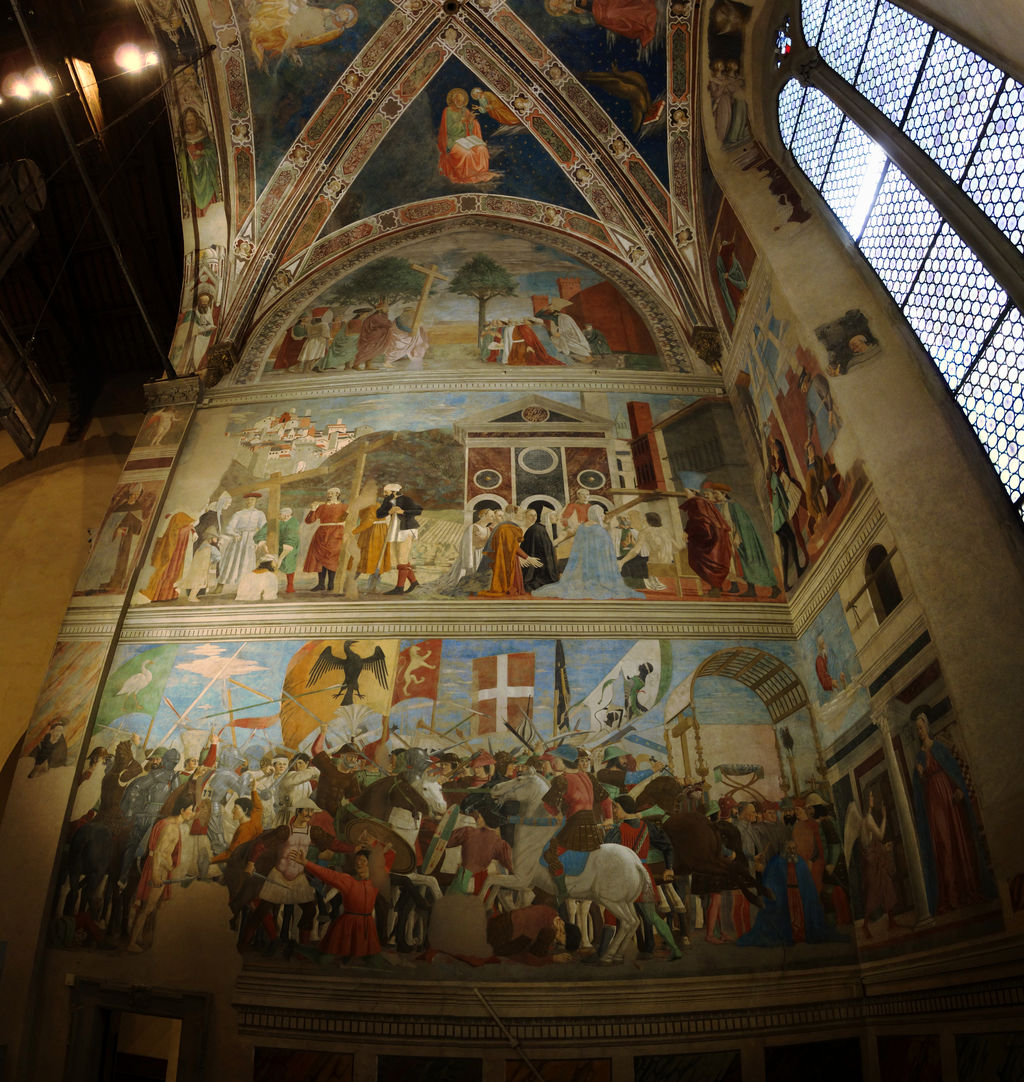
Left wall of the Bacci Chapel in San Francesco, Arezzo, as seen from the nave facing the altar. Spike. Image source. CC BY-SA 4.0. Resized from the source. This reproduction uses CC BY-SA 4.0.
1467–75: Religious houses, Urbino and commissions at home
A commission in Perugia shows how a religious community and a government could both shape a painting. The Franciscan Tertiaries of Sant’Antonio commissioned Piero to paint an altarpiece for the church outside their convent. The Galleria Nazionale dell’Umbria dates the Polyptych of Perugia to about 1467–69 and connects its completion with a municipal grant in 1468. The assembly fits the church’s presbytery and accommodates a series of saints and small narrative scenes. High above the gold background of the main panels, the Annunciation unfolds across a colonnade whose arcs diminish into depth. A single commission gave Piero room for both kinds of setting. [30]
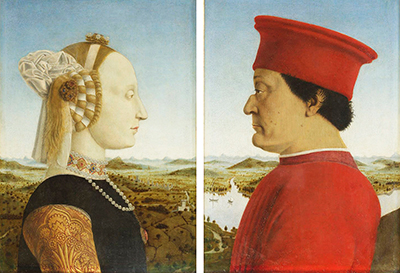
Work for Federico da Montefeltro placed Piero in a court where painting and scholarly manuscripts were both valued. Federico’s library at Urbino contained works on geometry, and Banker connects Piero’s visits in the 1470s with his reading as well as his commissions. His relationship with Federico and Battista Sforza is most familiar through the Duke and Duchess of Urbino, the double portrait now in the Uffizi, which dates it to about 1473–75. Their strict profiles face each other across the panels, with an extensive landscape behind both. Turn to the backs and each sitter appears in a triumphal procession above a Latin inscription. The diptych publishes family identity and claims to virtue on a scale small enough to handle. Battista’s death in 1472 may help explain the form in which her likeness was presented. [1] [31]
In the Brera Madonna, dated about 1472–74 by the Pinacoteca di Brera, Federico kneels in armour beneath a classical vault while the infant Christ sleeps in Mary’s lap. His position recalls Sigismondo’s at Rimini more than twenty years earlier. Federico is one participant in a crowded devotional painting, and the arrangement of saints and angels leaves the Virgin and Child firmly at its centre. The birth of a male heir and the death of Battista in the same year offer a context for a painting concerned with continuity and loss. Brera records San Bernardino outside Urbino as its former location and treats its intended first destination as an open question. [17]
The Urbino pictures can make the 1470s look wholly courtly. A series of dated entries from 1473 and 1474 shows Piero receiving payments from a Sansepolcro fraternity for painting the chapel of the Madonna in the abbey. A separate 1474 record puts him in town as guarantor for his brother-in-law in arrangements for the custody of his grandchildren. Read together, the records show the painter at work within local devotional and family relationships in the very years in which his name is linked to one of the most cultivated courts in Italy. [32] [33]
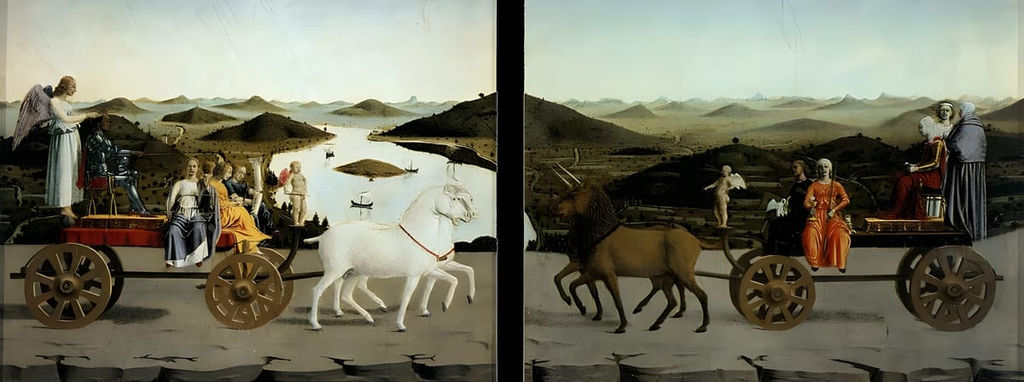
Triumphal processions on the reverse of the Urbino portraits, shown side by side. Image source. Public domain. Resized only; native appearance preserved.
The mathematical manuscripts and the Urbino library
The court connection continued on the page. In the dedication of the Libellus de quinque corporibus regularibus, Piero asks Guidobaldo da Montefeltro to place the treatise beside the one on perspective he had given to Guidobaldo’s father, Federico. That request provides a rare piece of evidence about where Piero wanted his work to go and how he intended it to be read. The volumes would sit among manuscripts that supported a courtly culture of collecting and study. The dedication to the son followed Federico’s death in 1482. The geometry could have been composed earlier, so the dedication dates one stage in the life of the book. The Vatican Library preserves the dedicated Latin manuscript. [10] [34]
Piero’s surviving work on mathematics and perspective ranges across three substantial treatises. The Trattato d’abaco belongs to a tradition of arithmetic taught for trade, and extends into algebra and geometry. Its problems include the kinds of calculation a merchant could use. In De prospectiva pingendi, Piero explains how to construct the appearance of forms on a flat surface, working towards demanding subjects such as the human head seen at an angle. The Libellus extends his studies of geometrical bodies. Their different language and audiences matter: the arithmetic and the vernacular version of the perspective treatise could be read in Italian, while the copy of the Libellus presented to Guidobaldo is in Latin. [10] [34] [35]
Another manuscript shows Piero reading and copying rather than addressing his own pupils or patrons. In 2005 Banker identified Piero’s handwriting in a copy of Archimedes in Florence’s Biblioteca Riccardiana. He compared it with handwriting in manuscripts already identified as Piero’s, among them the Trattato d’abaco. The Riccardiana manuscript preserves much of Archimedes in a Latin translation by Jacopo da San Cassiano, with carefully drawn figures alongside the text. The curves and labelled lines were instruments of study. They identify parts of a geometrical argument and can be followed independently of any painting. The date and circumstances of the copy remain subjects of scholarly discussion. [27] [11]
Luca Pacioli, another mathematician from Sansepolcro, praised Piero and knew of the perspective manuscript in the Urbino library. Pacioli’s printed works carried some of this material to a wider audience after Piero’s death. In the sixteenth century Vasari accused Pacioli of taking credit for what he had borrowed. The printed mathematical tradition, the surviving manuscripts and Vasari’s judgement are separate kinds of testimony. Read together, they show both Piero’s reputation among people who could follow his geometry and the difficulty of tracing authorship once results were copied or adapted. The quotes and writings from Piero’s circle offer some of these early accounts in translation. [15] [10] [35]
The 1480s to 1492: A family painting and the last records
The Nativity in London gives a view of Piero’s late painting at domestic scale. The National Gallery dates it to the early 1480s and places it in the Piero family house in Borgo San Sepolcro, where according to the gallery it hung in the principal bedchamber. The infant lies on Mary’s outspread blue mantle. The musicians stand close enough to form a chorus, each holding a particular posture. Beyond the roofed shelter, the eye reaches a landscape that has something of the contours and buildings familiar to people in the Borgo. The work moved in a world of family possessions, where a devotional painting might be looked at every day. [18]
Piero remained active in the town as an older man. In October 1480 the commune elected him to a one-year term as its accountant, the ragioniere. This office called on practical judgement about money, in a capacity distinct from writing mathematical treatises or negotiating the price of a painting. In 1481 he and two other priors of the fraternity of Saint Bartholomew gave their consent for four sisters to take possession of their mother’s estate. In October 1486 Piero and his brothers appointed two men to manage affairs on their behalf in Arezzo and elsewhere. The following December, after his brother Marco’s death, Piero undertook commitments concerning the dowry of Marco’s daughter Contessa. The latter document includes a dated statement in Piero’s own hand. It gives the painter a voice in circumstances far removed from his geometrical manuscripts: he was acting on a relative’s behalf, within a contract that mattered to her future. [36] [37] [38] [39]
Vasari’s biography says Piero went blind in old age, and the revised account places the loss of sight at around sixty. Piero was still adding a note to his will in July 1487 and writing the acknowledgement for Contessa in December. Those records make him an active writer well beyond the date implied by Vasari’s account. The precise condition of his eyes and the date he last put brush to panel remain uncertain. He died at Sansepolcro on 12 October 1492 and was buried in the family tomb in the chapel of San Leonardo in the abbey cloister. [4] [12] [6] [15] [38]
How later generations came to know Piero
Piero’s paintings took several paths after his death. The Arezzo murals continued to occupy the chapel for which they were made. The Augustinian altarpiece was dismantled and its known pieces eventually entered museums on both sides of the Atlantic. The Nativity passed down through the extended family and eventually reached London. These different histories shape what a viewer can learn from the objects now. A chapel cycle can still be seen across its walls, a surviving saint from an altarpiece has to be imagined alongside the lost or dispersed elements, and a painting hung in a national museum can be reconsidered as an object once seen at home. [13] [8] [18]
The National Gallery bought The Baptism of Christ in 1861 and The Nativity in 1874. The condition and authorship of the latter prompted questions in Parliament, where Prime Minister Benjamin Disraeli defended the purchase. Much later, the gallery’s conservation work, completed in 2022, found that damage from earlier overcleaning had helped create the impression that the work was unfinished. Close work on a panel could change how a picture made for a house was understood. It also weakened one historical reason for supposing that the painter had stopped work on the picture towards the end of his life. [16] [18] [40]
In Sansepolcro the Resurrection became central to the local museum’s identity. Writers such as Roberto Longhi and Aldous Huxley helped direct readers towards Piero, including to the towns that still held major paintings. The Resurrection has also acquired a wartime story in which a British artillery officer, Tony Clarke, recalled Huxley’s admiration for the painting as the army approached Sansepolcro. Clarke’s account was told after the war. In his recollection, he had already fired some shells and stopped after hearing that the Germans had left. The oft-repeated claim that a painting alone saved the town goes further than his own account. [28] [41]
The surviving Augustinian panels were brought together in stages. The Frick Collection in New York exhibited several of them in 2013, as part of an exhibition devoted to works Piero made in Sansepolcro. The Hermitage in Saint Petersburg included parts of the altarpiece in its 2018–19 monographic exhibition. Finally, in Milan in 2024, the Museo Poldi Pezzoli displayed all eight known survivors together. The central panel and much of the lower register are still missing. The reunion nevertheless put large saints and small devotional panels into a shared space, where the differences in scale could again be seen as parts of one commission. [13] [42] [43]
The first record of Piero at work describes sums owed for an altarpiece that was never installed in its intended form. Two decades later an Augustinian patron listed the cost of a wooden support, a land transfer and payments to the same painter. One deal failed to give the friars the object they wanted, and the other produced a large ensemble whose surviving panels can still be studied. This view from Sansepolcro takes in the years before and after the celebrated work at the courts. It also helps explain why so much of Piero’s life can be followed through ordinary records of debts, gifts and kinship. [2] [13] [25]
Browse the artworks
Compare Piero’s frescoes, panels and manuscript figures. The list includes ensembles and separately identifiable panels or scenes. Dates are approximate where the sources differ.
| Name | Date | Medium and source |
|---|---|---|
| The Baptism of Christ | Probably c. 1437–45 | Panel painting Catalogue. |
| The Flagellation of Christ | 1459–60 (GNDM) | Panel painting Catalogue. |
| The History of the True Cross | Mid-fifteenth century | Wall painting Catalogue. |
| Dream of Constantine | Mid-fifteenth century | Wall painting Catalogue. |
| The Duke and Duchess of Urbino | About 1473–75 (Uffizi) | Panel painting Catalogue. |
| The Resurrection | About 1458–68 (Opificio) | Wall painting Catalogue. |
| Brera Madonna | About 1472–74 | Panel painting Catalogue. |
| Annunciation at Arezzo | Mid-fifteenth century | Wall painting Catalogue. |
| Madonna del Parto | About 1450–65 (Monterchi) | Wall painting Catalogue. |
| Polyptych of the Misericordia | Commissioned 1445 | Panel painting Catalogue. |
| The Nativity | Early 1480s (National Gallery) | Panel painting Catalogue. |
| Madonna di Senigallia | About 1474–75 (GNDM) | Panel painting Catalogue. |
| Death of Adam | Mid-fifteenth century | Wall painting Catalogue. |
| Queen of Sheba | Mid-fifteenth century | Wall painting Catalogue. |
| Victory of Constantine | Mid-fifteenth century | Wall painting Catalogue. |
| Battle between Heraclius and Chosroes | Mid-fifteenth century | Wall painting Catalogue. |
| Saint Mary Magdalen | Wall painting Catalogue. | |
| The Augustinian Polyptych | 1454–69 | Panel painting Catalogue. |
| Polyptych of Perugia | About 1467–69 (GNU) | Panel painting Catalogue. |
| Perugia Annunciation | About 1468–70 (national catalogue) | Panel painting Catalogue. |
| St Francis and St Elizabeth | About 1467–69 (GNU) | Panel painting Catalogue. |
| Stigmatisation of St Francis | About 1468–70 (national catalogue) | Panel painting Catalogue. |
| An Augustinian Nun (Saint Monica) | 1454–69 | Panel painting Catalogue. |
| Augustinian Saint | 1454–69 | Panel painting Catalogue. |
| Saint Michael | 1454–69 | Panel painting Catalogue. |
| Saint Nicholas of Tolentino | 1454–69 | Panel painting Catalogue. |
| Saint John the Evangelist | 1454–69 | Panel painting Catalogue. |
| Virgin and Child Enthroned with Four Angels | About 1460–70 (Clark) | Panel painting Catalogue. |
| Portrait of Sigismondo Pandolfo Malatesta | About 1450–51, often proposed. Louvre catalogue range 1450–75. | Panel painting Catalogue. |
| Sigismondo before St Sigismund | 1451 | Wall painting Catalogue. |
| St Jerome and a Donor | 1460s (Accademia); about 1450 also proposed | Panel painting Catalogue. |
| St Jerome in Penitence | 1450, dated on the panel | Panel painting Catalogue. |
| Saint Julian | About 1455–60, often proposed | Wall painting Catalogue. |
| Saint Augustine | 1454–69 | Panel painting Catalogue. |
| Saint Apollonia | 1454–69 | Panel painting Catalogue. |
| Crucifixion from the Augustinian Polyptych | 1454–69 | Panel painting Catalogue. |
| Saint Louis of Toulouse | Wall painting Catalogue. | |
| Burial of the Wood | Mid-fifteenth century | Wall painting Catalogue. |
| Discovery and Proof of the True Cross | Mid-fifteenth century | Wall painting Catalogue. |
| Exaltation of the Cross | Mid-fifteenth century | Wall painting Catalogue. |
| Saint Anthony Raises a Child | About 1467–69 (GNU) | Panel painting Catalogue. |
| Saint Elizabeth Revives a Child | About 1467–69 (GNU) | Panel painting Catalogue. |
| Hercules | About 1470 | Wall painting Catalogue. |
| Portrait of a Boy (possibly Guidobaldo da Montefeltro) | Panel painting Catalogue. | |
| De prospectiva pingendi, Reggio Emilia witness (figures) | Manuscript diagrams Catalogue. | |
| The Interrogation of Judas | Mid-fifteenth century | Wall painting Catalogue. |
| Two prophets, Bacci Chapel | Mid-fifteenth century | Wall painting Catalogue. |
| Saint Clare of Assisi, upper predella | About 1467–69 (GNU) | Panel painting Catalogue. |
| Saint Agatha, upper predella | About 1467–69 (GNU) | Panel painting Catalogue. |
| Lost centre of the Augustinian Polyptych | 1454–69 | Lost panel or panels Catalogue. |
Frequently Asked Questions
Discussion
Look again at the images and ideas explored in Piero della Francesca: Biography and Timeline. These editorial prompts invite your observations.
Reader Insights
Compare the profile and kneeling posture of Sigismondo at Rimini with Federico’s at Brera. How does each painted setting direct your attention between the donor and the sacred figures?
Compare the 1432 debt record with the 1459 account of payment for the Augustinian altarpiece. What does each tell you about who supplied the materials and how the painter was paid?
Look for the landscape in The Baptism of Christ and The Nativity. How does the amount of countryside visible in each work affect your sense of where the scene takes place?
Join the Conversation
Share a detail, comparison or question about Piero della Francesca: Biography and Timeline below.
References
- James R. Banker, Piero della Francesca, Oxford Bibliographies in Renaissance and Reformation, updated 2024. Biographical introduction and the chronology of commissions and scholarship. View source.
- Dillian Gordon, San Sepolcro Altarpiece, The Fifteenth Century Italian Paintings, vol. 1, National Gallery, London, 2003. Catalogue and documentary reconstruction of Antonio’s and Sassetta’s commissions. View source.
- Carlo Bertelli, Piero della Francesca: il maestro nel suo tempo, I classici della pittura, Treccani, 2016. Archival biography and work catalogue. View source.
- Museo Civico di Sansepolcro, Biografie degli artisti: Piero della Francesca. Municipal museum’s biography and life dates. View source.
- National Gallery, London, Piero della Francesca. Artist profile and birth range used in the collection. View source.
- Gemäldegalerie, Staatliche Museen zu Berlin, Der heilige Hieronymus, inv. 1904. Object record with transcription of signature and date, and entry by Stephan Weppelmann. View source.
- Comune di Rimini, Il Tempio Malatestiano. Municipal guide to the remodelling of the church and the fresco’s setting, signature and date. View source.
- Musei di Arezzo, Frescoes by Piero della Francesca and Bacci Chapel frescoes guide. Chapel history, layout and episode guide. View source 1. View source 2.
- Ministero della Cultura, 1452–1466: affreschi di Piero della Francesca nella chiesa di San Francesco ad Arezzo, Catalogo generale dei beni culturali. Documentary dating and the earlier campaign. View source.
- Piero della Francesca, De prospectiva pingendi, critical edition of the Italian text, Edizioni Ca’ Foscari, 2016. Introduction on the textual corpus, court dedications and Pacioli. View source.
- Biblioteca Riccardiana, Parnaso di carta. Ricc. 106 and the identification of Piero’s hand. View source.
- Ronald W. Lightbown, Franceschi, Piero, Dizionario Biografico degli Italiani, vol. 49, 1997. Family, civic records, late writing and burial. View source.
- Museo Poldi Pezzoli, Piero della Francesca: The Augustinian Polyptych Reunited, exhibition curated by Machtelt Brüggen Israëls and Nathaniel Silver, 2024. Commission, completion, dispersal and reunions. View source.
- National Gallery, London, The National Gallery stages largest ever exhibition of Italian Renaissance painter Piero della Francesca. Exhibition announcement using the alternative birth estimate. View source.
- Giorgio Vasari, Lives of Piero della Francesca and Luca Signorelli, translated by Gaston du C. de Vere, 1912–15, Internet History Sourcebooks Project, Fordham University. English translation of the revised Lives. The age at which Vasari claimed Piero went blind appears in the 1568 Italian edition. View source 1. View source 2.
- National Gallery, London, The Baptism of Christ, NG665. Object record, dating and provenance. View source.
- Pinacoteca di Brera, Madonna and Child with Saints, Angels and Federico da Montefeltro, inv. 180. Object history, patronage and original destination question. View source.
- National Gallery, London, The Nativity, NG908. Object record, domestic setting, provenance and conservation. View source.
- Italian Renaissance Document Site, Antonio d’Anghiari and Piero paid for arms and banners, 1436. Papal accounts, published by Frank Dabell and James R. Banker. View source.
- Museo Nacional Thyssen-Bornemisza, Francesca, Piero della. Artist biography including the 1439 work with Domenico Veneziano. View source.
- Italian Renaissance Document Site, Misericordia altarpiece commission, 1445. Archivio di Stato, Firenze, Notarile antecosimiano 7026, Mario di Matteo Fedeli, c. 92r–v. Record published by James R. Banker and others. View source.
- Museo Civico di Sansepolcro, Polittico della Madonna della Misericordia, EmozionArti collection portal. Object and commission history. View source.
- Italian Renaissance Document Site, Piero witnesses the will of Simona di Feliciano, Ancona, 1450. Archivio notarile di Ancona 41, Marcuccio di Benincasa, fasc. II, cc. 145r–146r, published by Matteo Mazzalupi. View source.
- Musée du Louvre, Portrait de Sigismond Malatesta, seigneur de Rimini. Object record for the profile panel. View source.
- Italian Renaissance Document Site, Will recording payments for the Sant’Agostino altarpiece, 1459. Archivio storico comunale, Sansepolcro, ser. XXXII, 177, c. 21r–v, transcribed by James R. Banker. View source.
- Italian Renaissance Document Site, Sant’Agostino high-altarpiece commission, 1454. Archival record published by James R. Banker. View source.
- Paolo d’Alessandro, Carlo Maccagni and Pier Daniele Napolitani, Piero della Francesca, Francesco dal Borgo e la traduzione di Archimede: la datazione del Riccardiano 106, 2020, Università degli Studi Roma Tre repository. Evidence and chronology of Piero’s manuscript. View source.
- Museo Civico di Sansepolcro, Collezioni. Municipal collection history, approximate dating and literary reception of the Resurrection. View source.
- Opificio delle Pietre Dure, Piero della Francesca, La Resurrezione. Conservation report on the mural’s materials, date and movement. View source.
- Galleria Nazionale dell’Umbria, Polyptych of Sant’Antonio. Commission, municipal grant and object history. View source.
- Daniela Parenti, The Duke and Duchess of Urbino Federico da Montefeltro and Battista Sforza, Gallerie degli Uffizi. Object record for both faces of the diptych. View source.
- Italian Renaissance Document Site, Payments for painting the chapel of the Madonna of the Badia, 1473–74. Account entries of the fraternity of Saint Bartholomew, Sansepolcro. View source.
- Italian Renaissance Document Site, Piero acts as guarantor for his brother-in-law, 1474. Archivio di Stato, Firenze, Notarile antecosimiano 7002, Leonardo di Mario Fedeli, cc. 180r–183r. View source.
- Biblioteca Apostolica Vaticana, Urb.lat.632, digital manuscript of the Libellus. See also Museo Galileo’s catalogue entry on the dedication. View source 1. View source 2.
- Museo Galileo, The geometrical bodies and Trattato d’abaco, exhibition catalogue entries on the mathematical works and Pacioli. View source 1. View source 2.
- Italian Renaissance Document Site, Piero and two other priors consent to the acceptance of an inheritance, 1481. Record published by James R. Banker. View source.
- Italian Renaissance Document Site, Piero and his brothers appoint procurators, 1486. Archivio di Stato, Firenze, Notarile antecosimiano 7000, Leonardo di Mario Fedeli, 1486, no. 20. View source.
- Italian Renaissance Document Site, Piero undertakes his late brother’s dowry commitments, 1487. Archivio di Stato, Firenze, Notarile antecosimiano 7000, Leonardo di Mario Fedeli, 1487, no. 8, with Piero’s autograph. View source.
- Italian Renaissance Document Site, Piero’s appointments in Sansepolcro in 1480. Election as municipal accountant and earlier choice as a fraternity prior. View source.
- UK Parliament, House of Commons debate, 27 July 1874. Disraeli’s defence of the National Gallery’s purchase of the Nativity. View source.
- Nick Havely, Apennine Crossings: Travellers on the Edge of Tuscany, introduction, Oxford University Press, 2024. Account and chronology of Tony Clarke’s retrospective testimony. View source.
- The Frick Collection, Piero della Francesca in America, 2013. Exhibition on work made in Sansepolcro, including Augustinian panels. View source.
- State Hermitage Museum, Пьеро делла Франческа: каталог выставки, Saint Petersburg and Milan, 2019. Catalogue record for the monographic exhibition. View source.