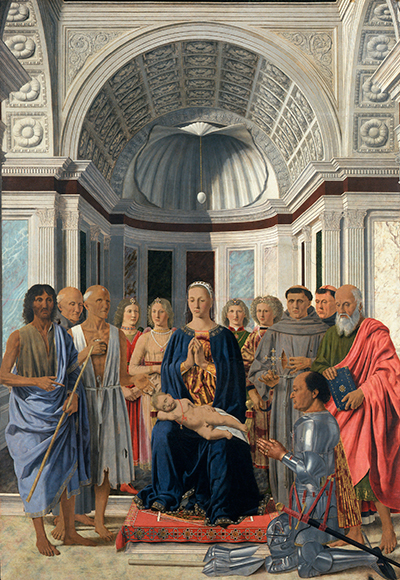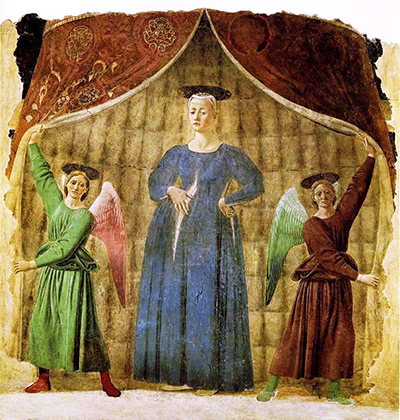
 by Tom Gurney
Tom Gurney BSc (Hons) is an art history expert with over 20 years experience
Published on June 19, 2020 / Updated on October 14, 2023
Email: tomgurney1@gmail.com / Phone: +44 7429 011000
The Baptism of Christ by Piero della Francesca: Introduction
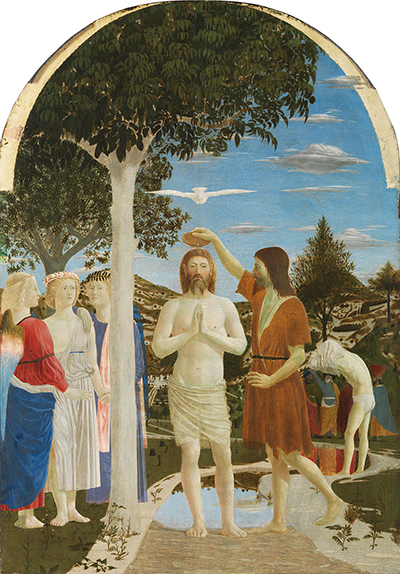
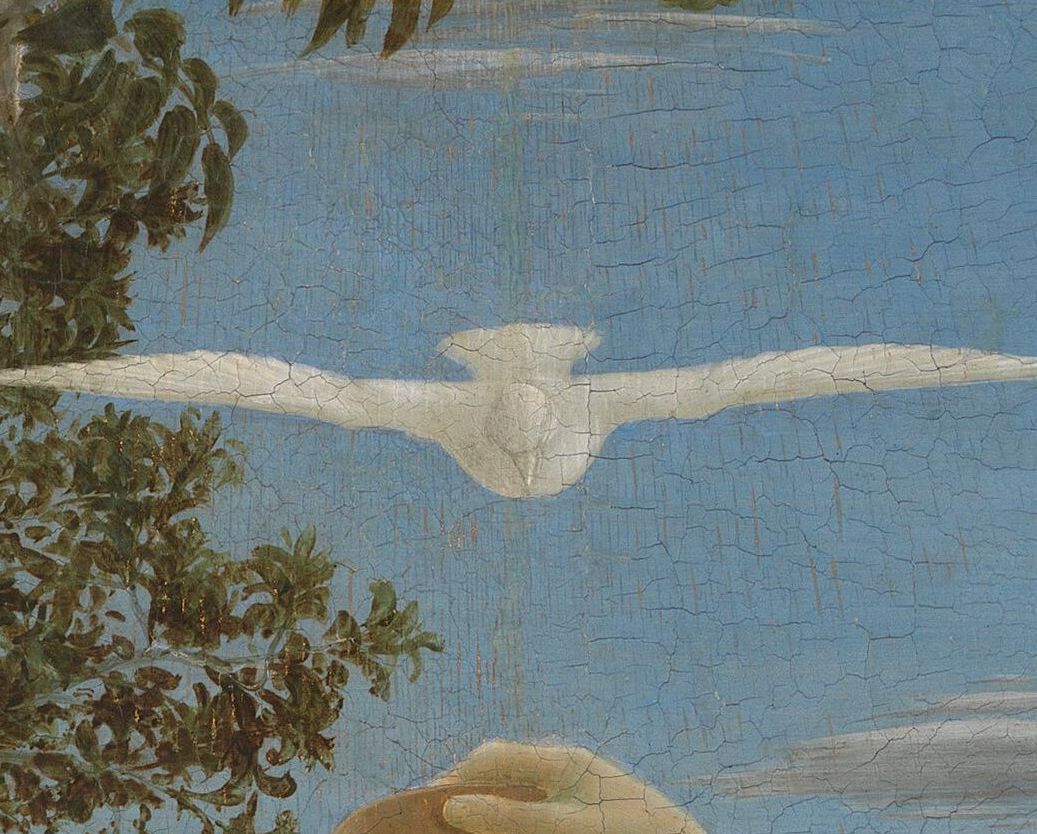
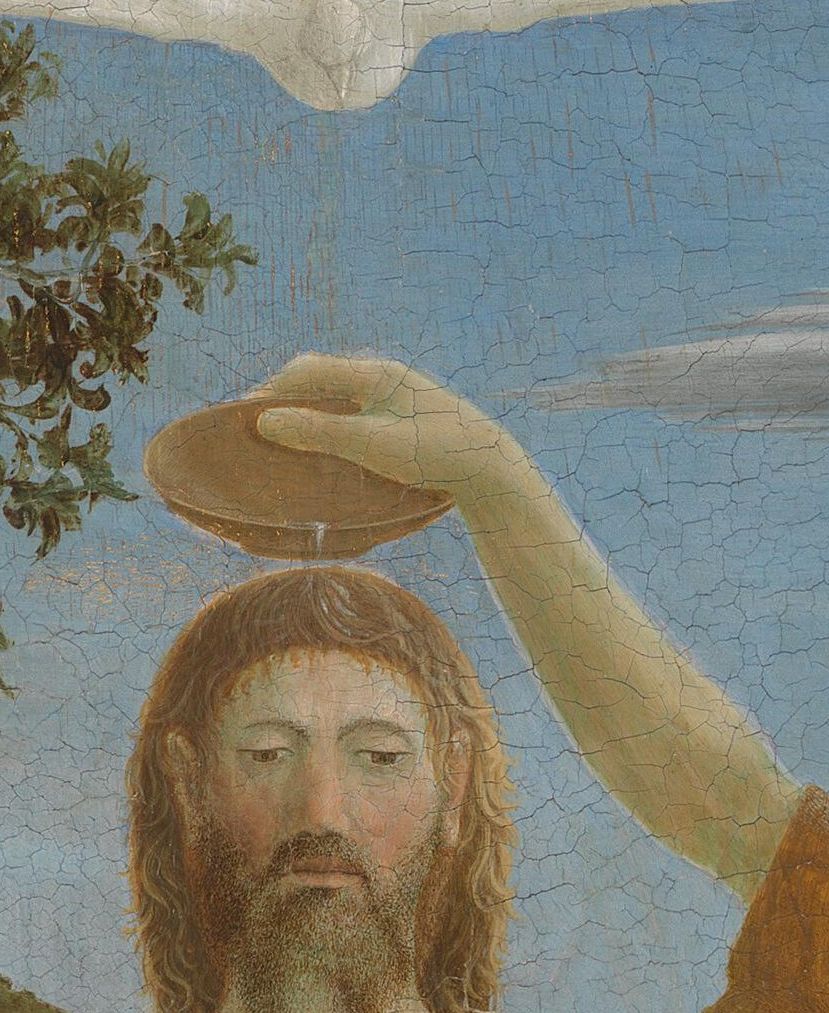
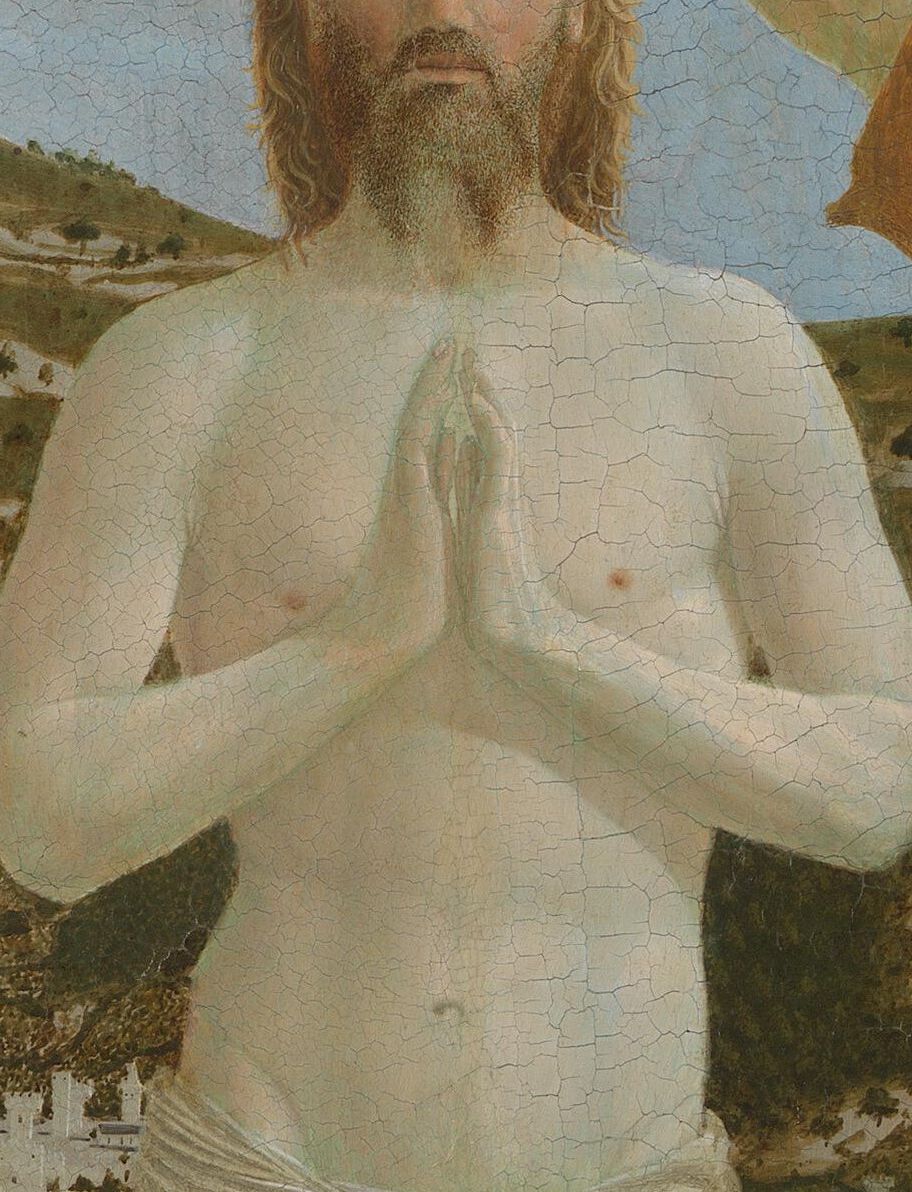
High in Piero della Francesca’s Baptism of Christ, a white dove spreads its wings against the sky. Below it, John the Baptist tilts a small bowl, releasing a thread of water just visible against Christ’s hair. Lower down, Christ presses his palms together. Behind him the river mirrors figures and hills. At his toes it almost disappears. Piero uses the same substance to mark the decisive instant of the story and to carry the eye deep into the landscape. [1]
The National Gallery in London dates the painting probably to about 1437–1445. It is an arched poplar panel, 167 by 116 centimetres, painted in egg tempera for a church in Piero’s hometown of Borgo Sansepolcro. The panel once stood between gilded saints in a much larger altarpiece. The alignment of the bird, the head and the praying hands would have carried across a church, even at a distance that made the thread of water difficult to see. [1] [2] [3]
Piero della Francesca, The Baptism of Christ, National Gallery, London. Image source. Public domain. Resized only; native appearance preserved.
At a Glance
- ArtistPiero della Francesca. [1]
- DateProbably about 1437–1445. [1]
- Medium and supportEgg tempera on poplar. [1]
- Dimensions167 × 116 cm. [1]
- CollectionNational Gallery, London, NG665. [1]
- Original ensembleCentral panel of the Sansepolcro Baptist altarpiece, with later companion pieces by Matteo di Giovanni. [1] [2] [3]
This work across Piero della Francesca’s career
The Baptism of Christ (current article)
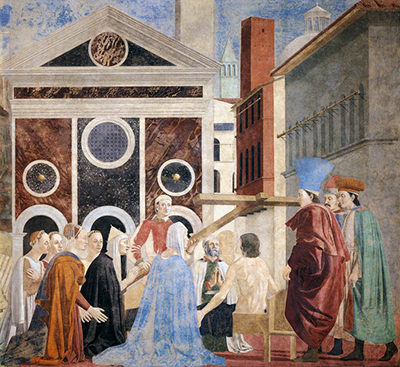
Probably about 1437–45The History of the True Cross
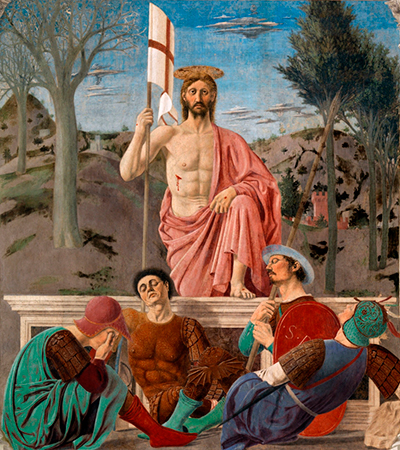
Mid-fifteenth centuryThe Resurrection
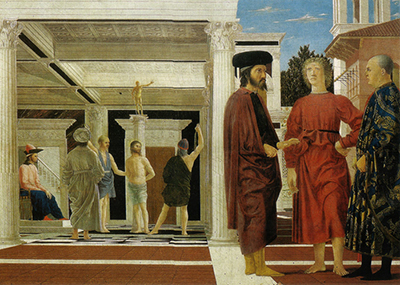
About 1458–68 (Opificio)The Flagellation of Christ
1459–60 (GNDM)The Montefeltro Altarpiece
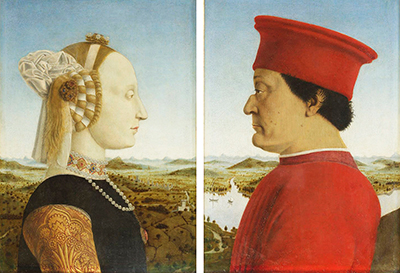
About 1472–74 (Brera)The Duke and Duchess of Urbino
About 1473–75 (Uffizi)The Nativity
Early 1480s (National Gallery)Contents
- The gesture at the centre
- Where the river goes
- The walnut tree and the distant town
- What might the angels and the onlookers mean?
- A panel painted to be seen with gold
- The commission and Matteo di Giovanni’s panels
- From Sansepolcro to London
- Annotated details
The gesture at the centre
John comes in from the right. His rough, warm-coloured tunic stops at the knees, and his feet occupy different levels at the edge of the stream. Follow the raised arm from the shoulder to the hand. The reach is long enough to bring the bowl over Christ without drawing John’s whole body into the centre. The angle of the bowl and the fine line falling from it show exactly how much of the action Piero chose to represent. We see the water after it has left the vessel and as it begins to touch Christ, before John can lower his arm. [1]
Christ faces almost straight towards us. His eyes are lowered, and his hands meet high against his chest. The broad chest and narrow ridge formed by the paired hands give the eye two very different scales of attention within the same figure. From a distance, his pale upright body fixes the position of the event. Closer to, the slight shifts of his wrists and fingers give the pose a concentration that a rigidly symmetrical outline would have lost. The figure has weight even as the motion required of him is almost imperceptible.
Matthew places the baptism in the Jordan and describes John’s initial reluctance to baptise Jesus. Jesus insists, the Spirit comes down like a dove, and a heavenly voice declares him the beloved Son. Luke explicitly puts Jesus at prayer as heaven opens and sets the event among the baptisms of the people. Those details give a reader two ways into the painting. John’s raised arm makes the physical act plain, while Christ’s prayer and the man getting ready further back connect it to a wider occasion. Piero gathers the pouring and the appearance of the Spirit into a single view. [4] [5]
The upright sequence is crossed by the dove. Its body is foreshortened as it comes towards us, and its extended wings form a short light band against the sky. The bird sits in an opening beside the walnut canopy, with room for its outline to register at a glance. The movement towards the viewer matters as much as the alignment down to Christ. The dove belongs to the space of the picture and appears to be on a course out of it. In Matthew and Luke the voice comes from heaven. Within the surviving panel Piero gives us the dove and Christ, leaving the voice to the account a worshipper would have known. [1] [4] [5]
The bowl belongs to a familiar pictorial treatment of baptism by pouring. In the later painting begun by Andrea del Verrocchio and worked on by Leonardo da Vinci, also called The Baptism of Christ, the Baptist uses a bowl while Christ stands in the Jordan. The Florentine panel makes the heavenly intervention more explicit with hands above the dove and rays directed downwards. It also places two kneeling angels near Christ, one holding his clothes. The comparison brings out what Piero made distinctive within shared conventions. His angels stand, the space above his dove contains broad daylight, and it is possible to look from Christ’s feet right into the distance without coming up against a crowded shore. [1] [6]
Where the river goes
Find the water in the middle distance first. Along the bend it holds broken patches of the onlookers’ colours, and further back the land makes an inverted image in the stream. These reflections matter because the bank itself can be hard to follow in the pale foreground. The reflections give us a stretch of recognisable surface and a way to locate its far edge. The winding shape then narrows, opens and narrows again. Following it into the distance is a different experience from following a straight line to a point. Each bend briefly hides the next stretch of water. [1]
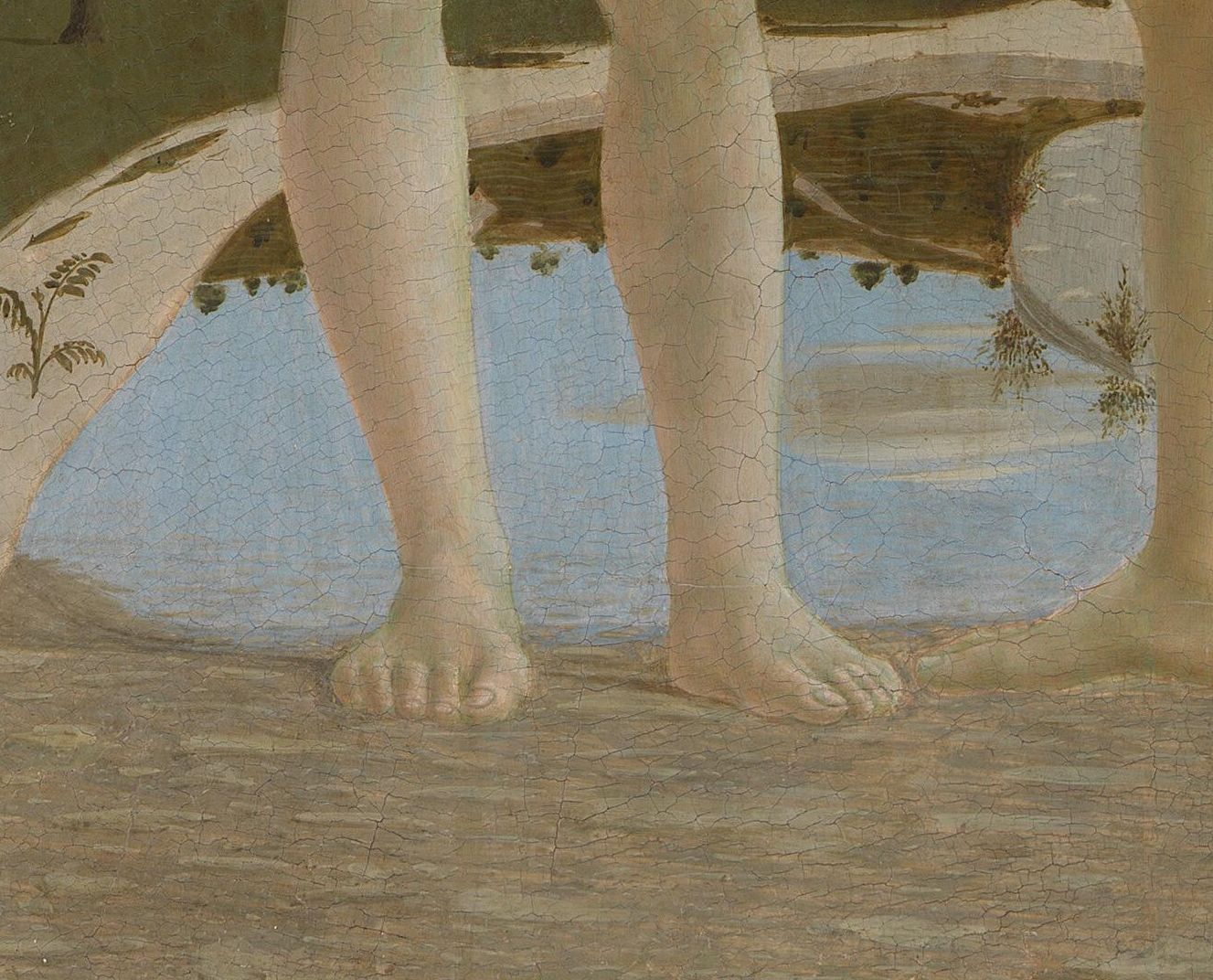
Around Christ’s feet the reflected scenery gives way to a stony bed. The Gallery suggests that we may be looking straight through clear water. That would put Christ and the viewer in the same stretch of shallows. The alternative impression, that the river has stopped at Christ, has a long history of its own. In her study of the altarpiece, Minako Uchijima discusses Marilyn Aronberg Lavin’s interpretation of the apparent stopping as a reference to biblical accounts in which the Jordan parts or ceases to flow at a divine intervention. The visual effect can support that association, even though the surface alone leaves open how literally to take it. [1] [7]
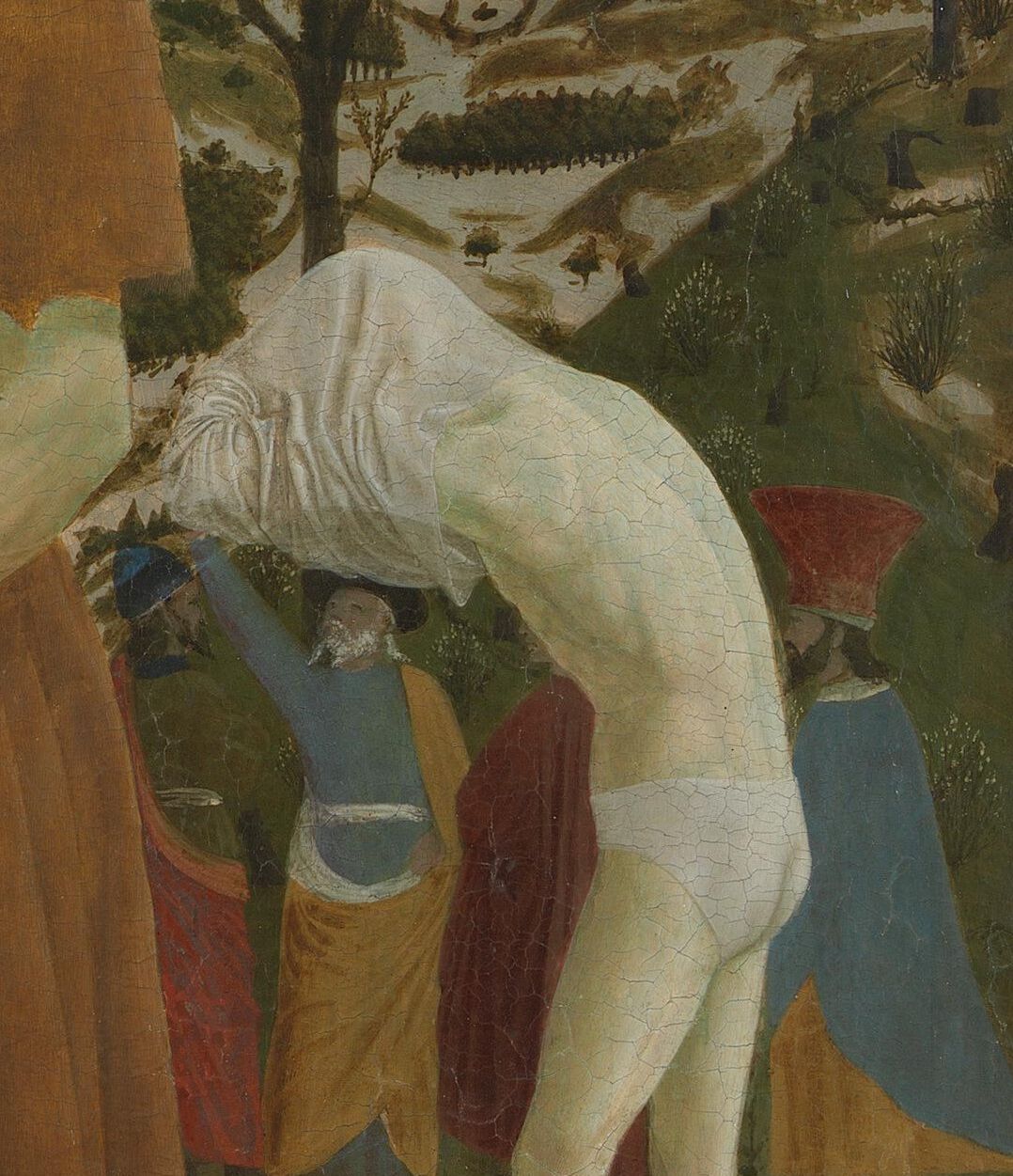
The half-dressed man gives us a measure of the distance across the foreground. Look for the bright bundle formed by his garment and then for his bent legs beneath it. The covering moves across his head while the exposed body stoops into the space behind John. His next action seems easy to imagine. A candidate preparing to follow Christ also makes sense of the contrast between the two men’s poses. One holds himself upright during the rite, while the other is still dealing with an ordinary difficulty, getting a piece of clothing over his head. [1] [5] [8]
The next figures back are smaller again. Their bright clothes keep them visible as individuals while details become harder to make out. Further left, one trunk succeeds another, and the walled settlement sits in a gap beyond Christ. Piero gives depth through changes in scale, overlap and repeated forms, without enclosing the event in architecture. He also gives the eye a reason to keep returning to the foreground. As the stream bends away from Christ, the tree draws attention back towards him. Its pale trunk rises almost parallel to his body, but the limbs and leaves turn over his head. The verticals establish a rhythm across the width of the panel while the branches let the landscape enter the curved top. [1]
These relationships can be tested by looking at the painting whole and then attending to its smaller intervals. The tree and Christ are neighbours in the plane of the picture, yet one is rooted on the bank and the other occupies the shoal. The distant figures are visible in a narrow opening between much larger bodies. An interpretation based on the painting’s proportions starts with those observable placements. For the diagrams and problems in which Piero explicitly explains how to project forms in space, see Piero della Francesca’s mathematics and perspective. [1]
Annotated Details from The Baptism of Christ
The numbered points identify visible features discussed in this article. Return from each detail to the numbered overview. Piero della Francesca, The Baptism of Christ, National Gallery, London. Image source. Public domain.
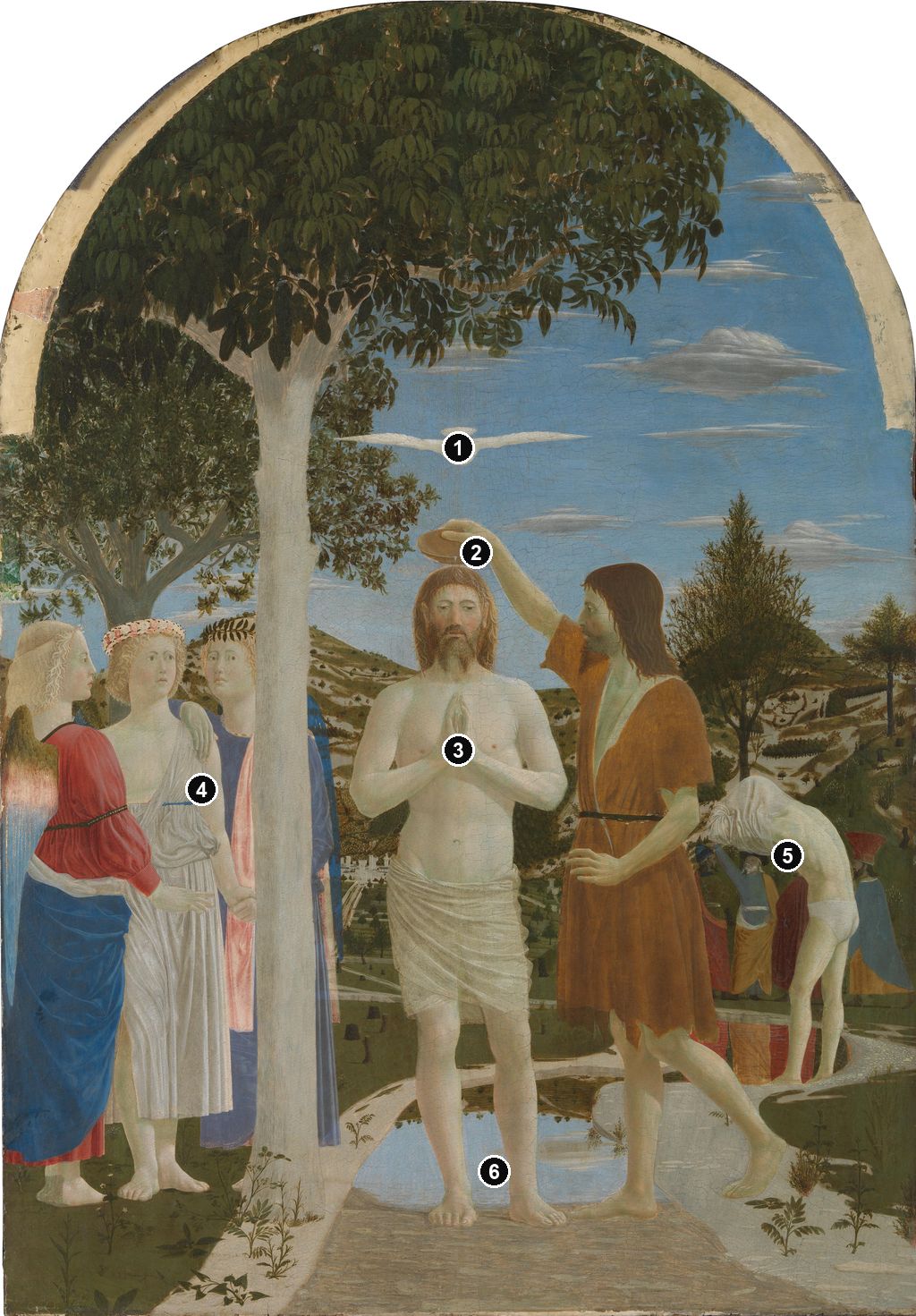
Details from THE BAPTISM OF CHRIST
Compare the cropped details with the source images above. Notice how their colours, shapes and positions contribute to the larger compositions.
Dove above Christ
The spread wings interrupt the sky. Their position sets the dove above the shallow vessel and Christ’s upright body.
Bowl and falling water
The small vessel tilts above Christ’s head. The thin stream makes the baptism easy to overlook amid the larger, still figures.
Hands in prayer
The fingertips and wrists meet under the dove and bowl. Their inward movement contrasts with John’s raised arm.
Tree and three angels
The pale trunk sets a strong vertical beside the group. Look at how the faces and coloured garments remain distinct in so little space.
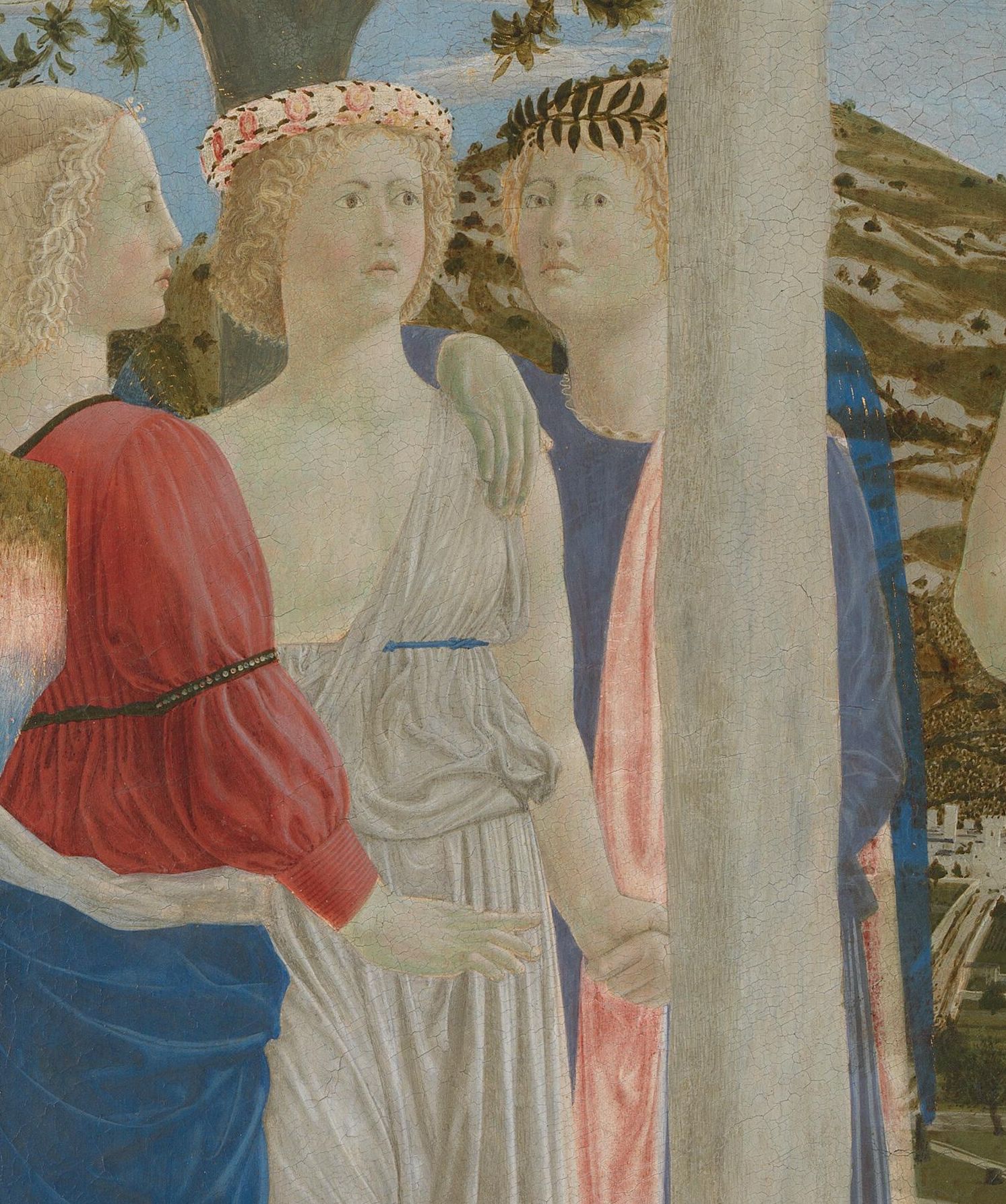
Figure changing clothes
A person bends behind the Baptist, pulling a light garment past the shoulders. The shape reads at a different scale from the nearby figures.
Water and light
Reflected sky appears in the water behind the feet. The different surfaces of stream, bank and foreground path help create depth.
The walnut tree and the distant town
Look under Christ’s elbow on the left of the picture for pale walls and towers. The National Gallery sees the settlement as a probable evocation of Sansepolcro. The river and hills recall the Upper Tiber Valley near the town, although recognising the region is easier than matching the painted buildings to a fifteenth-century view. Uchijima discusses the differences raised by the historian Ronald Lightbown, including the arrangement of the walls and the number of bell towers. A familiar landscape could make the biblical scene feel near even to a viewer who could identify no particular house or tower. [1] [7]
Sansepolcro takes its name from the Holy Sepulchre. In its foundation legend, the pilgrims Arcano and Egidio brought relics back from the Holy Land. In the version recounted by the National Gallery, the pilgrims rested beneath a walnut and woke to find the bundle containing their relics high in its branches. Some viewers in Piero’s town could therefore have seen much more than a familiar species in the prominent tree. The story gave them a way to associate their own landscape with sacred places they had never seen. The surviving altarpiece pilasters, which include figures of Arcano and Egidio, make the local association tangible in the ensemble, although they belong to its later phase. [1] [2] [7]
Uchijima builds on that connection in a reading about renewal. Baptism offers one kind of new life, and the story of the town’s founding proposes another kind of beginning. In this account the distant little settlement matters because it gives the first viewers somewhere to recognise themselves within the world of the painting. The tree works at more than one distance. Its pale trunk is large enough to help organise the whole image, while the local associations and the smaller plants at the foot of the bank reward a longer look. The foundation legend explains what the walnut might have called to mind. The picture leaves any direct reference to the legend implicit. [1] [2] [7]
What might the angels and the onlookers mean?
The three angels stand so close together that their arms briefly matter more than their wings. Two clasp hands, and a hand rests across a companion’s shoulder. On the head of the middle angel is a wreath of flowers. The angel with the more clearly exposed wing turns enough to show several bands of colour. The grouping reads from one body to the next through touch, as the action on the other side reads through the passage of water. Piero could rely on viewers knowing the tradition of angels present at the baptism even though the Gospel accounts do not place them on the riverbank. The clothes held by an angel in the Verrocchio and Leonardo panel show one customary role. Whether the red drapery here also serves as Christ’s clothing has been debated, but the hands and the gesture of companionship remain unusually conspicuous. [1] [6] [7] [8]
Marie Tanner interpreted the clasp as a gesture of concord and connected it with the attempt to reunite the Latin and Greek Churches at the Council of Ferrara–Florence in 1438–1439. The July 1439 decree of union addressed the procession of the Holy Spirit, one reason the public manifestation of the Spirit at Christ’s baptism made a plausible subject for such an allusion. Tanner also looked to the distinctive hats of the group near the river bend, comparing them with Italian representations of eastern visitors. The clasped hands and the figures’ dress give her argument two distinct features to explain. The decree establishes the historical occasion, and the connection between that occasion and the composition remains her interpretation. [8] [9]
The Camaldolese monk and scholar Ambrogio Traversari took part in the negotiations. The order’s ties to Sansepolcro offer one possible route by which the council’s ideas could have reached the people behind the commission. Piero is documented in Florence in 1439, working with Domenico Veneziano, so the council belongs to a world the young painter could have known. The surviving commission evidence tells us about funding the altarpiece and building its woodwork. It gives us no comparable account of instructions to picture the council, nor does it identify individual delegates in the painted group. [7] [8] [10]
Other readings begin with different parts of the same group. The Gallery raises the possibility of a reference to the Magi because the visit of the kings and Christ’s baptism both belonged to the celebration of Epiphany on 6 January. The four figures, viewed at a distance and with varied headgear, offer little basis for identifying three particular kings. A reference to the East could make sense within the feast without assigning each figure a name. Uchijima, meanwhile, considers the central angel’s flower crown through the classical figure of Flora and the association of spring with new life. On that reading the flowering details near the bank help connect the angels to the baptism as an act of renewal. These proposals start from visible choices, while the choice among them depends on how much historical weight we give the hats, the clasp or the flowers. [1] [7] [8]
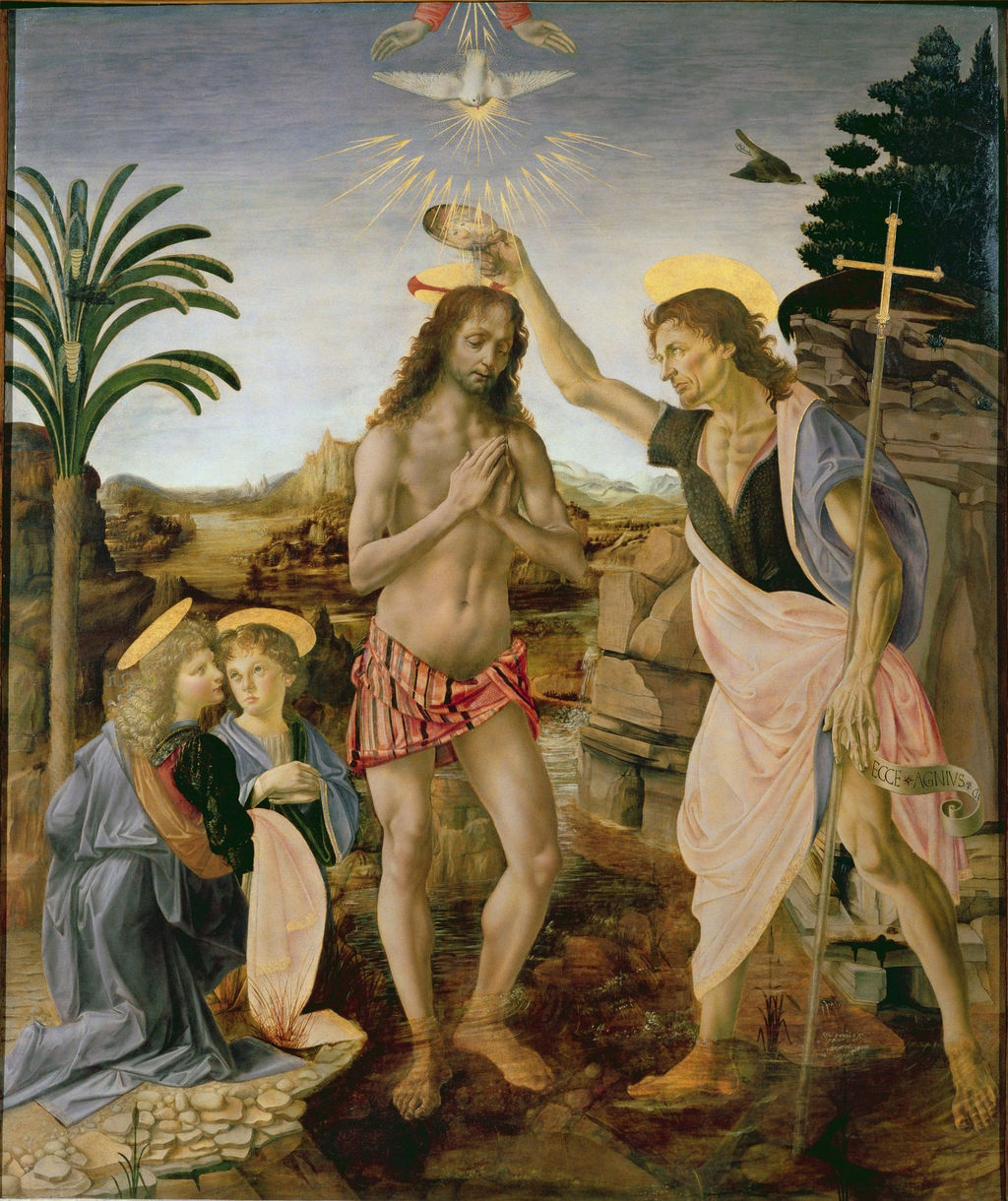
Andrea del Verrocchio and Leonardo da Vinci, The Baptism of Christ, Uffizi. Image source. Public domain. Resized only; native appearance preserved.
A panel painted to be seen with gold
Egg tempera binds pigment with egg. On this panel it produces both the powdery appearance of some pale passages and a sense of transparency in the fine touches of the landscape. Look at the dark foliage and the little horizontal strokes along the riverbed, where individual marks remain legible. In Christ’s flesh, the National Gallery identifies a greenish layer beneath the pale upper paint. The cool undertone is especially relevant where Christ stands beside the pale tree. Their colours approach each other at a distance, while the modelling of the body and the different marks on the trunk draw them apart as we move closer. [1]
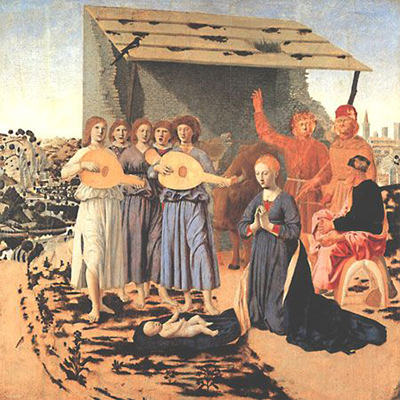
A comparison with Piero’s Nativity helps put the technique in perspective. The later work also brings a scriptural event into familiar Tuscan country, but the Gallery identifies oil as its medium and notes the greater saturation of its colours. The two paintings ask for different kinds of attention. In the Nativity the singers and the illumination on the shed give a different account of divine presence. In the Baptism, a fine trickle, a short span of white wings and the thinly worked water carry much of the event. [1] [11]
The surface has also had a history since Piero painted it. Elizabeth Eastlake’s account of the deliberations over the painting in 1861 records that Charles Eastlake worried about its condition. The National Gallery archive also lists 1971 notes among the Helmut Ruhemann papers concerning cleaning and restoration and the techniques employed. The present effect of pale light can be discussed from what remains visible and from the Gallery’s account of the paint. A historical comment about damage, by itself, cannot identify which specific passage has lost colour or detail. [1] [12] [13]
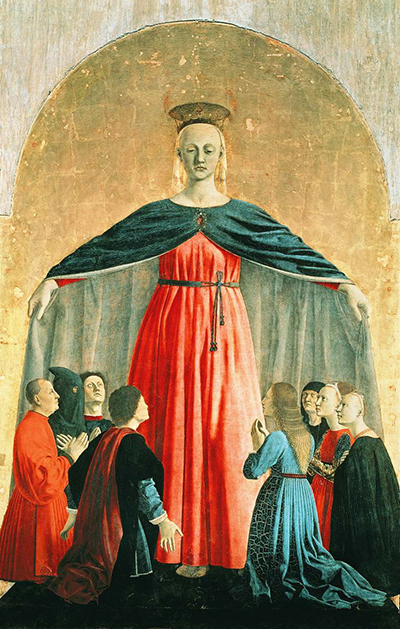
The English frame now around the panel dates from the nineteenth century. In the surviving Sansepolcro ensemble the central opening is flanked by tall compartments, patterned carving and gilding. The painted sky would have occupied a bounded space among those shining surfaces. Compare the Polyptych of the Misericordia, where gold surrounds the central figures as well. In the Baptist altarpiece the gold of the wings instead enclosed a centre in which light seems to come from a sky that continues behind the people. [1] [2] [3] [10]
Cima da Conegliano’s much larger treatment of the same subject, painted about 1492–1494, still dominates the high altar of San Giovanni in Bragora in Venice. Its landscape rises within the architectural frame, and both the height of the panel and the space above the altar are part of the encounter. It gives a sense of what a large painted landscape could contribute to a church dedicated to the Baptist. In London, the closer view brings Piero’s fine touches forward. In Sansepolcro, the surviving side panels show the size and density of the setting that once surrounded them. [1] [2] [14]
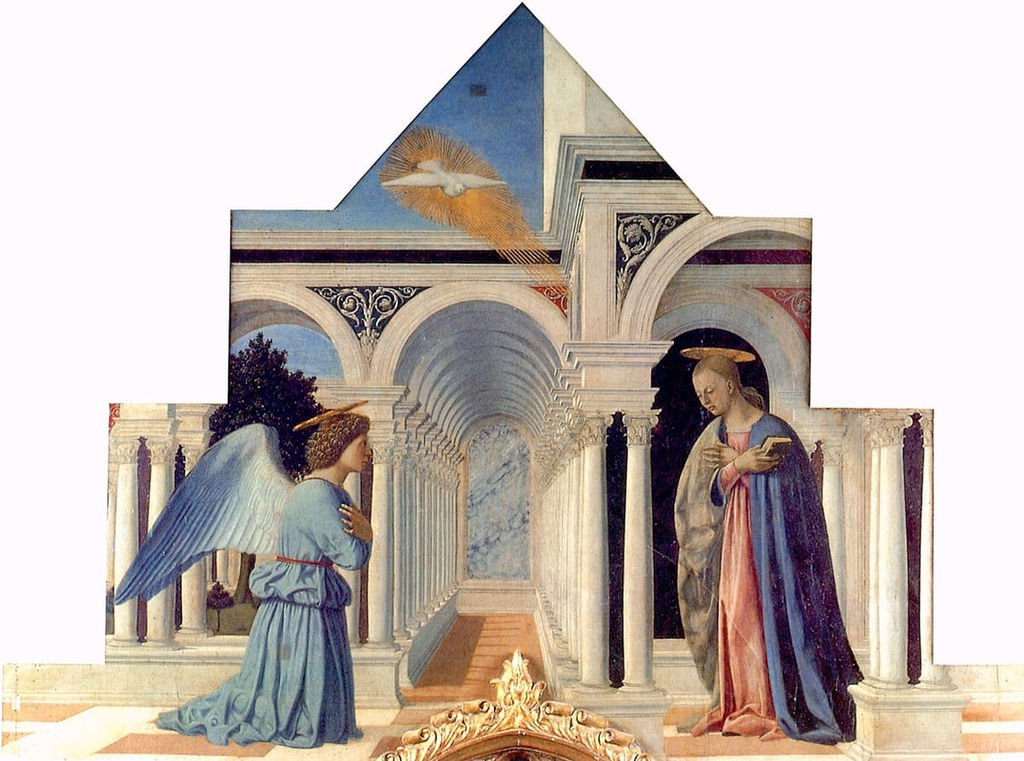
Piero della Francesca, Annunciation, crown of the Sant’Antonio Polyptych, Perugia. Image source. Public domain. Resized only; native appearance preserved.
The commission and Matteo di Giovanni’s panels
The likeliest intended destination is the high altar of San Giovanni Battista in Val d’Afra, in Borgo Sansepolcro. The National Gallery identifies that Baptist church in its main account, and the Museo Civico gives it as the provenance of the surviving side panels. The Gallery’s audio description refers to a Baptist chapel in the Camaldolese abbey. The Italian national catalogue preserves the separate proposals of an altar in the Camaldolese abbey of San Giovanni Evangelista, later the cathedral, and a site at the Pieve of Santa Maria. The 1433 records for altarpiece woodwork and a pastoral visitation recording the ensemble in the Baptist church in 1629 are good grounds for following the Val d’Afra identification. The documented move to the cathedral explains why both churches enter the story. [1] [2] [3] [10]
Andrea Di Lorenzo’s research traces the funding for the high-altarpiece project to the bequest of Angelo di Fante. He arranged for the proceeds from two houses to fund an altarpiece after their life tenant had died. Luca Pichi acted as his executor. In December 1433, Pichi commissioned the carpenter Benedetto del Cera to make the wooden structure to a design by Antonio d’Anghiari. A payment in 1437 is further evidence that the project had already advanced. These records identify who commissioned the structure and how it was financed. A surviving contract specifying when Piero was to paint the central scene would settle a different question. The Graziani arms on the later predella are evidence of another family’s connection with the ensemble. Their presence on that component cannot by itself establish who engaged Piero. [2] [7] [8] [10]
Matteo di Giovanni painted the later ensemble surrounding the central panel. Peter with his book and key stood on one side, and Paul with his sword on the other. Above them, Gabriel and the Virgin appear in separate roundels of the Annunciation. At the base, in the long band called the predella, scenes from the Baptist’s life flank a central Crucifixion. The birth and preaching of John lead towards that centre from one end, and the scenes with Herod follow on the other. The four Doctors of the Western Church stand between the episodes. When the parts were together, a viewer looking below the river encounter would have found Christ again directly beneath it, this time on the Cross. The tall landscape and the shorter scenes offered two different scales on which to follow the Baptist’s story. [2] [3] [8]
The Museo Civico dates Matteo’s contribution to about 1455, and Di Lorenzo places the ensemble’s completion by 1456. The National Gallery dates the additions to the 1460s, while the Italian catalogue gives about 1460–1470. All these accounts distinguish the later work from Piero’s central panel. Probably about 1437–1445 is the Gallery’s assessment of Piero’s panel. The dating of the surrounding pieces rests on separate evidence. That distinction allows for a substantial interval between the conception of the structure, the painting of the centre and the completion of the ensemble. [1] [2] [3] [10]
From Sansepolcro to London
After the suppression of the Baptist priory in 1808, the ensemble was moved to the sacristy of San Giovanni Evangelista, Sansepolcro’s cathedral. In 1859 John Charles Robinson acquired Piero’s panel from the Bishop and Chapter on behalf of Matthew Uzielli. It was lent to the South Kensington Museum in 1860–61. The National Gallery acquired it at the Uzielli sale on 13 April 1861, where it was lot 184. Matteo’s side panels, pilasters and predella are in the Museo Civico at Sansepolcro. Between the two collections the surviving pieces still show how much larger the church furnishing was than the picture now displayed in London. [1] [2] [3]
In 2024 the National Gallery hung the panel with two paintings David Hockney made in 1977. In My Parents a reproduction of the Baptism is visible in a mirror between the sitters. In Looking at Pictures on a Screen it is among the pictures a visitor bends to inspect in the studio. One painting shows Piero at a remove, glimpsed through a reflection, and the other makes the act of close looking part of its subject. Both recall something about the original encounter with the altarpiece. What you see depends partly on how far away you stand. At a distance you might catch the tall pale figure and the broken line of the river. As you approach, the picture yields the much smaller action on which it turns, the drop of water meeting Christ’s hair. [1] [15]
Watch the National Gallery on the Baptism
Begin with a short introduction to the painting, then explore how it fits into Piero’s career.
Piero della Francesca’s Baptism in 60 seconds
A short museum introduction to the painting’s subject and composition.
Watch on YouTubeBrowse the artworks
Compare Piero’s frescoes, panels and manuscript figures. The list includes ensembles and separately identifiable panels or scenes. Dates are approximate where the sources differ.
| Name | Date | Medium and source |
|---|---|---|
| The Baptism of Christ | Probably c. 1437–45 | Panel painting Catalogue. |
| The Flagellation of Christ | 1459–60 (GNDM) | Panel painting Catalogue. |
| The History of the True Cross | Mid-fifteenth century | Wall painting Catalogue. |
| Dream of Constantine | Mid-fifteenth century | Wall painting Catalogue. |
| The Duke and Duchess of Urbino | About 1473–75 (Uffizi) | Panel painting Catalogue. |
| The Resurrection | About 1458–68 (Opificio) | Wall painting Catalogue. |
| Brera Madonna | About 1472–74 | Panel painting Catalogue. |
| Annunciation at Arezzo | Mid-fifteenth century | Wall painting Catalogue. |
| Madonna del Parto | About 1450–65 (Monterchi) | Wall painting Catalogue. |
| Polyptych of the Misericordia | Commissioned 1445 | Panel painting Catalogue. |
| The Nativity | Early 1480s (National Gallery) | Panel painting Catalogue. |
| Madonna di Senigallia | About 1474–75 (GNDM) | Panel painting Catalogue. |
| Death of Adam | Mid-fifteenth century | Wall painting Catalogue. |
| Queen of Sheba | Mid-fifteenth century | Wall painting Catalogue. |
| Victory of Constantine | Mid-fifteenth century | Wall painting Catalogue. |
| Battle between Heraclius and Chosroes | Mid-fifteenth century | Wall painting Catalogue. |
| Saint Mary Magdalen | Wall painting Catalogue. | |
| The Augustinian Polyptych | 1454–69 | Panel painting Catalogue. |
| Polyptych of Perugia | About 1467–69 (GNU) | Panel painting Catalogue. |
| Perugia Annunciation | About 1468–70 (national catalogue) | Panel painting Catalogue. |
| St Francis and St Elizabeth | About 1467–69 (GNU) | Panel painting Catalogue. |
| Stigmatisation of St Francis | About 1468–70 (national catalogue) | Panel painting Catalogue. |
| An Augustinian Nun (Saint Monica) | 1454–69 | Panel painting Catalogue. |
| Augustinian Saint | 1454–69 | Panel painting Catalogue. |
| Saint Michael | 1454–69 | Panel painting Catalogue. |
| Saint Nicholas of Tolentino | 1454–69 | Panel painting Catalogue. |
| Saint John the Evangelist | 1454–69 | Panel painting Catalogue. |
| Virgin and Child Enthroned with Four Angels | About 1460–70 (Clark) | Panel painting Catalogue. |
| Portrait of Sigismondo Pandolfo Malatesta | About 1450–51, often proposed. Louvre catalogue range 1450–75. | Panel painting Catalogue. |
| Sigismondo before St Sigismund | 1451 | Wall painting Catalogue. |
| St Jerome and a Donor | 1460s (Accademia); about 1450 also proposed | Panel painting Catalogue. |
| St Jerome in Penitence | 1450, dated on the panel | Panel painting Catalogue. |
| Saint Julian | About 1455–60, often proposed | Wall painting Catalogue. |
| Saint Augustine | 1454–69 | Panel painting Catalogue. |
| Saint Apollonia | 1454–69 | Panel painting Catalogue. |
| Crucifixion from the Augustinian Polyptych | 1454–69 | Panel painting Catalogue. |
| Saint Louis of Toulouse | Wall painting Catalogue. | |
| Burial of the Wood | Mid-fifteenth century | Wall painting Catalogue. |
| Discovery and Proof of the True Cross | Mid-fifteenth century | Wall painting Catalogue. |
| Exaltation of the Cross | Mid-fifteenth century | Wall painting Catalogue. |
| Saint Anthony Raises a Child | About 1467–69 (GNU) | Panel painting Catalogue. |
| Saint Elizabeth Revives a Child | About 1467–69 (GNU) | Panel painting Catalogue. |
| Hercules | About 1470 | Wall painting Catalogue. |
| Portrait of a Boy (possibly Guidobaldo da Montefeltro) | Panel painting Catalogue. | |
| De prospectiva pingendi, Reggio Emilia witness (figures) | Manuscript diagrams Catalogue. | |
| The Interrogation of Judas | Mid-fifteenth century | Wall painting Catalogue. |
| Two prophets, Bacci Chapel | Mid-fifteenth century | Wall painting Catalogue. |
| Saint Clare of Assisi, upper predella | About 1467–69 (GNU) | Panel painting Catalogue. |
| Saint Agatha, upper predella | About 1467–69 (GNU) | Panel painting Catalogue. |
| Lost centre of the Augustinian Polyptych | 1454–69 | Lost panel or panels Catalogue. |
Frequently Asked Questions
Marie Tanner read their clasped hands as concord and suggested a reference to the reunion attempted at the council in 1438–1439. The gesture, the unusual hats of the distant figures and the theological subject make the association plausible. The figures’ exact identities and the intention behind the gesture remain uncertain. [7] [8] [9]
Discussion
Look again at the images and ideas explored in The Baptism of Christ by Piero della Francesca. These editorial prompts invite your observations.
Reader Insights
Follow the stream towards Christ’s feet. At what point do you stop seeing it as a reflective surface, and what tells you there is still water there?
Compare the angels’ contact with one another to Christ’s joined hands and John’s raised arm. How do the gestures change the pace at which you read the scene?
Imagine the landscape between the gilded figures of Peter and Paul, with the Crucifixion directly below. Which part of Piero’s panel would draw your eye first from across the church?
Join the Conversation
Share a detail, comparison or question about The Baptism of Christ by Piero della Francesca below.
References
- National Gallery, London. Piero della Francesca, The Baptism of Christ, NG665. Object record, in-depth commentary, audio-description transcript and provenance excerpt from Martin Davies’s The Earlier Italian Schools (1986 edition). View source.
- Museo Civico di Sansepolcro. Matteo di Giovanni, Pala dei Santi Pietro e Paolo. Collection guide. View source.
- Ministero della Cultura, Italy. San Pietro, San Paolo, Santi, angeli, annunciazione ed episodi della vita di San Giovanni Battista. National catalogue record 0900430224. View source.
- New American Bible, Revised Edition. Matthew 3:13–17. United States Conference of Catholic Bishops. View source.
- New American Bible, Revised Edition. Luke 3:21–22. United States Conference of Catholic Bishops. View source.
- Parenti, Daniela. The Baptism of Christ, Andrea del Verrocchio and Leonardo da Vinci. Uffizi Galleries. See also the Uffizi’s The Saint who baptized Christ, sections 20–22. View source 1. View source 2.
- Uchijima, Minako. ‘ピエロ・デッラ・フランチェスカ作《キリストの洗礼》の一解釈’ [‘An interpretation of Piero della Francesca’s Baptism of Christ’]. Bulletin of Seinan Gakuin University Museum, no. 2, pp. 25–35. View source.
- Tanner, Marie. ‘Concordia in Piero della Francesca’s Baptism of Christ’. The Art Quarterly 35, no. 1 (1972), pp. 1–20. View source.
- Council of Florence. Laetentur caeli, decree of union with the Greeks, 6 July 1439. Vatican. View source.
- Di Lorenzo, Andrea. ‘I Pichi di Sansepolcro e le loro commissioni artistiche nel Quattrocento’, especially pp. 87–88 and notes 28–33. In Ripensando Piero della Francesca. Il Polittico della Misericordia di Sansepolcro. View source.
- National Gallery, London. Piero della Francesca, The Nativity, NG908. Object record and in-depth commentary. View source.
- Sheldon, Julie. ‘A Woman of Letters: Lady Eastlake’s Legacy at the National Gallery’. Fourth Anna Jameson Lecture, National Gallery, especially the account of Elizabeth Eastlake’s letter to Austen Henry Layard, fig. 16 and note 31. View source.
- National Gallery Archive. ‘Piero della Francesca’, NG29/1/23. Helmut Ruhemann papers, 1971. View source.
- Chorus, Associazione per le Chiese del Patriarcato di Venezia. San Giovanni Battista in Bragora. See also Fondazione Federico Zeri’s catalogue entry for Cima’s Baptism of Christ. View source 1. View source 2.
- National Gallery, London. Hockney and Piero: A Longer Look. Exhibition release, 2024. View source.
Related Paintings
Annunciation (Perugia)
Piero della Francesca, Annunciation, crown of the Sant’Antonio Polyptych, Perugia. Image source. Public domain. Resized only; native appearance preserved.