 by Tom Gurney
Tom Gurney BSc (Hons) is an art history expert with over 20 years experience
Published on June 19, 2020 / Updated on October 14, 2023
Email: tomgurney1@gmail.com / Phone: +44 7429 011000
The Queen of Sheba and Solomon by Piero della Francesca: Introduction
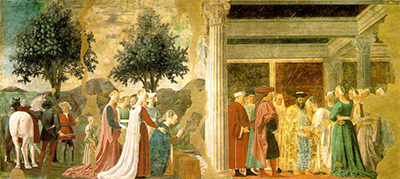
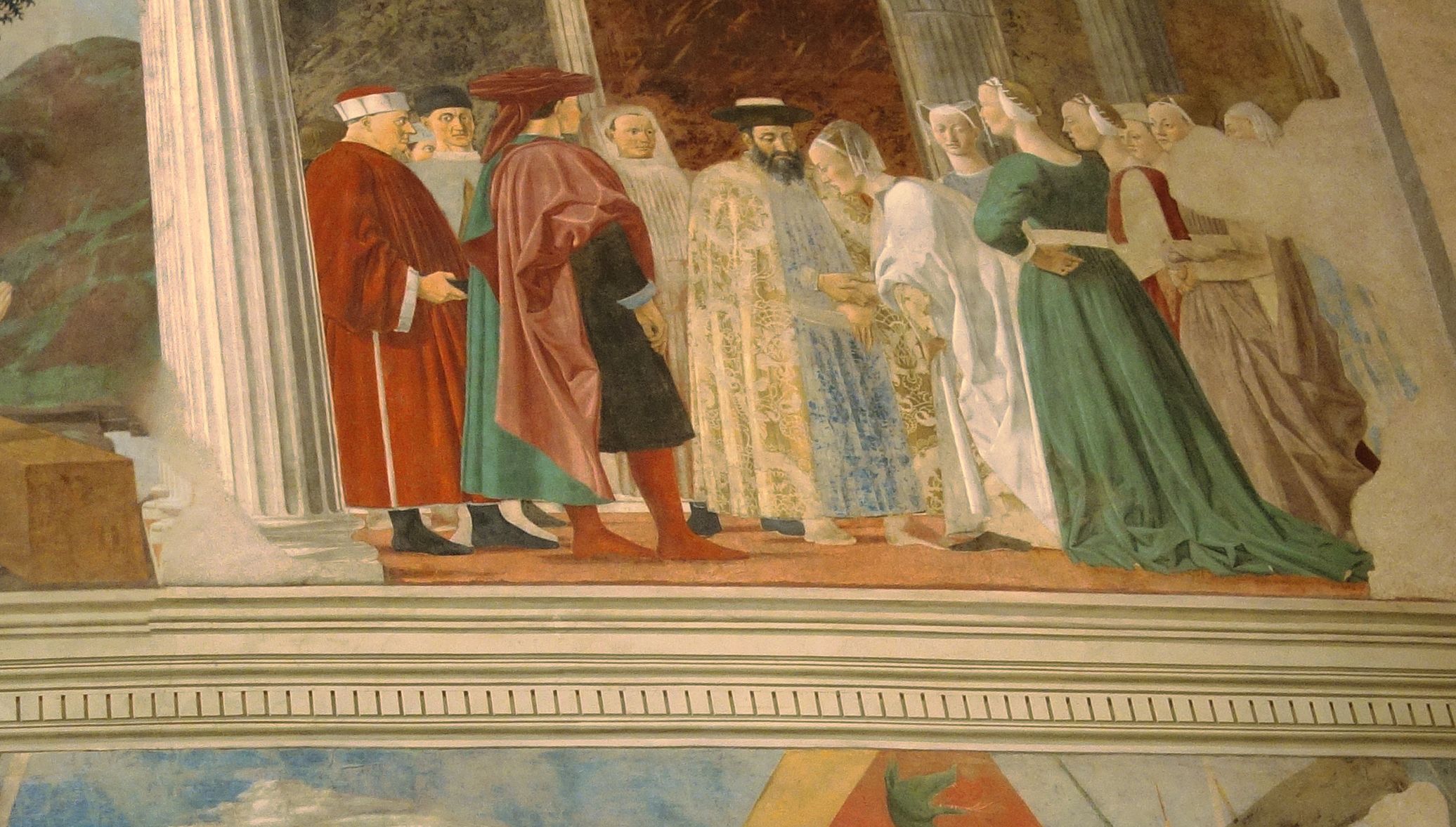
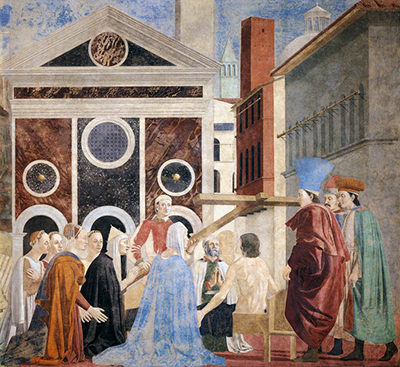
Piero della Francesca paints the Queen of Sheba twice in the same stretch of wall. On the left she kneels at the edge of a wooden bridge, her palms together and her eyes lowered. On the right she inclines her head before King Solomon as he reaches towards her. Between the two stands a fluted column. It belongs to Solomon’s palace, but it also marks the interval between the queen’s discovery and the moment she comes to tell the king what she has foreseen. The full title, Adoration of the Holy Wood and the Meeting of Solomon and the Queen of Sheba, describes both episodes. [1] [2] [3]
The fresco is in the middle register of the right-hand wall as you face the altar of the Bacci Chapel in San Francesco, Arezzo. It sits below the Death of Adam and above Constantine’s battle against Maxentius. The three scenes show the timber in different forms. In the upper lunette it begins as a tree growing out of Adam’s burial story. Here it is a rough crossing on the road to Jerusalem. In the battle beneath, the Cross is already a sign that Constantine can carry against his enemy. This view up and down the wall belongs to the wider Legend of the True Cross, whose episodes also continue on the altar wall and across the chapel. [1] [4]
At a Glance
- ArtistPiero della Francesca
- TitleAdoration of the Holy Wood and the Meeting of Solomon and the Queen of Sheba
- DateCommonly dated about 1452–58, within the chapel campaign conventionally dated about 1452–66 [5] [6] [7]
- MediumWall painting, conventionally described as fresco [5] [4]
- DimensionsApproximately 336 × 747 cm [5]
- LocationMiddle register of the right wall, facing the altar, Bacci Chapel, Basilica of San Francesco, Arezzo [1] [8]
- CycleLegend of the True Cross [1]
This work across Piero della Francesca’s career
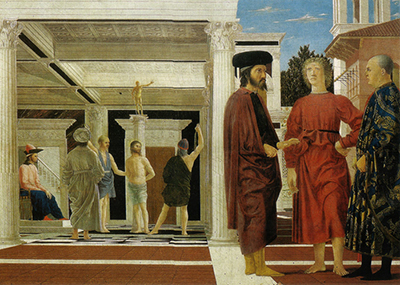
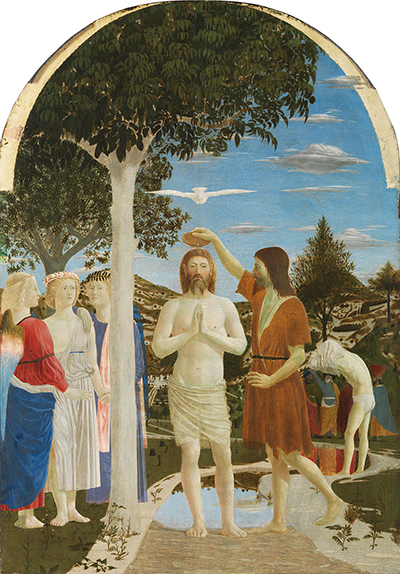
The Baptism of Christ
Probably about 1437–45The History of the True Cross
Mid-fifteenth centuryThe Queen of Sheba and Solomon (current article)
Within the Bacci Chapel campaignThe Resurrection
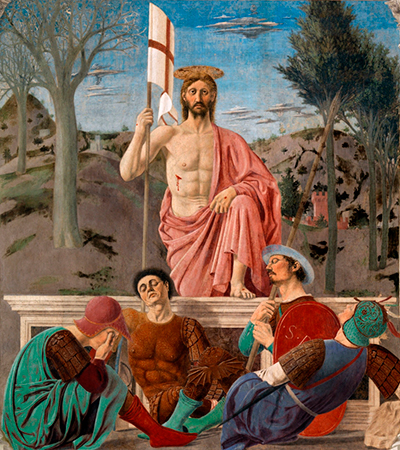
About 1458–68 (Opificio)The Flagellation of Christ
1459–60 (GNDM)The Montefeltro Altarpiece
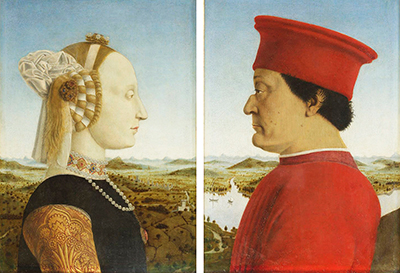
About 1472–74 (Brera)The Duke and Duchess of Urbino
About 1473–75 (Uffizi)The Nativity
Early 1480s (National Gallery)Contents
- The procession stops at the bridge
- What the queen tells Solomon
- How the legend joins Adam to Solomon
- How the painting holds two places together
- Reading the court in fifteenth-century terms
- Dating and the surviving wall
- Annotated details
The procession stops at the bridge
Follow the procession in from the left. Grooms wait beside the horses under the first tree, and a short figure in a striped garment stands in the interval between the horses and the women. The white horse presents its hindquarters while its head turns into the group. Nearby, profiles and pieces of harness emerge from the overlap of the animals and their keepers. These details establish the practical business of a journey. Piero puts that business on hold at the moment the queen stops. [2]
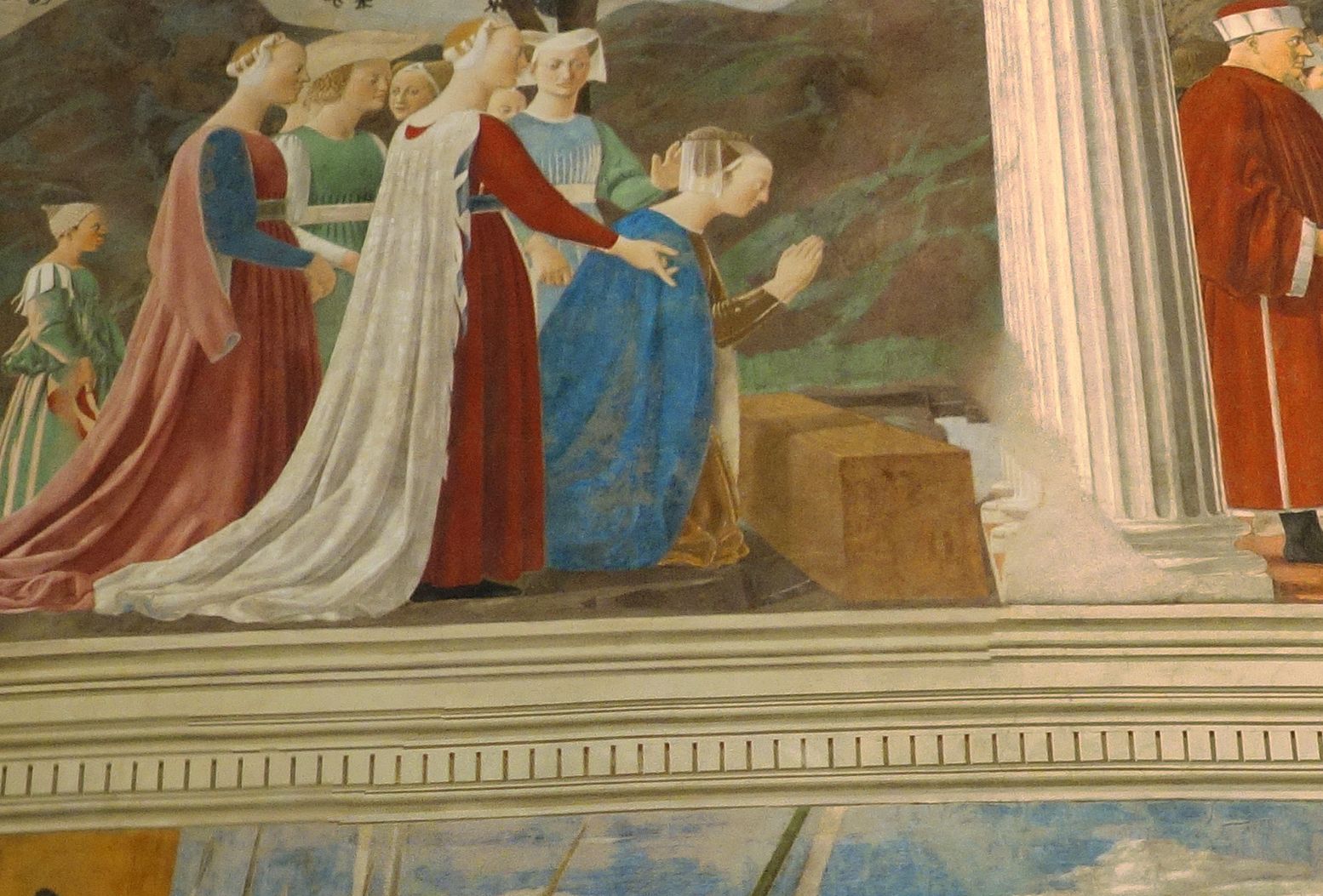
Under the second tree the women form a closer group. Long trains spread along the ground, and pale headdresses bring a succession of heads into view against the hills. One attendant reaches towards the queen’s shoulder. The others stand almost upright, making the kneeling figure’s change of height and angle immediately clear. The queen’s blue cloak gathers at the ground, leaving a strip of gold-coloured fabric visible at its edge. The lowered head and joined hands carry the action across the space between her and the beam. [1] [2]
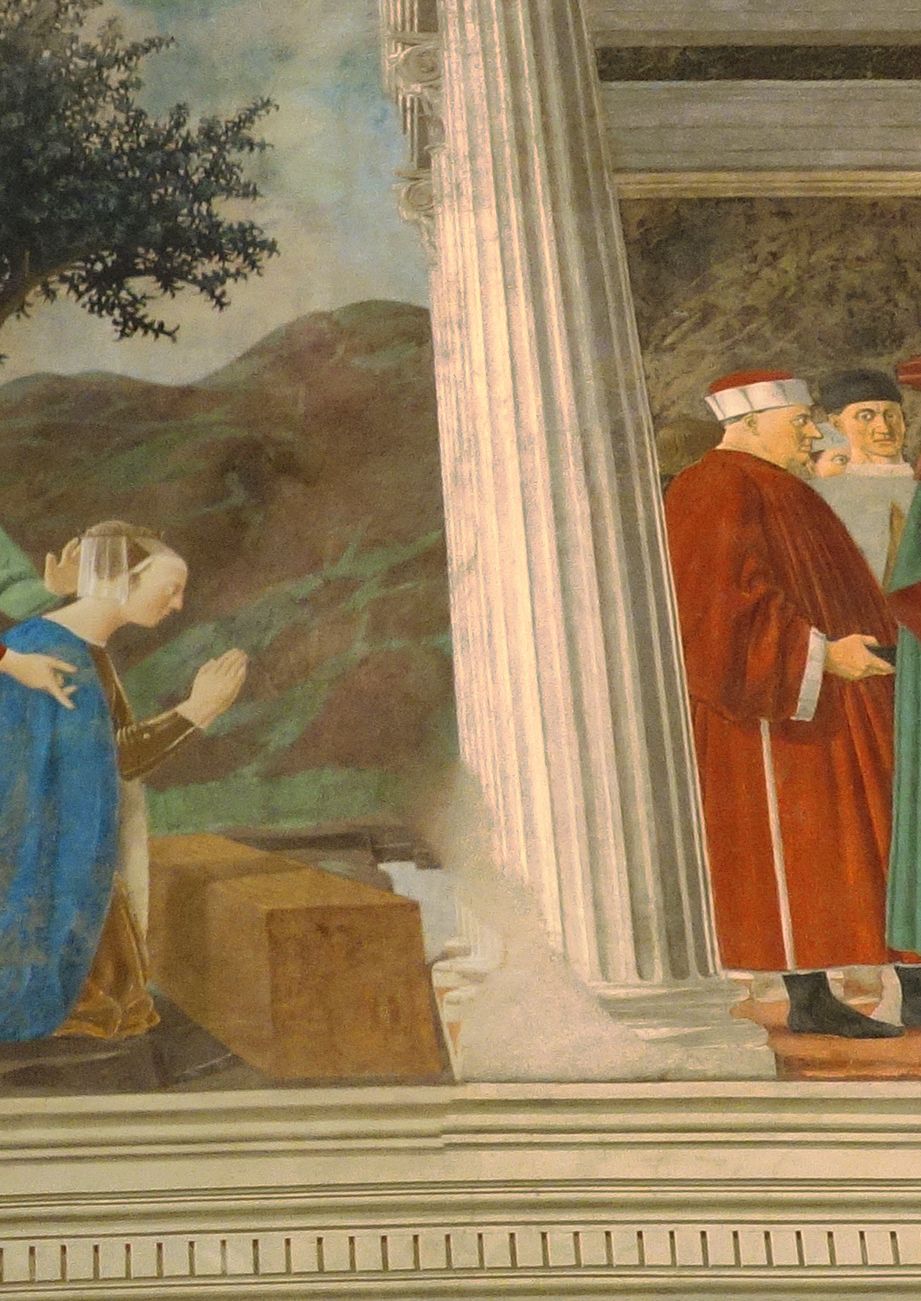
The timber is easy to miss from across the chapel. Look low and just left of the great column. A squared end projects towards the viewer, and the tiny glimpse of water beside it helps establish its ordinary use. Piero leaves a gap between the queen’s fingers and the wood. She has halted before setting foot on it and venerates it from the bank. The story tells us what she foresees. The fresco gives that knowledge a visible effect through the pause spreading back from the queen to the women, horses and grooms. [1] [2]
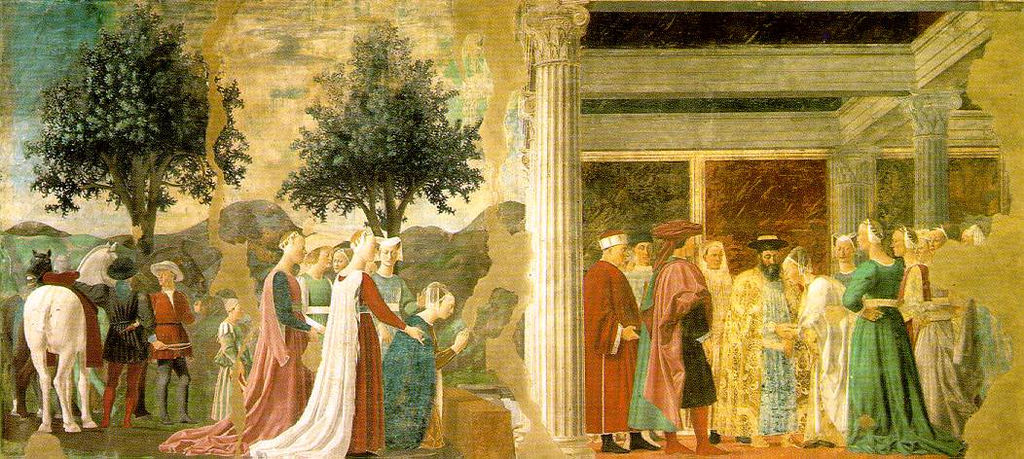
Adoration of the Holy Wood and Meeting of Solomon and the Queen of Sheba, Bacci Chapel. Image source. Public domain. Resized only; native appearance preserved.
What the queen tells Solomon
Inside the palace, Solomon stands in a patterned, gold-coloured robe and a broad, dark hat. The queen in pale drapery inclines her head, and his hand reaches towards hers at about waist height. The gesture occupies little space in a room that is nearly half the width of the fresco. It remains legible because the two groups gather on either side of it. Men stand behind and beside the king, and the queen’s attendants come in from the right. The green-clad woman nearest the viewer on that side turns back towards the royal pair. [2] [5]
The two appearances of the queen are linked by the inclination of her head. Outside, the kneeling posture and the joined hands express veneration. Inside, the shallower bow and the king’s answering gesture belong to a formal reception. The Arezzo guide describes the encounter as the moment when she tells Solomon what will happen to the timber. A viewer can read the sequence through her actions alone. She is first the person who sees the significance of the wood, then the person who brings that knowledge into the court. [1] [5]
In the biblical account, the direction of that exchange is different. In 1 Kings 10 and its parallel in 2 Chronicles 9, the queen comes to Jerusalem to test Solomon with difficult questions. She observes the wealth and organisation of his court, praises his wisdom and his God, gives him spices, gold and precious stones, and receives gifts in return. The Bible gives the visit and the royal encounter. The bridge, the veneration and the prophecy come from the medieval Christian history of the Cross. Piero can show the court receiving her without painting the parcels and vessels a scene of gift-giving might lead us to expect. The small movement of the hands is enough to establish a meeting. We learn the content of the meeting from what she has already done at the bridge. [2] [5] [9] [10]
Annotated Details from The Queen of Sheba and Solomon
The numbered points identify visible features discussed in this article. Return from each detail to the numbered overview. Right wall of the Bacci Chapel in San Francesco, Arezzo, as seen from the nave facing the altar. Spike. Image source. CC BY-SA 4.0. The numbered overview and detail crops are adaptations under CC BY-SA 4.0.
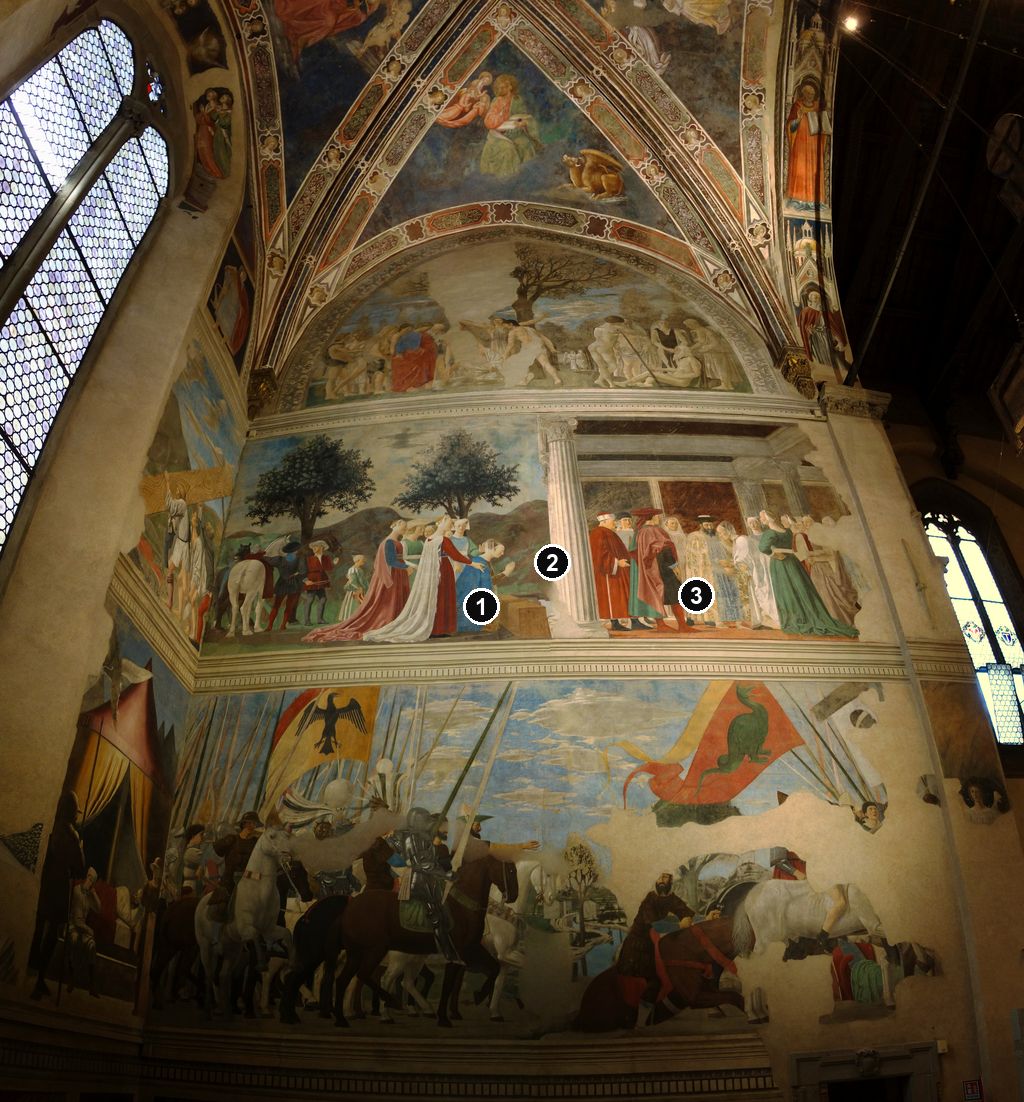
Details from THE QUEEN OF SHEBA AND SOLOMON
Compare the cropped details with the source images above. Notice how their colours, shapes and positions contribute to the larger compositions.
The kneeling queen
The outdoor procession stops at the wood. The pale fabrics around the kneeling figure make her pause legible even in this view from the floor.
The column between episodes
The pale column separates trees and open air from the palace. Its base and capital help the viewer follow the change in setting.
The meeting in the palace
The groups come close in the palace. Look between the two painted figures whose hands approach one another.
How the legend joins Adam to Solomon
Jacobus de Voragine’s thirteenth-century Golden Legend collects traditions about the wood in its account of the Finding of the Holy Cross. In the branch tradition associated with Adam, Seth receives a shoot from Paradise and plants it at his father’s grave. The tree survives into Solomon’s reign. Accounts differ over where the timber was installed and where the queen recognised it. The version discussed by the medievalist Anthony Bale has the discarded beam laid across water after it proved unsuitable for Solomon’s building. William Caxton’s English version describes the queen venerating the wood in connection with Solomon’s house. The Arezzo guide associates the rejected timber with the building of the Temple and identifies the crossing with the Siloe. The picture itself clearly shows a timber crossing in a landscape. [1] [2] [11] [12]
The court scene gives the queen’s recognition consequences. In the story the king orders the timber buried after hearing her warning. The transport and burial occupy a separate field on the altar wall of the Bacci Chapel. For the viewer looking for the next step, the change of wall matters. The adjoining scenes on the right-hand wall make comparisons across centuries, while the next action in the story carries the eye around the corner. The wood disappears from ordinary use and will return at the time of Christ’s Passion. [1] [11] [12]
Look across the chapel from the Sheba fresco and another woman leads the search at the same height. In the Finding and Proof of the True Cross, Helena and her attendants see the wood identified when it restores a dead man to life. Sheba sees the future of a beam that nobody else would stop to look at. Helena sees what the Cross can do after the Crucifixion. Placing the two fields opposite one another gives those separate moments of recognition a relationship that a strictly chronological arrangement would have lost. [1] [5] [4]
The subject was already at home in Franciscan mural painting. Agnolo Gaddi and his workshop told the history of the Cross in the chancel of Santa Croce in Florence in the late fourteenth century. A second comparison comes from Lorenzo Ghiberti’s Gates of Paradise for the Florence Baptistery. There the meeting closes a sequence from the Hebrew Bible, and the rulers come together before a great architectural backdrop. At Arezzo the central column gives the palace a distinct threshold and leaves room for the queen’s earlier act of devotion. Seen in sequence with the bridge, the palace receives a visitor who already has something urgent to say. [2] [13] [14]
How the painting holds two places together
The broad format, about 3.36 metres high by 7.47 metres wide, gives Piero room to give each event a different set of lines. Outdoors the hilltops rise and recede, and the spreading crowns of the trees lend a measure to the two groups below. Indoors the beams overhead, the rows of columns and the divisions of the marble-like wall behave in a more regular way. The ceiling and its supports draw the eye into the room, while the facing ranks of people bring it back to the queen and Solomon near the front. The outermost column sits close to the midpoint of the mural. Its tall, lit shaft remains prominent even when the capitals and people are hard to read from below. [1] [2] [5]
At ground level the beam projects forward and the column rises beside it. The two large solids help make the moment of transition visible from a distance. There is also a quieter continuity near the bottom of the image, where the trains of the women’s dresses travel over the earth and spread again on the palace floor. The crowded forms, reds, greens and pale veils carry across the division between the stories. Each time the queen turns towards the thing or person she honours, the bodies around her give the gesture room. [2]
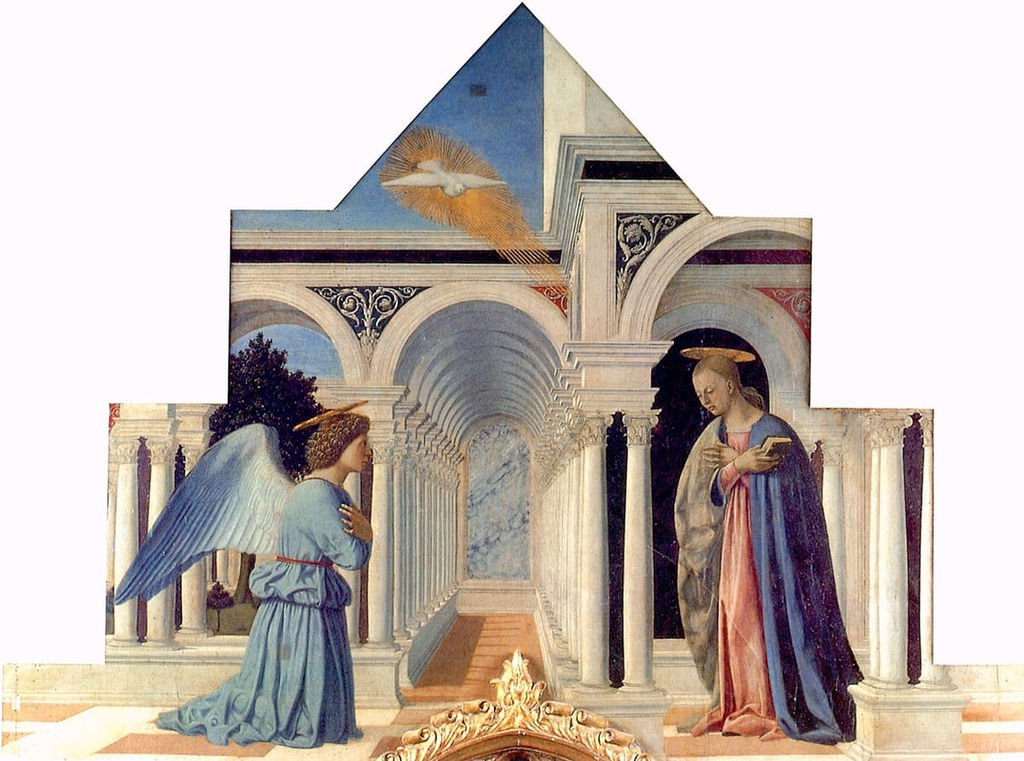
Columns play a different role in Piero’s Perugia Annunciation, at the top of the Polyptych of Sant’Antonio. There a colonnade runs deep into the space between Gabriel and Mary. At Arezzo the large column comes forward, separating two successive encounters within one field. In both works the location of a column determines when we see the gap between figures and when we look into the space beyond them. [2] [15]
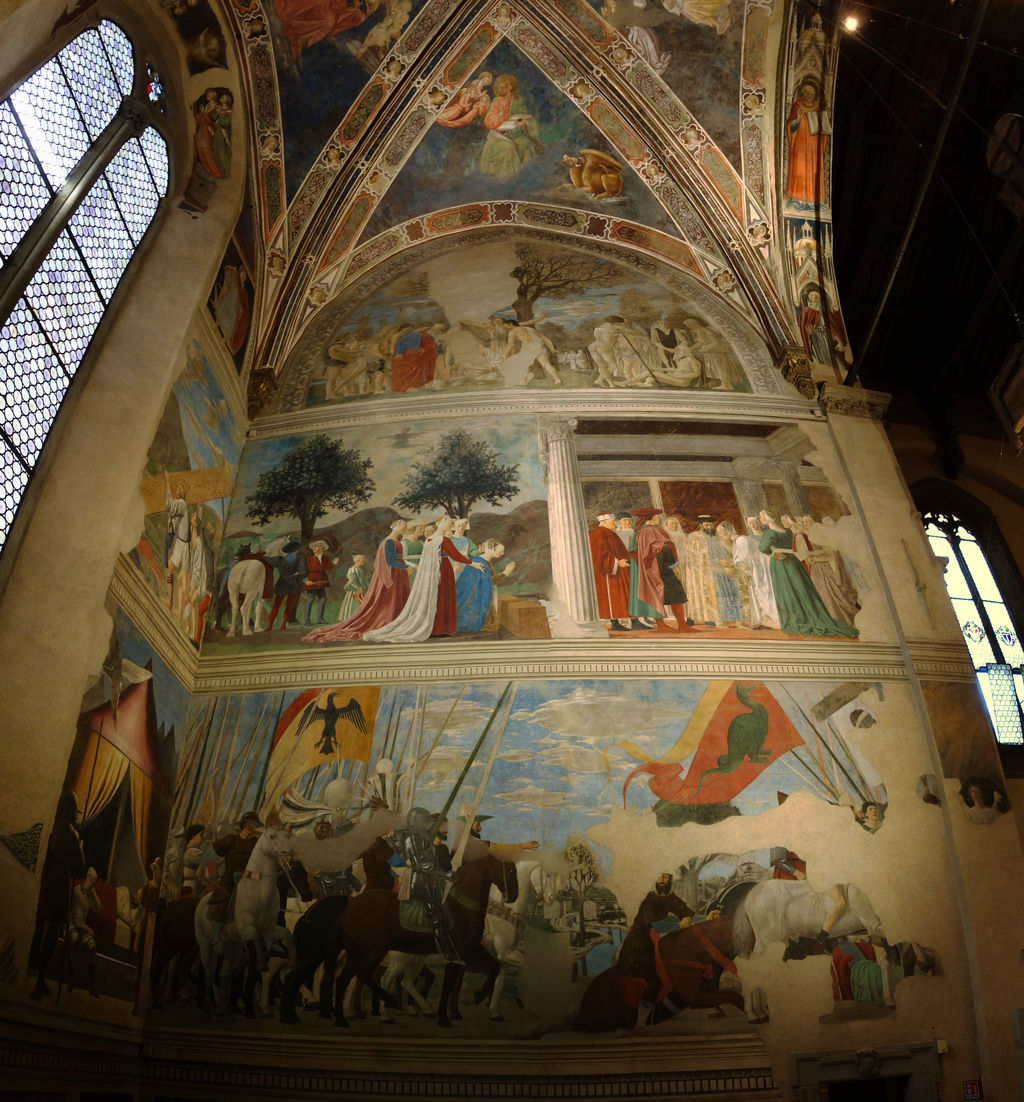
Right wall of the Bacci Chapel in San Francesco, Arezzo, as seen from the nave facing the altar. Spike. Image source. CC BY-SA 4.0. Resized from the source. This reproduction uses CC BY-SA 4.0.
Reading the court in fifteenth-century terms
The high foreheads, veils, fitted sleeves and trailing gowns belong to the world of Piero’s own viewers. Giorgio Vasari, writing in the following century, singled out the treatment of the queen’s attendants’ clothes in his life of Piero. The interest survives in the fresco itself. The queen and her women vary in pose without breaking the measured rhythm of the group. The folds gather densely around the woman in green at court, then flatten and extend across the floor. A few figures interrupt the pattern of profiles. Among the king’s attendants, a man in a dark cap looks out towards the viewer from between other heads. Harald Rupfle’s Innsbruck catalogue entry traces the debate over whether that man is Piero himself. His outward gaze is visible. His identity remains disputed. [1] [2] [16] [8]
Emanuelle Pastore and Laura de Fuccia Lederer discuss the greeting in relation to the ancient gesture of concord and to later Christian readings of the queen and Solomon as figures for the Church and Christ. The scene has also been linked to attempts at the Council of Florence in 1439 to reconcile the Greek and Latin churches. Some scholars have seen the features of Cardinal Bessarion, an advocate of union, in Solomon’s head. Those proposals give the dress, gesture and palace a possible resonance for a fifteenth-century audience. The fresco supplies neither an identifying inscription for Bessarion nor an explicit reference to the council. The courtly greeting remains intelligible through the stories painted on either side of it. [2] [5]
Dating and the surviving wall
Piero inherited the chapel decoration after Bicci di Lorenzo, who died in 1452. A 1457 record in which Andrea Bacci lists a debt to Piero for painting the main chapel places him on the project by that point. The reference to him in an Arezzo document of 1466 sets an outer limit commonly used for the cycle. The paired Sheba scene is often dated about 1452–58, but the documents give anchors for the chapel project as a whole. The fresco itself has no recorded completion date. The German-language Metapictor catalogue proposes 1454–58. The dates suggested for the wider campaign also vary. The regional museum authority gives about 1452–55, and the Japanese art historian Katsuhiko Hayashi has revisited the case for an earlier start. [5] [8] [6] [17] [3]
The wall surface carries a history of its own. Anna Maria Maetzke, who directed the modern project through the Arezzo heritage office, records serious deterioration across the chapel, including plaster separating from the wall, flaking in areas painted on dry plaster and damage associated with the crystallisation of gypsum. The conservation team began the systematic examination in 1985. Treatment began in 1991, and the chapel reopened to the public in April 2000. The collaboration with the Opificio delle Pietre Dure included study of the building, its environment and the paintings’ surfaces. [7] [4]
The project linked measured surveys and photography with maps of deterioration, technique and earlier restoration. Comparing records made before cleaning, during treatment and at its conclusion allowed the team to track changes to the same part of the wall. That distinction matters when looking at historic photographs of the queen and her entourage. A photograph may isolate one gesture or one group, as Lamberto Vitali’s 1963 photograph does with the kneeling queen. It also records the surface under a particular light and at a particular point in its treatment history. In a view of the full field, the irregular loss at the right edge cuts into the palace and the queen’s retinue. Enough survives to follow the two gestures across the composition and understand how Piero placed them. [2] [4] [18]
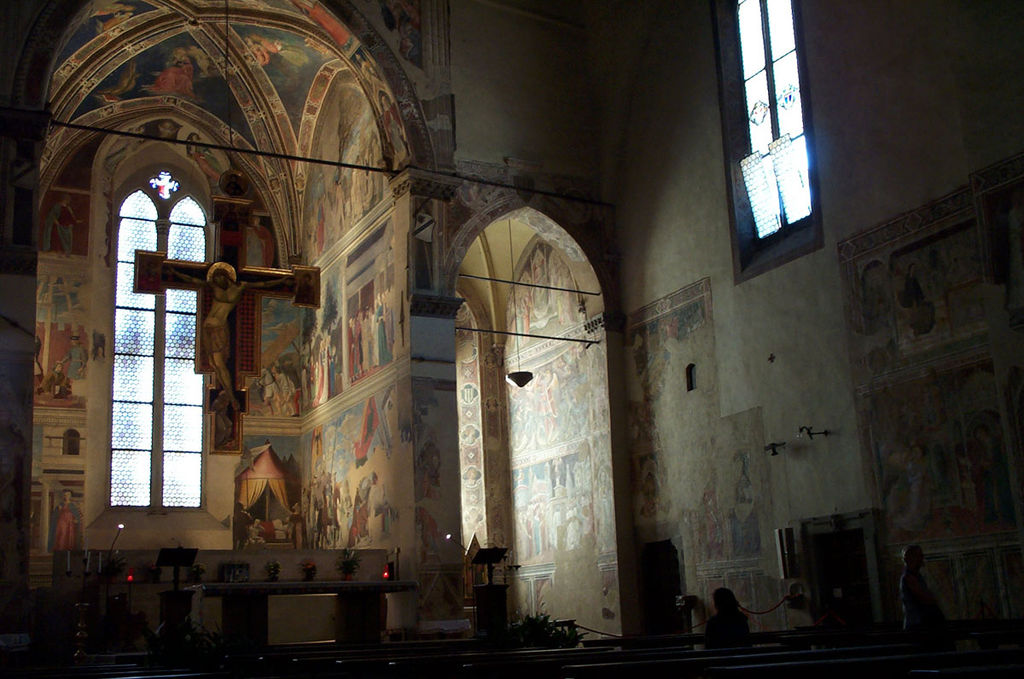
An oblique view of the Bacci Chapel with its window, suspended crucifix and right wall. louis-garden. Image source. CC BY-SA 2.5. Resized from the source. This reproduction uses CC BY-SA 2.5.
Browse the artworks
Compare Piero’s frescoes, panels and manuscript figures. The list includes ensembles and separately identifiable panels or scenes. Dates are approximate where the sources differ.
| Name | Date | Medium and source |
|---|---|---|
| The Baptism of Christ | Probably c. 1437–45 | Panel painting Catalogue. |
| The Flagellation of Christ | 1459–60 (GNDM) | Panel painting Catalogue. |
| The History of the True Cross | Mid-fifteenth century | Wall painting Catalogue. |
| Dream of Constantine | Mid-fifteenth century | Wall painting Catalogue. |
| The Duke and Duchess of Urbino | About 1473–75 (Uffizi) | Panel painting Catalogue. |
| The Resurrection | About 1458–68 (Opificio) | Wall painting Catalogue. |
| Brera Madonna | About 1472–74 | Panel painting Catalogue. |
| Annunciation at Arezzo | Mid-fifteenth century | Wall painting Catalogue. |
| Madonna del Parto | About 1450–65 (Monterchi) | Wall painting Catalogue. |
| Polyptych of the Misericordia | Commissioned 1445 | Panel painting Catalogue. |
| The Nativity | Early 1480s (National Gallery) | Panel painting Catalogue. |
| Madonna di Senigallia | About 1474–75 (GNDM) | Panel painting Catalogue. |
| Death of Adam | Mid-fifteenth century | Wall painting Catalogue. |
| Queen of Sheba | Mid-fifteenth century | Wall painting Catalogue. |
| Victory of Constantine | Mid-fifteenth century | Wall painting Catalogue. |
| Battle between Heraclius and Chosroes | Mid-fifteenth century | Wall painting Catalogue. |
| Saint Mary Magdalen | Wall painting Catalogue. | |
| The Augustinian Polyptych | 1454–69 | Panel painting Catalogue. |
| Polyptych of Perugia | About 1467–69 (GNU) | Panel painting Catalogue. |
| Perugia Annunciation | About 1468–70 (national catalogue) | Panel painting Catalogue. |
| St Francis and St Elizabeth | About 1467–69 (GNU) | Panel painting Catalogue. |
| Stigmatisation of St Francis | About 1468–70 (national catalogue) | Panel painting Catalogue. |
| An Augustinian Nun (Saint Monica) | 1454–69 | Panel painting Catalogue. |
| Augustinian Saint | 1454–69 | Panel painting Catalogue. |
| Saint Michael | 1454–69 | Panel painting Catalogue. |
| Saint Nicholas of Tolentino | 1454–69 | Panel painting Catalogue. |
| Saint John the Evangelist | 1454–69 | Panel painting Catalogue. |
| Virgin and Child Enthroned with Four Angels | About 1460–70 (Clark) | Panel painting Catalogue. |
| Portrait of Sigismondo Pandolfo Malatesta | About 1450–51, often proposed. Louvre catalogue range 1450–75. | Panel painting Catalogue. |
| Sigismondo before St Sigismund | 1451 | Wall painting Catalogue. |
| St Jerome and a Donor | 1460s (Accademia); about 1450 also proposed | Panel painting Catalogue. |
| St Jerome in Penitence | 1450, dated on the panel | Panel painting Catalogue. |
| Saint Julian | About 1455–60, often proposed | Wall painting Catalogue. |
| Saint Augustine | 1454–69 | Panel painting Catalogue. |
| Saint Apollonia | 1454–69 | Panel painting Catalogue. |
| Crucifixion from the Augustinian Polyptych | 1454–69 | Panel painting Catalogue. |
| Saint Louis of Toulouse | Wall painting Catalogue. | |
| Burial of the Wood | Mid-fifteenth century | Wall painting Catalogue. |
| Discovery and Proof of the True Cross | Mid-fifteenth century | Wall painting Catalogue. |
| Exaltation of the Cross | Mid-fifteenth century | Wall painting Catalogue. |
| Saint Anthony Raises a Child | About 1467–69 (GNU) | Panel painting Catalogue. |
| Saint Elizabeth Revives a Child | About 1467–69 (GNU) | Panel painting Catalogue. |
| Hercules | About 1470 | Wall painting Catalogue. |
| Portrait of a Boy (possibly Guidobaldo da Montefeltro) | Panel painting Catalogue. | |
| De prospectiva pingendi, Reggio Emilia witness (figures) | Manuscript diagrams Catalogue. | |
| The Interrogation of Judas | Mid-fifteenth century | Wall painting Catalogue. |
| Two prophets, Bacci Chapel | Mid-fifteenth century | Wall painting Catalogue. |
| Saint Clare of Assisi, upper predella | About 1467–69 (GNU) | Panel painting Catalogue. |
| Saint Agatha, upper predella | About 1467–69 (GNU) | Panel painting Catalogue. |
| Lost centre of the Augustinian Polyptych | 1454–69 | Lost panel or panels Catalogue. |
Frequently Asked Questions
Discussion
Look again at the images and ideas explored in The Queen of Sheba and Solomon by Piero della Francesca. These editorial prompts invite your observations.
Reader Insights
Follow the line from the horses to the queen’s palms. Which person or object first makes you feel the procession has halted?
Compare the queen’s kneeling profile with her bow in the palace. What changes in the surrounding figures make one gesture look devotional and the other courtly?
Look at the scene across its full width, then at the palace on its own. How does seeing the beam before the greeting change your understanding of the meeting?
Join the Conversation
Share a detail, comparison or question about The Queen of Sheba and Solomon by Piero della Francesca below.
References
- Musei di Arezzo, Frescoes by Piero della Francesca: Legend of the True Cross, episode 2, episodes 1 and 3, and chapel diagrams. View source.
- Piero della Francesca, Adoration of the Holy Wood and the Meeting of Solomon and the Queen of Sheba, Arezzo wall painting, full-field reproduction in the Web Gallery of Art. View source.
- Direzione regionale Musei nazionali Toscana, “Basilica di San Francesco”, Bacci Chapel description and caption for the paired Sheba episode. View source.
- Stefano Casciu, Giuseppe A. Centauro and Massimo Chimenti, “The Archival Documentation System: The Computerized Heart of the Restored ‘History of the True Cross’ by Piero della Francesca”, in Werner Schmid, ed., GraDoc, ICCROM (2000), pp. 208–219. View source.
- Emanuelle Pastore and Laura de Fuccia Lederer, “Solomon and the Queen of Sheba: Historical and Theological Issues in the First Book of Kings and in the Paintings of Piero della Francesca”, Religions 16, no. 7 (2025), 865, section 3 and figure 2. View source.
- Liletta Fornasari, “Lo sviluppo della cultura figurativa quattrocentesca in Arezzo e Val di Chiana, da accezioni tardogotiche a formule pienamente rinascimentali”, in Liletta Fornasari and Paola Refice, eds., Rinascimento in terra d’Arezzo, pp. 39–40, on the 1457 and 1466 records. View source.
- Anna Maria Maetzke, “Il restauro de La Leggenda della Vera Croce”, Treccani, Il Libro dell’Anno (2000). View source.
- Harald Rupfle, “Die Anbetung des heiligen Holzes und die Begegnung von Saba und Salomon”, Metapictor, Universität Innsbruck, especially Bildnis 1. View source.
- 1 Kings 10:1–13, New American Bible, United States Conference of Catholic Bishops. View source.
- 2 Chronicles 9:1–12, New American Bible, United States Conference of Catholic Bishops. View source.
- Jacobus de Voragine, “Of the Invention of the Holy Cross”, The Golden Legend, English translation by William Caxton, vol. 3. View source.
- Anthony Bale, “Cosmopolitanism or Competition? Late Medieval Pilgrims at the Eastern Christian Holy Places”, Études arméniennes contemporaines 9 (2017), pp. 17–37, especially pp. 22–24. View source.
- Opera di Santa Croce, “Chancel Chapel”, account of the Gaddi fresco cycle. View source.
- Opera del Duomo, Florence, “Lorenzo Ghiberti and the Opera del Duomo of Florence: beauty, technique, and thought”, on the Baptistery doors and their final panel. View source.
- Galleria Nazionale dell’Umbria, Polyptych of Sant’Antonio, collection record and discussion of perspective. View source.
- Giorgio Vasari, “Piero della Francesca”, Lives of the Most Excellent Painters, Sculptors, and Architects, English translation by Mrs Jonathan Foster. View source.
- Katsuhiko Hayashi, “ピエロ・デッラ・フランチェスカ中期の編年と《聖十字架伝》の制作年代をめぐる一試論”, 60th Annual Meeting of the Japanese Society for Aesthetics, panel C-1, conference abstract. View source.
- Civico Archivio Fotografico di Milano, Dipinto murale – Adorazione del Sacro Legno e incontro tra Salomone e la Regina di Saba, Lamberto Vitali photograph, 1963, SIRBeC record IMM-3a140-0000108. View source.
Related Paintings
Annunciation (Perugia)
Piero della Francesca, Annunciation, crown of the Sant’Antonio Polyptych, Perugia. Image source. Public domain. Resized only; native appearance preserved.