 by Tom Gurney
Tom Gurney BSc (Hons) is an art history expert with over 20 years experience
Published on June 19, 2020 / Updated on October 14, 2023
Email: tomgurney1@gmail.com / Phone: +44 7429 011000
The Dream of Constantine by Piero della Francesca: Introduction
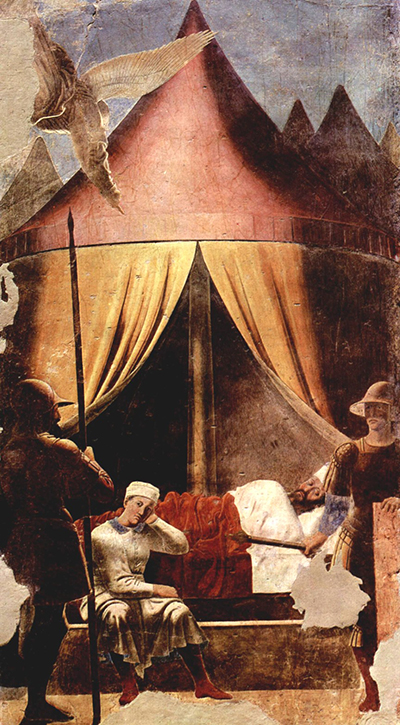
In Piero della Francesca’s Dream of Constantine, an angel dives from the upper left towards a tent where the Roman emperor sleeps. Two soldiers stand guard, and a young attendant sits on the step looking out at us. The angel carries the sign of the cross, a promise of victory in the battle to come. Light spreads down from the apparition, catching the tent, the bedding and the men around it. Piero gives a dream that belongs to one person visible effects throughout the camp. [1] [2]
The fresco is in the Bacci Chapel of the Basilica of San Francesco in Arezzo, where Piero painted the History of the True Cross in the mid-fifteenth century. Face the chapel’s back wall and look at the lowest tier. Constantine’s tent is on the right, across from the Annunciation on the left. The emperor’s victory follows in the story and occupies the adjoining side wall. The change of wall happens to accompany a remarkable change of scale and light. [1] [3]
At a Glance
- ArtistPiero della Francesca. [1] [3]
- DateMid-fifteenth century, within the Arezzo History of the True Cross campaign. [1] [3] [4]
- MediumFresco, preserved in its original chapel setting. [1] [4]
- LocationLower right of the back wall of the Bacci Chapel, Basilica of San Francesco, Arezzo. [1] [3]
- SubjectAn angel brings Constantine the sign of the cross, promising victory. [1]
- Details to look forThe two differently lit guards, the attendant on the step and the stars above the tents. [1] [2] [5]
This work across Piero della Francesca’s career
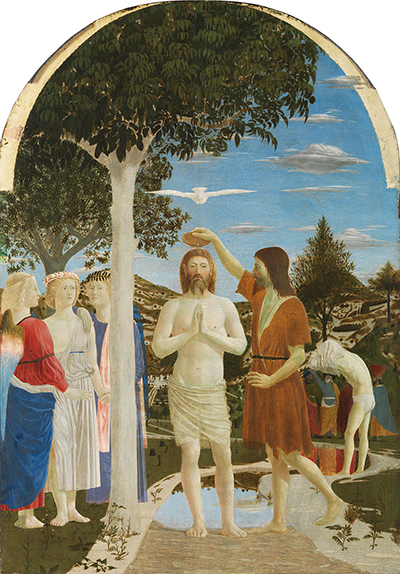
The Baptism of Christ
Probably about 1437–45The History of the True Cross
Mid-fifteenth centuryThe Dream of Constantine (current article)
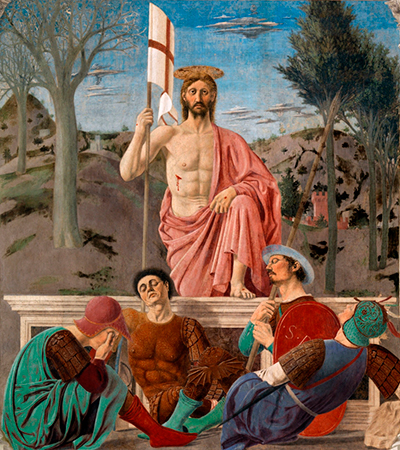
Mid-fifteenth centuryThe Resurrection
About 1458–68 (Opificio)The Flagellation of Christ
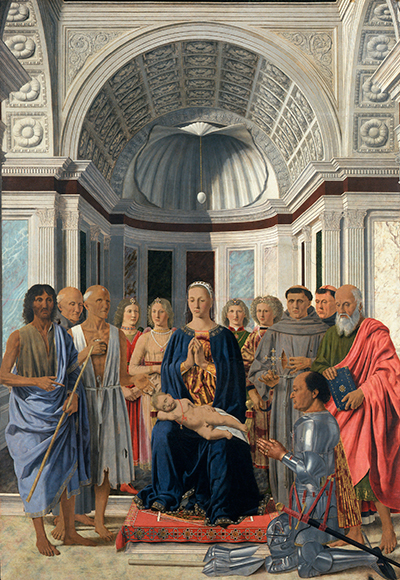
1459–60 (GNDM)The Montefeltro Altarpiece
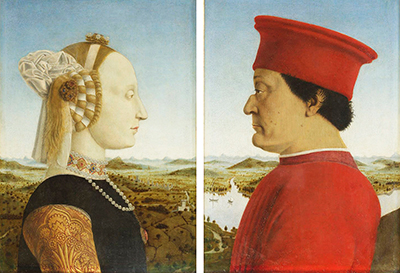
About 1472–74 (Brera)The Duke and Duchess of Urbino
About 1473–75 (Uffizi)The Nativity
Early 1480s (National Gallery)Contents
- Inside the emperor’s tent
- Follow the light from the angel to the bed
- Night, dawn and the painted stars
- How the story reached Arezzo
- Two messages across the chapel wall
- What conservation helps us see
- Annotated details
Inside the emperor’s tent
The roof of the tent rises to a point, with a curved lower edge that suggests the round space beneath it. The opening cuts into the front of that volume. Pulled back, the curtains let us see the emperor’s pillow and bright bed linen. The red of the canopy and the warmer tones of the parted fabric mark out his shelter from the dark tents farther back. Piero gives those distant roofs just enough definition to suggest the rest of an army encamped around these few people. [1] [2]
The bed lies across the opening, its low horizontal shape under the steep rise of the canopy. Constantine’s head rests towards the left, and his recumbent figure is partly screened by the seated attendant. That overlap matters. A standing soldier could block the entire opening, but the attendant’s position leaves the emperor’s head and enough of the bed in view for us to understand what is happening. The arrangements of bed, curtains and step give the messenger a precise destination within the camp. Once our eyes have adjusted to the picture’s contrasts, the tent reads both as a large object standing in open air and as a small room occupied by people. [1] [2]
The sentries are placed near opposite edges. The soldier on the left presents his back to us and is largely in shadow. The guard on the right turns more towards us and offers the light broader surfaces to strike. Compare the two men before looking up to see where the illumination comes from. The difference between their bodies makes the direction of the light apparent even at the level of the ground. Their upright forms also steady the composition beneath the steep angle of the angel’s flight. [1] [2] [3]
The attendant is the only figure whose attention seems directed out of the scene. He sits at the threshold, near enough to tend the sleeper, with his face turned towards the viewer. His gaze has the effect of making us pause at the opening before looking past him. Across the scene Piero distributes attention in unexpected ways. Constantine has his eyes closed, the sentries keep their places and the attendant looks out. There is no collective gasp to show that something extraordinary has happened. The human figures give us the stillness of an ordinary watch, which makes the angel’s movement and the spread of its light feel all the more sudden. [1] [6]
Follow the light from the angel to the bed
Piero shows the angel in foreshortening, compressing the figure’s apparent length because it is seen at a steep angle. The wings are easier to make out than the body, which appears to be travelling down into the space of the camp. The painter Giorgio Vasari singled out this headlong arrival in his 1568 life of Piero. He admired the painter’s judgement in using the angel’s own light to illuminate the tent and its surroundings. Vasari’s praise tells us how strongly the fresco’s treatment of light impressed at least one sixteenth-century viewer. [2] [7]
At a distance, the brightest shapes, particularly the linen and the opening of the tent, can attract attention before the small cross becomes clear. The path back to the angel is visible in the different ways the light falls. Cloth brightens across a continuous area, the bedding catches a stronger patch, and the soldiers acquire quite different degrees of definition. At the roof, illuminated fabric sits against the darker sky. The edges of the opening then guide the eye down towards the body the vision concerns. [1] [2] [3]
Piero has given an experience of sleep enough substance to be painted with the same attention as a tent or an armoured man. Kenneth Wilder describes the picture as giving its viewer access to the contents of Constantine’s dream while showing the dreamer as a figure within the scene. We can see the angel and sleeper together, even though our view of the bed from outside is quite distinct from whatever Constantine might see in his sleep. The attendant’s outward gaze makes that position especially vivid. He seems close enough to address, while the rest of the scene remains absorbed in its own quiet. [1] [6]
Annotated Details from The Dream of Constantine
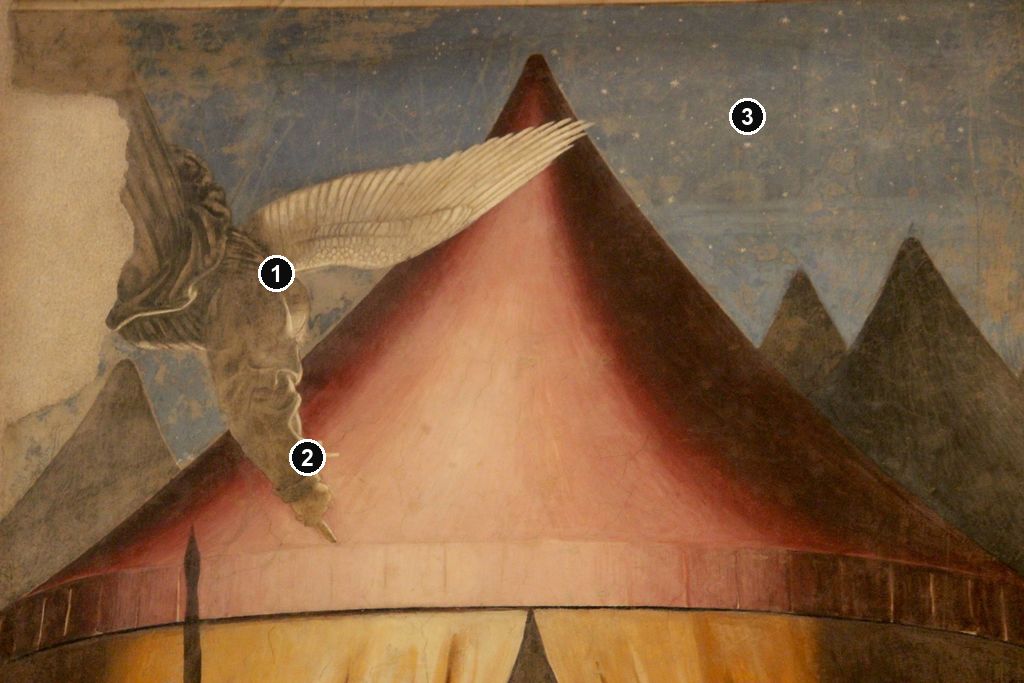
The numbered points identify visible features discussed in this article. Return from each detail to the numbered overview. Detail of the angel, tent and sky in The Dream of Constantine, Arezzo. Miguel Hermoso Cuesta. Image source. CC BY-SA 4.0. The numbered overview and detail crops are adaptations under CC BY-SA 4.0.
Details from THE DREAM OF CONSTANTINE
Compare the cropped details with the source images above. Notice how their colours, shapes and positions contribute to the larger compositions.
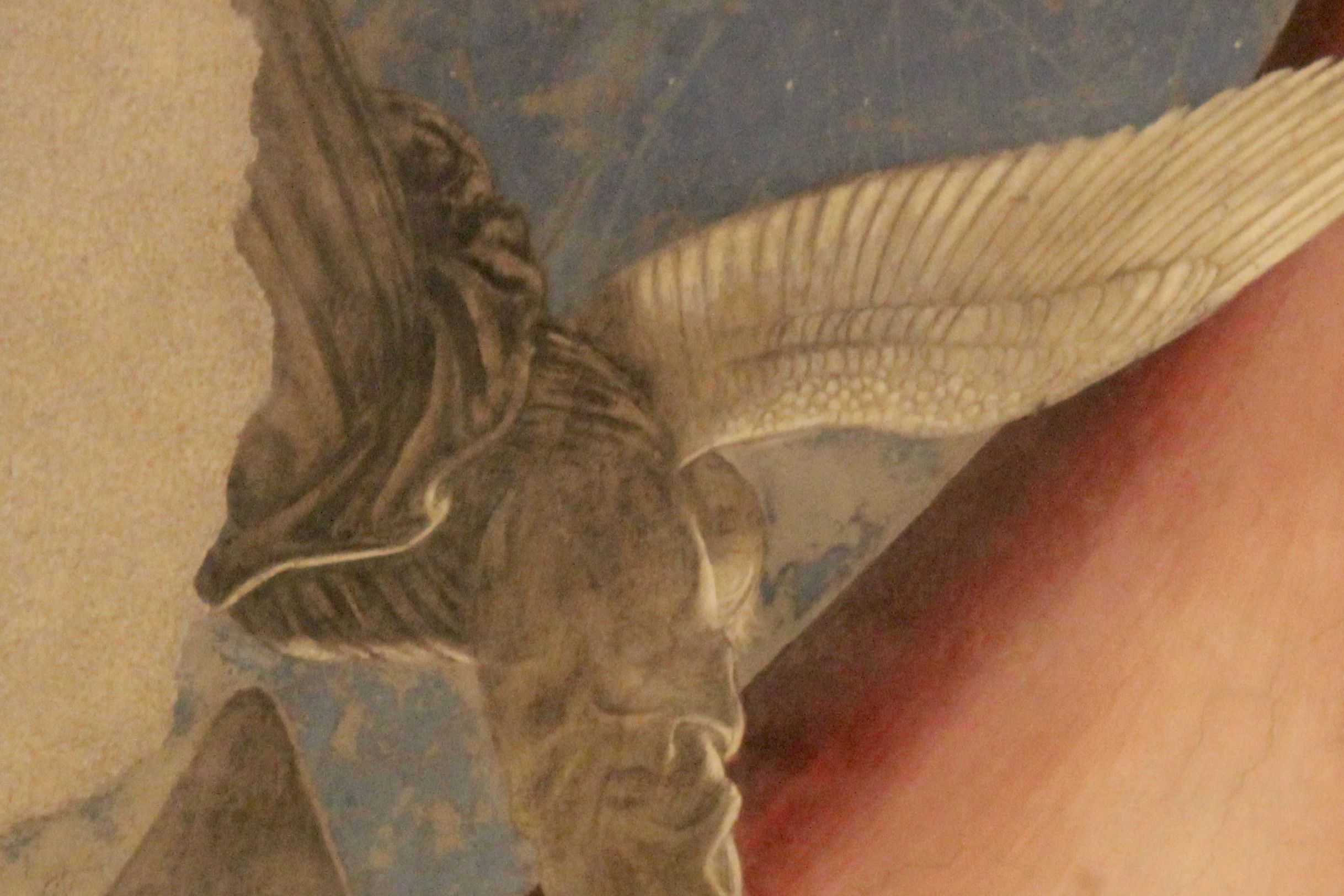
The angel’s diagonal
The partly silhouetted angel enters at an angle. The bright wing stretches in the opposite direction above the canvas roof.
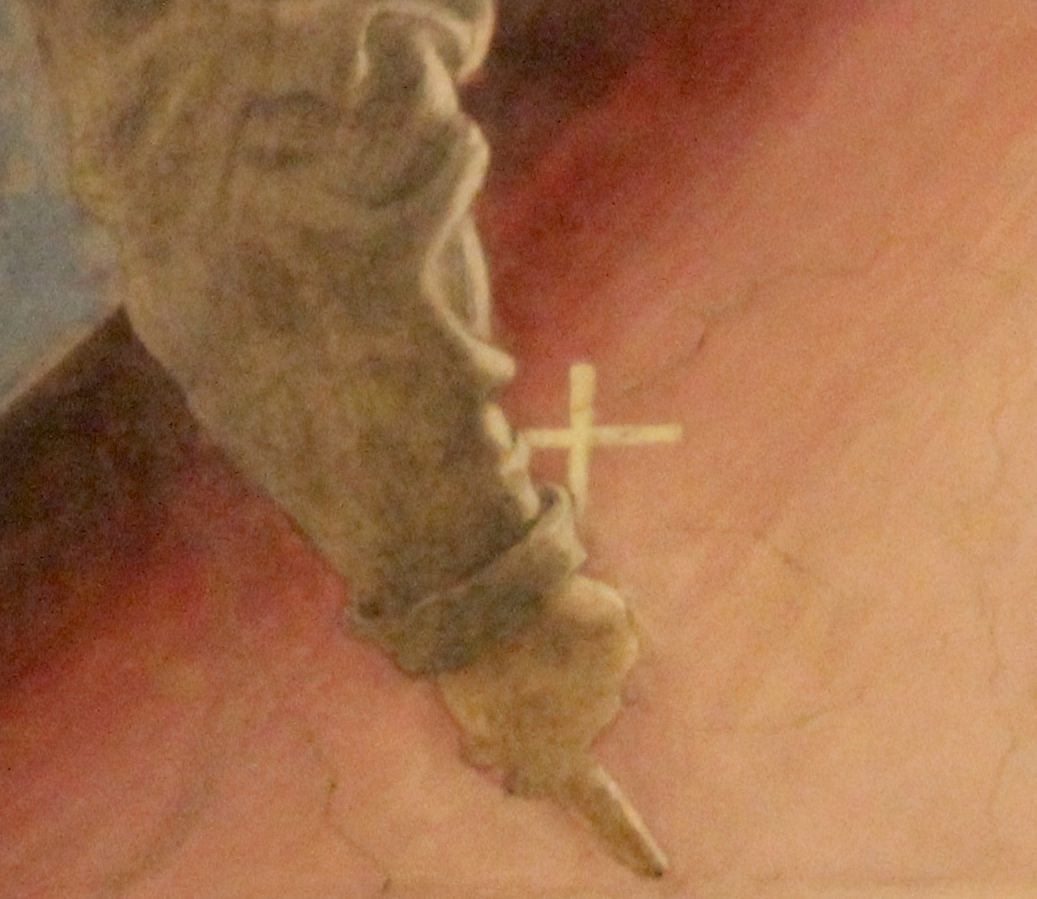
The cross near the tent
A small cross is visible beside the angel’s descending arm. Its scale makes it easy to miss amid the broad masses of shadow.
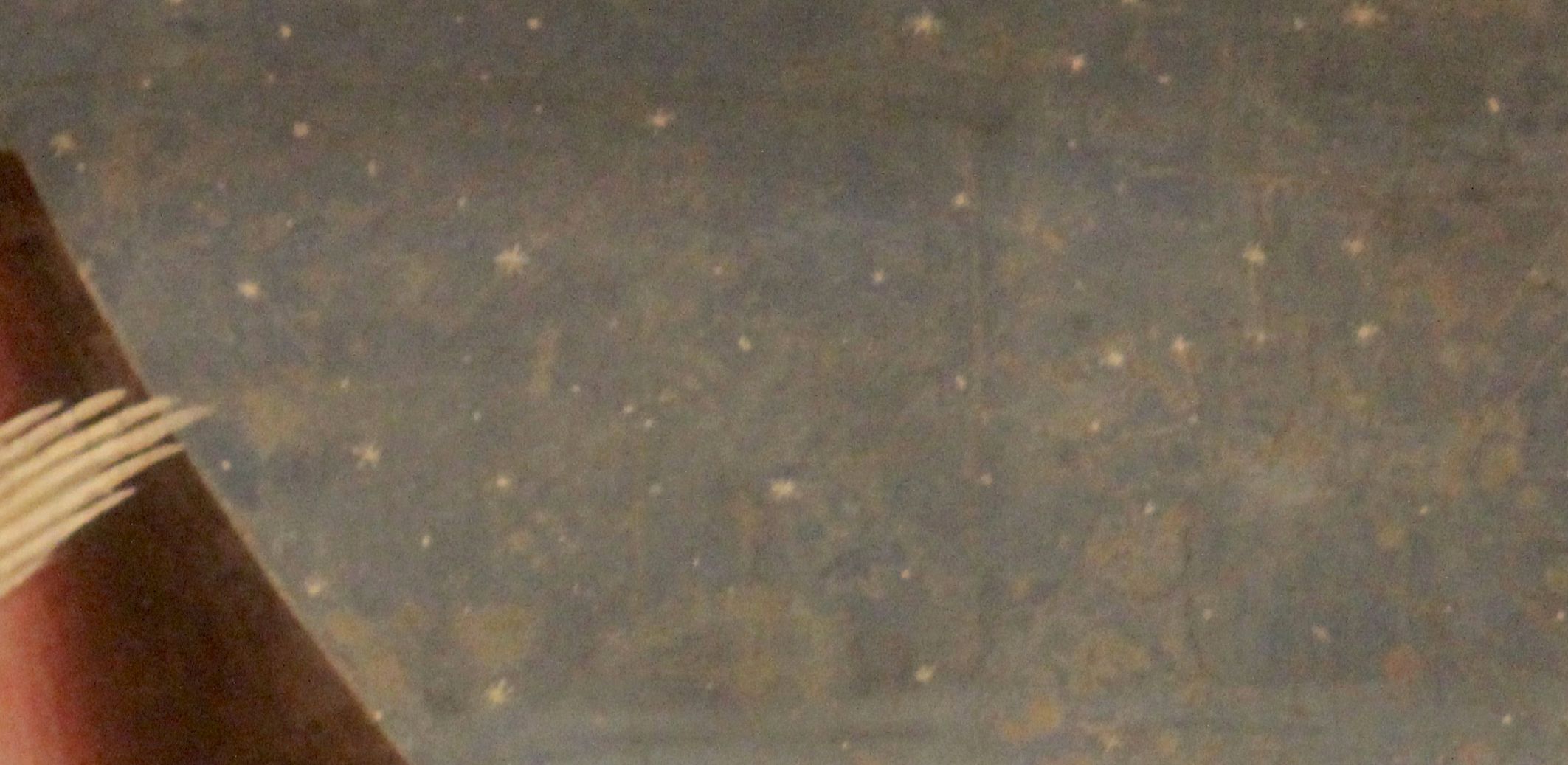
Sky above the canvas
The upper sky includes small light points. The red cone of the tent and darker tents behind it frame the area of surviving blue.
Night, dawn and the painted stars
Vasari called the scene night. The modern Musei di Arezzo guide sets it at dawn. Carlo Bertelli draws both impressions together in his account of the fresco, describing a nocturne in which the first light of morning is appearing above the darker roofs of the tents. The sky is still starry and the camp is still deeply shaded. An approaching dawn leaves ample room for the angel’s much more concentrated light to pick out the imperial tent. This distinction is easiest to grasp by looking first above the distant tents and then at the brightest part of the bedding. The faint light in the sky suggests the hour, and the bright linen marks the place where the vision is taking hold. [1] [2] [7]
The stars have their own history of interpretation. After the modern restoration, Anna Maria Maetzke drew attention to the recognisable shape of Ursa Minor, the Little Bear, which contains the group of stars often called the Little Dipper. Vladimiro Valerio compared the painted arrangement with a star map and found that the Little Dipper’s form appeared reversed from the way it is seen looking up at the sky. He argued that Piero had worked from the kind of image that shows the stars as though viewed from outside the celestial sphere, in the manner of a globe. The resulting sky could look convincingly natural while relying on a carefully constructed model. [5]
Valerio also put forward a possible connection with the astronomer Regiomontanus and Cardinal Bessarion, whose journey through Italy in 1463 he compared with the proposed chronology of the fresco. It remains a hypothesis about how Piero might have obtained a model. The painted view lacks a clear horizon from which to establish the site’s latitude, and the readable points of light cannot independently give a date for the fresco or settle what happened to Constantine centuries earlier. Even without a chart, a viewer can observe the contrast between the relatively faint stars and the much stronger light at the front of the picture. [2] [5]
How the story reached Arezzo
Constantine defeated his rival Maxentius at the Milvian Bridge near Rome in AD 312. Two early Christian authors tell different stories about a sign associated with Constantine’s campaign. Lactantius, in On the Deaths of the Persecutors, has Constantine receive instructions in a dream to put a heavenly sign on his soldiers’ shields before battle. He describes how that mark was made. The emphasis falls on the command and what Constantine does in response. [8] [9]
In the Life of Constantine, Eusebius says that Constantine saw a cross of light above the sun, with an inscription promising him victory, and that the army witnessed it too. Christ subsequently appeared to Constantine in his sleep and instructed him to have a likeness of the sign made for use as protection in battle. Eusebius credits Constantine himself with recounting the story much later. These details give the two accounts different settings and audiences. Lactantius places the instruction close to the decisive battle, while Eusebius leaves the location and timing of the daytime vision less specific. In a study of the accounts, the historian Jan Willem Drijvers points out that a speech honouring the emperor in 313 celebrates his victory without mentioning a dream or any Christian intervention. The battle belongs to a documented campaign, and the story of revelation comes to us through particular accounts of that campaign. [9] [10]
The medieval Golden Legend, compiled by Jacobus de Voragine, makes the angel central to the episode. In its chapter on the finding of the Cross, an angel wakes Constantine during the night and shows him a luminous cross with a promise that he will win under its sign. Constantine has the cross carried on a banner the next morning. The chapter locates the impending struggle by the Danube. The Arezzo guide reads Piero’s scene in connection with the battle against Maxentius. The difference in geography shows how the cross and the promise attached to it could pass between versions of the story. [1] [11] [12]
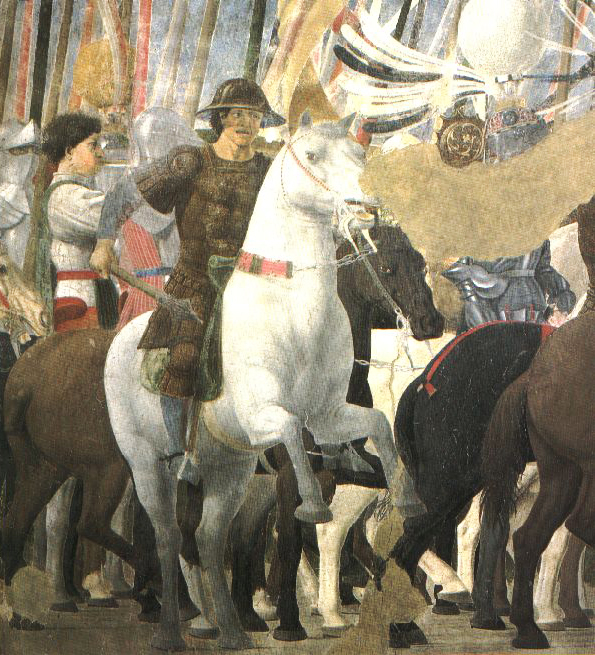
The familiar Latin formula In hoc signo vinces means ‘In this sign you will conquer’. In front of the fresco, the message is conveyed by the action and by the small cross borne into the tent’s vicinity. Piero keeps the emperor asleep at the instant we see him, which brings the painting close to the experience of a dream while leaving open the moment of awakening related in the medieval text. The Victory of Constantine at the Battle of the Milvian Bridge takes up the sign again in daylight, as Constantine shows a cross from horseback. The change from the dark tent to the open landscape makes the passage from private revelation to public action visible. [1] [2] [3] [11]
Two messages across the chapel wall
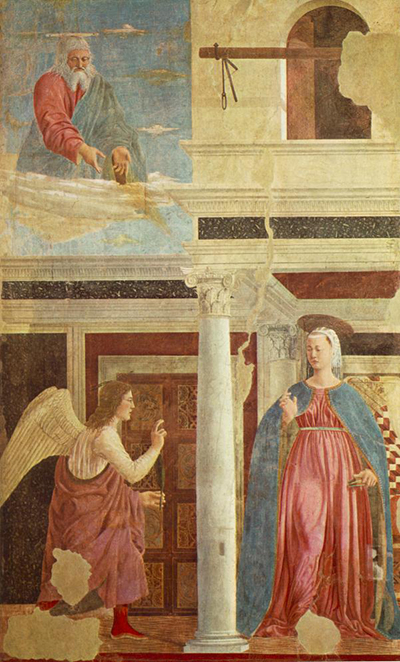
The Annunciation across the back wall helps explain why such a quiet scene was given this position. Gabriel’s message to Mary is delivered within a carefully ordered architectural setting. The angel in Constantine’s dream speeds towards a fabric shelter in a military camp. Mary is awake to receive her message, while the emperor sleeps. Bertelli sees the pairing as a deliberate correspondence between a daylight apparition and a nocturnal vision. The sharing of a tier lets a visitor take in these quite different ways of receiving a divine message almost in one glance. [1] [2] [3]
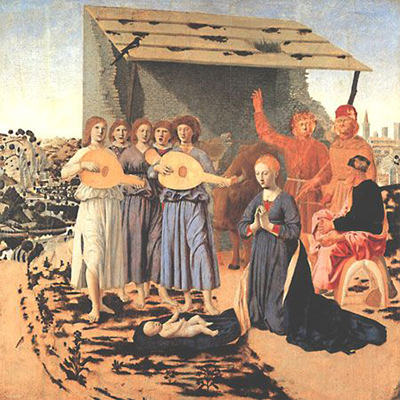
A second comparison can be made with Piero’s later Nativity, now in the National Gallery in London. In that work a shepherd points towards the divine light falling on the wall of the shed through an opening in its roof. In Arezzo it is the fabric and the guards that give the visitor the strongest sense of where the heavenly radiance falls. Each image gives the light ordinary surfaces to work on, allowing us to follow something extraordinary by looking closely at the material world. [1] [13]
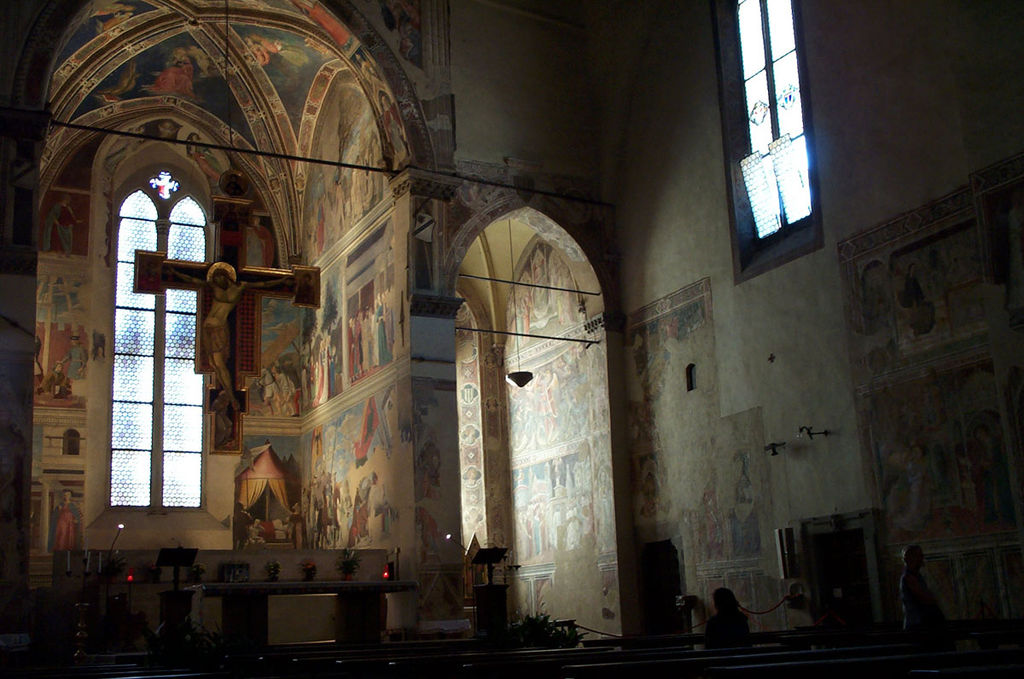
An oblique view of the Bacci Chapel with its window, suspended crucifix and right wall. louis-garden. Image source. CC BY-SA 2.5. Resized from the source. This reproduction uses CC BY-SA 2.5.
What conservation helps us see
The picture visitors see is still on the chapel wall. That setting made the state of the building part of the conservation problem. In 1985 a major programme began by studying the chapel’s environment, structure, painted surfaces and history. Specialists documented the wall paintings alongside technical findings and photography. The programme’s archival team recorded where observations and treatments belonged on the walls so that later studies could relate new evidence to the same areas. Treatment began in 1991 and the chapel reopened on 7 April 2000. [3] [4]
Cracks, flaking paint and salts on the surface were among the problems recorded across the cycle. Some earlier materials and repairs also had to be assessed. These findings describe the condition of the murals as a whole. For the Dream specifically, one documented gain was that details of the star field were legible enough to invite closer study. A conservation campaign can clarify what survives on a wall and help recover relationships among colours and forms. The distinction between night and early dawn belongs to how scholars and viewers read those forms. [3] [5] [4] [14]
In the chapel, begin by finding the tent on the lower right of the back wall and looking across to the Annunciation. Then give the Dream time on its own. Pick out the two sentries, the face of the seated attendant and whatever you can see of the sky. From the upper edge of the tent, follow the returning diagonal towards the angel. This alternation between the whole wall and the small details brings out one of the fresco’s finest qualities. A revelation of consequence to the entire cycle is made visible in the light on a few bodies and a narrow strip of linen. [1] [2] [3]
Browse the artworks
Compare Piero’s frescoes, panels and manuscript figures. The list includes ensembles and separately identifiable panels or scenes. Dates are approximate where the sources differ.
| Name | Date | Medium and source |
|---|---|---|
| The Baptism of Christ | Probably c. 1437–45 | Panel painting Catalogue. |
| The Flagellation of Christ | 1459–60 (GNDM) | Panel painting Catalogue. |
| The History of the True Cross | Mid-fifteenth century | Wall painting Catalogue. |
| Dream of Constantine | Mid-fifteenth century | Wall painting Catalogue. |
| The Duke and Duchess of Urbino | About 1473–75 (Uffizi) | Panel painting Catalogue. |
| The Resurrection | About 1458–68 (Opificio) | Wall painting Catalogue. |
| Brera Madonna | About 1472–74 | Panel painting Catalogue. |
| Annunciation at Arezzo | Mid-fifteenth century | Wall painting Catalogue. |
| Madonna del Parto | About 1450–65 (Monterchi) | Wall painting Catalogue. |
| Polyptych of the Misericordia | Commissioned 1445 | Panel painting Catalogue. |
| The Nativity | Early 1480s (National Gallery) | Panel painting Catalogue. |
| Madonna di Senigallia | About 1474–75 (GNDM) | Panel painting Catalogue. |
| Death of Adam | Mid-fifteenth century | Wall painting Catalogue. |
| Queen of Sheba | Mid-fifteenth century | Wall painting Catalogue. |
| Victory of Constantine | Mid-fifteenth century | Wall painting Catalogue. |
| Battle between Heraclius and Chosroes | Mid-fifteenth century | Wall painting Catalogue. |
| Saint Mary Magdalen | Wall painting Catalogue. | |
| The Augustinian Polyptych | 1454–69 | Panel painting Catalogue. |
| Polyptych of Perugia | About 1467–69 (GNU) | Panel painting Catalogue. |
| Perugia Annunciation | About 1468–70 (national catalogue) | Panel painting Catalogue. |
| St Francis and St Elizabeth | About 1467–69 (GNU) | Panel painting Catalogue. |
| Stigmatisation of St Francis | About 1468–70 (national catalogue) | Panel painting Catalogue. |
| An Augustinian Nun (Saint Monica) | 1454–69 | Panel painting Catalogue. |
| Augustinian Saint | 1454–69 | Panel painting Catalogue. |
| Saint Michael | 1454–69 | Panel painting Catalogue. |
| Saint Nicholas of Tolentino | 1454–69 | Panel painting Catalogue. |
| Saint John the Evangelist | 1454–69 | Panel painting Catalogue. |
| Virgin and Child Enthroned with Four Angels | About 1460–70 (Clark) | Panel painting Catalogue. |
| Portrait of Sigismondo Pandolfo Malatesta | About 1450–51, often proposed. Louvre catalogue range 1450–75. | Panel painting Catalogue. |
| Sigismondo before St Sigismund | 1451 | Wall painting Catalogue. |
| St Jerome and a Donor | 1460s (Accademia); about 1450 also proposed | Panel painting Catalogue. |
| St Jerome in Penitence | 1450, dated on the panel | Panel painting Catalogue. |
| Saint Julian | About 1455–60, often proposed | Wall painting Catalogue. |
| Saint Augustine | 1454–69 | Panel painting Catalogue. |
| Saint Apollonia | 1454–69 | Panel painting Catalogue. |
| Crucifixion from the Augustinian Polyptych | 1454–69 | Panel painting Catalogue. |
| Saint Louis of Toulouse | Wall painting Catalogue. | |
| Burial of the Wood | Mid-fifteenth century | Wall painting Catalogue. |
| Discovery and Proof of the True Cross | Mid-fifteenth century | Wall painting Catalogue. |
| Exaltation of the Cross | Mid-fifteenth century | Wall painting Catalogue. |
| Saint Anthony Raises a Child | About 1467–69 (GNU) | Panel painting Catalogue. |
| Saint Elizabeth Revives a Child | About 1467–69 (GNU) | Panel painting Catalogue. |
| Hercules | About 1470 | Wall painting Catalogue. |
| Portrait of a Boy (possibly Guidobaldo da Montefeltro) | Panel painting Catalogue. | |
| De prospectiva pingendi, Reggio Emilia witness (figures) | Manuscript diagrams Catalogue. | |
| The Interrogation of Judas | Mid-fifteenth century | Wall painting Catalogue. |
| Two prophets, Bacci Chapel | Mid-fifteenth century | Wall painting Catalogue. |
| Saint Clare of Assisi, upper predella | About 1467–69 (GNU) | Panel painting Catalogue. |
| Saint Agatha, upper predella | About 1467–69 (GNU) | Panel painting Catalogue. |
| Lost centre of the Augustinian Polyptych | 1454–69 | Lost panel or panels Catalogue. |
Frequently Asked Questions
Vasari described it as night and the Musei di Arezzo guide describes it as dawn. The stars are still visible and the camp remains shaded, so early dawn can account for the light in the sky while preserving the scene’s nocturnal character. The angel produces the stronger local illumination. [1] [2] [7] [5]
Discussion
Look again at the images and ideas explored in The Dream of Constantine by Piero della Francesca. These editorial prompts invite your observations.
Reader Insights
Which detail makes the direction of the light clearest to you, the tent, the bed or one of the soldiers?
How does the seated attendant’s gaze affect your sense of standing outside Constantine’s tent?
Compare the fresco with the Annunciation opposite it. What difference does the setting make to the way each messenger is received?
Join the Conversation
Share a detail, comparison or question about The Dream of Constantine by Piero della Francesca below.
References
- Musei di Arezzo, Basilica of St. Francis: Frescoes by Piero della Francesca, particularly “Constantine’s Dream” and “Annunciation”. View source.
- Carlo Bertelli, “Piero della Francesca: il maestro nel suo tempo”, I classici della pittura, Treccani, 2016, Arezzo discussion. View source.
- Anna Maria Maetzke, “Piero della Francesca: Il restauro de La Leggenda della Vera Croce”, Il Libro dell’Anno, Treccani, 2000. View source.
- Stefano Casciu, Giuseppe A. Centauro and Massimo Chimenti, “The Archival Documentation System: The Computerized Heart of the Restored ‘History of the True Cross’ by Piero della Francesca”, in GraDoc, ICCROM, 2000, pp. 208–220. View source.
- Vladimiro Valerio, “Piero della Francesca’s Sky in The Dream of Constantine”, in The Inspiration of Astronomical Phenomena VI, Astronomical Society of the Pacific Conference Series 441, 2011, pp. 161–168. View source.
- Kenneth Wilder, Projective Space: Structuring a Beholder’s Imaginative Response, PhD thesis, 2009, discussion of fig. 51. View source.
- Giorgio Vasari, “Piero della Francesca”, in Le vite de’ più eccellenti pittori, scultori e architettori, 1568 edition. View source.
- Lactantius, On the Deaths of the Persecutors, chapter 44, translated by William Fletcher. View source.
- Jan Willem Drijvers, “Panegyricus Latinus 12(9): Constantine’s Religious Ideology”, Journal of Late Antiquity 14, no. 1, 2021, pp. 50–74. View source.
- Eusebius of Caesarea, Life of Constantine, book I, chapters 28–31, translated by Ernest Cushing Richardson. View source.
- Jacobus de Voragine, “The Invention of the Holy Cross”, The Golden Legend, volume 3, William Caxton translation edited by F. S. Ellis, Fordham University Internet Medieval Sourcebook. View source.
- Visit Arezzo, Guide to “The Legend of the True Cross” by Piero della Francesca, episodes 5–6. View source.
- The National Gallery, London, The Nativity, NG908. View source.
- Ursula Schädler-Saub, “Dealing with Authenticity in the Conservation and Restoration of Wall Paintings and Architectural Surfaces”, Protection of Cultural Heritage 8, 2019, Arezzo case study. View source.