 by Tom Gurney
Tom Gurney BSc (Hons) is an art history expert with over 20 years experience
Published on June 19, 2020 / Updated on October 14, 2023
Email: tomgurney1@gmail.com / Phone: +44 7429 011000
Madonna del Parto: Introduction
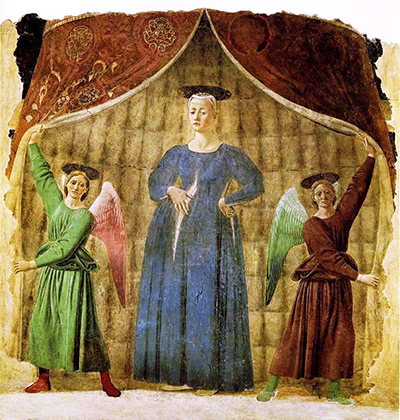
Two angels lift the sides of a tent to reveal a heavily pregnant woman. One of her hands rests at her hip. The other touches the opening in her blue dress, where a pale undergarment shows against the swell of her abdomen. This is the Virgin Mary before the birth of Christ, painted by Piero della Francesca for the small church of Santa Maria di Momentana, outside Monterchi in Tuscany. The surviving mural is roughly two metres square and can be seen in the civic museum in Monterchi. Its missing canopy top and the history of the wall it was painted on are part of what we see today. [1] [2] [3]
At a Glance
- ArtistPiero della Francesca. [1] [2]
- DateMid-fifteenth century. The civic museum gives about 1450–65. [1]
- MediumDetached fresco, with work on dry plaster in Mary's dress. [1] [4]
- Surviving sizeApproximately 2 × 2 metres. [1] [5]
- SubjectThe pregnant Virgin Mary revealed by two angels drawing back a canopy. [1] [6]
- Original settingSanta Maria di Momentana, outside the town of Monterchi. [1] [2]
- Current locationMusei Civici Madonna del Parto, Via della Reglia 1, Monterchi, Tuscany. [7] [8]
This work across Piero della Francesca’s career
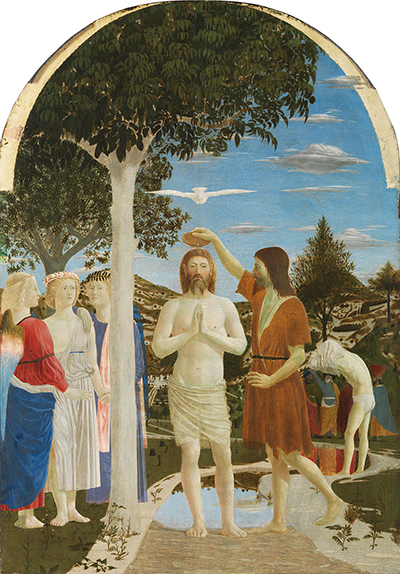
The Baptism of Christ
Probably about 1437–45Madonna del Parto (current article)
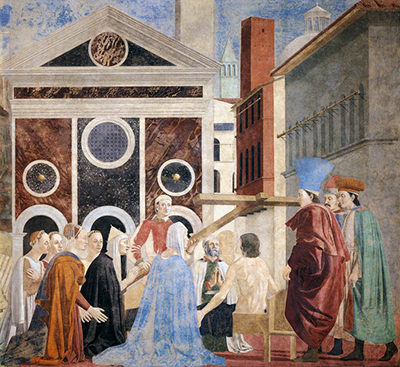
About 1450–65 (Monterchi)The History of the True Cross
Mid-fifteenth centuryThe Resurrection
About 1458–68 (Opificio)The Flagellation of Christ
1459–60 (GNDM)The Montefeltro Altarpiece
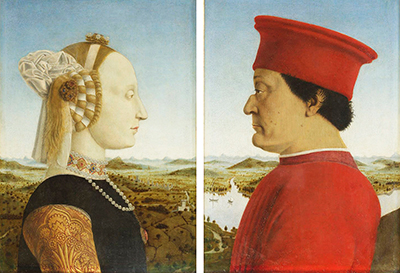
About 1472–74 (Brera)The Duke and Duchess of Urbino
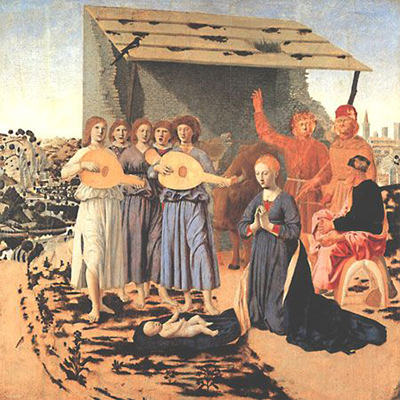
About 1473–75 (Uffizi)The Nativity
Early 1480s (National Gallery)Contents
- Mary before the birth
- Two angels from the same design
- Inside the pavilion
- From the altar to the viewer
- A painting prayed before
- How the wall painting survived
- Looking at Piero across the Upper Tiber Valley
- Annotated details
Mary before the birth
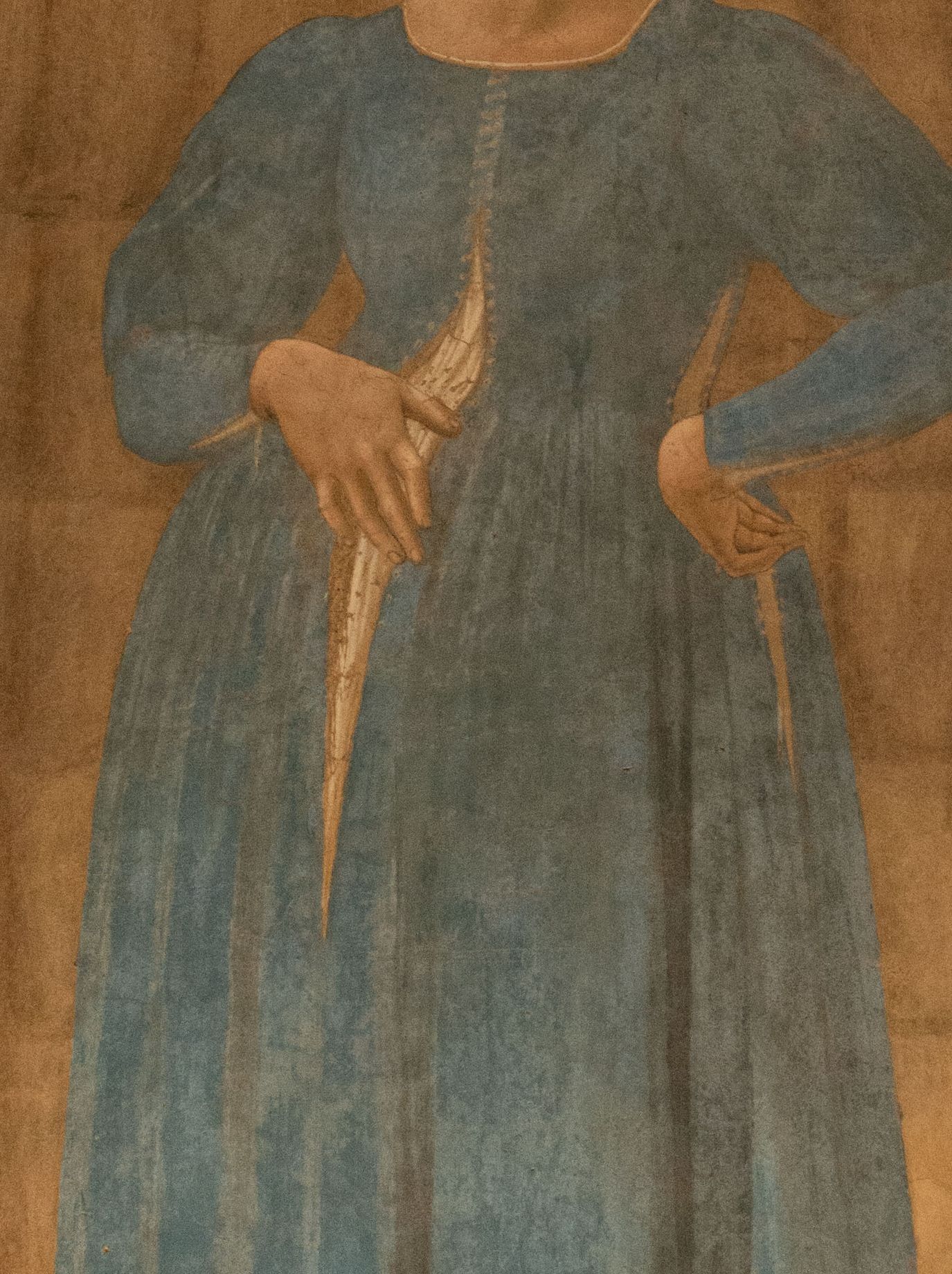
Mary stands almost on the central axis, under the parting in the curtains, but her head and body turn slightly. Her left arm bends into a pronounced angle at the elbow as her hand settles against her hip. With her right hand she touches the edge of the opening across her abdomen. Watch what happens to the upright line of the bodice as it reaches that hand. The blue fabric gives way to a pale opening that widens and then narrows as it follows the rounded form beneath it. We see the shape of her pregnancy through the layers of cloth, and the opening gives her fingers a place to rest. The turn of the body makes the shape easier to see than it would be in a rigidly frontal pose. [1] [6]
The dress has a fitted upper section and a full skirt. The sleeves are fuller above and taper towards the wrists. In the lower half, long, comparatively straight folds fall to the floor, carrying the eye back to the small area where the fabric pulls away from the body. At her head there is another contrast of textures. Light bands cross her brow and hold her fine braids in place. The hair stays close to the oval of the head, while the elbow extends beyond the fall of the skirt. These details make the figure easy to read from a distance, even without the identifying halo. [1] [6] [4]
Mary's lowered eyes are particularly striking beside the angels' outward gaze. Her chin tilts a little, with the eyelids doing most of the work. Her expression allows room for a viewer to see thought, fatigue or composure. The painting gives us posture and gesture to work with, while leaving her precise state of mind open. Antonio Paolucci, the former director of the Vatican Museums, saw self-possession in the hand at the hip and a protective gesture in the hand at the dress. The hand at the hip makes the line of her upper body look braced. The other draws the eye to the altered fit of the dress. [6]
The museum's account of the technique describes seven giornate, the sections of fresh plaster prepared for successive painting sessions, and identifies Mary's dress as an area finished on dry plaster. The surface therefore records more than one way of applying paint. Calling the work a fresco describes its principal technique. It also helps to know about the work on dry plaster when looking at a colour that now varies across the garment. Even the halos have a material history. The museum's leaflet notes that their grid-like marks have been read as reflections of a tiled floor, but favours an explanation based on the wear of adjoining squares of gold leaf. [2] [4] [9]
Two angels from the same design
Look across the picture from one angel's raised hand to the other. The angle of the wrist, the turn of the head, the position of the lowered arm and the placement of the feet correspond in reverse. Piero used one full-sized drawing, or cartoon, and turned it over to obtain its counterpart. The museum describes the transfer as spolvero, or pouncing. Powder tapped through pinholes in the paper left a dotted outline on the plaster. Reversing the sheet gave the second angel the same proportions and the opposite orientation. [6] [4]
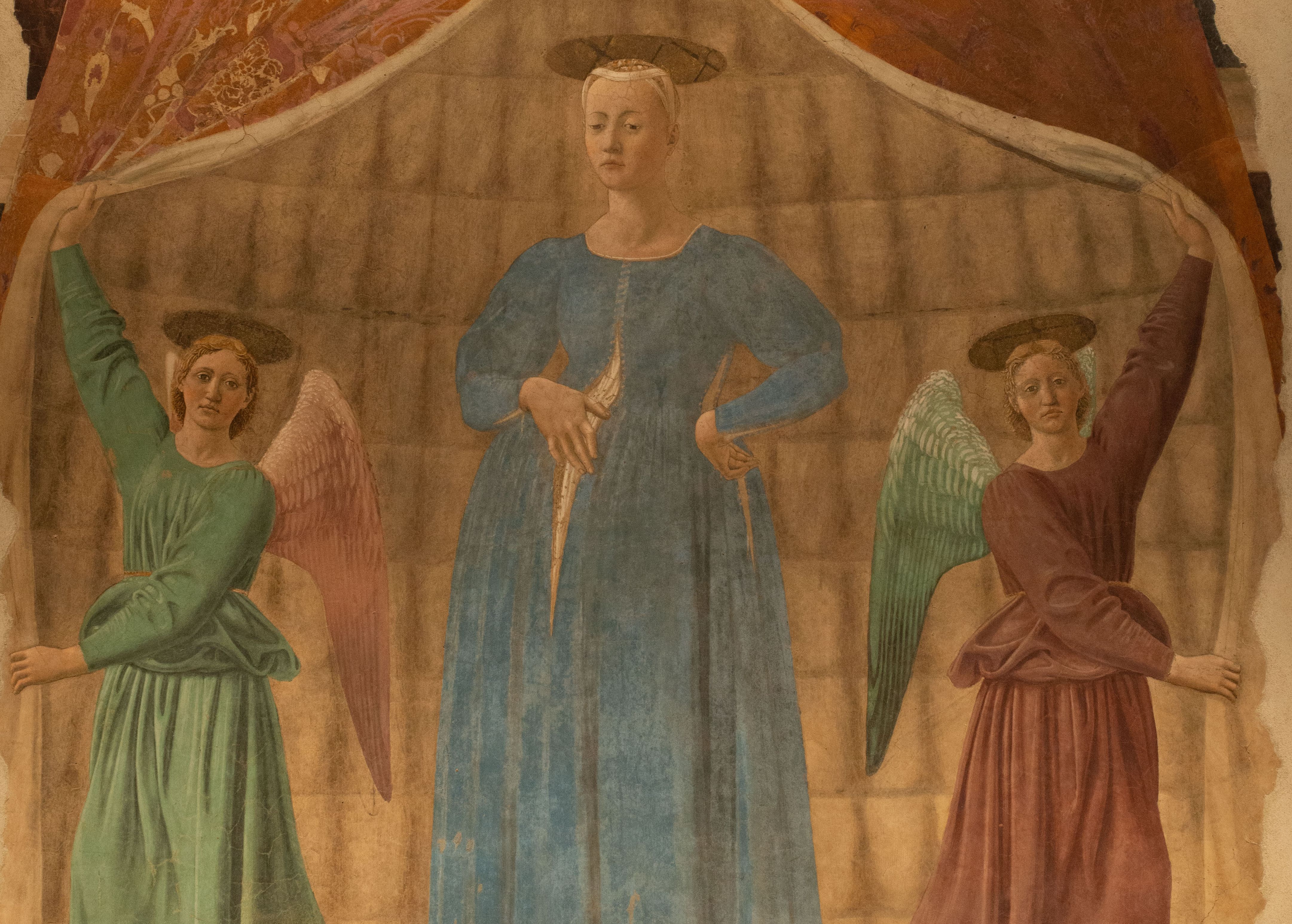
Piero changed the colours as he changed sides. On the viewer's left, the angel wears green with reddish accents at the feet and wings. Across the opening the garment is red, with green at the feet and wings. The stronger patches of red and green answer one another diagonally across the picture. At the same time the repeated outlines let us register the action almost at once. One angel confirms what the other is doing. The upward stretch of both arms takes the weight of the painted fabric, while the outer hands gather the returning folds lower down. Their matched gestures make the canopy look poised between opening and being held in place. [1] [6] [4]
Mary's dress introduces a third colour and a different kind of balance. Her arms make unequal shapes, and her head turns within the otherwise balanced enclosure. The symmetry is clearest in the hands that lift the curtains, where it frames her head, and in the feet, where it establishes a level on either side of her skirt. Piero makes the space seem orderly enough to be ceremonial and leaves the figure at its centre the freedom to stand as a person might. [1] [6]
Annotated Details from Madonna del Parto
The numbered points identify visible features discussed in this article. Return from each detail to the numbered overview. Piero della Francesca, Madonna del Parto, on display at the civic museum in Monterchi. Maarten Heerlien. Image source. CC BY 2.0. The numbered overview and detail crops are adaptations under CC BY 2.0.
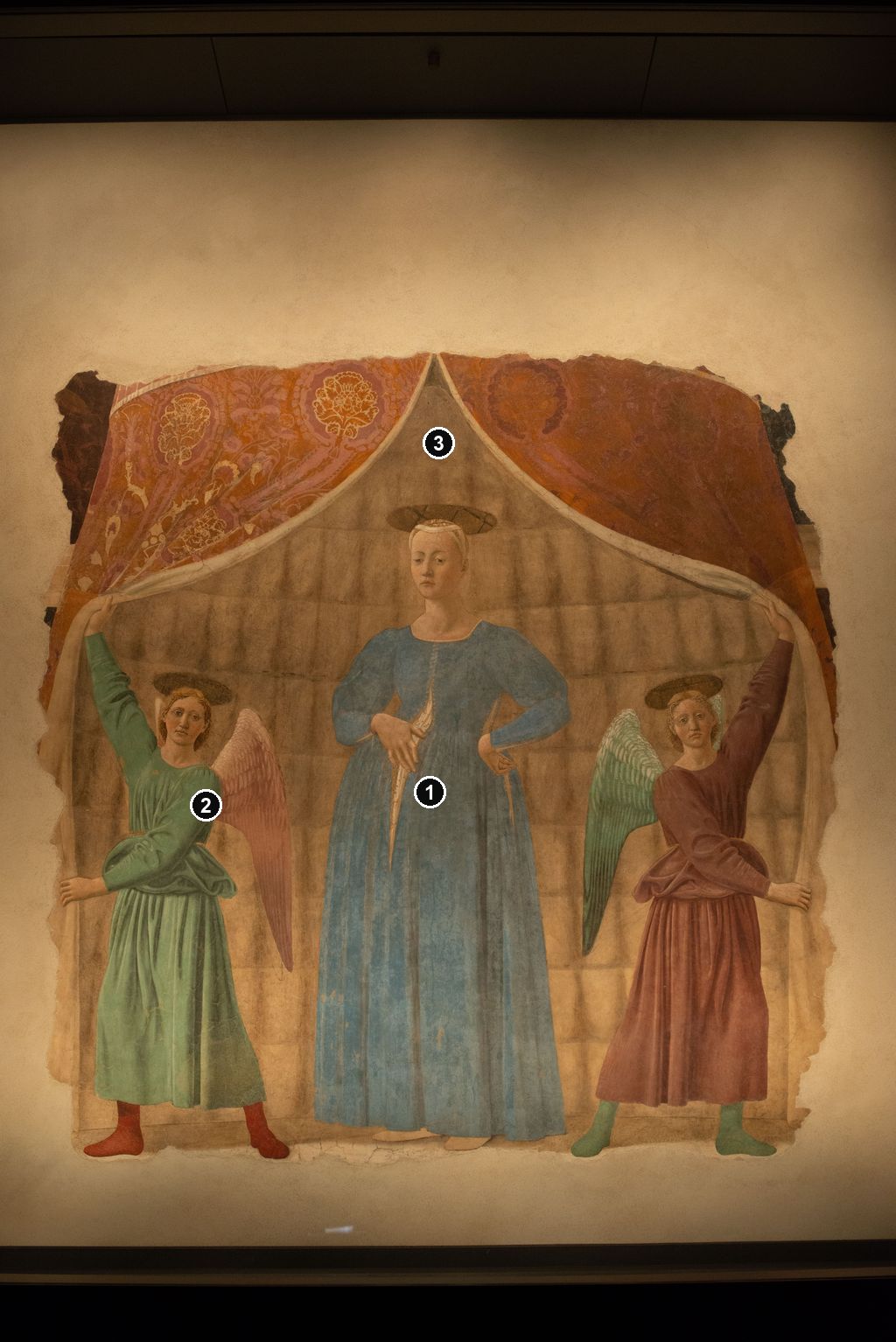
Details from MADONNA DEL PARTO
Compare the cropped details with the source images above. Notice how their colours, shapes and positions contribute to the larger compositions.
The opening in the dress
Mary’s lowered right hand touches the opening in the blue dress. The fingers fall beside the thin strip of lighter fabric.
Two gestures at the curtains
The angels lift and gather the canopy at similar heights. Their heads and raised wrists bracket the Virgin, while the alternating colours distinguish the two sides.
The edge of the baldachin
Decorated fabric turns outwards above the Virgin. The dark line along the surviving edge makes the incomplete top visible.
Inside the pavilion
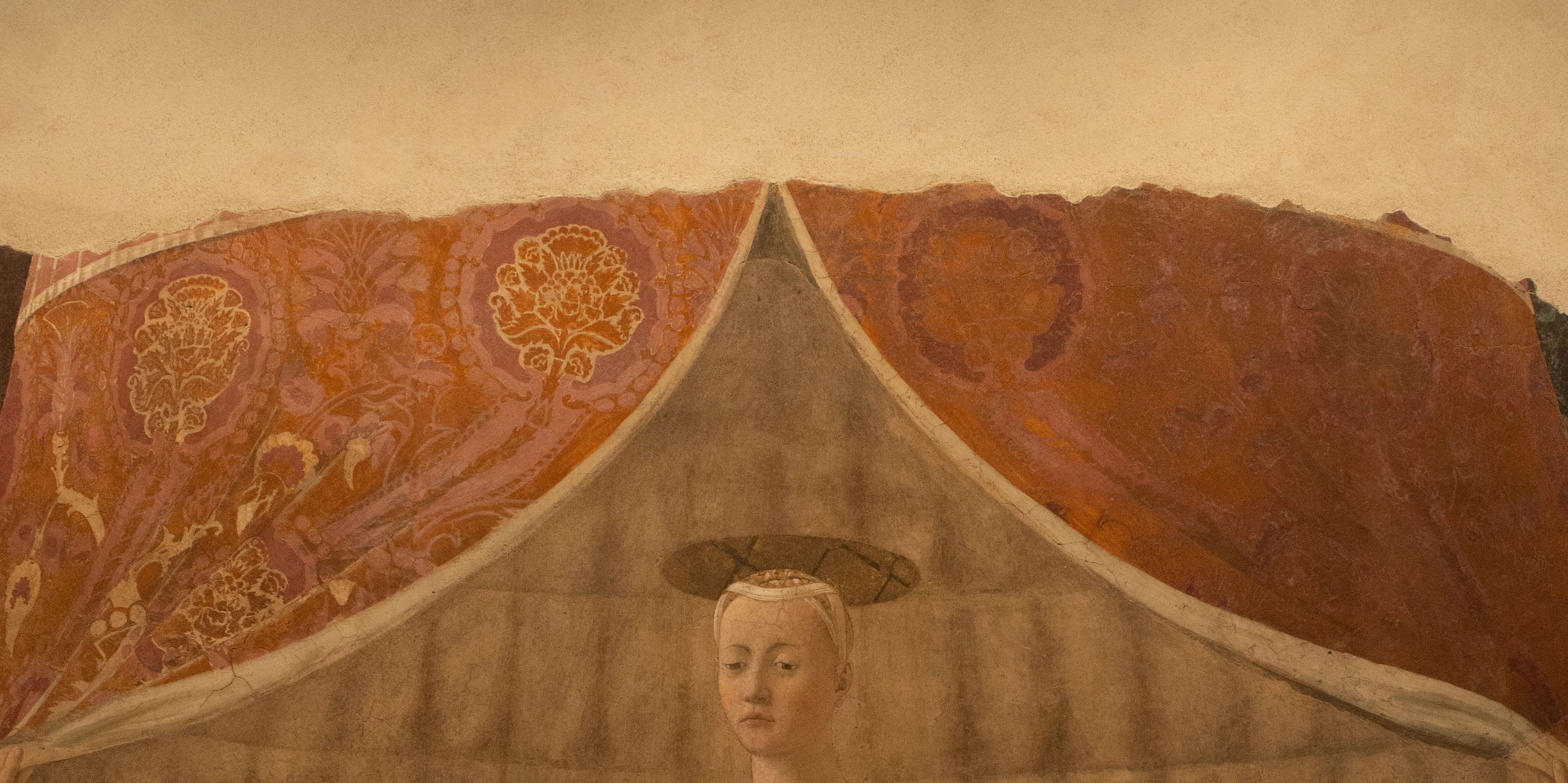
The curtains have two distinct surfaces. Where the outer textile turns towards us near the raised hands, it shows a repeating red-and-gold pattern that the museum identifies as pomegranates. Further in, the lighter lining is broken into ranks of small, darker shapes, described in Monterchi as vaio, the fur of a squirrel. You can follow the turn from one surface to the other at the outer edges of the opening. The dense exterior pattern marks the face of the fabric. The repeated pieces of pale lining carry the eye around the enclosure behind Mary. The curve of that lining makes a material that could have looked like a flat hanging suggest a space with room for a body. [1] [4]
The meeting of the curtains overhead and the widening opening below give the standing figure nearly the full height of the surviving painting. The angels are smaller, and their arms and wings occupy the flanks. There is something of the cloth of honour used in other images of the Virgin here, with precious material and attendants giving distinction to the person they surround. At Monterchi, however, the two open sides create the sense that the viewer is present for the unveiling. It makes a difference that we see the hands in the act of holding the opening, even though the figures' faces and poses are so still. [1] [4] [10]
The surviving curves have also allowed researchers to ask how much of the canopy could be recovered on paper. Fabio Colonnese and Luca Guerini tested ways of projecting the curves of the tent as circles seen in perspective. They used those shapes and the surviving painted lines to explore a possible horizon and viewing position, then considered how a wider painted scheme might have fitted the old church. The study distinguishes between clues in the fragment and the choices required to fill the gaps. The peak familiar from some older reproductions came from an early restoration. The authors produced two proposals for the architectural framing, using stronger colours for the surviving core and reduced colour for the conjectural parts. That distinction matters when a model looks persuasive enough to pass for a record of the lost painting. [3]
From the altar to the viewer
Piero's painting belongs to a Tuscan tradition of images of the expectant Virgin that was already established in the fourteenth century. Examples vary considerably. Some gave Mary a book, and some Florentine works show a girdle. Brendan Cassidy connects the girdle in a particular group of pictures with the veneration of a relic at Prato and with the concerns of pregnant women and their families. At Monterchi, Mary's free hands, the wide opening in the dress and the attendants' act of disclosure make pregnancy legible through a different set of details. Piero's Christ is present as the child she carries. The visible subject is the woman who carries him. [1] [10] [11]
Paolucci proposed reading the fresco through the Hail Mary, where the blessing of Mary is bound to the blessing of the fruit of her womb. He also likened the opened pavilion to a tabernacle containing the Eucharist. The likely setting matters to this reading. Studies of the old church place the painting at the end of the building, above its principal altar. A person seeing it there could have looked from the altar used for Mass to the painted enclosure and its pregnant figure. That setting helps explain why the opening of the tent has been understood as a solemn act of showing the body of Christ, whose physical presence the image asks the viewer to imagine. [3] [6] [10]
The French ethnographer Claude Macherel drew attention to the painted enclosure inside the stone enclosure of the church. His analogy restores something the museum room can make easy to forget. A visitor had already passed into a real interior before looking into the one opened by the angels. [12]
The tent can also recall the sanctuary of the Israelites in Exodus, an association discussed in scholarship on the fresco. The museum leaflet draws attention to the pomegranate pattern as an emblem of fruitfulness. It identifies a second act of disclosure in Mary's hand at the opening of her dress. Both readings begin with something the eye can follow. They also depend on associations a worshipper might have brought to the painting. The evidence of the altar gives the liturgical reading a setting, and the evidence of prayer gives the image a history of use. The patron’s instructions would help establish what the commission was meant to convey, but none have come to light. [4] [10]
A painting prayed before
The original church stood on the slope below the town, towards Citerna. Piero painted over an earlier mural of the Virgin and Child, identified in local accounts as a fourteenth-century Madonna del Latte, or nursing Madonna. It was discovered during the detachment in the early twentieth century. The two images connect the same wall with devotion to Mary at different moments. One shows her with the child at her breast, the other with the child still within her. Their physical relationship is evidence of a pre-existing Marian image at Momentana. The plaster preserves the sequence. The reasons for covering the first painting remain uncertain. [2] [4] [13]
Piero's mother, Romana di Perino, came from Monterchi. Local tradition connects the fresco with her death and sometimes gives 1459 as the occasion for it. The family connection is real, but the proposed memorial remains a tradition. The dates assigned to the painting also vary. The civic museum gives 1450–65 and the Zeri photographic archive allows about 1450–74. An Italian national heritage record gives 1445–50. These are assessments made long after the work was painted. Writing soon after the 1990s treatment, Jack Flam reported that the restorers thought the painting predated Romana’s death by several years. Mid-fifteenth century is a practical description, with the precise year and the circumstances of the commission still open. [1] [2] [4] [9] [13] [14] [15]
There is firmer evidence for the picture's later devotional life. Frank Ferrie cites a church visitation of 1828 recording that the altar was properly kept and that the congregation sang an antiphon in honour of Mary's expectation of childbirth. Paolucci describes women of the Upper Tiber Valley visiting the picture to commend the children they carried to Mary. Piero Calamandrei, writing in 1954, recalled the local trust in the image and described adopting the custom himself in a different form, by sending reproductions as good wishes to expectant mothers. These accounts show how the picture was used and what it meant to different people long after its making. Ferrie also reports periods when the altar lacked the fittings necessary to celebrate Mass. That uneven record makes it difficult to trace any one form of devotion back to the original commission. [6] [10] [16]
How the wall painting survived
In 1785 Monterchi made room for a cemetery at Momentana. Much of the church was demolished, and what remained was adapted as a burial chapel. Piero's painting was reduced in the process, with the upper part of the pavilion among the losses. Colonnese and Guerini describe the surviving section as having been cut out with its backing wall and set in a niche. That earlier move was therefore distinct from Fiscali’s later separation of the plaster from the wall. Earthquakes in 1789 and 1917 damaged the site. Between them, in an intervention generally dated 1910–11, the restorer Domenico Fiscali detached the painted plaster. That operation gave the image a separate support and exposed the earlier Madonna underneath. Fiscali also reconstructed the top of the tent. The resulting taller outline remained familiar for much of the twentieth century. [2] [3] [4] [13] [14]
After the 1917 earthquake the painting was sheltered by the local Mariani family. It went to Sansepolcro in 1919 and returned to the cemetery chapel in 1922. In 1944, when officials arrived to remove it to safety, residents resisted. Monterchi's account, drawing on Calamandrei, describes women ringing the bells to summon the village. The local authorities then bricked up the niche to protect the painting during the war. The episode shows how much the consent of people in Monterchi mattered in practice, even when specialists and government officers believed that removing an artwork was the best way to safeguard it. In 1955–56 the chapel was rebuilt on a different axis, and the mural, which had occupied the east end, was installed on the north wall. Even before the move into town, the approach and the light had changed. [1] [3] [4] [13]
A new conservation campaign began in 1992 under the Arezzo heritage authority, with Guido Botticelli carrying out the restoration. The mural was moved to the former school on Via della Reglia and shown there in connection with the 1993 exhibition. Fiscali's reconstructed canopy top was removed during the campaign. The University of Florence's comparison puts the fresco with the addition at 260 by 203 centimetres and the present fragment at about 203 by 203. This explains why a catalogue can give a substantially greater height than the figure used by the museum. The close upper edge of the modern display is a visible consequence of that decision about what to retain with the original painting. [1] [3] [9] [13] [14] [5] [17]
The former school was initially a conservation venue and became the civic museum. Flam, who had seen the mural in the chapel, recorded his different experience of it in a glass case after the restoration. His account is an early example of how the work’s preservation and the choice of a setting could be judged quite differently. [15]
The choice of a permanent home has been contested by the town, the diocese and the state. In 2022 Italy's Council of State upheld the heritage measures tying the work to Momentana. The ministry's response to parliament distinguished that ruling from the project that would be needed to return it to the cemetery chapel. The ministry and the court treated the place as part of the work's historical identity even after alterations to the building had severed the material link with the wall. The civic museum and Regione Toscana continue to list the fresco at Via della Reglia 1. [18] [19] [7] [8]
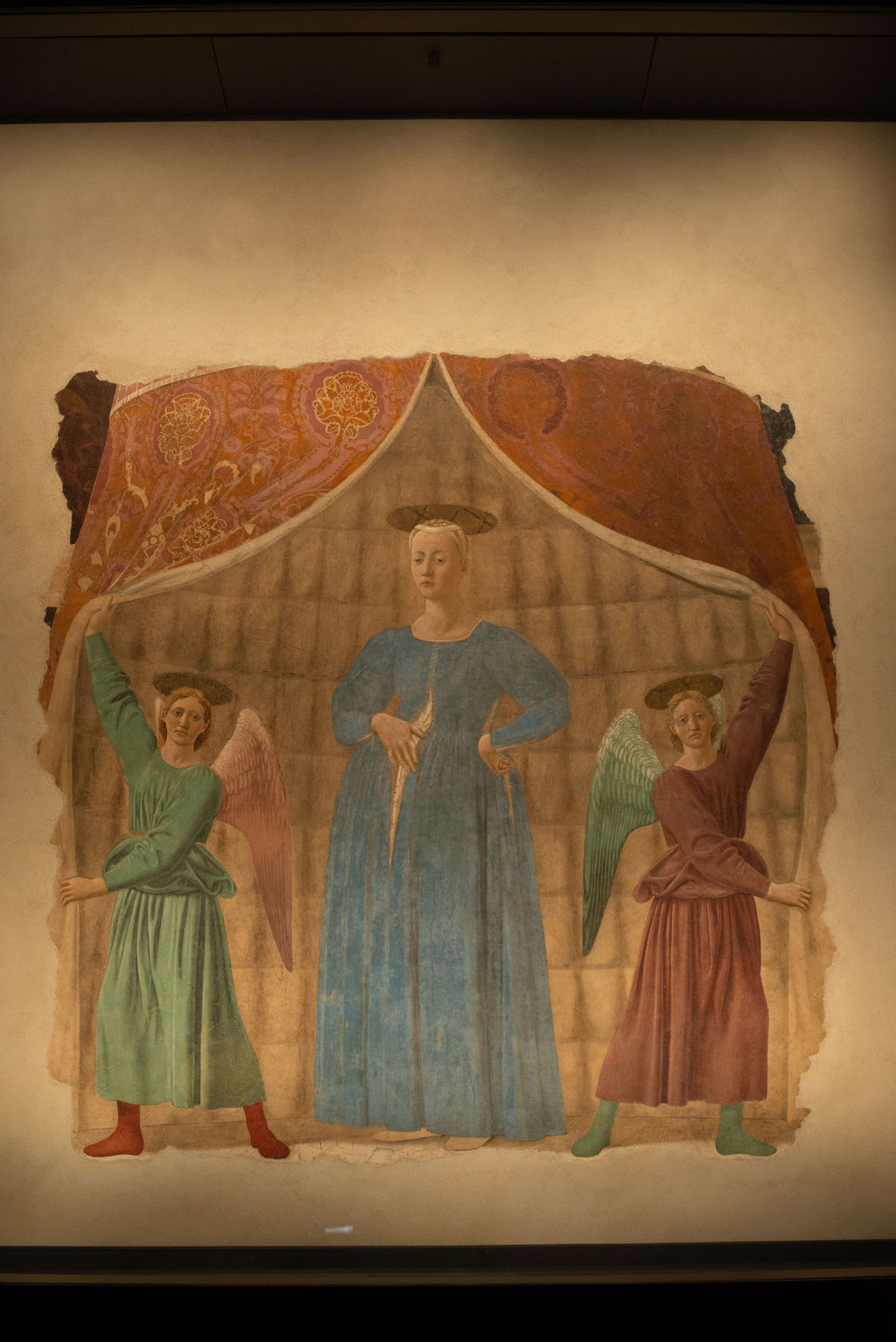
Piero della Francesca, Madonna del Parto, on display at the civic museum in Monterchi. Maarten Heerlien. Image source. CC BY 2.0. Resized from the source. This reproduction uses CC BY 2.0.
Looking at Piero across the Upper Tiber Valley
At Monterchi, step back far enough to take in the figures' feet and the cut across the canopy at the same time. Then follow the lining into the painted space and look at the hand on the dress again. The museum introduced new lighting in 2021, and the resulting view belongs to the painting's current life as a conserved fragment. Its near-square shape, artificial lighting and close viewing distance make for a different encounter from an approach down the body of a church towards a painting over an altar. [1] [5]
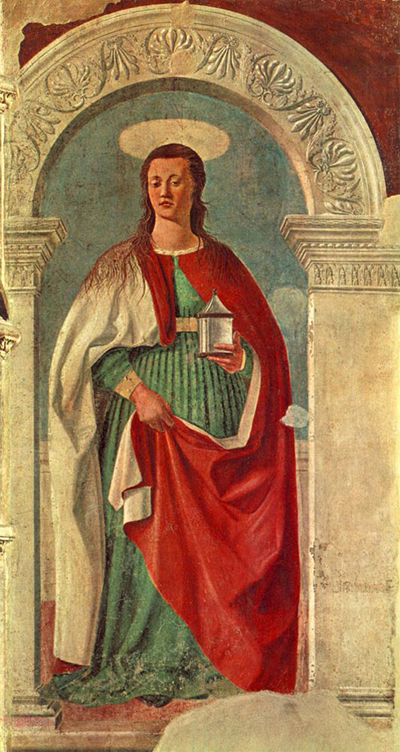
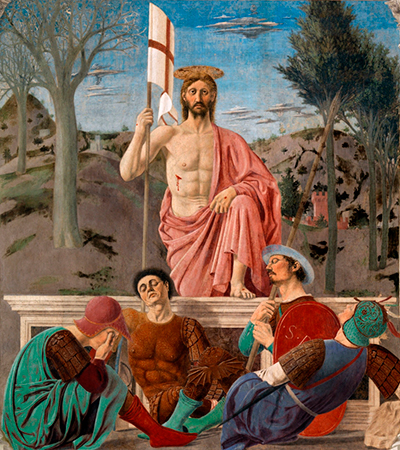
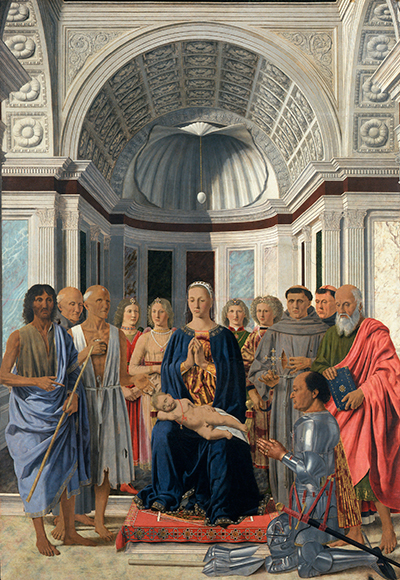
In Arezzo Cathedral, Piero's Saint Mary Magdalen offers another standing figure framed by a painted enclosure. The jar in the saint's hand concentrates attention on a small gesture within a large, stable figure. In Sansepolcro, the Resurrection offers a comparison in scale and in the physical history of the wall. Its central figure looks directly out, and technical study found that this mural too was moved, with a section of its masonry. For a further comparison, the Brera Madonna puts the seated Virgin and the sleeping Christ beneath a painted architectural vault. Its kneeling donor, Federico da Montefeltro, gives the Milan picture a clue to its commission of the kind that is missing at Monterchi. The guide to where to see Piero's work brings these locations together. [20] [21] [22]
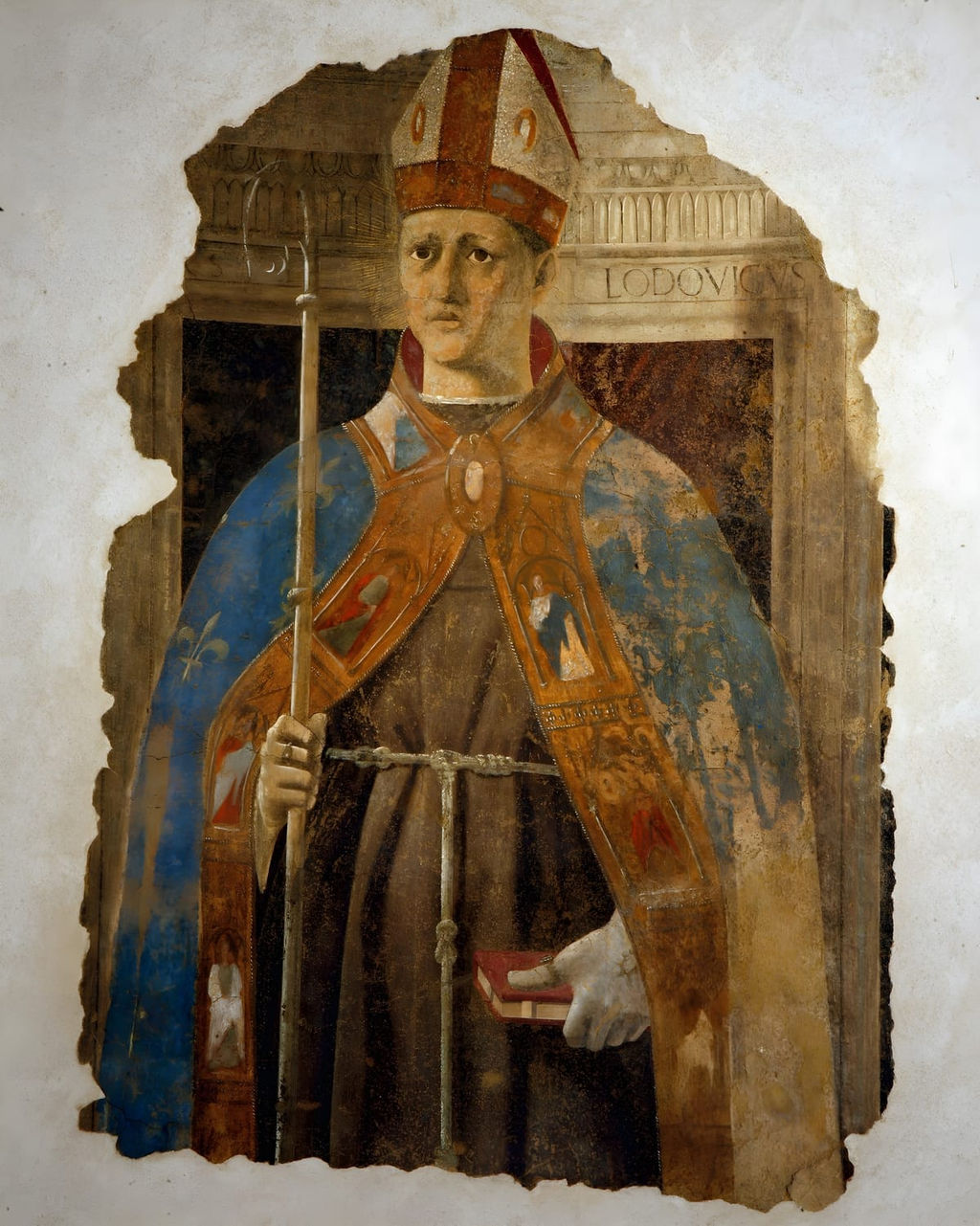
Piero della Francesca, Saint Louis of Toulouse, detached fresco, Museo Civico, Sansepolcro. Image source. Public domain. Resized only; native appearance preserved.
Browse the artworks
Compare Piero’s frescoes, panels and manuscript figures. The list includes ensembles and separately identifiable panels or scenes. Dates are approximate where the sources differ.
| Name | Date | Medium and source |
|---|---|---|
| The Baptism of Christ | Probably c. 1437–45 | Panel painting Catalogue. |
| The Flagellation of Christ | 1459–60 (GNDM) | Panel painting Catalogue. |
| The History of the True Cross | Mid-fifteenth century | Wall painting Catalogue. |
| Dream of Constantine | Mid-fifteenth century | Wall painting Catalogue. |
| The Duke and Duchess of Urbino | About 1473–75 (Uffizi) | Panel painting Catalogue. |
| The Resurrection | About 1458–68 (Opificio) | Wall painting Catalogue. |
| Brera Madonna | About 1472–74 | Panel painting Catalogue. |
| Annunciation at Arezzo | Mid-fifteenth century | Wall painting Catalogue. |
| Madonna del Parto | About 1450–65 (Monterchi) | Wall painting Catalogue. |
| Polyptych of the Misericordia | Commissioned 1445 | Panel painting Catalogue. |
| The Nativity | Early 1480s (National Gallery) | Panel painting Catalogue. |
| Madonna di Senigallia | About 1474–75 (GNDM) | Panel painting Catalogue. |
| Death of Adam | Mid-fifteenth century | Wall painting Catalogue. |
| Queen of Sheba | Mid-fifteenth century | Wall painting Catalogue. |
| Victory of Constantine | Mid-fifteenth century | Wall painting Catalogue. |
| Battle between Heraclius and Chosroes | Mid-fifteenth century | Wall painting Catalogue. |
| Saint Mary Magdalen | Wall painting Catalogue. | |
| The Augustinian Polyptych | 1454–69 | Panel painting Catalogue. |
| Polyptych of Perugia | About 1467–69 (GNU) | Panel painting Catalogue. |
| Perugia Annunciation | About 1468–70 (national catalogue) | Panel painting Catalogue. |
| St Francis and St Elizabeth | About 1467–69 (GNU) | Panel painting Catalogue. |
| Stigmatisation of St Francis | About 1468–70 (national catalogue) | Panel painting Catalogue. |
| An Augustinian Nun (Saint Monica) | 1454–69 | Panel painting Catalogue. |
| Augustinian Saint | 1454–69 | Panel painting Catalogue. |
| Saint Michael | 1454–69 | Panel painting Catalogue. |
| Saint Nicholas of Tolentino | 1454–69 | Panel painting Catalogue. |
| Saint John the Evangelist | 1454–69 | Panel painting Catalogue. |
| Virgin and Child Enthroned with Four Angels | About 1460–70 (Clark) | Panel painting Catalogue. |
| Portrait of Sigismondo Pandolfo Malatesta | About 1450–51, often proposed. Louvre catalogue range 1450–75. | Panel painting Catalogue. |
| Sigismondo before St Sigismund | 1451 | Wall painting Catalogue. |
| St Jerome and a Donor | 1460s (Accademia); about 1450 also proposed | Panel painting Catalogue. |
| St Jerome in Penitence | 1450, dated on the panel | Panel painting Catalogue. |
| Saint Julian | About 1455–60, often proposed | Wall painting Catalogue. |
| Saint Augustine | 1454–69 | Panel painting Catalogue. |
| Saint Apollonia | 1454–69 | Panel painting Catalogue. |
| Crucifixion from the Augustinian Polyptych | 1454–69 | Panel painting Catalogue. |
| Saint Louis of Toulouse | Wall painting Catalogue. | |
| Burial of the Wood | Mid-fifteenth century | Wall painting Catalogue. |
| Discovery and Proof of the True Cross | Mid-fifteenth century | Wall painting Catalogue. |
| Exaltation of the Cross | Mid-fifteenth century | Wall painting Catalogue. |
| Saint Anthony Raises a Child | About 1467–69 (GNU) | Panel painting Catalogue. |
| Saint Elizabeth Revives a Child | About 1467–69 (GNU) | Panel painting Catalogue. |
| Hercules | About 1470 | Wall painting Catalogue. |
| Portrait of a Boy (possibly Guidobaldo da Montefeltro) | Panel painting Catalogue. | |
| De prospectiva pingendi, Reggio Emilia witness (figures) | Manuscript diagrams Catalogue. | |
| The Interrogation of Judas | Mid-fifteenth century | Wall painting Catalogue. |
| Two prophets, Bacci Chapel | Mid-fifteenth century | Wall painting Catalogue. |
| Saint Clare of Assisi, upper predella | About 1467–69 (GNU) | Panel painting Catalogue. |
| Saint Agatha, upper predella | About 1467–69 (GNU) | Panel painting Catalogue. |
| Lost centre of the Augustinian Polyptych | 1454–69 | Lost panel or panels Catalogue. |
Frequently Asked Questions
Discussion
Look again at the images and ideas explored in Madonna del Parto. These editorial prompts invite your observations.
Reader Insights
Compare the angels' hands at the curtains with Mary's hand at her dress. What do those gestures invite you to notice first?
How does the painting change if you imagine approaching it along a church aisle and seeing it above an altar?
What can an old photograph with Fiscali's canopy help you understand about the fresco's history?
Join the Conversation
Share a detail, comparison or question about Madonna del Parto below.
References
- Musei Civici Madonna del Parto, ‘L’opera’. Museum object account. View source.
- Fondazione Federico Zeri, Università di Bologna, ‘Pietro di Benedetto dei Franceschi, Madonna del parto’. Fototeca Zeri, record 16789. View source.
- Fabio Colonnese and Luca Guerini, ‘Modellando Piero. Indagini ricostruttive sulla Madonna del Parto’, in Transizioni, 2023, pp. 1089–1110. DOI 10.3280/oa-1016-c339. View source.
- Comune di Monterchi and Musei Civici Madonna del Parto, Madonna del Parto. Italian museum leaflet. View source.
- Università degli Studi di Firenze, Dipartimento di Architettura, Una stanza per Piero. Project brochure, measurements and retrospective on the conservation campaign. View source.
- Antonio Paolucci, ‘Piero e l’attesa di Maria’, Luoghi dell’Infinito, January 2014, pp. 72–73. Vatican Museums archive. View source.
- Musei Civici Madonna del Parto, Museum and visitor information. View source.
- Regione Toscana, ‘Musei civici Madonna del Parto’. Regional public directory. View source.
- Ministero della Cultura and ICCD, ‘Madonna del Parto’, Catalogo generale dei Beni Culturali, national catalogue no. 0900637215. View source.
- Frank Ferrie, ‘Piero della Francesca’s Madonna del Parto and the Function of Images of the Pregnant Virgin Mary’, Dandelion 2, no. 1, spring 2011, pp. 1–13. View source.
- Brendan Cassidy, ‘A Relic, Some Pictures and the Mothers of Florence in the Late Fourteenth Century’, Gesta 30, no. 2, 1991, pp. 91–99. View source.
- Claude Macherel, ‘Madonna del Parto, par Piero della Francesca. Une saisie ethnographique’, Journal des Africanistes 69, no. 1, 1999, pp. 133–174. DOI 10.3406/jafr.1999.1190. View source.
- Monterchi Turismo, ‘Madonna del Parto’. Local history and description. View source.
- Comune di Monterchi and Musei Civici Madonna del Parto, Madonna del Parto. English museum leaflet. View source.
- Jack Flam, ‘Madonna in Distress’, The New York Review of Books, 6 October 1994. Eyewitness account of the chapel and the early museum installation. View source.
- Piero Calamandrei, ‘Verrà a Firenze la Madonna del parto?’, Il Ponte 10, no. 3, March 1954, pp. 431–440. Extracts and discussion in Nuovo diritto civile 4, 2020, pp. 162–63. View source 1. View source 2.
- Comune di Monterchi and Soprintendenza Beni A.A.A.S. di Arezzo, with texts by Guido Botticelli, Giuseppe Centauro and Anna Maria Maetzke, Il restauro della Madonna del Parto di Piero della Francesca. Poggibonsi, Lalli, 1994. BiblioToscana record. View source.
- Camera dei Deputati, Commissione VII, government response on the restoration of the Madonna del Parto, 5 May 2022, annex 1, pp. 45–46. View source.
- Guglielmo Perini, ‘L’interesse culturale nella relazione fra bene e contesto sociale: la vicenda della ricollocazione della Madonna del Parto’, Aedon 2, 2023. DOI 10.7390/108968. View source.
- Opificio delle Pietre Dure, ‘Piero della Francesca, La Resurrezione, 1458–1468, Museo Civico, Sansepolcro (Arezzo)’. Conservation project account. View source.
- Pinacoteca di Brera, ‘Madonna and Child with Saints, Angels and Federico da Montefeltro (San Bernardino Altarpiece)’. Museum collection entry. View source.
- Visit Arezzo, ‘Itinerario Piero della Francesca Arezzo’. Arezzo Cathedral and the Magdalen. View source.