


 by Tom Gurney
Tom Gurney BSc (Hons) is an art history expert with over 20 years experience
Published on June 19, 2020 / Updated on November 18, 2026
Email: tomgurney1@gmail.com / Phone: +44 7429 011000
Aeneas, Anchises and Ascanius
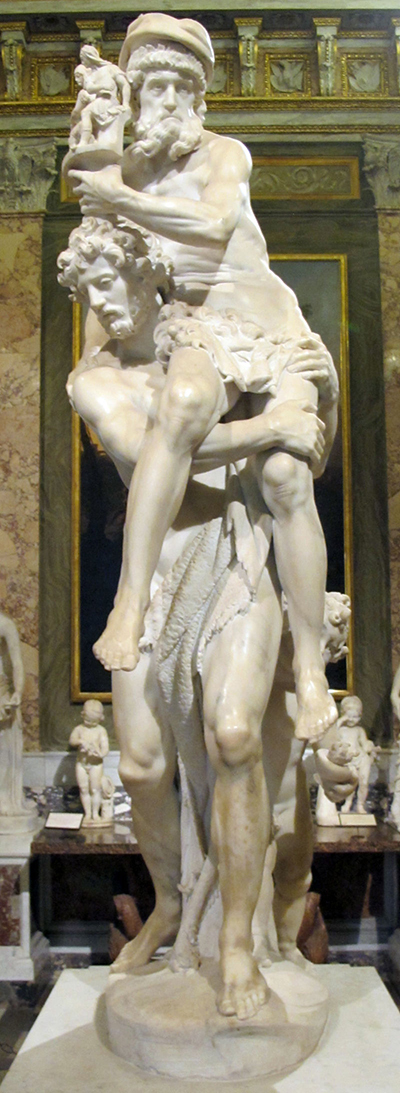
Aeneas advances with his father on his shoulder and his young son close behind. In Gian Lorenzo Bernini’s marble group, the three figures are gathered so tightly that the gesture of each helps explain the position of the next. The old man leans against his son, the adult grips the leg he supports, and the boy looks out from behind the two of them. The Galleria Borghese dates the work to 1619 and identifies it as Bernini’s first large sculptural group for Cardinal Scipione Borghese. Its subject comes from Virgil’s account of the flight from Troy. The city’s destruction is conveyed through what the family carries and the way its members move together. [1][2]
At a Glance
- Date1619
- Location or statusGalleria Borghese, Rome
- WorkMarble group of three Trojan generations
The work in Bernini’s career
Aeneas, Anchises and Ascanius
1619The Rape of Proserpina
1621–22Apollo and Daphne
1622–25David
1623–24What the family carries out of Troy
In book two of the Aeneid, Aeneas tells how he escaped the city after the Greeks took it. He takes Anchises on his shoulders and asks him to carry the sacred objects and the Penates, the household gods. Aeneas has come from fighting and says he must cleanse himself before handling them. His son Ascanius, whom Virgil also calls Iulus, keeps hold of his hand and follows with shorter steps. Aeneas’s wife Creusa follows behind. Virgil later describes how she becomes separated from the group. Bernini brings forward the three generations who escape together, making their different tasks visible within a single block of figures. [1][2]
In the sculpture Anchises sits high enough for the sacred objects to appear near the top. He braces himself against his son, while Aeneas uses both hands to support the old man’s leg. Ascanius is low and behind, where he carries what the Galleria identifies as the sacred fire of Vesta. The sculptor has rearranged the contacts given in the poem. Virgil connects adult and child by a clasp of hands. In the marble Aeneas needs both hands to secure Anchises. Ascanius’s closeness to the legs of his father and his position in the direction of the group’s movement give him a place in the same action. [1][2]
Three ages in marble
The group stands 220 centimetres high. Its overall movement rises from the young figure near the base to the old man over Aeneas’s shoulder. Aeneas, the strongest of the three, is at the centre, where the joined figures have their greatest breadth. He carries most of the apparent weight. The pose of Anchises makes the weight visible through a freely hanging leg, the bend of the back and the hand that steadies him. Find the hands gripping his other leg and the whole group becomes easier to read. That crossing of limbs joins the upper figure to the adult’s forward stride. [1]
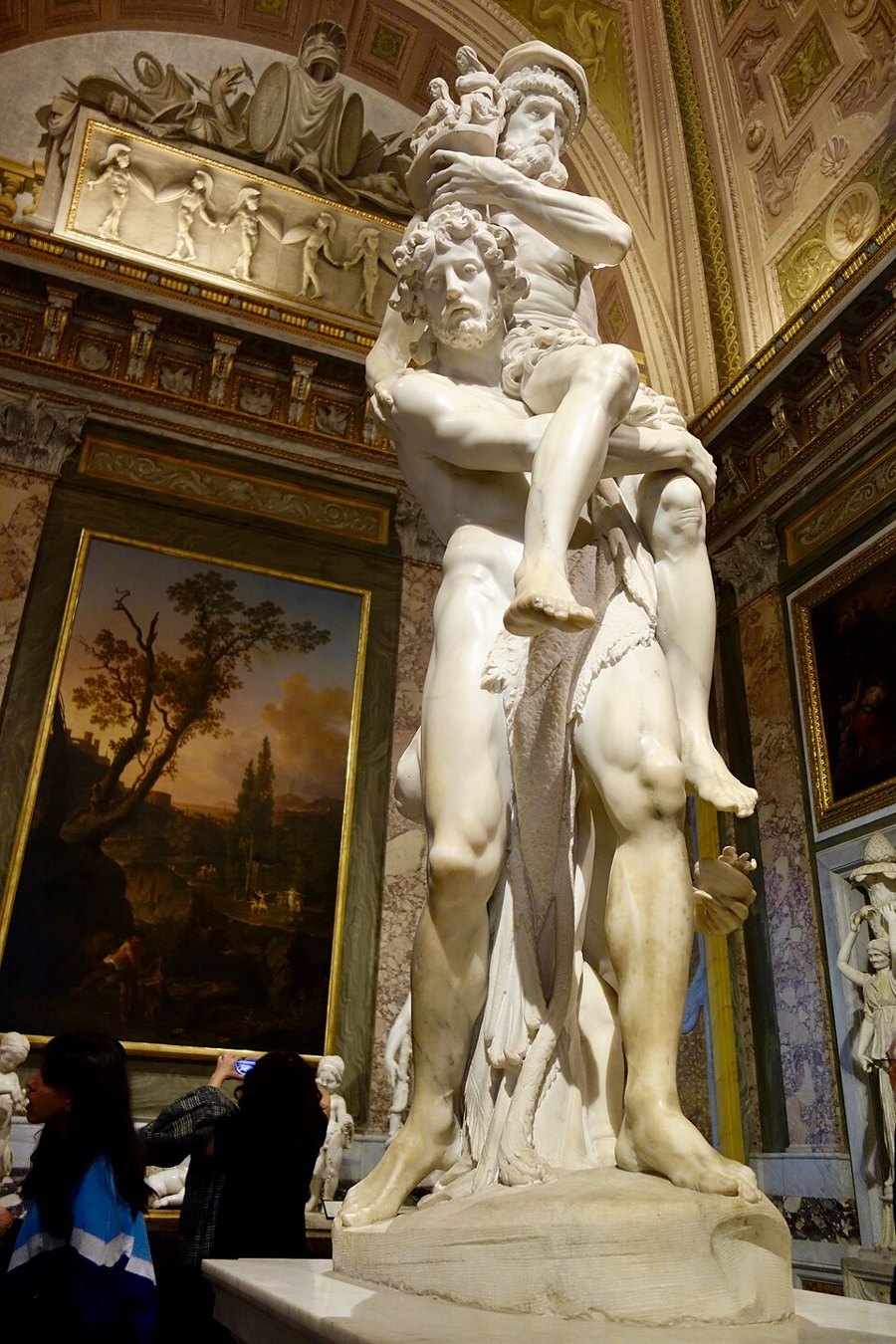
The differences in age emerge in details of the surface. Ascanius has the softer forms of a child. Aeneas’s skin lies taut over the muscles that bear the load. Anchises has a more rounded back and the looser surfaces of age. At a distance the vertical arrangement distinguishes the son, father and grandfather. At closer range the marble brings their separate conditions into focus. The family story gives Bernini a reason to make those differences part of the same design. One figure can walk unaided, one can bear another person, and one must be carried while keeping hold of what the family needs to save. [1][2]
In the gallery, look from the front towards the right side. The catalogue notes areas left unfinished away from that preferred view. From the favoured direction the child begins to emerge from behind the adult and the old man’s bent body is easier to distinguish. A viewer moving around the sculpture today can see places where the difference between worked and less finished surfaces tells us something about the original presentation. The effects of the group depend on how much of each figure could come into view from the intended side. [1]
A commission with a disputed history
The Borghese catalogue records a payment receipt from 1619 for the group and a second receipt in the same year for its base. It credits the sculpture to Gian Lorenzo. Joachim von Sandrart, writing in the seventeenth century, had maintained that he worked on it with his father Pietro. The gallery treats the receipt as decisive for assigning the commission to Gian Lorenzo. The earlier attribution remains part of the history of the sculpture. Pietro’s role in his son’s training and the evidence of their collaboration on other works explain why the question arose, while the record for this group belongs to its own set of documents. [1][4]
The sculpture and its present pedestal also have separate histories. The original cylindrical support, decorated with garlands and ox skulls, came from an ancient altar and survives in the gallery’s collection. A wooden base replaced it in the nineteenth century, before the present marble pedestal by Pietro Fortunati. The group originally stood in another room of the villa. The gallery records subsequent moves and places it in the centre of Room 6 from 1888, in a position formerly occupied by the ancient sculpture known as the Borghese Gladiator. The centre of the room invites the modern visitor to walk around the work, while the carving still preserves evidence of Bernini’s preferred approach. [1]
How early writers identified the group
The payment record and the early descriptions answer different questions about the sculpture. In 1650 Jacopo Manilli gave readers a location for the group in his guide to the Villa Borghese. Joachim von Sandrart, in his 1675 Teutsche Academie, described it while discussing the work of the elder Bernini and his sons. His passage singles out the feat of showing the escape in one piece of marble. It also calls the child Cassandro. In his account of his father's life, Domenico Bernini placed the group among Gian Lorenzo's works for Scipione. The modern editors of Sandrart’s text trace the older attribution to Pietro and its eventual revision in favour of Gian Lorenzo. [5][6]
Read against the 1619 receipt, those later accounts show how a sculpture could remain recognisable while its authorship was disputed. Sandrart’s reference to the single block directs attention to a real problem of carving. Anchises needs to look as though he can shift his weight on his son’s shoulder, yet several parts of his body must stay connected to the figure below. The boy can be seen as a separate body even when his outline merges with the adult’s. The passage in Sandrart records a response to that achievement. The receipt gives the gallery firmer evidence for the name of the sculptor paid for it. [5][6]
From Room 3 to the centre of Room 6
The gallery places the sculpture in Room 3 in Manilli's 1650 guide and still there in Antonio Nibby's account of 1832. It subsequently stood in the upstairs gallery, now Room 14, and then in the entrance hall. When the work reached the centre of Room 6 in 1888, it took over a position that had once held a much older sculpture. The Louvre records the purchase of the Borghese Gladiator in 1807, and the Galleria Borghese dates its transfer to Paris to 1808. The two dates concern different stages of the same departure. Bernini’s group took up that position eighty years after the transfer. [5][7]
The ancient marble and the seventeenth-century group ask a viewer to follow weight in different directions. The Louvre’s catalogue identifies the ancient figure as a warrior and records the Greek signature of Agasias of Ephesus on the tree trunk that supports it. The warrior's torso and limbs extend away from the trunk. In the Bernini, the figures climb from the boy to his grandfather, and the adult's body supplies the principal visible support. A position in the middle of the room lets a visitor test how those bodies fit together from successive viewpoints. It changes the conditions in which we see the marble that the sculptor originally finished most carefully for a view from the front and right. [5][7]
How the flight from Troy circulated in prints
By the time Bernini undertook the group, another version of the escape had been circulating on paper for more than twenty years. Barocci painted an earlier version for Rudolf II in Prague, which is now lost. Windsor holds a drawn and painted treatment of the composition that the Royal Collection considers a probable model for Agostino Carracci's engraving. The engraving bears the date 1595, three years before the date on the surviving Borghese painting. A print could therefore bring Barocci’s treatment of the subject to viewers who had no access to either canvas. The possible use of the Windsor study helps explain how Carracci could translate the design into a print. [8][9]
In the Cleveland impression, Creusa’s separation from the group anticipates her loss. Architecture and strong changes of tone give the family a city to run through. In the marble, there is no street in which to place Creusa at a distance from the others. The spectator has to infer the urgency of the flight from the adult’s stride and the boy’s effort to keep close. The engraving establishes an earlier circulation of Barocci’s composition. The comparison with the sculpture shows what Bernini could leave to the bodies and their gestures once he isolated the three figures from the surrounding action. [5][9]
Aeneas in paint and stone
Scipione owned another treatment of the same subject. Federico Barocci’s Aeneas Fleeing Troy, signed and dated 1598, is documented in the cardinal’s collection in 1613. Its broad canvas can show the family within the destruction and include Creusa. Bernini’s version brings the action into a much narrower space, where the combined bodies must provide the sense of danger and movement. The two works were shown in relation to each other in the Galleria Borghese’s 2017 exhibition, which drew on Jacopo Manilli’s early account of the villa. [1][3][4]
The gallery compares Bernini’s arrangement with the Carracci treatment of the flight in Palazzo Fava, Bologna, where Anchises is likewise carried on one shoulder. A comparison with Raphael’s Fire in the Borgo gives a different solution, with the father borne on the young man’s back. How the older person is carried determines how the group fills the space and which faces can be seen. In Bernini’s marble the high position of Anchises also gives prominence to the small objects he has rescued, while the child completes the movement at the other end of the group. Looking from the carrier’s hands up to the gods and back down to the boy brings the family’s three responsibilities into view. [1][2]
The gallery also records a political reading in which Aeneas’s support for Anchises evokes the relationship between Scipione and his uncle, Pope Paul V. That interpretation draws on the Latin word scipio, a staff, and on the traditional association of Aeneas with Rome’s origins. The commission gives the reading a historical setting. The marble itself keeps the allusion indirect. Its visible subject is still a son taking his father’s weight while the older man preserves the objects entrusted to him. [1][2]
Discussion
The positions of the three figures make the weight of Anchises visible.
Reader Insights
Which hand or foot best reveals how Aeneas balances his father?
What changes when the boy comes into view?
How does this close grouping compare with the outstretched limbs in Apollo and Daphne?
Join the Conversation
Share a detail, comparison or question about Aeneas, Anchises and Ascanius by Gian Lorenzo Bernini below.
References
- Felici, Sonja. Aeneas, Anchises and Ascanius. Galleria Borghese, inv. CLXXXII. View source
- Virgil. Aeneid, book II, especially lines 707–29. Translated by H. Rushton Fairclough. View source
- Galleria Borghese. Aeneas Fleeing Troy, Federico Barocci, inv. 068. View source
- Galleria Borghese. Bernini. Exhibition materials, 2017–18. View source
- Felici, Sonja. Enea, Anchise e Ascanio. Galleria Borghese, inv. CLXXXII. Italian catalogue.
- Sandrart, Joachim von. Teutsche Academie, book II, p. 199. 1675. German critical edition and commentary.
- Musée du Louvre. Gladiateur Borghèse. Ma 527. French collection catalogue.
- Royal Collection Trust. Drawing the Italian Renaissance, Nash Gallery labels. Pp. 68–69, RCIN 902343.
- Cleveland Museum of Art. Aeneas and His Family Fleeing Troy. Agostino Carracci after Federico Barocci, 1595, inv. 1963.456.








