


 by Tom Gurney
Tom Gurney BSc (Hons) is an art history expert with over 20 years experience
Published on June 19, 2020 / Updated on November 18, 2026
Email: tomgurney1@gmail.com / Phone: +44 7429 011000
Fontana del Tritone
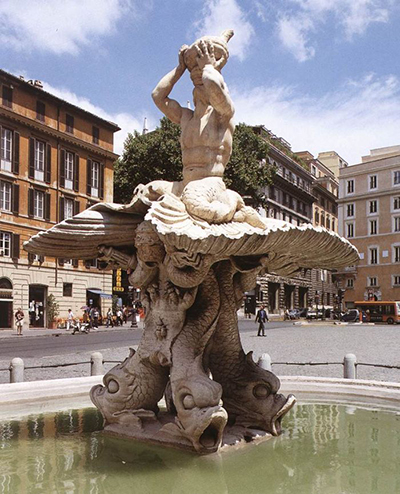
Above the basin in Piazza Barberini, a sea creature lifts a spiral shell to his lips. Water rises from it and falls across the figure and the broad shell on which he sits. Below, four dolphins bring their tails together to carry that upper basin. Gian Lorenzo Bernini designed the Triton Fountain for Pope Urban VIII Barberini, and Rome’s heritage authority dates the work from late 1642 to the first half of 1643. The fountain puts the path of the water where the viewer can follow it, through a figure whose effort seems to send it into the air. Its stone forms show how the sculptor joined the work of holding and carrying water to the subject of the sea. [1][2]
At a Glance
- Date1642–43
- Location or statusPiazza Barberini, Rome
- WorkFountain commissioned by Urban VIII
The work in Bernini’s career
Fontana del Tritone
1642–43Ecstasy of Saint Teresa
1647–52Fountain of the Four Rivers
1648–51A public fountain for Piazza Barberini
The fountain stood in the square beside the new palace of the pope’s family. Urban VIII commissioned it as a public ornament, and the Acqua Felice aqueduct provided its original water supply. The site gave Bernini open space in which to organise a view from several directions. A person approaching across the square could see the tall central figure before making out what supported him. Water rising above the stone extended the outline higher. At the base, the papal arms placed among the dolphins identified the patron and the Barberini bees associated the work with the family whose palace stood nearby. [1]
The fountain was carved in travertine. Its large shapes read clearly in the open air, and their hollows give the stone areas of shade even under a bright sky. The broad open shell is particularly important. It forms a horizontal interruption between the dolphin tails below and Triton’s rising body above. It also receives some of the falling water. The contrast of the broad shell and the narrow jet gives a person standing at some distance two different lines to follow. One marks the width of the central structure and the other continues the motion of the raised arms. [1][2]
Giovanni Battista Falda’s etching of the fountain became plate sixteen in an album of Roman fountains. The Rijksmuseum preserves an impression. The title printed on the sheet identifies it through the Prince of Palestrina, an association with the Barberini family visible on the monument itself through the heraldry. The print also makes it possible to single out a view of the fountain in the square and to compare it with Falda’s other Roman waterworks. In the piazza, the spectator could change position and alternate between seeing the building, the fountain and the coats of arms. In the printed series, the design takes its place among other identifiable parts of the city. [1][4]
Dolphins, shells and moving water
The dolphins take the place of the upright support often used to hold a fountain’s raised basin. Their heads are low and their tails meet under the shell. The route from their bodies to the upper basin can be read as a joint in the structure and as a gathering of four animals. From one side, an individual head emerges near the lower water. From another, it is easier to see how the tails join. Putting the papal shields between the dolphins gives the heraldry a place between supporting forms, while leaving the outline of the upper shell and its occupant free to remain the focus of the design. [1]
The shells have different functions. The open shell under Triton is broad enough to receive water. The shell he holds is a narrower, twisting object that establishes the direction of the jet. His head tilts back and his arms lift at different heights to bring it to his mouth. The upward movement starts at his seated lower body, passes through the turned torso and continues into the raised shell. When the water falls back, its direction reverses the movement implied by the pose. The particular form of the statue makes that rise and fall seem to belong to the action of the figure. [1][2][3]
In the first book of Ovid’s Metamorphoses, Neptune calls on Triton to sound his conch when the waters of the Flood must withdraw. The Metropolitan Museum suggests that Bernini may have had this episode in mind. Triton’s shell in the poem gives a signal far beyond where he stands. In the fountain, the figure and the operation of the water give that implied call a visible direction and scale. The fountain continues to make sense as an image of a sea being sounding his shell even for a viewer unfamiliar with the episode. [2][5]
The chalk study and the fountain
The Metropolitan Museum preserves Bernini’s red chalk Study for a Triton, dated 1642–43. It is the only known drawing by Bernini himself for this commission. The raised arms and the twist of the body already resemble the carved figure. Ian Wardropper notes that the shape of the conch changes in the finished work and that the prominent moustache is absent in the sketch. The lower body receives less attention on the sheet than the chest and arms. The drawing isolates the part of the design that would give the fountain its clearest gesture when viewed from below. [2][3]
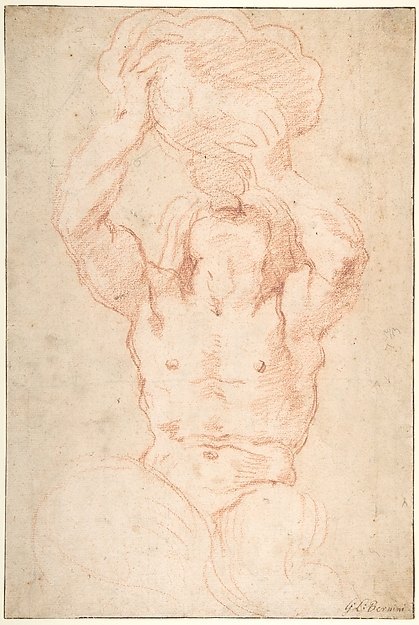
The scale of the supports and the use of water become clear in the finished work. The broad basin and grouped tails give a stable base to a pose that seemed to be in the middle of a movement even on paper. By comparing the sketch and the fountain, one can see that the gesture stayed recognisable as more parts joined it. Seen first in chalk and then above the dolphins, the same bend of the head looks at home on different scales because its relation to the raised arms remains clear. [1][2][3]
Two drawings and two ways to study the fountain
The red chalk drawing at the Met follows the part of the figure that rises above the basin. A sheet in the Royal Collection shows the whole design from the front. The upper figure and the structures beneath it can be judged together there, including the relative widths of the raised shell and the lower support. On the chalk sheet a slight change in the angle of an arm can be read as a change in effort. On the whole design that same arm becomes part of the outline against the open space above the fountain. The Royal Collection lists the sheet under Bernini, while the Met identifies its own chalk study as the only known autograph drawing. That difference in catalogue treatment leaves a question about the hand responsible for the whole design sheet. Both drawings are evidence for what could be studied on paper. [7][8]
The relation between figure and whole also has a precedent in Bernini’s early fountain for the Villa Montalto. The V&A’s group puts Triton below Neptune, at the end of a large fishpond. At Piazza Barberini the figure previously placed near the base has become the principal subject at the top. Its conch determines where the water appears in the outline. Comparing the two commissions helps explain the work done by the blank space above the chalk study. The figure’s arms are already shaped to lead the eye into that space. The fountain completes the direction with a jet. [8][9]
How a Roman design reached Nuremberg
The Triton Fountain on Nuremberg’s Maxplatz began running in November 1687, according to the chronicle cited by the city’s virtual museum. The museum identifies the Roman work as its immediate model. Erich Mulzer traces a possible route for the design through a Nuremberg edition of Falda’s Roman fountains published by Sigmund Froberg in 1685. That publication was available shortly before the local fountain was built. An engraving could supply the outline of the raised conch and the grouping of figure, bowl and lower support. Mulzer also points out how disproportionately large the fountain looks in the print beside the people in the square. It was possible to take the design seriously without taking its scale from the figures beside it. [10][11]
The differences are particularly clear from the side. The Roman Triton crouches into the shell, whereas the Nuremberg figure rises more nearly upright. A solid pier with dolphin heads takes the place of the Roman dolphins whose rising bodies appear to carry the weight of the shell. The Nuremberg bowl is heavier in outline, and steps bring more attention to its lower basin. Mulzer relates some of these differences to what the frontal print could convey. He treats the engravings as a likely route of transmission, while the identity of the Nuremberg sculptor remains open. The museum tentatively favours Johann Jacob Sommer and records that the figure and bowl were reconstructed by Albert Feist after wartime damage. The fountain visible there today thus carries a history of alteration of its own. [10][11]
Maintaining the travertine and the water system
Anelinda Di Muzio’s account of the 2012–13 conservation project describes a survey of earlier restorations and the condition of the travertine. The work addressed the modelling of both the central sculpture and the basin through cleaning, reintegration and protection. The project also included the water and lighting installations. That pairing reflects the way a working fountain is experienced. The surfaces can be cleaned and conserved, but the jet still depends on an installation operating inside and below the visible stone. [12]
Rome’s heritage authority made the relation explicit in its 2017 maintenance notice. It planned to turn the water off while a team working from an elevated platform removed algal growth and loose surface deposits and inspected the monument. The utility was to check the recirculation equipment and clear the pipes at the same time. The authority also notes that the jet had formerly been much taller. The notice gives no exact historical height. Read beside the prints, it makes clear why the height of the stream in one illustration or photograph should be treated as evidence of a particular representation or operating condition. [11][13]
Two Barberini waterworks
Bernini also designed the nearby Fountain of the Bees. Rome’s heritage authority describes its original position near Via Sistina and its role as a place for travellers to obtain water. The agency records a system for collecting return water from the Triton Fountain in the account of the smaller waterwork. The two commissions therefore belong to the same history of water provision as well as to the same patronage. Looking between them also gives a sense of where Bernini put each work’s emphasis. The Fountain of the Bees brought water within reach. The Triton raised its water over the centre of an open square, so that sculpture, falling water and the surrounding buildings could be seen together. [1][6]
Rome’s heritage record lists restoration in 1987–88 and again in 2013, with intervening maintenance. Those entries are part of the history of a sculpture made to stay outdoors and to carry running water. The etching fixes one historical appearance, and the chalk sheet preserves one stage in the design. The fountain itself has continued to present the form under changing conditions, with the water alternately revealing and obscuring the paths cut into the stone. [1][2][4]
Discussion
Four dolphin tails rise together to support the shell beneath Triton.
Reader Insights
How does the jet of water continue the movement of Triton’s arms?
Where do the Barberini emblems sit within the structure?
Which qualities of the fountain are easiest to understand from across the piazza?
Join the Conversation
Share a detail, comparison or question about Triton Fountain by Gian Lorenzo Bernini below.
References
- Sovrintendenza Capitolina ai Beni Culturali. Fontana del Tritone. View source
- Metropolitan Museum of Art. Study for a Triton (recto); Anatomical Studies? (verso), 1973.265. View source
- Wardropper, Ian. “Sketching on Paper and in Clay,” in Bernini: Sculpting in Clay. Metropolitan Museum of Art, 2012, figs. 38–39 and cat. D.15. View source
- Rijksmuseum. Fontana del Tritone op Piazza Barberini te Rome, Giovanni Battista Falda, BI-1893-A39-16. View source
- Ovid. Metamorphoses, book I, lines 324–47. Translated by A. S. Kline. View source
- Sovrintendenza Capitolina ai Beni Culturali. Fontana delle Api. View source
- Royal Collection Trust. A study for the Fontana del Tritone, Piazza Barberini, Rome, RCIN 905626.
- Metropolitan Museum of Art. Study for a Triton, 1973.265. Identification and catalogue discussion.
- Victoria and Albert Museum. Neptune and Triton by Gian Lorenzo Bernini. Villa Montalto group and fishpond.
- Virtuelles Museum Nürnberger Kunst. Tritonbrunnen. Chronicle and reconstruction.
- Mulzer, Erich. Der Tritonbrunnen auf dem Maxplatz, Nürnberger Altstadtberichte 19, pp. 27–62, especially pp. 36–41.
- Di Muzio, Anelinda. Fontana del Tritone (1642–1643). Project account, 2012–13.
- Sovrintendenza Capitolina ai Beni Culturali. Al via la manutenzione della Fontana del Tritone. Scope of planned 2017 maintenance.







