


 by Tom Gurney
Tom Gurney BSc (Hons) is an art history expert with over 20 years experience
Published on June 19, 2020 / Updated on November 18, 2026
Email: tomgurney1@gmail.com / Phone: +44 7429 011000
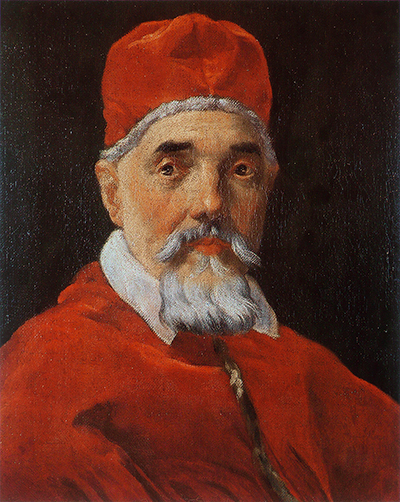
Portrait of Pope Urban VIII
Urban VIII turns his head towards the viewer above the broad red folds of his cape. His white beard is set off by a pale collar and a dark ground. This oil portrait belongs to the Gallerie Nazionali di Arte Antica at Palazzo Barberini. It was exhibited as a work by Gian Lorenzo Bernini at the Galleria Borghese in 2017–18 and is generally placed around 1632. The painting belongs to a group of likenesses that Bernini made or designed in different media during the pontificate of Maffeo Barberini. The red garment and the short distance between the sitter and the edge of the picture give the painted version a character of its own. [1][2][3]
At a Glance
- Datec. 1632
- Location or statusPalazzo Barberini, Rome
- WorkOil portrait of Urban VIII
The work in Bernini’s career
David
1623–24St Peter’s Baldachin
1624–33Portrait of Pope Urban VIII
c. 1632The turn of the figure
The cape occupies much of the lower half of the picture. Its main folds travel down and across the canvas, giving the upper body a direction before the face is considered. The head turns towards the viewer from that position. The central fastening is visible beneath the beard, but the line of the garment does not continue straight into the line of the face. The sitter seems to have redirected his attention while leaving his shoulders in place. This was a way of giving movement to a portrait that shows only the upper body. [1][2]
Bernini does much of the work with three areas of colour. The cap and cape are both red, the beard and collar are pale, and the background is dark. The pale band below the cap establishes a boundary just above the brows. The collar, which spreads out below the ears, makes a wider pale area below. Together those parts link the head with the surrounding clothing without making every edge equally distinct. The effect is clearest where the grey hair and collar approach the same value. A small change in paint direction lets the viewer recognise one as hair and the other as a surface of cloth. [1][2]
The background gives no separate scene or furnishings to interpret. At the shoulder it acts as a place into which the cape can extend. Near the head it gives the outline of the cap a clearer boundary than the skin at the side of the face. There the shadows around the eyes and cheek sustain the shape of the sitter. The viewer can follow the shift from the large red surfaces to this quieter area of modelling. The painting presents enough of the office through dress to leave much of its attention on the appearance of the man wearing it. [1][2]
A likeness for a book of poems
The painting has been related to Bernini’s design for the engraved portrait in Urban’s Poemata. The Rijksmuseum catalogues an impression of the print, dated 1632, as an engraving by Claude Mellan after a drawing by Bernini. It identifies the book for which the portrait was made and separates the work of the designer from the work of the printmaker. The painting and print are evidence that Bernini developed Urban’s likeness across more than one kind of object. The print’s dependence on a drawing does not make it a direct reproduction of the oil. It supplies a dated comparison for the treatment of the same sitter. [2][3]
In a book the portrait forms part of the reader’s encounter with a written work. It connects a face with the name under which the poems were published and situates the sitter as an author. On canvas the figure has no adjoining printed text to explain that role. Red pigment sets the cap and cape apart from their surroundings, while the engraved portrait has to describe changes of tone and texture through marks on paper. The relation of the face to the cap and collar remains visible across those changes, but colour can carry more of the structure of the portrait on canvas. [1][2][3]
Bernini also supplied the design for the book’s title-page image, which the Rijksmuseum records separately. It depicts David overcoming a lion and was engraved by Mellan after Bernini. The two prints did different work in the same publication. One presented the pope’s likeness and the other gave the reader a biblical image at the title. Both placed the artist’s design within a printed sequence. This aspect of Urban’s patronage gives a context for a painted portrait which can otherwise seem private in scale and manner. [3][4]
The engraved plate and the painted likeness
The surviving copperplate gives a date for the collaboration between Bernini and Claude Mellan. Francesca Gentile’s catalogue records the plate at the Istituto Centrale per la Grafica. It measures 22.1 by 15.5 centimetres and is gilded on its engraved face. The lettering at the top gives Urban’s papal and family names. At the foot, the inscriptions credit Bernini with the drawing and Mellan with making the engraving, which bears the date 1631. Those details belong to the metal object. The Rijksmuseum also catalogues a paper impression under that same year, alongside the impression it dates to 1632. Bernini’s painted portrait can be compared with the design by 1631, though the inscription dates the plate and supplies no date for the application of paint to the canvas. [7][8]
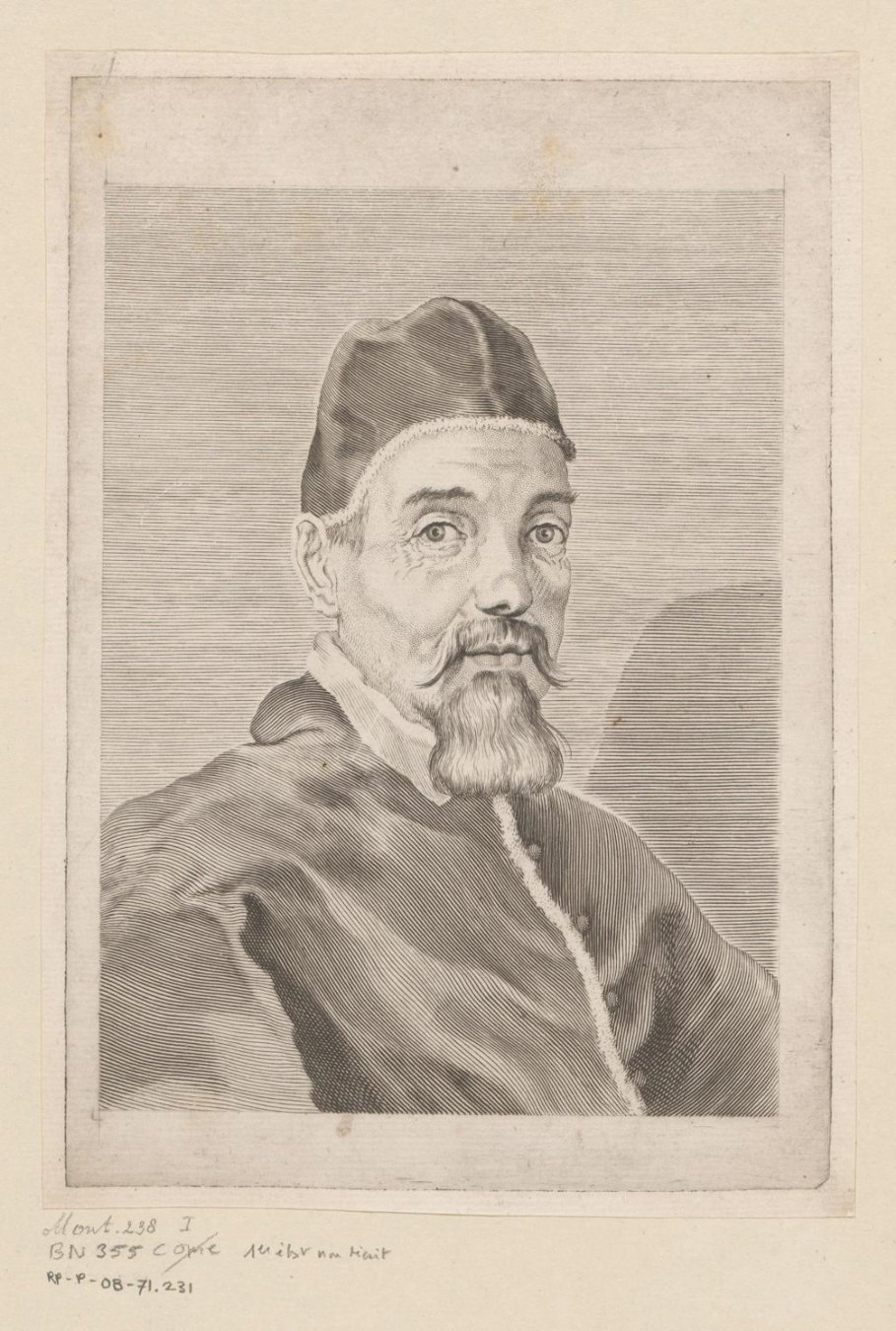
Gentile describes the portrait as a combination of ordered parallel strokes and stippling, with no continuous contour lines enclosing the figure. In the Rijksmuseum impression, the sitter’s pale collar comes forward where the engraved marks thin out. The dark surround gives the edge of the head and collar definition. Closely spaced strokes make a darker tone, while the fine points allow a more gradual transition where two areas of shadow meet. It is worth looking at the edge of the cheek in both works. In the engraving Mellan controls that edge by changing the distribution of marks. In the oil, the transition depends on a change of tone in the painted surface. The comparison offers a way to see how much of the portrait depends on the treatment of adjoining areas, even when the two artists are using very different tools. [7][8]
Facing pages and the figure of David
The Louvre preserves the drawing for the title page. It is a sheet in red chalk with highlights in white, roughly twenty-one centimetres high. Mellan engraved David in reverse relative to the drawing. The Louvre identifies the print as a companion to the portrait in the 1631 Roman edition and interprets David as a representation of Urban’s spiritual responsibilities. The biblical king tended a flock, composed poetry and became a ruler. In the Louvre’s interpretation the lion threatens the flock, an image of the danger that heresy posed to the Church in the eyes of the book’s designers. A reader who had just looked at Urban’s engraved features was thus invited to see a second kind of likeness in the action of David. [9]
The smaller and luxury forms of the collection also shaped what a reader saw. The editorial history of the poems records that the 1631 revision included thirty-five previously unpublished poems and an explanation of their metres. The larger quarto combined red and black printing with an engraved title page and portrait. The smaller octavo printed the poems in black and white. The shared text could reach readers in formats that gave very different weight to the ceremonial opening. A German-language catalogue at the Werner Oechslin Library records a quarto copy with a 1631 Roman colophon and describes its dedication to Cardinal Francesco Barberini, printing privilege and red-and-black decoration. The description also distinguishes the book’s publication details from the marks on the library’s individual copy, which bears a later owner’s stamp. The surviving books therefore preserve evidence of both the intended presentation and the paths individual copies subsequently took. [10][11]
The oil at Palazzo Barberini places a similar claim to authority in a single frame. Its cap and cape provide an immediate indication of office. There is room to linger on the turning head, the eyes and the fall of light on the collar. The sequence in the luxury book extends that encounter by adding a title, a named author and a biblical scene. Bernini’s role in both designs makes the shift particularly clear. The face can establish a recognisable person on its own, while the drawing of David relies on position, text and the facing likeness to connect its action with that person. That connection belongs to the book’s arrangement and helps explain why a print extracted from a volume can lose part of the meaning it had for its first readers. [8][9][10]
Urban in marble and bronze
The face and dress can also be compared with the marble bust at Palazzo Barberini and the related bronze in the Vatican Apostolic Library. The Vatican Museums describes the bronze as deriving from the marble of about 1632 and identifies the cap and short cape as features of the sculpted design. A person viewing the bust can move from a frontal position and see how far the face projects beyond the folds at the neck. The painting conveys the distinction with a bright collar, the shadow under the beard and the direction of the folds. Its fixed viewpoint lets colour reinforce the movement of the head and shoulders. [1][5]
The library bronze had a documented setting in a niche in a Barberini bookcase. The painted portrait’s association with a printed likeness is a different sort of evidence. One places a specific object within a family interior, while the other connects a composition with an image designed for circulation in a book. Neither relationship can stand in for a documented early location for the canvas. The Borghese exhibition checklist securely identifies its modern collection. The print and sculpture help explain the range of settings for which Bernini developed comparable likenesses of Urban. [1][3][5]
The pope also sat for other artists. The Capitoline Museums holds a painted image by Pietro da Cortona, associated with the relationship between the Barberini and Sacchetti families. A shared sitter and related dress are starting points for comparison. They do not identify an otherwise unlabelled portrait as a Bernini. The direction of the head, the scale of the figure and the evidence from the collection record all carry more weight when considered together. In the Palazzo Barberini oil, the sharp division between the dark background and the folds of the cape remains one of the clearest ways to recognise the picture. [1][2][6]
Discussion
Urban’s beard and collar stand out against the broad red cape and dark ground.
Reader Insights
What in the painting directs your attention towards the eyes?
Which details translate most readily into bronze or marble?
How does the oil portrait compare with Bernini’s public images of Urban?
Join the Conversation
Share a detail, comparison or question about Portrait of Pope Urban VIII by Gian Lorenzo Bernini below.
References
- Galleria Borghese. Bernini, 2017–18 exhibition dossier. Checklist item 45, Ritratto di papa Urbano VIII. View source
- Gallerie Nazionali di Arte Antica. L’immagine sovrana. Urbano VIII e i Barberini. Palazzo Barberini exhibition captions for the painted portrait, dated about 1632. View source
- Rijksmuseum. Portret van paus Urbanus VIII. Claude Mellan after Bernini, RP-P-OB-71.233. View source
- Rijksmuseum. David de leeuw wurgend. Title-page design for Urban’s poems. View source
- Vatican Museums. Portrait of Urban VIII. The Vatican Library bronze, its setting and its relationship to the early Palazzo Barberini marble. View source
- Musei Capitolini. Portrait of Urban VIII. Catalogue record for Pietro da Cortona’s independent painted likeness. View source
- Francesca Gentile. Sapienza University of Rome doctoral thesis. Catalogue of the Urban VIII portrait matrix, VIC. 1823, Cl. 17256.
- Rijksmuseum. Portret van Urbanus VIII. Impression RP-P-OB-71.232, catalogued as 1631.
- Musée du Louvre. David étouffant un lion. Drawing INV 12093 and discussion of the facing images.
- Princeton University Press. Editorial note, On the Life of Galileo. Publication history of the Poemata, pp. lxiv–lxv.
- Stiftung Bibliothek Werner Oechslin. Maphaei S.R.E. Card. Barberini Nvnc Vrbani PP. VIII. Poemata. German-language description of copy G12e.







