


 by Tom Gurney
Tom Gurney BSc (Hons) is an art history expert with over 20 years experience
Published on June 19, 2020 / Updated on November 18, 2026
Email: tomgurney1@gmail.com / Phone: +44 7429 011000
Charity with Four Children
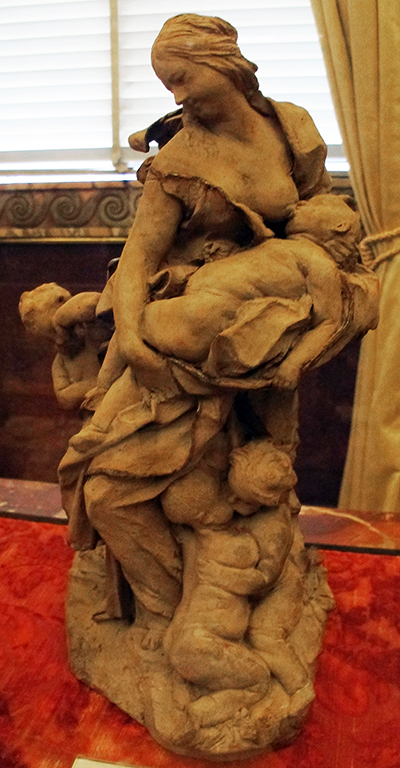
A woman inclines her head towards a child in her arms while three other children gather around her. The group, only thirty-nine centimetres high, is a fired-clay model in the Vatican Museums, inventory 2423. It is generally attributed to Gian Lorenzo Bernini and connected with the figure of Charity on his tomb of Pope Urban VIII in St Peter’s. The Metropolitan Museum of Art’s catalogue dates it between 1627 and before 1634, while the Vatican’s exhibition material places it around 1627–28. Its crowded arrangement and the marks left by alterations give an unusually direct view of how a sculptural group could be prepared for a monument. [1][2][3]
At a Glance
- Date1627 to before 1634, Met dating
- Location or statusVatican Museums, inventory 2423
- WorkFired-clay model attributed to Bernini
The work in Bernini’s career
Apollo and Daphne
1622–25Ecstasy of Saint Teresa
1647–52St Peter’s Square
1656–67Charity with Four Children
1627 to before 1634, Met datingHow the children gather around Charity
The central woman provides a continuous upright form around which the smaller bodies can be arranged. The child high in her arms brings one part of the action close to her face. The others draw attention down towards the base and across the spread of her robe. Their heads are at different levels, so the viewer can follow their positions even where shoulders, arms and folds overlap. Charity’s downward attention makes an additional connection between the upper part of the group and the people below it. The figure has to read as a single person while also creating places for several smaller figures to lean, reach and settle around her. [1]
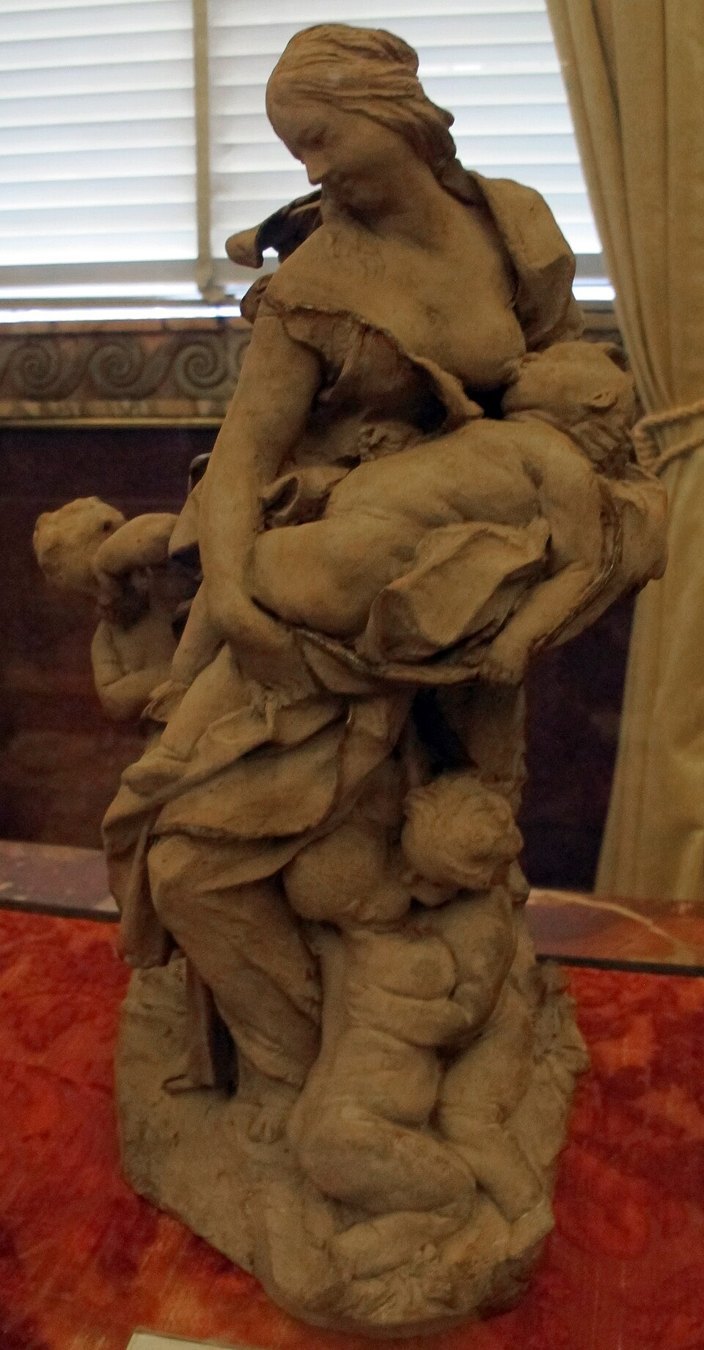
The garment has a practical role in the modelling. Its ridges and hollows distinguish the continuous mass of the woman’s body from the smaller, rounder forms of the children. As a viewer changes position, some figures separate from the folds and others become more closely grouped with them. From the front the arrangement appears compact. A view from the side explains how much of that effect depends on setting the children at different depths. The group could therefore be studied for its outline as well as for the relationships between individual figures. Both would matter once Charity stood beside another large element of a tomb. [1][2]
One child carries an extinguished torch. The Met catalogue uses that detail as evidence for a funerary setting. The torch belongs to the smaller incidents in the group and may take a moment to pick out. Once seen, it brings death into a sculpture otherwise occupied with acts of care. This is more specific evidence for the intended setting than the presence of several children, which could also be appropriate for a freestanding allegory of Charity. The proposed destination accounts for a feature that would otherwise seem incidental to the arrangement. [1]
Evidence of fitting the model to a tomb
The area beneath Charity’s left arm has been chiseled away. The intervention was made after the clay was fired. The Met’s catalogue suggests that the space was cut to allow the corner of a model sarcophagus to fit beside the figure. If so, the marks record a test of the relationship between the sculpted figure and the architecture. The height of the arm and the angle at which the body leans become easier to explain if the empty space once had another object against it. The adjustment would have let the group be tried in that relationship without making another figure from the beginning. [1]
The underside preserves evidence of another alteration. The base was sawn down after firing. The cut exposes changes in colour within the clay that the Met relates to conditions during firing. It also gives the model a different height and footprint from those it had when first made. Lowering the base would have changed the relationship between the children near the ground and the architectural elements beside them. The exact reason for the cut remains inferential. Together with the trimming under the arm, it establishes that the fired object was still being treated as something that could be modified. [1]
Four children, two children and the finished marble
The Vatican Museums displays the model in the context of other terracottas from Cardinal Flavio Chigi’s collection. It interprets the four-child group and a second figure with two children as evidence of two stages in developing Charity for the tomb of Urban VIII. The Met catalogue treats the second terracotta as a copy associated with that design. These views concern the status of the surviving objects. A terracotta can give evidence of a design even if the clay was worked by a copyist. A model with changes made by the sculptor or workshop offers different evidence about how an initial arrangement was tested. [1][2]
The finished figure on the tomb has fewer children, giving the marble a simpler outline beside the sarcophagus. The clay group spreads the younger figures across more of the woman’s body and robe. A reduction in their number changes the intervals of open space around her and leaves more room to see the larger folds. The trial in clay brings a greater number of individual gestures into close contact. The final arrangement places a different emphasis on Charity’s silhouette as one part of a larger monument seen from the floor of St Peter’s. [1][2]
The child added late in the modelling
The cracks visible on the underside are evidence of how the group was built. The Metropolitan Museum’s technical study interprets their pattern as the result of shrinkage in a column of clay from which Charity’s body was modelled. The children were made separately and joined to it. An X-radiograph shows a particularly clear seam between the woman and the child standing at her left. The investigators concluded that the child was attached after a substantial clay support had already been removed from the back. Strokes pressed across the seam spread clay over the join. The sequence shows how the modeller could revise the balance and outline of the group even after removing a temporary support. It leaves open whether the extra figure had already been envisaged when work began. [4]
The back shows how smaller pieces supplied the raised passages of the arm and drapery. Deep finger strokes helped press added clay into the main mass. Around the back of Charity’s head, the catalogue identifies a swipe used to round off the form. Beside the hairline, an oval-tipped implement cut a curved separation between the hair and neck. The authors compare these gestures with marks on accepted models by Bernini. They also record very fine toothed marks on the drapery and ground. Those are unusual in his work, although a similar tool appears on the clay Allegorical Figure associated with the memorial to Carlo Barberini. The attribution weighs the combination of construction and finishing habits, some shared across several examples and some uncommon. [4]
How many children belonged beside the sarcophagus?
A document from 1630 discussed by the Met indicates that the choice was then between two and three children. The four in the terracotta cannot be matched directly to that record, but the document shows that the number was still under consideration during the design period. The writers place the resolution of the marble group before carving began in 1634. They also distinguish a letter of 1626 about a large marble Charity and a posthumous inventory entry for a marble Charity with four children. Whether those written records refer to the same marble remains open. For the Vatican terracotta, the inverted torch and the cut beneath Charity’s arm provide more specific evidence of a tomb setting than the number of children alone. [4]
Edme Bouchardon’s red-chalk study, drawn in Rome in the early eighteenth century and now in the Louvre, helps show what the two-child version became in marble. On the same sheet, Bouchardon traced the curve of the sarcophagus beside the figure. The Louvre observes that he used short curved marks around untouched areas of paper to suggest light on polished flesh and looser lines to follow the folds of the robe. The geometrically drawn mouldings show how close the figures are to the architectural forms. The drawing records a finished relationship between statue and tomb that the clipped clay under the model’s arm only allows us to infer. [5]
How the marble composition was studied and changed
The German catalogue of the Staatliche Museen zu Berlin identifies a smaller fired-clay Charity by Melchiorre Caffà, dated 1661–67. It treats the sculpture as a variation on Bernini’s completed figure at St Peter’s and leaves its intended setting open. Its modelling uses shallow areas and deeply worked recesses to make light and shadow legible at a small scale. This is a separate Roman response to the completed monument. It shows how the figure could be taken out of its architectural setting and reworked in clay after the marble was already in place. [6]
The completed Charity also changed in place. In 2025 the Fabbrica di San Pietro removed a plaster covering attributed to the nineteenth-century sculptor Pietro Galli. The Vatican report says the covering obscured the connection between the exposed breast and the nursing child. The removed feature was documented with a three-dimensional laser scan. Bouchardon’s drawing predates the intervention and preserves an earlier reading of the group. The terracotta has a separate history of coatings and losses. Read together, the clay, the drawing and the restored marble show how the act of nursing persisted as a central feature even as the number of children, their gestures and the treatment of the surface changed. [4][5][7]
Attribution and the Chigi collection
The Met catalogue weighs objections to the attribution, including the unusual treatment of some limbs, against handling it considers sufficiently close to Bernini’s other models. It compares the figure with the terracotta for the memorial to Carlo Barberini, where some limbs likewise appear compressed. The catalogue also discusses whether the Chigi provenance might indicate a relationship with the later tomb of Alexander VII. It favours the earlier connection with Urban’s tomb while presenting the points that make the question worth considering. The identification rests on the physical arrangement, the funerary attribute and comparisons with other models. [1]
The surface also reflects the model’s life as a collectible object. The Met notes that terracottas in the Chigi collection were painted a dark bronze colour and that this coating was removed from the four-child group. A bronze-coloured finish would have made the assembled figures read differently in a cabinet, while the present exposed clay makes some evidence of the toolwork and later cuts easier to discuss. The history of the coating belongs to the life of the model after it left use in the workshop. [1]
Cardinal Flavio Chigi kept terracottas at his house near the Quattro Fontane. The Vatican records their later incorporation into the family collection at Piazza Colonna and their donation to Pope Pius XI in the twentieth century. That collecting history allowed a small model to survive separately from the monument. The large marble gives the result of later decisions, while the clay retains details that would otherwise be difficult to recover, including the fit of the figure against a neighbouring form and the crowded arrangement of children around her. [1][2]
Discussion
The clay model brings four children into a group less than forty centimetres high.
Reader Insights
Which gestures link the children to the central figure?
What do the small changes in the clay reveal about planning the larger marble?
Which differences might reflect a change in the tomb’s design?
Join the Conversation
Share a detail, comparison or question about Charity with Four Children by Gian Lorenzo Bernini below.
References
- Dickerson, C. D. III, Anthony Sigel and Ian Wardropper. Bernini: Sculpting in Clay. Metropolitan Museum of Art, 2012. Catalogue entry 1 and figures 82 and 165. View source
- Vatican Museums. Drafts from the Chigi Collection. The two Charity models and their collection history. View source
- Vatican Museums. Giovan Lorenzo Bernini e i suoi modelli. Exhibition presentation and dating of the four-child and two-child models. View source
- C. D. Dickerson III, Anthony Sigel and Ian Wardropper. Bernini: Sculpting in Clay, technical discussion of Charity. Catalogue entry 1, pp. 112–17, analysis of assembly and the dates of the tomb designs.
- Musée du Louvre. Edme Bouchardon, Allégorie de la Charité. Drawing INV 24082 and analysis of the relationship to the marble and sarcophagus.
- Staatliche Museen zu Berlin. Melchiorre Caffà, Caritas (Allegorie der Nächstenliebe). German catalogue for the distinct terracotta, inventory 7231.
- Fabbrica di San Pietro. Restauro del Sepolcro di Papa Urbano VIII. April 2025 conservation statement, including the plaster covering and its documentation.








