


 by Tom Gurney
Tom Gurney BSc (Hons) is an art history expert with over 20 years experience
Published on June 19, 2020 / Updated on November 18, 2026
Email: tomgurney1@gmail.com / Phone: +44 7429 011000
Fontana della Barcaccia
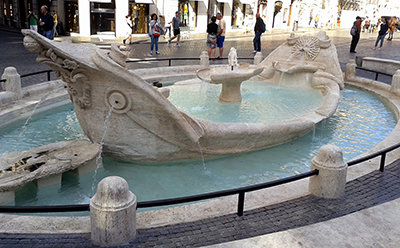
A stone boat sits low in a pool at the foot of the Spanish Steps in Rome. Water runs across its sides and through openings at the raised ends. The fountain was built between 1626 and 1629 for Pope Urban VIII, who entrusted the commission to Pietro Bernini, architect of the Acqua Vergine. Rome’s heritage office credits Pietro and allows for the possible contribution of his son Gian Lorenzo. The fountain’s unusual form, in which the boat seems to settle into the water it delivers, belongs to the history of the aqueduct as much as to the history of sculpture. Its position below the level of the square helped it make use of water arriving at low pressure. [1][2][3]
At a Glance
- Date1626–29
- Location or statusPiazza di Spagna, Rome
- WorkFountain by Pietro Bernini, with possible involvement by Gian Lorenzo
The work in Bernini’s career
Apollo and Daphne
1622–25David
1623–24St Peter’s Baldachin
1624–33Fontana della Barcaccia
1626–29Bringing the Acqua Vergine into the square
Pietro had held the office of architect of the Acqua Vergine since 1623. The scheme to bring fountains to prominent squares served by the restored aqueduct went back to 1570. Urban VIII’s commission continued that work at Piazza di Spagna. The water supply was already an important constraint by the time the shape of the fountain was decided. The aqueduct could deliver water, but at this point in the city it offered little pressure for raising it into the air. The basin was therefore set down into the square, close to the level at which the water could be delivered by gravity. [1][2][3]
The design gives the water several short paths on which it can be seen. It can emerge inside the boat, spill over the low sides and collect in the pool below. Other outlets send it straight into the outer basin. A spectator can look across the water from the edge of the square and see flows that begin and end within a small vertical distance. How far the water spreads becomes as significant to the design as how high it rises. The ends of the stone hull give the shape a clear profile while the middle drops sufficiently low to make the spilling water part of the outline. [1][2][3]
Katherine Rinne situates the fountain within a walk along the aqueduct’s route. She compares it with the waterworks of gardens on the hill, where lifting water to a higher level required a different approach. In Piazza di Spagna the useful level was already available at the foot of the slope. The thin flows that can be seen from beside the oval pool are one result of that position. The view from the higher ground reverses the relation of spectator and fountain. From above, the shape to follow is the boat inside the surrounding water, an arrangement that is only partly visible when approached at the level of the square. [2][3][4]
A boat that appears to be taking on water
The two ends of the hull respond to one another. Each rises above the centre, and inside each end a carved sun releases water into the boat. A small bowl near the middle supplies another flow. The sides are low enough that the boat seems to be shipping water as the stream spreads over its edges. The oval pool below gives the excess somewhere to go and provides a continuous surface around the hull. The repetition of the two ends means there is a clear way into the design from either direction. From along one side, the dip at the middle gives the impression of the hull settling into its surroundings. [1][4]
The surface of the travertine helps the eye follow what is happening. The raised end gives a readable contour above the water, while the lower surfaces can darken as they are wetted. Look at the narrow divisions between the boat, the falling water and the pool. They change with the angle of view and the light, even though the profile of the stone remains fixed. The carved suns have a different task from the rim. A sun marks a point where water enters, and the rim distributes the flow from that source over a broader length. Following the movement from one to the other shows how closely the sculpture accounts for the action of its supply. [1][3]
On the outside of the prow and stern are openings shaped like gunports and the coats of arms of Urban VIII. The three Barberini bees identify the family. The water from the outer openings falls directly into the pool, so the forms that look like features of a ship are also outlets in use. Rinne notes a reading in which the ship gives water in place of cannon fire. The arrangement supports it through the proximity of the papal arms to the mouths of the outlets. A moving stream draws the eye towards the heraldry even from outside the boat, where the carved suns on its inner faces are less easily seen. [1][3][4]
The flood story and the square
A story connects the boat with the Tiber flood of 1598. According to that account, a boat was carried inland by the water and left aground here. The flood reached this part of Rome, but Rinne notes that most scholars discount the story of the stranded boat as an explanation for the design. The sunken profile gives the legend an immediately recognisable form. It also makes sense in relation to the conditions of the commission. The basin had to sit low to make use of the aqueduct, and a boat that seems already to have sunk part of the way can be carved to fit that level. [1][2][3]
The Spanish Steps provide a broad setting for the fountain today. They were built in the eighteenth century, about a century after the fountain, to connect the square and the church of Trinità dei Monti above it. The height of the stairway makes the low position of the boat especially easy to see and gives the visitor a series of viewpoints along the descent. The boat was already a feature of the square before those views became part of the approach. Its low profile and its place on the aqueduct belong to the earlier history of Piazza di Spagna. [1][3][4]
A papal ship that fires water
Urban VIII gave the fountain a subject in verse as well as a coat of arms. His Latin poem on the boat-shaped fountain contrasts the flames of battle with the water discharged by a papal ship, which extinguishes war. Irving Lavin discusses the verse alongside Baldinucci’s account of how the fountain came to be made. Read with the poem, the gunports at the bow and stern give the visitor a way to see the reversal for themselves. The water spread around the boat carries the argument of the verse into the square. The poem documents how Urban presented the work, while the division of design and execution between Pietro and Gian Lorenzo remains debated. [6][7]
Lavin associates the conceit with the position of the fountain between signs of two powers in Rome. The Spanish ambassador’s residence gave the square its name, and the church of Trinità dei Monti on the hill had a French royal foundation. He proposes that a vessel that quenches rather than spreads fire could be read there in terms of the pope’s role as a mediator. The fountain’s arms and the pope’s verse lend the interpretation a basis. The idea that the precise site was chosen for this diplomatic effect is Lavin’s reading of the evidence. [6]
Other boats in the Rome of the Barberini
The Vatican’s Galera fountain offers a comparison from the preceding pontificate. The account from the papal parish of Sant’Anna describes a vessel made in copper and lead, elaborate enough to have fittings and guns from which water issues. The Galera presented viewers with a miniature warship. The Barcaccia gives a much larger share of its outline to the low sides and exposes the top of the hull to the eye. Both turn a ship’s artillery into a means of moving water, with different effects on how the boat can be seen. The Vatican boat retains details that recall an armed vessel, while the spare shape in the square exposes the water that seems to be overtaking it. [7][8]
The Louvre also preserves a drawing after the Navicella, the mosaic made to Giotto’s design for Saint Peter’s. The museum records that the mosaic was dismantled in 1610 and was moved and altered several times. The drawing is evidence of the circulation of a familiar Christian ship image during a history of changes to its setting and appearance. Scholars have compared the Barcaccia to that Petrine tradition as well as to working boats and the papal galley. A reference to the Church as a ship would account for part of the symbolism. The stone form remains interpretable through several kinds of vessel, and the drawing supplies a comparison without establishing a direct model. [6][7][9]
The fountain in the square after the steps were built
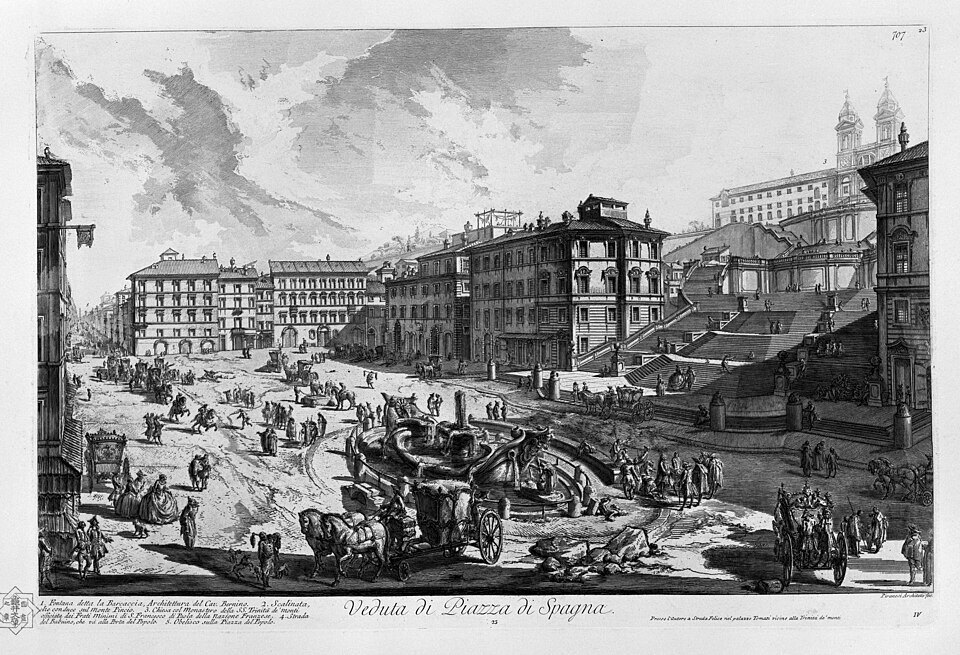
An etching published in Rome in 1763 after a design by Jean Barbault gives a later view of the square. The German catalogue in Kassel identifies both the Barcaccia and Trinità dei Monti, and the printed plate names the square in Italian and French. The steps and the fountain are visible in one view, along with wheeled traffic and the buildings around the square. The etching shows what eighteenth-century viewers understood as the ensemble even though its components were built at different times. It also shows how a low object could remain distinct within a view whose chief architectural lines lead uphill. [10]
The civic catalogue records a restoration in 2013–14 and a separate extraordinary maintenance intervention completed in April 2025 under the Caput Mundi programme. The latter was part of a programme extending to several historic fountains. The dates illustrate the continuing work involved in keeping a public fountain in use. Its form directs water across the stone rim and concentrates other flows around small outlets, so the wet surfaces are part of what visitors see. The heritage office gives the date of the recent intervention on the boat. The wider programme description covers several fountains and supplies no detailed treatment sequence for this one. [11][12]
Pietro’s commission and Gian Lorenzo’s possible role
The municipal heritage catalogue gives Pietro’s office, the commission from Urban VIII and the dates of the work. It describes collaboration with Gian Lorenzo as possible. Rinne argues more specifically for Gian Lorenzo’s participation in the final form. Those accounts agree on Pietro’s responsibility for the project. They give different degrees of weight to the son’s contribution. A feature such as the use of the boat’s edges to shape the flow can be discussed in detail from the stone without having to assign that feature to a particular hand. [1][3]
Gian Lorenzo’s later Fountain of the Bees, also made for Urban VIII, offers a comparison within the family’s work. Its shell receives water from outlets beside sculpted Barberini bees. The Barcaccia uses the same emblems on the outside of a hull and gives the moving water a larger part in establishing the whole outline. In both fountains water has to pass over or beside the stone for a visitor to see the full purpose of the carving. The Barcaccia’s arrangement is especially tied to the level of the square. Seen from beside its pool, the half-submerged body of the boat explains how the designers made a public fountain out of a supply with little height to spare. [1][3][5]
Discussion
The boat sits unusually low in the basin beneath the Spanish Steps.
Reader Insights
How do the low water level and raised ends affect the silhouette?
Which features would a person approaching from the piazza notice first?
Why does the distinction between a documented commission and possible workshop assistance matter here?
Join the Conversation
Share a detail, comparison or question about Fontana della Barcaccia by Pietro Bernini below.
References
- Sovrintendenza Capitolina ai Beni Culturali. Fontana della Barcaccia. Monument record for the commission, material, design and aqueduct. View source
- Turismo Roma. The Barcaccia Fountain. Account of the water supply and the position of the basin. View source
- Rinne, Katherine Wentworth. “Water’s Pilgrimage in Rome”, pp. 36–40. Discussion of the Acqua Vergine, flood tradition and authorship. View source
- Turismo Roma. Piazza di Spagna. Site record for the fountain and Spanish Steps. View source
- Sovrintendenza Capitolina ai Beni Culturali. Fontana delle Api. Monument record for Gian Lorenzo Bernini’s related Barberini fountain. View source
- Lavin, Irving. Bernini’s Barcaccia in the Piazza di Spagna. An Art-Political No Man’s Land. Artibus et Historiae 84 (2021), pp. 221–235.
- Tchikine, Anatole. Galera, Navicella, Barcaccia? Bernini’s fountain in Piazza di Spagna revisited. Studies in the History of Gardens & Designed Landscapes 31, no. 4 (2011), pp. 311–331. Notes on Urban’s poem and competing vessel comparisons.
- Pontificia Parrocchia Sant’Anna in Vaticano. Account of the Galera fountain. Italian description of the Vatican vessel and its jets.
- Musée du Louvre. La Navicella. INV 1249, recto. French catalogue of the drawing after the mosaic.
- Hessen Kassel Heritage. Ansicht der Piazza di Spagna. German catalogue of the 1763 etching after Jean Barbault.
- Sovrintendenza Capitolina ai Beni Culturali. Fontana della Barcaccia. Intervention dates in the municipal monument record.
- Sovrintendenza Capitolina ai Beni Culturali. Caput Mundi fountain maintenance announcement. Programme scope, 7 October 2024.








