


 by Tom Gurney
Tom Gurney BSc (Hons) is an art history expert with over 20 years experience
Published on June 19, 2020 / Updated on November 18, 2026
Email: tomgurney1@gmail.com / Phone: +44 7429 011000
The Goat Amalthea with the Infant Jupiter and a Faun
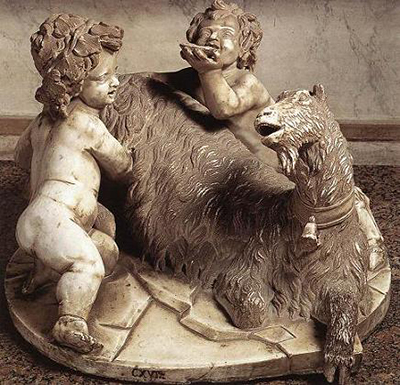
An infant reaches under a reclining goat to draw milk while a young faun drinks from a bowl. The goat turns her head back towards the infant and he returns her gaze. The Galleria Borghese identifies them as Amalthea, Jupiter and Pan. The marble group is only forty-five centimetres high and is documented in Cardinal Scipione Borghese’s collection in 1615. The museum catalogues it as attributed to Gian Lorenzo Bernini. It has often been used to introduce his youthful work, though the surviving record establishes its early ownership more securely than it establishes the sculptor’s identity. [1]
At a Glance
- DateDocumented in 1615
- Location or statusGalleria Borghese, Rome
- WorkMarble group attributed to Bernini
The work in Bernini’s career
The Goat Amalthea with the Infant Jupiter and a Faun
Documented in 1615The Rape of Proserpina
1621–22Apollo and Daphne
1622–25David
1623–24A myth told through the work of feeding
Jupiter’s father Cronus feared a prophecy that one of his children would overthrow him. Rhea spirited Jupiter away to Crete, where he could be raised in safety. Accounts differ over whether Amalthea was his nurse or the goat that supplied him with milk. In the version used here the goat dominates the group physically, and the child depends on her. A sixteenth-century engraving by Giulio Bonasone, now in the Metropolitan Museum of Art, gives the same myth a different emphasis. Its title identifies Jupiter as suckling from the goat. In the Borghese marble he takes the milk by hand, and the bowl held by the faun extends the episode to a second child. [1][2]
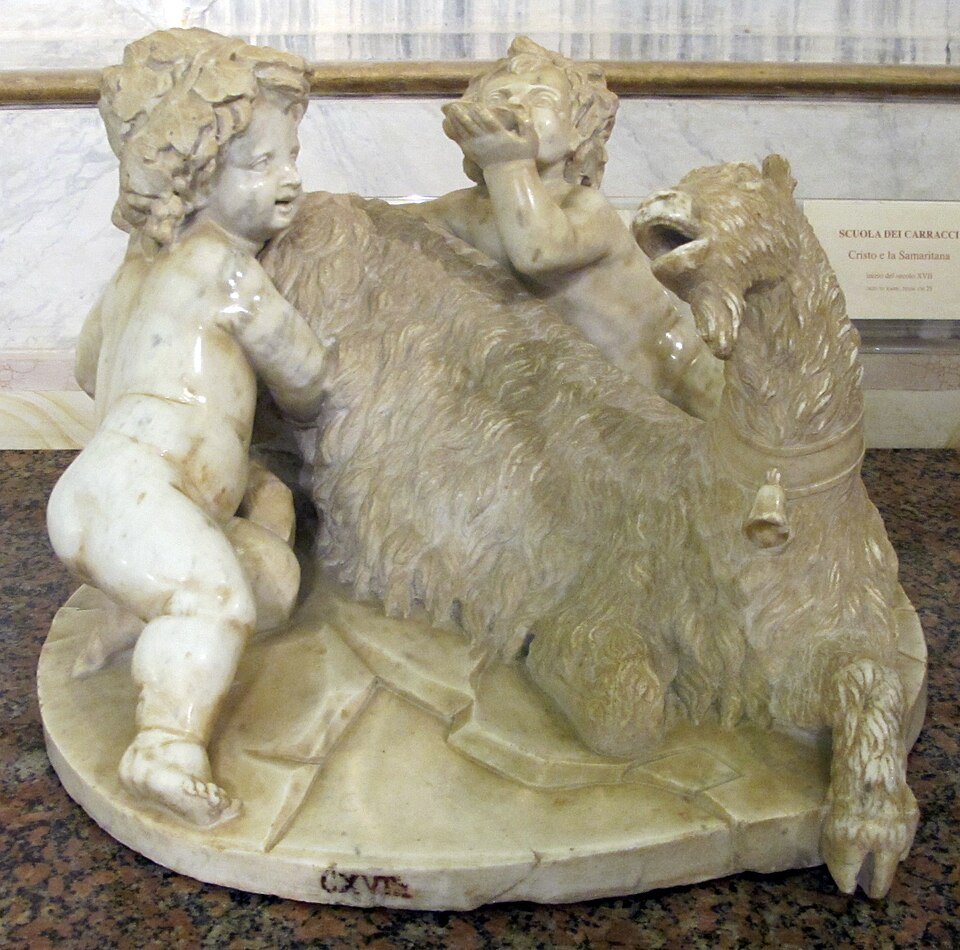
The goat’s flank makes a continuous horizontal form where the figures gather. Jupiter sits close to her body and reaches into the space under it. Her neck turns back, bringing her face towards his and returning attention to the part of the group where most of the action takes place. The vine wreath on Jupiter’s head is small enough to be discovered after this turn of the faces. The bowl at the faun’s mouth is likewise read in relation to a gesture. The arrangement keeps its principal lines close to the ground and builds the episode out of ordinary movements that the viewer can recognise one at a time. [1]
How the carving suggests the senses
Details competing for attention at close range take on different roles when seen together. The bowl suggests taste through the way the faun holds it to his mouth. The contact between Jupiter’s hand and the goat gives the scene an action the viewer can understand through touch. The bell at Amalthea’s neck and her open mouth suggest sounds a marble figure cannot make. These details were among those Rudolf Preimesberger used to discuss the senses in the group, as the museum’s catalogue records. The exchange of looks between the goat and the child makes sight part of the subject, as well as the means by which the viewer discovers the rest. [1]
The stone differentiates skin, hair and the small accessories through their edges and surfaces. The bell has to read as a distinct object even though it occupies a small area close to the animal. The carved edge of the drinking bowl has a similar job beside the faun’s hands and mouth. The museum notes separately attached repairs or adjustments at the bowl and at parts of the goat, including the horns. It also observes that surfaces expected to be hidden received less finish. These features offer evidence of the work’s execution and its intended display. Smoothness and completeness were concentrated where they would help articulate the scene from its expected viewpoints. [1]
Dating the group and identifying its maker
The earliest secure date comes from a payment to Giovanni Battista Soria for a wooden base in 1615. A record of a base locates the sculpture within the collection by that year. The museum’s catalogue distinguishes it from a bill for carving the marble, which has yet to be located in the Borghese records. One scholarly proposal is that the group arrived as a gift intended to demonstrate a young sculptor’s capabilities. That remains an interpretation of how the work might have entered the collection. The commission and date of carving are consequently more difficult to establish than its presence at the villa. [1]
The history of the attribution also has several stages. Jacopo Manilli’s account of the villa in 1650 described the sculpture without naming its maker. Joachim von Sandrart is the early authority cited for the attribution to Gian Lorenzo in 1675. Roberto Longhi connected Sandrart’s attribution with the Borghese group in 1926. The Galleria Borghese’s 2017–18 exhibition placed it alongside other youthful groups with putti, providing a way to compare them with work linked to Pietro Bernini, Gian Lorenzo’s father and teacher. Those comparisons matter because the younger sculptor acquired his technique in Pietro’s workshop and some work from the period is associated with both men. [1][3]
An instructive comparison is the Metropolitan Museum’s Faun Teased by Children. In that marble, children scramble around a grown faun and one pulls at his hair. The play unfolds up and around a tree trunk, while the two young figures in the Borghese group are brought low by their activities around the animal. The Met discusses the sculpture in the context of the two Berninis’ work. Setting the compositions side by side shows why the comparison rests on more than the presence of small children. A trunk offers opportunities to arrange overlapping bodies at successive heights. The reclining animal in the Borghese group leads their movements back towards a common level. The same interest in childhood gestures can produce quite different encounters with a block of marble. [1][3][4]
What changes when Jupiter milks the goat
Ovid tells the story while marking the first of May in the Fasti. In his version Amalthea is a nymph who hides Jupiter in the woods and owns the goat that suckles him. When the goat breaks a horn against a tree, the nymph fills it with fruit and brings it to the child. Jupiter rewards the goat and the horn with a place among the stars once he rules heaven. The story thus explains both a name in the sky and the horn’s association with plenty. The marble brings the feeding forward as an event in its own right. Jupiter already has enough agency to supply milk by hand, and the companion who shares it belongs to the immediate action. [5]
A later treatment in paint shows how unusual that arrangement is. In Jacob Jordaens’s picture at the Louvre, the nymph Adrasteia milks the goat while Jupiter holds a feeding vessel. The Louvre places the picture in the early 1630s and identifies a satyr who distracts the child by waving a branch. A later engraving by Schelte Bolswert gives the satyr a tambourine instead. The museum uses that print, which varies the composition, to help explain why the gesture is hard to read in the surviving canvas. In the Borghese marble the child who will rule the gods takes over from the nurse, and the faun’s hands are occupied with drinking. The comparison shows how artists could distribute feeding and distraction among very different figures within the same story. [5][6]
A goat and two children in the early records
The German critical edition of Sandrart’s Teutsche Academie lets readers compare the language of the 1675 biography with the name now used in the gallery. Sandrart describes two Bacchic children enjoying milk from a reclining goat and calls it the sculptor’s first celebrated work. That description precedes his account of the David. The editors also reproduce the description of the base in the payment record, which identifies it by reference to the little goat and its companion. Both records use visible features to identify a work. Only Sandrart associates the group with Bernini, and it was Longhi who connected his description with the surviving marble. [7]
The degree of confidence still depends on the catalogue. In her 2021 catalogue of Bernini’s sculpture, Maria Grazia Bernardini assigns the group to Gian Lorenzo. Stéphane Loire’s assessment of her catalogue sets it alongside early pieces assigned to Gian Lorenzo alone and distinguishes these from works she gives to father and son together. The Musée Jacquemart-André presented the sculpture to Paris visitors in 2024 as an example of the adolescent Bernini’s work, within an exhibition about the Borghese collection. In Rome the holding museum uses the more cautious attribution. These positions concern the same marble, whose date in the collection is fixed by the base even though that payment says nothing about the author of the carving. [7][8][9][10]
Irving and Marilyn Aronberg Lavin’s chronology shows how much the attribution affects the story of Bernini’s training. They list a possible date as early as 1609 and mark it as an opinion. Their separate August 1615 entry refers to the documented base, when Bernini was sixteen. They also compare the handling of animal hair in the group with the rendering of hair and fur elsewhere in the father’s and son’s work, including Pietro’s John the Baptist in the Barberini Chapel. Such comparisons can suggest what the younger Bernini learned in the family workshop. A dating proposal as early as 1609 would make that learning visible at a much earlier stage than the document alone can establish. [12]
What the conservation records establish
The Borghese conservation archive records a 1996 report prepared by the Istituto Centrale per il Restauro ahead of preliminary investigations and decisions on how the sculpture should be cleaned. The archive identifies the sculpture by inventory number CXVIII and points to a technical report in the museum’s restoration files. Its public entry outlines the purpose of that work. It gives neither a cleaning recipe nor the results of any tests. The archive date belongs to the modern care of the marble. It falls just before the year in which the gallery records the group’s return to the Lanfranco Loggia. [10][11]
At the scale of the group, a small join can affect how easily a feature reads. A continuous rim helps the viewer make out the cup where it meets the faun’s face, and the goat’s horns have to be legible against the turn of her head. The object catalogue reports pieces attached with rosin in these areas, drawing on Anna Coliva’s discussion of the sculpture. That observation concerns the construction of the objects and forms visible today. The separate archival notice concerns planning for cleaning. Together the two records show why a closer survey of the marble would have to distinguish applied parts, degrees of surface finish and traces of later care before drawing conclusions about a sculptor’s technique. [10][11]
The sculpture in the Borghese collection
The museum links the marble to a decorative programme in the villa’s loggia in 1624, where Giovanni Lanfranco painted an assembly of the gods on the vault. Looking from the sculpture to the ceiling would place the period of Jupiter’s infancy alongside the adult god’s company. Amalthea also belonged to stories of plenty through the cornucopia made from her horn. The decorative programme gave that association a contemporary bearing in the Borghese household. The later setting can support an interpretation of the work as part of a celebration of a renewed Golden Age. The record for the base places the sculpture in the collection years before that programme was in place. [1]
Later moves brought other associations to the fore. The group was shown with small works of Bacchic subject after the architect Antonio Asprucci reorganised the collection in the late eighteenth century. In that company the vine leaves and the young Pan would have acquired particular prominence. It went back to the loggia in the nineteenth century, occupied the entrance hall for a period and returned again to the loggia in 1997. The dimensions that make the marble so distinct from the villa’s later large figure groups also made these different arrangements possible. Its posture and the gaze linking the child and the goat remain consistent as the works around it bring different parts of the story into view. [1]
Discussion
At forty-five centimetres high, the group keeps several exchanges of looks and gestures close together.
Reader Insights
How does the goat’s turned head connect the infant and the animal?
What becomes easier to see when you move around the group?
Which comparisons would help evaluate the attribution?
Join the Conversation
Share a detail, comparison or question about The Goat Amalthea with the Infant Jupiter and a Faun, Attributed to Gian Lorenzo Bernini below.
References
- Felici, Sonja. The Goat Amalthea with the Infant Jupiter and a Faun. Galleria Borghese, January 2024. Inventory CXVIII. View source
- Metropolitan Museum of Art. Jupiter suckled by the goat Amalthea. Engraving by Giulio Bonasone. View source
- Galleria Borghese. Bernini exhibition materials, 2017–18. Sections on Pietro’s workshop and the early putti. View source
- Metropolitan Museum of Art. Faun Teased by Children. Collection record. View source
- Ovid. Fasti, book V, lines 111–128. Translated by J. G. Frazer.
- Musée du Louvre. Jupiter enfant nourri par la chèvre Amalthée, Jacob Jordaens. INV 1405. French collection catalogue.
- Sandrart, Joachim von. Die Ziege Amalthea («Capra Amaltea»). Critical edition of the Teutsche Academie, with commentary by Cecilia Mazzetti di Pietralata.
- Loire, Stéphane. Un nouveau catalogue des sculptures du Bernin. Zeitschrift für Kunstgeschichte 86, no. 2 (2023), pp. 272–277.
- Musée Jacquemart-André. Chefs-d’œuvre de la Galerie Borghèse, exhibition dossier, p. 7.
- Felici, Sonja. La capra Amaltea con Giove bambino e un faunetto. Galleria Borghese, inv. CXVIII. Italian collection catalogue.
- Galleria Borghese, Archivio Restauri. La capra Amaltea, conservation and diagnostics entry, record CXVIII_1996.
- Lavin, Irving, with Marilyn Aronberg Lavin. Bernini’s Bust of Prospero Farinacci. Artibus et Historiae 77 (2018), pp. 276, 283.








