


 by Tom Gurney
Tom Gurney BSc (Hons) is an art history expert with over 20 years experience
Published on June 19, 2020 / Updated on November 18, 2026
Email: tomgurney1@gmail.com / Phone: +44 7429 011000
Portrait of a Young Man, Traditionally Called Nicolas Poussin
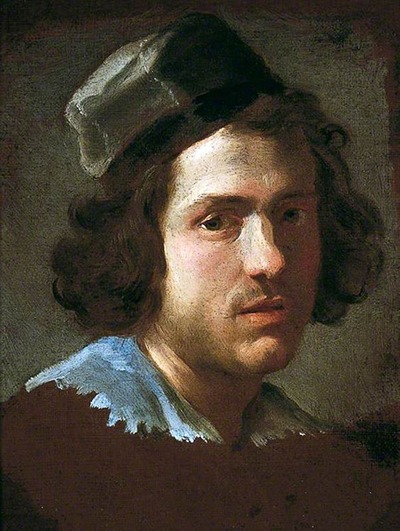
A young man in a tilted cap looks out from a dim background. Light falls across one side of his face and catches the uneven edge of his collar. The painting belongs to York Museums Trust and is recorded as YORAG 1502. The Galleria Borghese exhibited it in 2017 as an oil on canvas by Gian Lorenzo Bernini, dated 1628–29. Its exhibition title called it the so-called portrait of Nicolas Poussin. That qualification allows the historical name to remain useful while leaving open the identity of the sitter. [1][2][3]
At a Glance
- Date1628–29
- Location or statusYork Museums Trust, YORAG 1502
- WorkOil on canvas. The traditional identification as Nicolas Poussin is uncertain.
The work in Bernini’s career
David
1623–24St Peter’s Baldachin
1624–33Portrait of a Young Man, Traditionally Called Nicolas Poussin
1628–29The York painting and its title
The painting was acquired for York in 2000, according to the acquisition list of the Friends of York Art Gallery. The list records it as Portrait of Nicolas Poussin and identifies Bernini as the painter. When the Galleria Borghese included the canvas in its 2017–18 Bernini exhibition, the checklist gave York Museums Trust as the lender and listed it as a portrait of a young man with the Poussin identification qualified. The records can thus be read together to identify the canvas across two settings, even where the wording of the title varies. [1][2]
The cap, curls and broken edge of the collar make this painting easy to distinguish from Bernini’s youthful self-portrait in the Borghese collection. The angle of the face and the points of light on the lips and nose also match the photograph of the York picture made at the exhibition. These visible details are particularly valuable when several catalogues use variants of the generic title Portrait of a Young Man. The York loan shown in Rome was a painting from a separate collection. Its appearance in the exhibition records a loan and an attribution, and supplies no evidence of an original commission by the Borghese family. [1][3][4]
Light across the face
The light begins on the upper forehead, just below the forward edge of the cap. It picks out the bridge of the nose and the brighter cheek, then thins towards the chin. On the other side, the eye remains visible in an area of lower contrast. The two eyes can be located even when the viewer is far enough away for the smaller marks around them to merge. Their visibility across different light levels is important for the sense that the sitter has looked up or across towards someone standing nearby. [3]
The lips are slightly parted, with narrow areas of warm paint along their top and bottom. The expression depends on very small differences between those accents and the darker line between the lips. Around the jaw the pale colour gives way gradually to shadow before it meets the background. That edge is less emphatic than the contour of the forehead under the cap. It gives the viewer a sense of the turn of the head without requiring every part of the face to be outlined with equal force. [3]
Cap, collar and clothing
The cap contributes an angle that the face alone would lack. Its pale side catches light high on one side of the canvas, balancing the illuminated forehead lower down. A darker wedge cuts across the top of the hair. The curls spread either side of the face and meet the background without a sharp boundary in some places. The cap provides a compact shape above that softer transition. Its slant gives the eye a route from the upper edge of the picture towards the face. [3]
The blue-grey collar offers a second route into the face. It spreads outward across the shoulder and comes up towards the warmer neck in the centre. The edge breaks into short light marks, which are easier to distinguish than the forms across the dark clothing below. The lower part of the canvas therefore holds relatively little descriptive detail. There is enough contrast to suggest the position of the shoulders, and the open space below the collar lets the uneven marks remain visible. The face carries most of the fine distinctions of colour and light. [3]
The name on the catalogue record
The Friends of York Art Gallery list their contribution to the acquisition in 2000, under the title Portrait of Nicolas Poussin and the number YORAG 1502. Seventeen years later the Borghese exhibition identified the loan as a portrait of a young artist conventionally called Poussin. The number in the acquisition record and the named York lender in the exhibition checklist make it possible to follow the same object across those two forms of title. The older wording identifies the picture for a reader searching the acquisition history. The exhibition wording gives a more qualified account of the sitter. A change in the wording of the label needs to be distinguished from a change in the attribution of the painting. [7][8]
The question arises for other works in this group. The French national catalogue records a Portrait d’un artiste at the Musée Magnin in Dijon as an oil on canvas measuring 38.5 by 31 centimetres. It describes Poussin as a possible sitter and attributes the painting to Bernini, recording a former tentative attribution to Juan Bautista Martínez del Mazo. It also compares a portrait formerly reported in a collection at Hovingham. That record is evidence of how scholars grouped likenesses in France and England. Its named collection and inventory number identify the Dijon painting as a separate object. The resemblance proposed in the catalogue leaves open how the pictures came to share a name. [9]
Comparison with documented likenesses of Poussin
Two documented self-portraits give a firmer basis for discussing what Poussin looked like later in life. Poussin painted the Berlin canvas for Jean Pointel in 1649 and the Louvre canvas for Paul Fréart de Chantelou in 1650. Their museum records connect the works with individual patrons and a specific exchange. Those circumstances supply evidence for the sitter independent of an apparent likeness. The portrait commissioned by Chantelou also places the head beside the edges of stacked canvases and includes a prominent inscription. In the York canvas, the head and the pale collar provide the chief points of attention against the dark space. [8][10][11]
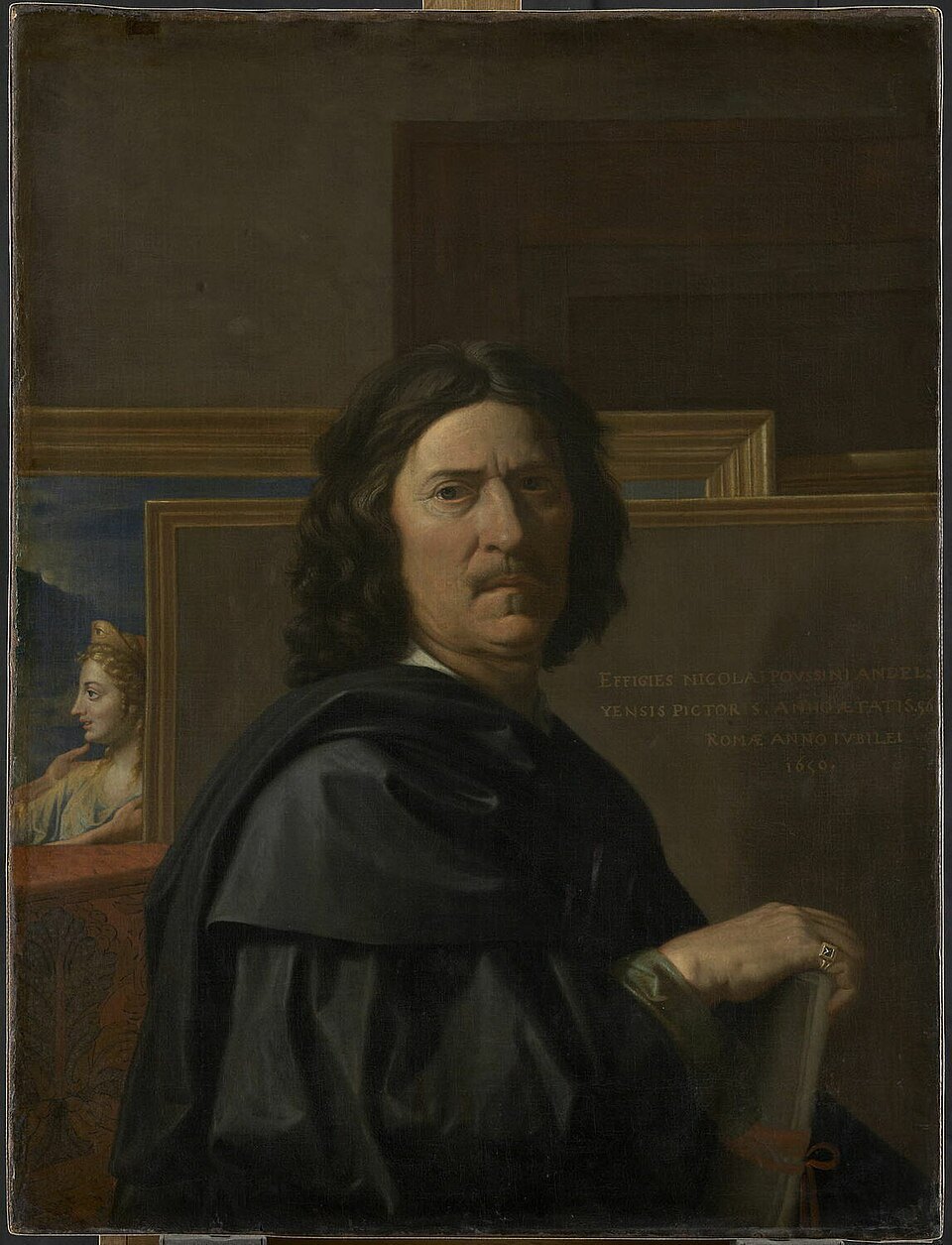
The difference in date limits the comparison. If York’s proposed date is right, about two decades separate its face from the two self-portraits. The visible shape of a nose or brow can be compared across the works, but hair, bearing and the apparent weight of the face can all change over such an interval. A seated painter also has reasons to compose a self-portrait differently from the way another artist might paint him. The more securely named likenesses establish a reference point for the question rather than a way of resolving it from appearance alone. [8][10][11]
The Borghese’s own Portrait of a Young Boy offers a comparison of a different kind. Its catalogue draws attention to the likeness between the boy and the York sitter and offers a possible connection with the artist’s family. Here the comparison begins with the handling and features of two paintings discussed under Bernini’s name. The museum leaves the boy’s identification open, so following the likeness from one face to the other cannot give the York portrait a secure name. It can, however, help explain why a display of Bernini’s painting placed such small, closely observed heads in relation to each other. [8][12]
Comparing the sitter with other portraits
The Galleria Borghese’s record for its Portrait of a Young Boy draws attention to a resemblance between the boy in that painting and the sitter in York. It suggests that the same model might have been used and discusses proposals that the Borghese boy was one of Bernini’s younger brothers. Both proposals are tentative. They matter for the York work because they show that the Poussin title is one part of a history of identification. The museum’s comparison offers a different direction in which to examine the faces. Resemblance may help formulate a question about a sitter, but it does not independently document a name. [1][5]
The Borghese Self-portrait as a Young Man gives another comparison for the way Bernini arranged a face against dark clothing. The museum relates its identification to a contemporary engraving and points to features such as the moustache and the small patch of hair under the lower lip. The evidence for that comparison is more specific than a general likeness of pose or lighting. It also shows the value of keeping titles attached to the actual recorded objects. A similar concentration on the face can occur in portraits whose sitters and histories are very different. [3][4][5]
The exhibition also brought the York canvas into proximity with another youthful portrait lent from a private collection. The catalogue numbered them consecutively and gave them closely related dates. Their compositions make different use of dress. In the York painting the cap provides a strong upper edge, and the collar interrupts the dark clothes with a cool accent. In the privately lent portrait, a bare neck and loose mass of dark hair frame the warm cheek. The comparison helps distinguish the paintings by what a viewer can see as well as by their catalogue entries. It also shows how two small studies of faces could take on quite different shapes through the choice of a hat or the amount of clothing left visible. [1][3][6]
The effect of the abbreviated surface
The painting brings the spectator close enough to register the shifting expression without filling the canvas with separate descriptions of costume and setting. The dark background gives the cap and hair enough room to establish the silhouette. The highlight on the collar then returns the viewer’s attention towards the warmth of the face. Even differences between reproductions make the design easier to understand: the collar can appear greyer or bluer, but its irregular edge still interrupts the dark mass at the same point. The location of the large contrasts is part of what lets the portrait retain its effect at more than one scale. [1][3]
Discussion
The tilted cap and uneven collar make the young man’s pose distinct.
Reader Insights
Where does the light change across the brow and cheek?
What would support the traditional identification as Nicolas Poussin?
Which details would help distinguish this York canvas from the London portrait?
Join the Conversation
Share a detail, comparison or question about Portrait of a Young Man, Traditionally Called Nicolas Poussin below.
References
- Galleria Borghese. Bernini, exhibition checklist. No. 15, York Museum Trust loan, 1628–29. View source
- Friends of York Art Gallery. Art the Friends of York Art Gallery Have Helped to Acquire. Acquisition listing for YORAG 1502. View source
- Sailko. Ritratto di giovane artista, detto il Poussin. Photograph of the York canvas. View source
- Galleria Borghese. Self-portrait as a Young Man. Object record and comparison with the engraved likeness. View source
- Galleria Borghese. Portrait of a Young Boy. Object record and discussion of the possible connection to the York sitter. View source
- Sailko. Ritratto di giovane sbarbato. Photograph of the privately lent painting shown as no. 16. View source
- Friends of York Art Gallery. Art the Friends of York Art Gallery Have Helped to Buy, p. 2. Acquisition year, historic title and accession number.
- Galleria Borghese. Bernini, exhibition checklist, no. 15. York loan and qualified title.
- Ministère de la Culture. Portrait d’un artiste. Musée Magnin object 1938 E 100 and related portrait.
- Musée du Louvre. Autoportrait. Poussin’s 1650 self-portrait for Chantelou.
- Staatliche Museen zu Berlin. Selbstbildnis. Poussin’s 1649 self-portrait for Pointel.
- Galleria Borghese. Ritratto di fanciullo. The related painting and the museum’s proposed comparison.








