


 by Tom Gurney
Tom Gurney BSc (Hons) is an art history expert with over 20 years experience
Published on June 19, 2020 / Updated on November 18, 2026
Email: tomgurney1@gmail.com / Phone: +44 7429 011000
Portrait of Pope Clement IX
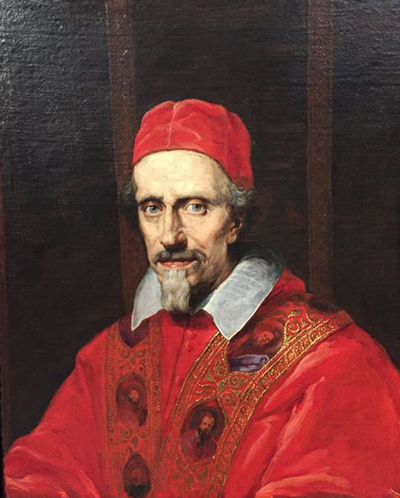
Clement IX looks towards the viewer from a dark seat. A red cap, pale collar and embroidered stole frame his face. The painting illustrated here corresponds to the private-collection canvas exhibited under Gian Lorenzo Bernini’s name at the Galleria Borghese in 2017–18. The exhibition checklist identifies it as an oil on canvas and gives its measurements as 91.5 by 77 by 5 centimetres. Letters from 1667 establish that Bernini painted two portraits of Clement IX. The connection between those letters and the surviving canvas requires a separate judgement. The documents describe specific portraits, and several painters made likenesses of this pope. [1][2][3]
At a Glance
- Location or statusPrivate collection
- WorkOil on canvas exhibited under Bernini’s name in 2017–18
The work in Bernini’s career
Apollo and Daphne
1622–25Ecstasy of Saint Teresa
1647–52St Peter’s Square
1656–67Portrait of Pope Clement IX
Date discussed in the articleHow the painting directs attention to the face
The red of the cap prepares the eye for the much larger area of red across the lower part of the picture. Between them, the face and collar form a bright passage set against the dark backing of the chair. The head takes up relatively little of the canvas. Its position between the red above and the white below gives it a clear place within the larger arrangement. The edge of the cap is sharply visible. It leads to patches of grey hair at the sides of the head, and they bring the eye down into the smaller contrasts near the eyes, moustache and beard. [1]
The shoulders occupy different depths in the picture. On one side the stole crosses a broad surface of red cloth. Its embroidered border gives the shoulder an angle that can be followed towards the neck. On the other side the cloth and its decoration are compressed into a shorter passage. The head presents a more direct encounter than the shoulders do. The small differences in the size and visibility of the two sides of the face sustain that sense of a body seen at a slight turn. The painting makes the sitter’s attention available to a viewer without requiring all parts of the figure to meet the viewer squarely. [1]
The embroideries are legible as part of the dress even where the details are small. Their gold outlines and the smaller dark images are set into strips which follow the fall of cloth. The collar does related work nearer the head. Its pale angles carry the direction of the shoulders into the space below the beard. In a more ornate setting those passages might have competed with furniture or objects of office. The dark upright lines around the sitter leave the concentration of light and colour within the figure. [1]
Two portraits in the letters of 1667
Clement IX was Giulio Rospigliosi. After his election in June 1667, his nephew Giacomo travelled towards Rome and fell ill on the journey. Correspondence published by Tomaso Montanari shows Giacomo’s brother Vincenzo writing to Bernini on 1 November. He refers to a profile portrait of the new pope which Bernini had already made and which Giacomo liked. Vincenzo wanted a likeness presenting Clement from the front. He asked Bernini to have a painter adapt the earlier image and, if possible, make adjustments in the presence of the pope. [2]
The request is unusually specific about the task of adapting a portrait. A painter facing a sitter directly would have to account for the width and shape of features which a profile gives from only one side. Vincenzo’s wish for another encounter with Clement suggests that information from the first image could be carried over, while the new view should still be tested against the sitter. The task was to retain the likeness while changing its direction. It helps explain how a sequence of papal portraits might emerge from a single commission without every version having the same pose. [2]
A letter from the nuncio Pietro Niccolò Bargellini at Rivoli, dated 13 November, records the arrival and favourable reception of the portrait. The thanks refer to Bernini’s own hand, and Montanari reads them as evidence that Bernini himself painted the second likeness. A further letter to Bernini’s son Pier Filippo confirms that the work had been presented to Giacomo’s household. The letters establish that Bernini was still painting late in his career and that the first and second portraits offered different views of the sitter. They record the making and delivery of the works, without tracing either object forward to the twentieth or twenty-first century. [2]
Clement IX in different official poses
A portrait can identify Clement IX through vestments, features and the furniture of office while giving the figure a different action. The Italian state catalogue records a painting of Clement blessing attributed to Giovanni Battista Gaulli. It also records a proposal that the painting is another version of the Rospigliosi composition at Palazzo Barberini. The lifted hand makes the pose intelligible at a distance and gives the painting a subject beyond the presentation of the face. Where a version repeats such a gesture, the composition can remain recognisable even if details of the face or the rendering of the cloth change. For the privately held portrait, shared papal dress therefore carries less weight in identifying a specific commission than the particular arrangement of the face, chair and stole. [5][6]
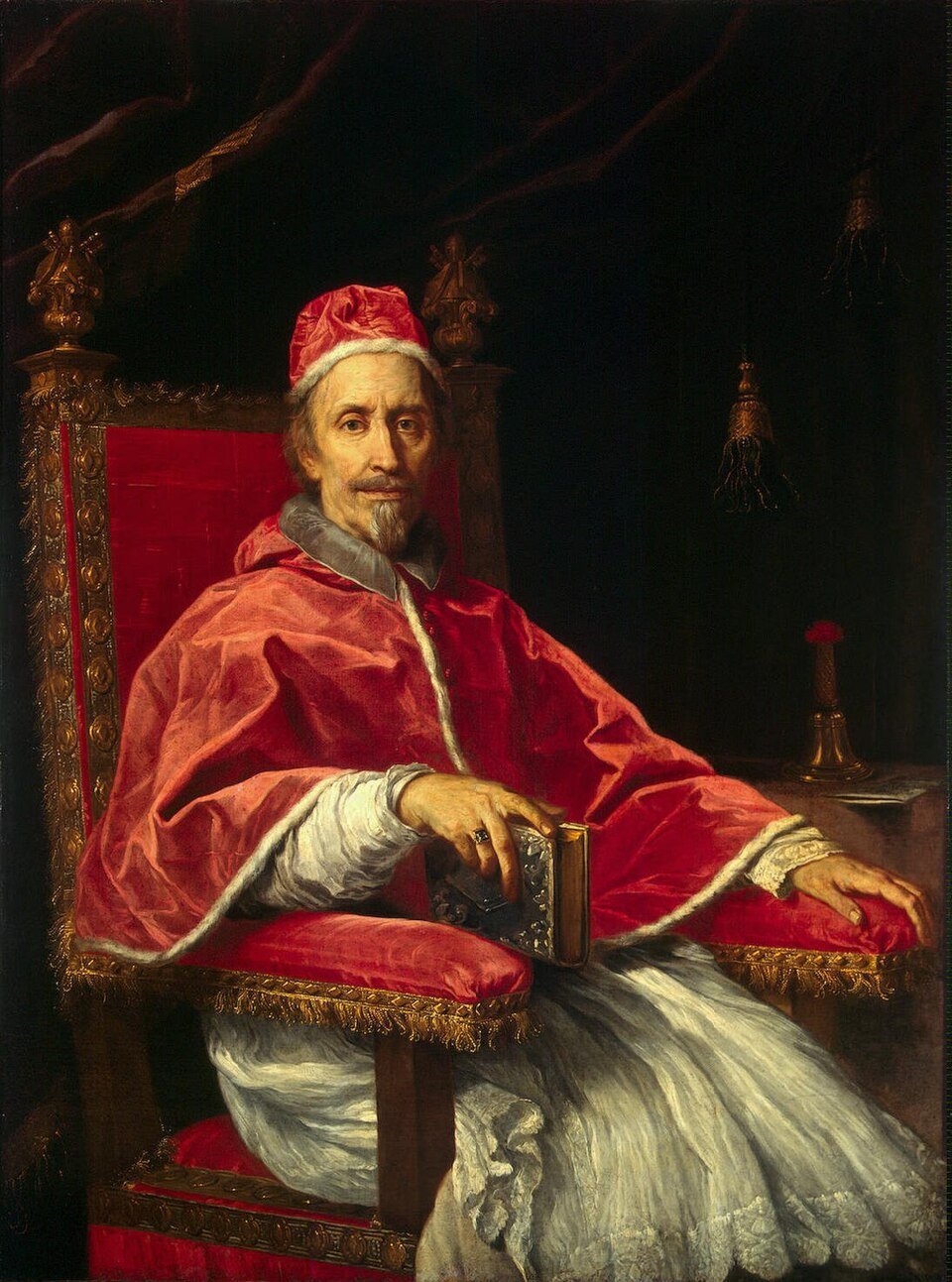
The signed and dated 1669 portrait by Carlo Maratta in the Vatican Pinacoteca gives a separate point of comparison. Clement sits on a throne in a three-quarter pose. The Vatican’s German catalogue compares the arrangement to Velázquez’s portrait of Innocent X. That comparison supplies a reason for marshalling the head, body and chair into a single composition. The resemblance is to a model of papal portraiture in which the direction of the gaze can differ from the orientation of the body. Maratta’s signature provides evidence of authorship independent of the pose. In the case of the canvas shown at the Borghese, the attribution and possible connection with the portrait requested in November have to be assessed from other evidence. [5][7]
What the different records can prove
The Louvre describes a drawing of a pope blessing from his throne that bears the Rospigliosi arms. It provisionally attributes the drawing to Giovanni Maria Morandi. The family arms connect the subject with Clement’s pontificate, while the scene concerns a collective ceremony and gives space to surrounding bishops and clergy. The catalogue can therefore identify the historical context more readily than the draughtsman. The heraldry, like the garments worn in the painted portraits, has a distinct evidentiary role. It can help date or identify a subject without resolving the question of who produced the image. [7][8]
Franco Mormando’s account, citing Montanari, treats the two oil portraits mentioned in the correspondence as untraced and reports the suggestion that Gaulli’s picture at the Collegio Alberoni might preserve something of an original. The Borghese checklist records an extant private canvas attributed to Bernini. The two accounts address different questions. One follows the paintings mentioned in the 1667 exchange and the possible survival of a composition. The other documents an attribution and a specific modern loan. Linking them would require a traceable history of the exhibited object or a feature of the painting specific to the work described in the letter. The existence of related painted and drawn likenesses makes that distinction consequential. They show a pope whose likeness circulated through a number of images during and after his reign. [5][6][8][9]
The surviving canvas and related likenesses
The Borghese exhibition provides evidence for the attribution of the canvas shown here. It presented the oil under Bernini’s name and listed it as privately held. The correspondence shows why a portrait of Clement can belong within a study of Bernini as a painter. To identify the exhibition canvas with one of the documented pictures would require tying the composition and its ownership to the work mentioned in the letters. The size of the exhibited painting is useful for identifying the object in modern records. The instructions about the angle of the head concern the historical request and can only answer part of that question. [1][2]
Montanari explores another possible connection with the painted likeness of Clement in the Collegio Alberoni in Piacenza, associated with Giovanni Battista Gaulli. He proposes that the Piacenza picture might transmit something of the requested frontal design while doubting that Bernini painted it himself. The proposal is about the survival of a composition through another hand. It gives a reason to examine the face, drapery and position of the sitter separately from the brushwork. Carlo Maratta’s portrait of the same pope, catalogued by the Fondazione Zeri and dated 1669, is an independent likeness. Its existence shows how easily a sitter’s name can bring together objects with different authors, histories and purposes. [2][3]
The sequence of dates is important to the comparison. Maratta’s portrait belongs to 1669, while the letters concerning Bernini were exchanged within the first months of Clement’s reign. A later painter could depict the same vestments and still produce a different kind of image. Studies of a surviving picture therefore need to ask whether a feature identifies the sitter, whether it belongs to the conventions of papal portraiture, or whether it is specific enough to connect the work with a particular description. The frontal view requested in November is one such clue, but it was also available to other painters who wanted to give Clement a direct address. [1][2][3]
A sculpted portrait offers a further distinction. The Detroit Institute of Arts preserves a bronze portrait of Clement IX connected with Bernini and Girolamo Lucenti. Its catalogue concerns the making and attribution of a work in metal. The 1667 letters concern paintings sent or discussed by members of Clement’s family. Together these records show why the name of the pope is a starting point for research and why material, pose and provenance have to be established for each surviving object. [2][4]
Discussion
A pale collar and embroidered stole frame the pope’s face.
Reader Insights
Which details distinguish the canvas from other portraits of Clement IX?
What would link the surviving portrait to one of the documented commissions of 1667?
How would you phrase the difference between an exhibition attribution and a documented identification?
Join the Conversation
Share a detail, comparison or question about Portrait of Pope Clement IX, Attributed to Gian Lorenzo Bernini below.
References
- Galleria Borghese. Bernini, 2017–18 exhibition dossier. Checklist item 75, Ritratto di papa Clemente IX. View source
- Montanari, Tomaso. “Una traccia per la pittura del tardo Bernini. Notizie dal carteggio su due ritratti di Clemente IX”. In A Transitory Star: The Late Bernini and His Reception, 2015, pp. 183–90. Includes the 1667 correspondence and the Piacenza comparison. View source
- Fondazione Federico Zeri. Ritratto di papa Clemente IX. Record for the separate portrait by Carlo Maratta. View source
- Detroit Institute of Arts. Pope Clement IX. Object record for the bronze portrait. View source
- Galleria Borghese. Bernini, exhibition dossier, no. 75. The modern loan.
- Ministero della Cultura. Ritratto di Clemente IX benedicente. Italian record of the Gaulli portrait and its proposed relationship to the Barberini version.
- Vatican Museums. Carlo Maratta, Portrait Clemens’ IX. German catalogue of the signed and dated portrait.
- Musée du Louvre. Pape sur son trône, entouré d’évêques, bénissant des prêtres. French catalogue of the drawing with the Rospigliosi arms.
- Mormando, Franco. Bernini Updates 1. English discussion of the two portraits in the correspondence and the Piacenza comparison.








