


 by Tom Gurney
Tom Gurney BSc (Hons) is an art history expert with over 20 years experience
Published on June 19, 2020 / Updated on November 18, 2026
Email: tomgurney1@gmail.com / Phone: +44 7429 011000
Memorial to Ippolito Merenda
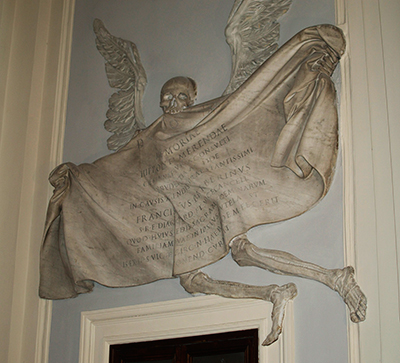
A winged skeleton holds a cloth in its hands and teeth above a doorway in San Giacomo alla Lungara in Rome. The cloth is white marble, and the inscription cut into it commemorates Ippolito Merenda, an advocate in the Roman Curia. Cardinal Francesco Barberini commissioned the memorial in recognition of a bequest to the religious community under his protection. Gian Lorenzo Bernini designed the work, which his workshop executed around 1640–41. The skeleton gives the inscription a visible action. Its hands open the cloth to the viewer, its teeth hold it from above and its feet meet the architecture below. [1][2][3]
At a Glance
- Datec. 1640–41
- Location or statusSan Giacomo alla Lungara, Rome
- WorkMarble wall memorial designed by Bernini and executed by his workshop
The work in Bernini’s career
Memorial to Ippolito Merenda
c. 1640–41Ecstasy of Saint Teresa
1647–52Fountain of the Four Rivers
1648–51Reading the cloth from below
The head, wings and limbs are visible around the edges of the cloth. Much of the skeleton’s body lies behind it. The position of the teeth establishes the high point from which the fabric appears to hang, and the hands draw its sides outward. The arrangement leaves a broad field for the inscription without the regular borders of an architectural tablet. The diagonals of the creases keep the surface connected to the places where it is held. The cloth seems subject to the pull of the skeleton’s grip and to the weight of the material hanging below it. [1][2]
At the edges the cut marble gives the cloth an identifiable thickness. In some areas the shape of bones appears beneath the fabric, a detail Marcello Fagiolo draws attention to in his study of the work. It is possible to follow the figure even where the carved surface depicts something lying over it. At the centre, where the inscription takes precedence, the relative smoothness provides room for lines of text. The same block of white stone describes the resistance of bone, the shift of a fold and the cuts that make words. Each kind of detail becomes legible at a different scale. [1][3]
The work is mounted high enough that most visitors see the silhouette and the large folds before reading the letters. The wings can be recognised from farther away than the grip of the teeth. Nearer the doorway, the hand and the line of lettering can be related to the crease that runs between them. Judith Bernstock observes that the feet anchor the skeleton to the architecture even though the wings suggest rising movement. The door surround provides a visible point of support for the figure, and the irregular edges of the fabric appear to depart from the rigid lines beneath it. [1]
The benefaction named in the inscription
The memorial addresses Merenda as a lawyer from Cesena and praises his ability and integrity. It names Francesco Barberini and records why he had it placed. Merenda had made the community of women at the church his heir, with a bequest Bernstock gives as about twenty thousand scudi. The inscription uses the ancient denomination of sesterces to express the gift. Its wording records the relationship between the person remembered, the community receiving the money and the cardinal who protected it. That relationship explains why the memorial belongs to San Giacomo even though it is not the site of Merenda’s burial. [1][2]
Merenda had also endowed the Chapel of Saint Francis in Santa Maria della Vittoria in 1629. Bernstock distinguishes the tablet commemorating that act from the relief at San Giacomo. The earlier inscription records the building, decoration and endowment of the chapel. The later one praises the lawyer and records the benefit to another institution. These different commemorations explain why a visitor can find the same name in two Roman churches. The character of the marble cloth at San Giacomo is bound to the fuller account of the bequest that it presents. [1][3]
Date, patronage and placement
The inscription itself is undated. Bernstock dates the work to about 1640–41 and cites a payment of 3 December 1641 to Lorenzo Florij for expenses incurred in the work. The document helps establish when the workshop was carrying out the commission, after Merenda’s death in 1636. It records the handling of expenses and leaves the individual carving of the skull, wings and folds without a secure attribution. Bernstock credits Bernini with the design and the workshop with its execution. The distinction matters because the relief’s effects depend on both the conception of the figure and the way the inscription was cut into a complex surface. [1]
Turismo Roma and Fagiolo connect the memorial with the former monastery of the Convertite adjoining the church. Fagiolo says it was moved into the church after the convent was demolished. The setting described by Bernstock is above a doorway to the right of the high altar. That position helps the figure look as though it has come to rest momentarily on an architectural edge. It also belongs to the later history of the monument. The community named in the inscription explains its original destination, while the doorway shapes the view available today. [1][2][3]
The church interior changed during Barberini’s renewal of the complex. Turismo Roma credits Luigi Arrigucci with the conversion from three aisles to one nave during the seventeenth-century restoration. Fagiolo discusses the memorial alongside Giovanni Francesco Romanelli’s altarpiece of Saint James, another work associated with the cardinal’s patronage. The pairing in the church today gives the viewer two kinds of encounter close to the altar. The painting presents a saint and his surroundings through colour and recession. The memorial depends on the real wall and doorway for the position from which its carved figure addresses the visitor. [2][3]
The cloth among Bernini’s figures of Death
Marcello Fagiolo discusses the Merenda memorial alongside the Chigi chapel pavement in Santa Maria del Popolo and the tombs of Urban VIII and Alexander VII in St Peter’s. Each gives Death a task. The skeleton in the pavement raises the Chigi arms. On Urban’s tomb Death writes the pope’s name in a book. At the tomb of Alexander VII the skeleton lifts a stone drapery and holds up an hourglass. The Merenda skeleton, by contrast, uses its teeth and hands to present writing already cut into a cloth. These differences are apparent before a visitor reads a single word. The body’s action determines what object can be seen and how the inscription enters the composition. [4][5]
Fagiolo also compares the folds and the forms of bone beneath them with other representations of sacred or funerary cloth. In the Merenda relief the form beneath the sheet is made visible by a change of level in the stone. In Mochi’s Veronica at St Peter’s the surface of a cloth displays a face, while the gesture of the saint extends the object away from her body. Fagiolo’s interpretation invokes the tradition of the Shroud, although the physical differences in the two works give the comparison its force. At San Giacomo, the carved surface has to evoke thin fabric and maintain a field for letters at the same time. The extent of any deliberate allusion to the Shroud remains a question of interpretation. [4]
From permanent marble to a temporary funeral setting
In the Castello Sforzesco’s collection of drawings, Giovanni Battista Gisleni’s design for the obsequies of Anna Marcybella Pac at Wilno is dated 1643. The Italian catalogue relates Gisleni’s treatment of funerary ornament to the Valtrini and Merenda monuments in Rome. The drawing is a project for a ceremonial altar, whereas the work at San Giacomo gives a lasting form to a benefaction. Their juxtaposition shows how the imagery of Death could be used in two kinds of object. A drawing specifies how forms would be distributed for a particular occasion. A marble relief can preserve the sense of momentary movement long after that setting and its original audience have changed. [5][6]
The adaptation of cloth held by the teeth is especially legible in the account of Gisleni’s Zaleski monument in Warsaw. Two skulls held a folded, inscribed cloth beside a likeness of the deceased. At San Giacomo a single set of teeth and the two hands are points in a continuous figure. In Warsaw the equivalent grips were distributed and made to frame the portrait. The Roman monument could thus offer a specific device for supporting an epitaph even when its full composition was not carried over. The documented Warsaw example and the drawing for Wilno show different uses of a funerary vocabulary also visible in Rome. The precise route by which Gisleni developed each version remains open. [6][7]
A comparison with the Valtrini memorial
Cardinal Francesco Barberini also commissioned Bernini’s memorial to Alessandro Valtrini at San Lorenzo in Damaso. There a winged skeleton carries an oval likeness and points towards the face. The inscribed cloth is part of the setting for that portrait. In the Merenda relief the skeleton grips and opens the inscribed cloth itself, so the act of commemoration leads directly towards the words. Bernstock considers an older suggestion that there was once a portrait bust and observes that a drawing used to support it actually concerns another monument. The surviving relief supplies a complete relationship between the skeleton, the cloth and the epitaph. [1][3]
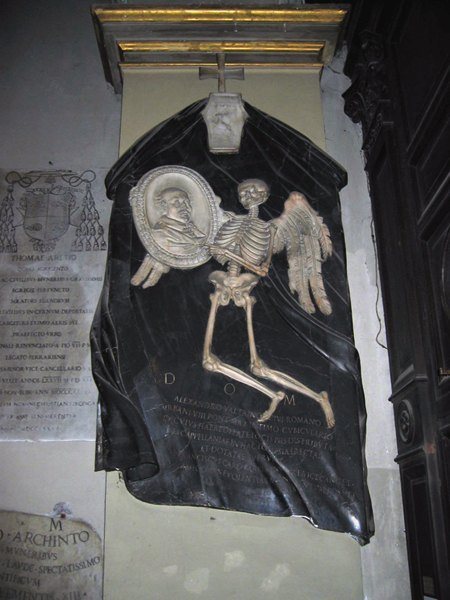
Bernstock places these works in a tradition in which Death can preserve a memory as well as mark its end. The contrast is visible in the work carried out by the skeleton. The teeth that make the skull immediately recognisable also keep the writing raised. The feet set the action against the door and the wings give it the appearance of being in progress. The visitor encounters an act of display whose purpose is to make the words of an epitaph visible. Its folds and the means of holding it are part of that purpose. [1][3]
Discussion
The skeleton uses both its hands and teeth to hold the marble cloth open.
Reader Insights
Where can you see the weight of the inscription and its support?
What changes when the memorial is read from below the doorway?
How does this skeleton’s role differ from the one on Valtrini’s memorial?
Join the Conversation
Share a detail, comparison or question about Memorial to Ippolito Merenda by Gian Lorenzo Bernini and Workshop below.
References
- Bernstock, Judith E. “Bernini’s Memorials to Ippolito Merenda and Alessandro Valtrini”. The Art Bulletin 63, no. 2, 1981, pp. 210–232. Accessible transcription. View source: “Bernini’s Memorials to Ippolito Merenda and Alessandro Valtrini” View source: Accessible transcription
- Turismo Roma. Chiesa di San Giacomo alla Lungara. Church history and description of the memorial. View source
- Fagiolo, Marcello. “Tra Morte e Assunzione in Cielo”. Study of the memorial, former convent and church setting. View source
- Fagiolo, Marcello. Tra Morte e Assunzione in Cielo, 2020. Comparative account of the Chigi pavement, papal tombs and meaning of the cloth.
- Kapustka, Mateusz. Der Körper des Künstlers als Bild, p. 164 n. 11. The Roman memorials as precedents for Alexander VII’s tomb.
- Lombardia Beni Culturali. Altare per esequie di Anna Marcybella Pac a Wilno, record 4y010-26764. Milan drawing and commentary on the Roman monuments.
- Czyżewski, Krzysztof J., and Marek Walczak. The Monuments with Portrait Busts of the Bishops of Cracow: On the History of the Reception of Roman Baroque Models of Sepulchral Art in Poland, p. 196. The Zaleski memorial and Roman precedents.








