


 by Tom Gurney
Tom Gurney BSc (Hons) is an art history expert with over 20 years experience
Published on June 19, 2020 / Updated on November 18, 2026
Email: tomgurney1@gmail.com / Phone: +44 7429 011000
Self Portrait 1638
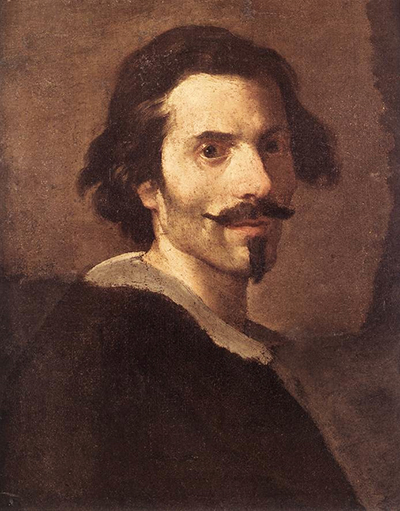
Gian Lorenzo Bernini turns his face towards the viewer while his dark-clad body continues across the canvas in profile. The head stands out against a lighter area of the background, and a few strokes of white at the neck mark the turn of the clothing. The Galleria Borghese holds this oil on canvas as inventory 545 and dates it to about 1635–40. A date around 1638 is one proposal within that range. The painting is a distinct work from the Uffizi self-portrait of similar date. It has also been discussed as a possible fragment of a double portrait, a suggestion the Borghese catalogue treats as open. [1][2]
At a Glance
- Datec. 1635–40
- Location or statusGalleria Borghese, Rome
- WorkOil on canvas, inventory 545
The work in Bernini’s career
David
1623–24St Peter’s Baldachin
1624–33Self Portrait 1638
c. 1635–40Looking back over the shoulder
The direction of the body is visible in the shape of the cape and the way it passes out of the picture. The face has to turn against that direction to meet the viewer. Bernini keeps enough of the shoulder in view to make the turn legible. In a tighter crop the head could look almost frontal. With the shoulder and collar present, its position appears to be one that has been reached through movement. The eyes complete the encounter while the body still belongs to the space at the side of the canvas. [1]
The edge of the hair merges with the ground in some places, while small differences in tone distinguish it in others. The background lightens near the head, giving an area of separation that does not depend on a continuous outline. The paint around the eyes and nose has to convey smaller differences than the paint of the cape. The collar can be suggested by a few quick changes in value, while the face needs a more particular account of the turn from a lit surface into shade. The balance between the two speeds of description lets the viewer recognise the clothing without losing the expression among its details. [1]
A lighter patch beneath the ear interrupts the darker area of the beard. The Borghese catalogue reports the suggestion that the passage may be evidence of an unfinished state. That possibility concerns a specific part of the surface. It need not explain every loose passage in the portrait. The fabric and the background can carry broad directional information even where the individual brush marks remain apparent. The tighter attention to the face helps distinguish what the painter chose to develop in detail from the parts that establish its position on the canvas. [1]
What the date rests on
The portrait has been assigned dates ranging from the 1620s to the 1650s. Pietro D’Achiardi supported the attribution to Bernini early in the twentieth century and placed the picture among his earlier works. Later scholars have found the sitter’s apparent age hard to reconcile with that proposal. Valentino Martinelli suggested a date in the 1650s, reading the thin face in connection with an illness in that period. Tomaso Montanari has argued that the style and the appearance of a man of about forty fit a date around 1638. The museum adopts a range around the second half of the 1630s. It presents the individual years as interpretations of evidence rather than a date inscribed on the painting. [1]
The different proposals show the difficulty of turning an expression into a chronology. A dark area below an eye could result from the sitter’s appearance, the direction of light or the painter’s decision to give weight to the gaze. The catalogue compares the portrait with examples in which Bernini depicted himself at different ages and notes that the direction of the body in the Borghese canvas is shared by several works associated with the 1630s. In the gallery’s younger self-portrait, dated about 1623, the turn goes the other way. The visual pattern offers context for the apparent age without requiring one feature to carry the whole case. [1][3]
Could it have been part of a double portrait?
Maurizio and Marcello Fagiolo dell’Arco proposed that the canvas had formed part of a documented double portrait of Bernini with a woman, probably Costanza Bonarelli. In that reconstruction the original painting would have been divided between 1681 and 1706. Kristina Herrmann Fiore drew attention to the more pronounced fringe at the right edge of the Borghese canvas, which she considered compatible with cutting on that side. A cut could help account for a change in the dimensions of a painting. It cannot on its own identify a lost companion figure or the appearance of the work before separation. [1]
Montanari questioned the identification on compositional grounds. He suggested that in a double portrait the two sitters might have been turned to exchange glances, while the surviving face directs its attention towards the viewer. He also identified a possible reference to Raphael’s portrait of Bindo Altoviti. In Raphael’s painting the body turns away and the face looks back over the shoulder, with a hand and a ring contributing to the effect of a person momentarily arrested in a turn. In Bernini’s self-portrait the head, collar and shoulder perform most of that work. The parallel concerns the organisation of the pose. The proposed connection remains a reading of the picture rather than a documented source. [1][4]
Testing a likeness across collections
The Musée Fabre in Montpellier holds a painting it calls Portrait d’homme (Autoportrait?), dated around 1630–40. Its record includes an attribution to Bernini and the later proposal that the painting came from his circle. This makes it a useful comparison with the Borghese painting, whose authorship the owning gallery regards as secure. The Montpellier canvas can show how the turn of the head and the arrangement of a dark garment recur in related portraits. The open questions over artist and sitter limit its use as evidence for the date or authorship of another picture. [5][6]
A drawing at the Städel Museum offers a comparison in another medium. The museum attributes it to Bernini, dates it to around 1635 and catalogues it as a male portrait in three-quarter profile. It records wording on the back of the mount identifying Bernini as both subject and author. The museum’s descriptive title leaves the sitter open. The difference between the inscription and the catalogue title is important. The inscription documents how the drawing was identified at some point in its history. Its presence on the mount leaves the date and authority of the identification to be established separately. The drawing can be considered alongside the Borghese painting for the direction of the face and the concentrated attention given to the eye without assigning the man the same name. [5][7]
The two comparisons show why a group of similar-looking images is difficult to turn into a sequence of self-portraits. A picture can be securely assigned to Bernini while the sitter is uncertain, or a sitter can resemble the sculptor in a work whose authorship is disputed. In the Borghese canvas, the turn from the shoulders to the eyes remains a visible basis for comparison. Whether the sitter represents Bernini in other works rests on the evidence for each of those works. [5][6][7]
A face on the fifty-thousand-lira note
In the design described by the 1984 decree, Bernini’s portrait occupies the right of the front of the note. The Bank of Italy describes a violet-red engraved image bounded by an oval formed from lines in the background. The portrait also appears in the watermark. The name around the printed image identifies the man outside any museum context. Dark strokes and areas of lighter paper take the place of the oil’s differences between the coat, the collar and the skin. The turn of the face is still readable when the portrait is reduced to a fraction of the canvas’s size. [5][8]
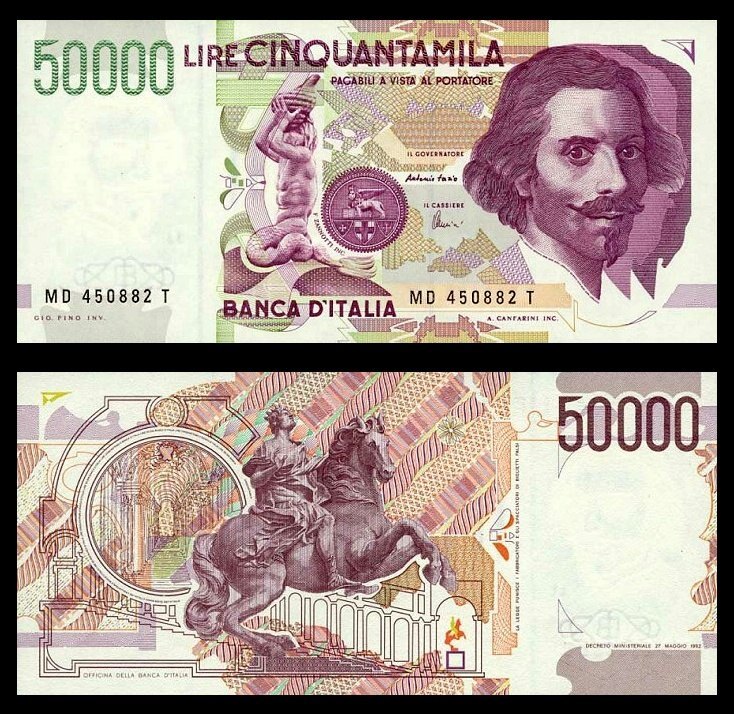
The first issue places a detail of the Triton Fountain towards the left and images of Bernini’s work elsewhere in the design. This creates a different relation between the face and the artist’s career. An unlabelled oil portrait can be approached initially as a painted likeness. The banknote names the sitter and associates him with works of sculpture and architecture in a single object made to circulate. The repeated image in the watermark could be encountered by holding the note up to the light. That made one adaptation of the painting visible in two different ways on the same sheet. [5][8]
From a private collection to the Borghese
Baron Otto Messinger donated the painting to the Galleria Borghese in 1911. The gallery notes that works in his possession had come from the Chigi family, but that the connection has not been documented for this canvas. Its recorded arrival in Rome’s public collection therefore has a firmer basis than the proposed Chigi provenance. The gallery also records a series of treatments and diagnostic studies, including work in the 1990s. The dimensions of the canvas and the evidence of its edge belong to the history of the object that entered the museum, while the identification of a companion painting still depends on linking that object to earlier records. [1]
The Borghese gives the canvas’s dimensions as 53 by 43 centimetres and records a larger, black-ground frame decorated with flowers and rosettes. The dimensions of the frame are catalogued separately from those of the painting. That distinction is useful to the question of the right edge. The frame defines an outer perimeter for a visitor, while evidence of trimming has to be sought in the canvas itself. The museum lists restorations in 1936 and 1950, as well as its later diagnostic work. Those entries document the picture’s treatment during its lifetime at the gallery. [1]
The work later circulated widely through its use on the Italian 50,000-lira banknote. The banknote gave the face a public identity independently of the canvas and its frame. In the painting itself the collar, shoulder and background are needed to see how that gaze was constructed. They establish the direction from which the figure turns, giving an image that can be recognised in isolation a more particular relation to its setting. [1]
Discussion
The body remains in profile while the face turns out of the background.
Reader Insights
How does the light behind the head affect its outline?
What changes when it is compared with the young Borghese self-portrait?
Why might an inventory number help more than a conventional date in the title?
Join the Conversation
Share a detail, comparison or question about Self-Portrait of Gian Lorenzo Bernini, circa 1638 below.
References
- Galleria Borghese. Self-portrait at a Mature Age. Inventory 545, chronology, attribution, provenance and technical observations. View source
- Fondazione Federico Zeri. Autoritratto di Gian Lorenzo Bernini. Catalogue and photographic record of the separate Florence self-portrait. View source
- Galleria Borghese. Self-portrait as a Young Man. Inventory 554, dated about 1623. View source
- National Gallery of Art, Washington. Bindo Altoviti. Raphael’s portrait, accession 1943.4.33. View source
- Galleria Borghese. Autoritratto in età matura. Italian catalogue for inv. 545, comparative portraits and the banknote adaptation.
- Musée Fabre. Portrait d’homme (Autoportrait?). French object record, sitter and attribution history.
- Städel Museum. Männliches Porträt im Dreiviertelprofil nach rechts. German object record, 13675 Z, maker, date and mount inscription.
- Banca d’Italia. Normativa sulle emissioni, 1981–97. 1984 decree, Gazzetta Ufficiale, no. 327. The printed design and watermark.








