



 by Tom Gurney
Tom Gurney BSc (Hons) is an art history expert with over 20 years experience
Published on June 19, 2020 / Updated on November 18, 2026
Email: tomgurney1@gmail.com / Phone: +44 7429 011000
David
David twists above a piece of discarded armour. His feet are spread, his arms cross in front of him and his eyes fix on a point beyond the marble. The sling is already in his hands. Gian Lorenzo Bernini gives the young fighter the posture of someone about to send a stone out into the space where the viewer stands. The sculpture, made in 1623–24, is now in the Galleria Borghese in Rome. It stands 170 centimetres high and is carved from white marble, possibly from Carrara. [1]
At a Glance
- Date1623–24
- Location or statusGalleria Borghese, Rome
- WorkWhite marble statue, 170 cm high
The work in Bernini’s career
The Rape of Proserpina
1621–22Apollo and Daphne
1622–25David
1623–24St Peter’s Baldachin
1624–33The story has a visible hero and an opponent who has to be imagined. There is no second figure on the base. David’s gaze establishes the direction of the encounter, while the disposition of his arms and feet lets a viewer anticipate how he will act. The small things underfoot, easy to miss on a first look, tell us how he came to be standing like this. [1]
Five stones and a sling
In the First Book of Samuel, Goliath challenges the Israelites to send a champion against him. David comes to the camp with provisions for his brothers and hears the challenge. Saul offers him armour, which David tries and removes because he is unaccustomed to it. He takes smooth stones from a stream and goes forward with his sling. The story places unusual weight on that choice of equipment. What Saul provides would have made David look like a warrior of the army. David relies on a weapon he already knows how to use. [2]
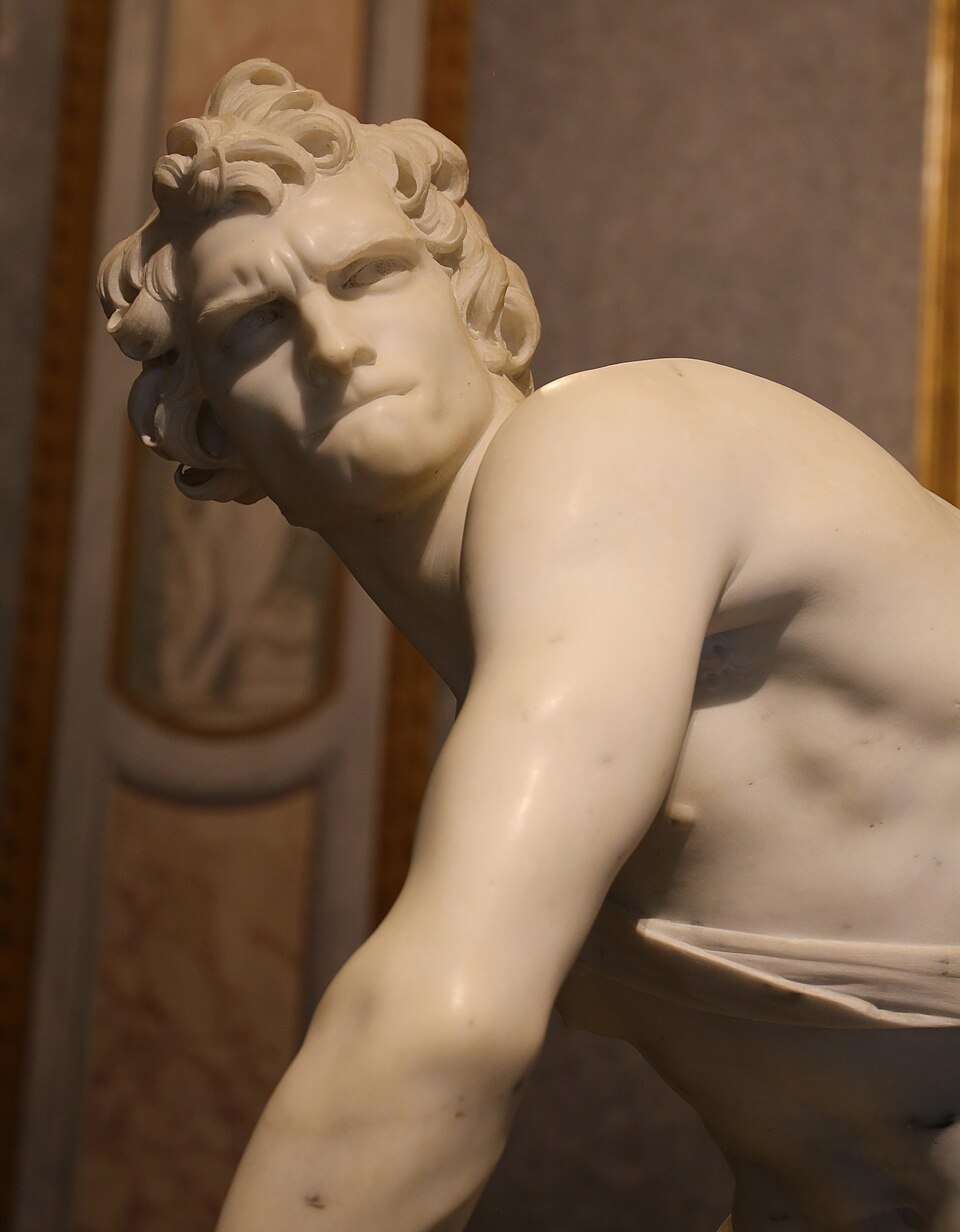
Bernini chose the moment before the stone leaves the sling. David has drawn his arms across his body and set his weight over his bent legs. His brow and mouth have tightened with the effort. The turn across his middle gives his upper body a different direction from the spread of his feet. A viewer can infer the next motion from the difference. The knot of bodily effort belongs to the instant immediately before the cast, when David still has the stone and Goliath is still somewhere in front of him. [1]
The biblical account goes on to describe the stone striking Goliath and the consequences of his fall. Bernini leaves those later actions to the viewer’s knowledge of the story. The work instead gives close attention to a brief change in balance. David has to keep his footing long enough for the motion of his arms and torso to carry the sling through. The figure’s concentration suggests how little of his attention is available for anything else. [1][2]
Armour beneath the figure
Look between David’s legs and the relationship between story and stone becomes especially clear. The Galleria Borghese identifies the cuirass as the armour he has put aside. Its position under the body also gives the marble an additional point of support. David’s equipment is part of the account of the combat and of the practical arrangement that makes his stance possible. From the front, the support can remain close to the body without interrupting the silhouette of the arms. [1][2]
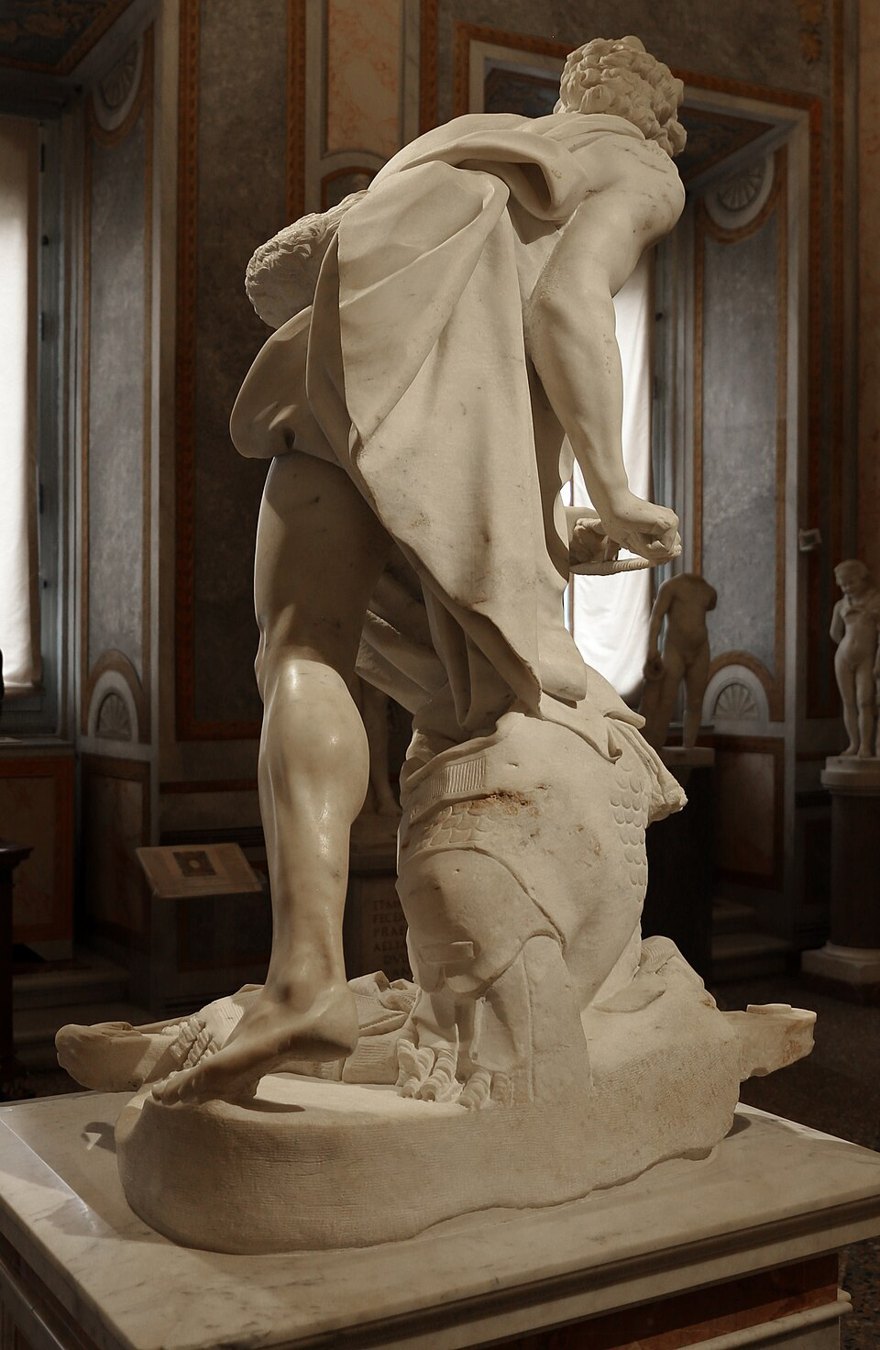
The other object near the ground is a stringed instrument. The museum associates it with David’s later thanksgiving and identifies the eagle’s head at its end as a device of the Borghese family. It therefore brings two times and two settings together. The instrument looks forward from the combat to David’s music. The eagle refers to the family for whose villa the sculpture was completed. Both clues are set low enough that someone absorbed by the figure’s face might initially pass over them. [1]
The place of the viewer
The museum describes a position against a wall and a low original base. From the frontal view, looking towards David means standing in the direction he is watching. The Borghese catalogue associates that position with Goliath. The missing antagonist is supplied by the direction of the figure’s attention and the placement of the viewer. It is one reason the sculpture can make the encounter feel immediate with only one person represented in stone. [1]
A later visitor can also move around the marble. The catalogue records that parts of the back were unfinished and the left heel was absent until twentieth-century restoration. Those details give the historic placement a physical basis. They also change how we look at the rear today. Its different finish supplies evidence about the conditions under which Bernini expected the work to be seen. An angle accessible in the modern gallery may therefore show something about the sculptor’s priorities that a seventeenth-century visitor had little chance to inspect. [1]
In the same collection, Apollo and Daphne was also put near a wall, but the intended approach led visitors along Apollo’s right side. The visitor could discover the transformation as the relative positions of the figures changed. David concentrates more of the action in an initial meeting from the front. Together the two works show that the use of a wall could give Bernini different ways to control where and when a story became clear. [1][3]
Who commissioned David?
The Galleria Borghese traces the commission back to Cardinal Alessandro Peretti Montalto, who requested a work on the subject in March 1623. His death in June halted that project. Cardinal Scipione Borghese took up the commission, and Bernini interrupted work on Apollo and Daphne to carry it out. The eagle on the instrument ties the finished work to the patron for whom it entered the collection. The chronology makes it possible to distinguish the first commission from the circumstances in which Bernini finished the surviving marble. [1][3]
The early biography by Filippo Baldinucci says that the work took seven months. It also tells a story about Cardinal Maffeo Barberini holding a mirror while Bernini used his own features for the hero’s face. The Galleria Borghese reports both episodes as early testimony. The second offers a way to think about modelling an expression from life, but the pose and gaze still make sense without a secure identification of the face as Bernini’s own. [1]
Keeping the sling clear of the body
The sling is a narrow piece of stone between two hands. It is also one of the parts least able to tolerate the force required to remove the marble around it. In a conservation study of Saint Bibiana, Maria Grazia Chilosi identifies the suspended part of David’s sling as a separate insert. This is a practical difference between making hands that appear to hold a continuous object and carving the entire object continuously with those hands. A join can help preserve the open interval that makes the tension of the sling visible. [6]
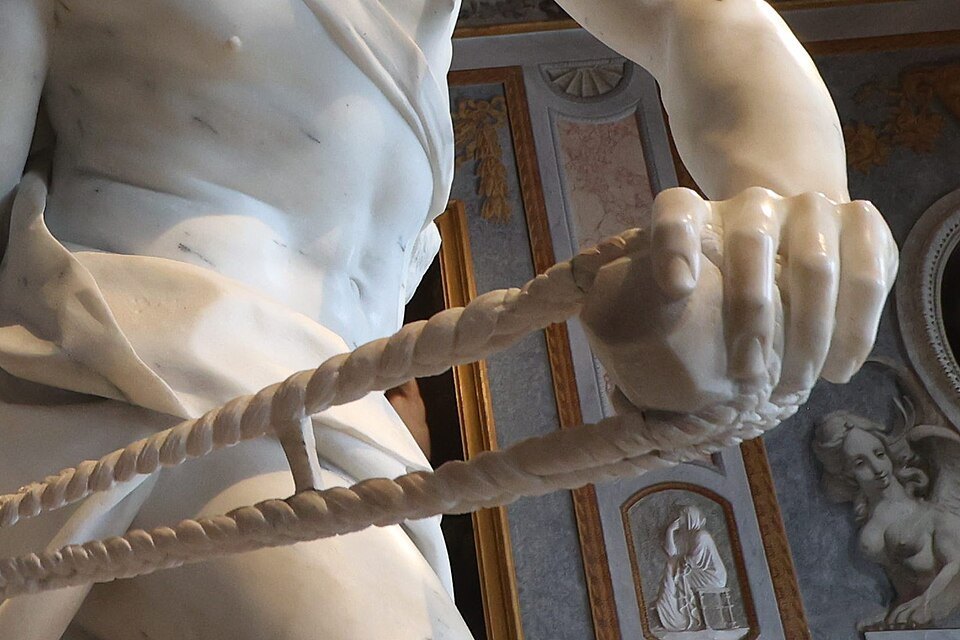
The same study identifies another insert in a large fold under the fur bag. The two pieces raise different questions. The sling needs to be read across an opening. The fold needs to continue a shape partly hidden by the material above it. Chilosi suggests that some such additions in Bernini’s early works helped resolve difficulties with the stone. That possibility accounts for an insert under a fold without assuming it was devised for the same reason as the sling. Both passages show how little the visible action tells us about which bits of stone were made together. [6]
There is additional evidence in the parts of the surface that are hard to see from in front. The conservation account notes mineral inclusions and traces of yellow-orange limonite on the reverse, as well as areas of incomplete finish. Such traces are useful for comparison with other Bernini marbles, but similarities in visible inclusions alone cannot assign the block to a particular supplier or quarry. The rougher passages and the finished sling offer two different kinds of information. One helps locate parts that were given less attention from the intended view. The other marks a place where a small piece of stone had to carry an important part of the action. [6]
The base and the line of the shot
Chilosi identifies Bernardino Radi with the worked base of 1624. Putting a name to the base extends the commission beyond the figure itself. The Borghese’s account of the statue stresses the original base’s low height, which brought the action closer to the observer’s level. It is worth considering that height together with the opening between the two hands. The sling makes sense as part of a movement across the body. When the figure stands low enough for a viewer to look almost along that movement, the sculpture can suggest a target in the space beside the viewer. Raising the same figure substantially would change the angle from which people see the sling, even if they stood at much the same distance. [6][7]
Two photographs and a disputed viewpoint
Luca Simonato’s study of the young Rudolf Wittkower reproduces two photographs of David taken by his sister Käte, one frontal and one from the side. Simonato also discusses Max Raphael’s German captions of 1928, which dismiss one view and value another for making the figure’s motion emerge from the space around it. Wittkower, as Simonato explains, later argued for a principal view nearer the central axis. Two viewers could therefore agree that the sculpture had a privileged aspect and still disagree about which angle made its action most legible. [8]
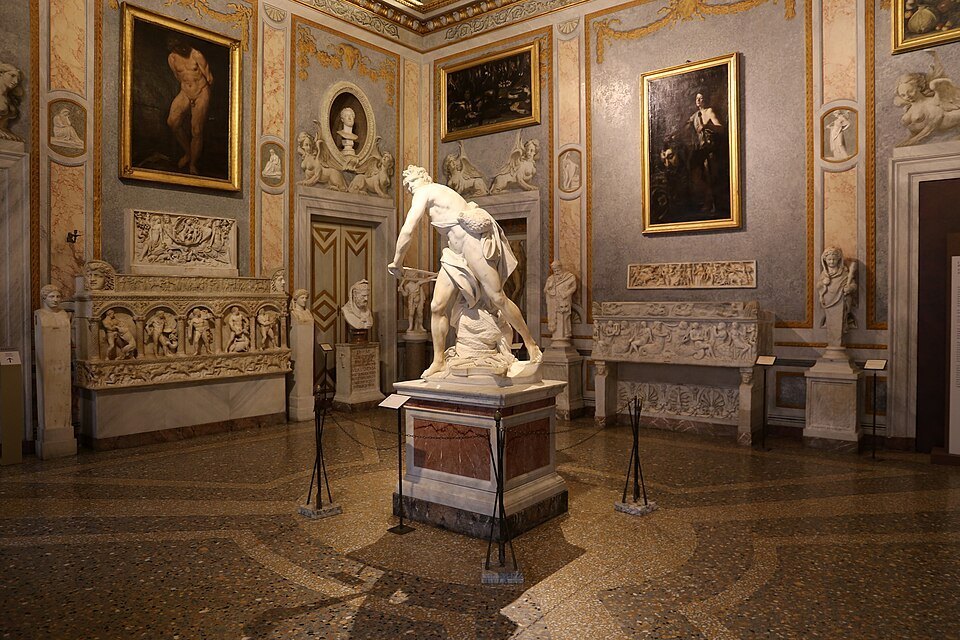
Try asking a more particular question of each view. From one angle the face and the direction of the gaze are especially easy to read. From another the back and the set of the legs offer clearer information about the turn. The photographs make it possible to compare those effects without assuming that one image represents the entire encounter. They also show why the apparent direction of the throw was a matter of argument in twentieth-century writing about the statue. Discussion of the original setting can constrain the possibilities. It still leaves room for disagreement about which view reveals most about the work. [7][8]
Earlier bodies in motion
Michelangelo’s David in Florence presents a figure standing upright while his attention is already engaged. Bernini gives the same anticipation a different physical form. His David has already arranged the body for a specific movement, and the compressed face accompanies the turn of his shoulders and arms. The difference is especially plain if we look first at the relation of the feet to the direction of the head. Each work uses that relation to show how much of the action still lies ahead. [1][4]
The Borghese catalogue also compares the twisting figure with the marble known as the Borghese Gladiator, now in the Louvre, and with Annibale Carracci’s painted Polyphemus at Palazzo Farnese. The ancient figure offers a comparison for a body that seems to extend into space under pressure. Carracci provides an example of a violent action implied by the movement of a figure. These comparisons help identify practical choices in Bernini’s treatment of the biblical story. Follow the feet, then the armour, then the sling. Finally return to the gaze that first drew you in. All four details have a part in making the instant before the throw intelligible. [1][5]
Related videos
Choose from five films: close studies of Bernini’s works alongside wider context on his methods and career.
Bernini, David
Study the twisting pose and the viewer’s involvement in Bernini’s David.
Watch on YouTubeDiscussion
The sling gives David’s crossed arms a purpose beyond the marble.
Reader Insights
Which part of the figure first tells you where Goliath must be?
How does the discarded armour affect the balance of the pose?
Where would you place the viewer in relation to the implied line of the shot?
Join the Conversation
Share a detail, comparison or question about David by Gian Lorenzo Bernini below.
References
- Galleria Borghese. David, inv. LXXVII. View source
- Bible Gateway. First Book of Samuel, chapter 17. View source
- Galleria Borghese. Apollo and Daphne. View source
- Galleria dell’Accademia di Firenze. Michelangelo’s David. View source
- Musée du Louvre. Le gladiateur Borghèse. View source
- Chilosi, Maria Grazia, et al. Conservation study of Bernini’s Santa Bibiana, Bollettino d’Arte. Comparison with David’s marble, incomplete areas and inserts. See the discussion of Bernardino Radi and notes 4, 6, 9 and 17.
- Galleria Borghese. David. Catalogue discussion of the original height, position and sightline.
- Simonato, Luca. “Un punto di vista unico sulla Galleria Borghese: il giovane Wittkower a Roma (1923–1927)”. Discussion of Käte Wittkower’s photographs, Max Raphael’s German captions and Rudolf Wittkower’s account of a principal view. See fig. 5 and note 82.









