


 by Tom Gurney
Tom Gurney BSc (Hons) is an art history expert with over 20 years experience
Published on June 19, 2020 / Updated on November 18, 2026
Email: tomgurney1@gmail.com / Phone: +44 7429 011000
Barberini Fawn
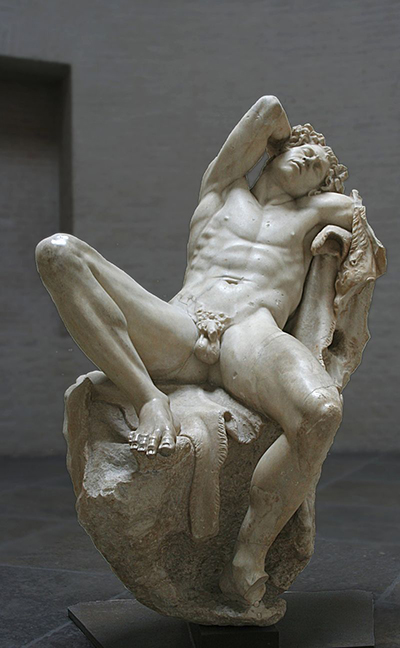
In Munich’s Glyptothek, an over life-size satyr sleeps against a rock. His eyes are closed and one arm bends above his head, stretching the chest even as the face relaxes. The marble is ancient, but the figure that visitors see reflects a long history of restoration. It entered the Barberini collection in Rome after its discovery in the seventeenth century. Some accounts have associated Gian Lorenzo Bernini with its early restoration, an attribution that scholars have questioned. A terracotta in Berlin, historical prints and records of later interventions help explain why the sculpture’s present form cannot be assigned wholesale to any one restorer. [1][2][3]
At a Glance
- Location or statusGlyptothek, Munich
- WorkAncient marble satyr. Bernini’s role in its restoration is uncertain.
The work in Bernini’s career
Apollo and Daphne
1622–25Ecstasy of Saint Teresa
1647–52St Peter’s Square
1656–67Barberini Fawn
Date discussed in the articleAn ancient body in an unsettled pose
The figure’s pointed ears and tail identify a satyr, a creature associated with Dionysus and his followers. Yet it is the distribution of the body's weight that first explains what the creature is doing. The head rests against the raised shoulder and the muscles of the chest follow the arm lifted above it. The open arrangement of the legs and the angle of the torso expose much of the figure at once. In a standing sculpture that much torsion could suggest preparation for movement. Here the head, limbs and rock direct the weight back into a pose of sleep. [1][2]
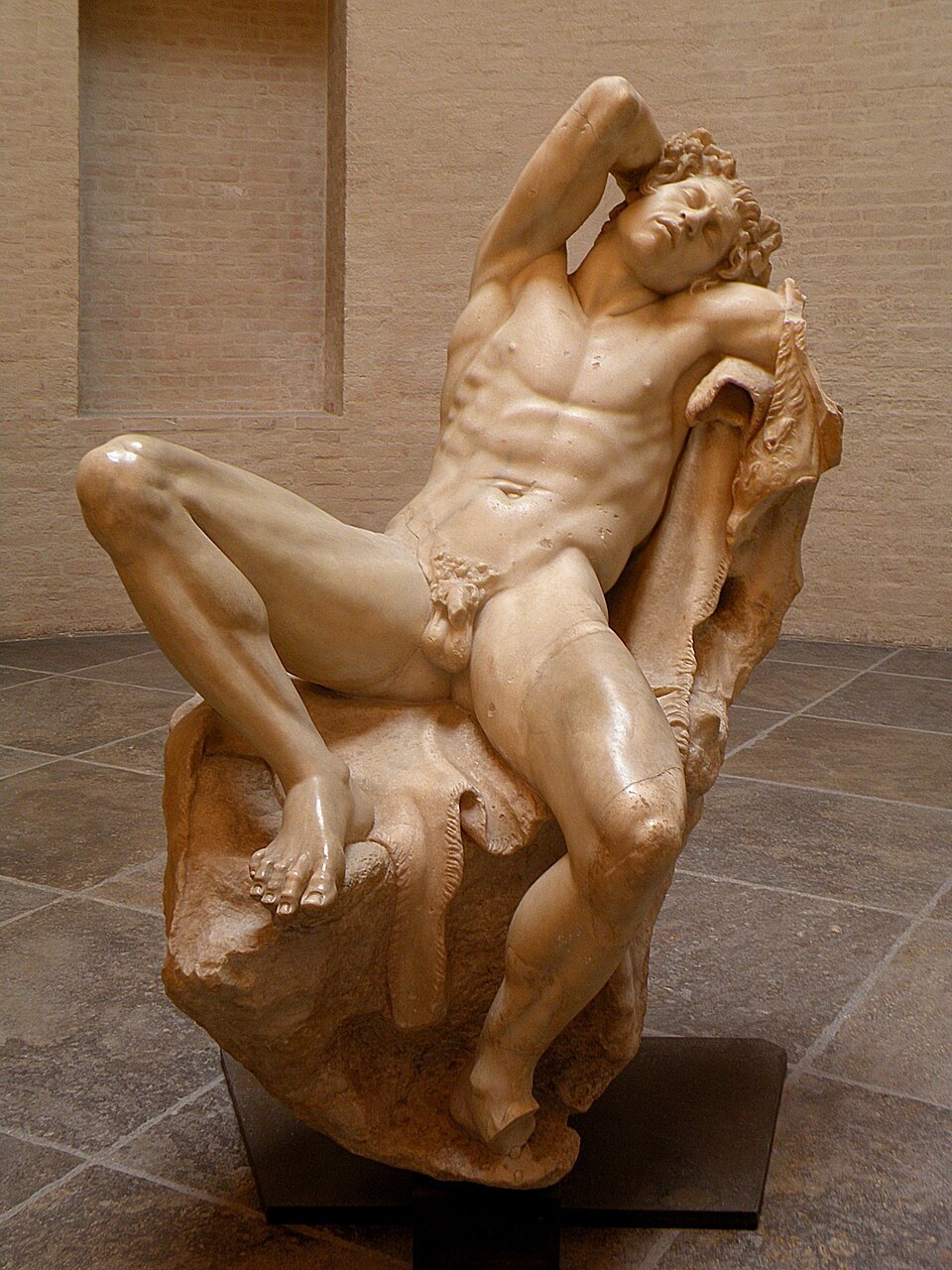
Jean Sorabella sees the bent arm, twisted torso and spread legs as clues to a subject more specific than sleep alone. She interprets the figure as a satyr overcome by drink and vulnerable to capture, and proposes a connection with the story of King Midas. This is an interpretation supported by comparisons with other ancient images. The viewer can see the bodily signs of sleep without accepting a particular narrative. The exact origin of the marble remains debated as well. Cambridge’s cast catalogue allows for a Hellenistic original, a Roman copy, or a Roman creation in a Hellenistic idiom. [1][2]
The modern position of the right leg affects this reading. Move the foot farther from the body and the figure appears differently balanced against the rock. Scholars have also considered whether the torso originally reclined farther. Sorabella argues that the carving on the back supports a partly upright attitude, while leaving the exact placement of the leg open. The largest part of the ancient gesture remains visible in the raised arm, the turning chest and the resting head. The restored support and limbs nevertheless affect how readily the figure looks at ease. [2]
Discovery and the disputed Bernini connection
The antiquarian Cassiano del Pozzo recorded that the sculpture had been found in works near Castel Sant’Angelo and taken to the gardens of Cardinal Francesco Barberini. Sorabella links the discovery to the probable period of work on the fortifications in the 1620s. Cassiano called it a torso and compared its quality with the celebrated Belvedere Torso. The ancient head was already part of what had been found, but important portions of the limbs were missing. The word torso in that early account captures how differently an observer could have encountered the sculpture before its completion for display. [1][2]
Bernini’s name has been attached to the statue’s restoration, including to a stucco pedestal that once supported it. Sorabella documents the disagreement. Jennifer Montagu rejected the tradition and Francis Haskell and Nicholas Penny doubted it. Other scholarship has examined evidence for possible involvement, including a small model attributed to Bernini’s workshop. There is no secure basis here for calling the present limbs Bernini’s work. The early restorations were repeatedly altered, and a workshop model can document knowledge of the statue without identifying the hand responsible for every addition to it. [2][3]
The early images belong to that same problem. A print represents the sculpture as someone chose to render it at one date. It can preserve a configuration that changed later, but an image might also suggest a completion. Sorabella discusses an illustration of 1642 that shows the figure lying flatter, and reports scholarship comparing its treatment with a drawing by Michelangelo. The comparison gives a concrete reason to read an early print carefully before using its outline to establish the precise placement of missing stone. The Rijksmuseum’s later engraving by Louis Desplaces, after a drawing by Charles Joseph Natoire, likewise has a history of its own in addition to the one it records. [2][4]
What the French marble records
Edme Bouchardon began his marble copy in Rome late in 1726 while studying at the French Academy. The Louvre dates its completion to July 1730 and records its installation in the Louvre’s antiquities room the next year. The French copy stands 1.84 metres tall. The Getty’s exhibition checklist records its weight as 1,800 kilograms. The measurements give a sense of what it took to transport the copy from Rome and put it on display in Paris. Its completion predates the Pacetti restorations, so its appearance can be weighed against the later terracotta in Berlin. Bouchardon’s choices are evidence of how the Roman marble could be seen and interpreted in the 1720s. The copy has no direct bearing on who carved any particular early addition. [7][8][9]
Louis XV gave the copy to the Marquis de Marigny in 1753. Isabelle Gensollen’s study of the administration of the arts under Louis XV links that gift to a record in the French national archives. The Louvre traces the marble to the garden of Marigny’s Paris residence, then probably to the garden at Monceau. After a revolutionary seizure it was sent to the museum, and in 1802 it was requested for a fountain basin at Saint-Cloud, where it appears in an 1824 inventory. It later stood in the Luxembourg garden and re-entered the Louvre in 1892. This sequence follows Bouchardon’s marble through spaces in which it was viewed as an example of antique sculpture, a private garden figure and a work in a public collection. The ancient original was still following a separate route from the Barberini collection towards Munich. [7][9]
A sale negotiated in the sculptor’s lifetime
Vincenzo Pacetti’s journal offers a view of the purchase before the restoration entered the dispute over ownership. An entry for 27–28 December 1798, transcribed in a study of the painter Prospero Mallerini, records the duke sending Mallerini to find out whether Pacetti would consider buying some sculptures from his gallery. Pacetti went to make a selection, and the Faun appears in the list that followed. This gives the negotiation a named intermediary and puts the statue among several works under consideration. Lucia Faedo’s study uses papers from the Barberini archive at the Vatican Library to fill gaps in the surviving state archive documentation for the sale and the dispute that followed. The records distinguish the question of what Pacetti acquired from the questions of what was added and how much the work was worth after restoration. [10][11]
When a plaster cast became a working model
Hans Walter used a cast transferred from the Technical University in Munich to investigate the position of the right leg in 1958. The original was unavailable while the Glyptothek was being rebuilt. Walter worked from acquisition papers, correspondence, drawings, prints and small models, and with the sculptor Eberhard Luttner tried a higher, less widely spread leg on the cast in 1959–60. The account in the Munich cast museum’s history specifies that this proposal was only partially reflected in decisions taken for the original in 1965. It was possible to test a pose at the scale of the statue before making a corresponding change to the marble. [12]
The University of Zurich holds a cast formed before 1965, which preserves the more widely spread Pacetti leg. Its catalogue dates the remodelling in plaster of the present right leg to 1984 and describes it as less widely spread. The casts help compare the historical poses because each fixes the legs in a particular relation to the rock. The Zurich cast records a display condition that was subsequently altered, while Walter’s cast shows how a duplicate could serve as the working surface for a proposal. The Munich marble’s replacement leg incorporates the outcome of modern decisions made in the absence of the original limb. [12][13]
The Pacetti restoration and the move to Munich
The Berlin sculpture collection holds a fired clay figure dated 1799. Its catalogue connects the model with the replacement of older additions at the end of the eighteenth century. It credits Giuseppe Pacetti with the intervention, undertaken on behalf of his father Vincenzo. Lucia Faedo’s study of archival records places Vincenzo at the centre of the purchase and of a subsequent dispute about the restoration and ownership. Reading these records together separates the business history of the marble from the workshop attribution given to the model in Berlin. The terracotta preserves evidence of how the added parts looked in an earlier state of the work. [3][5]
The marble eventually went to Bavaria for Ludwig’s planned Glyptothek. Sorabella records that it reached Munich in 1820. The sculpture’s position in a collection of antiquities gave viewers another context in which to consider the relationship between the surviving stone and the added parts. During the Glyptothek’s twentieth-century renovations, the old marble additions and stucco base were removed. Sorabella describes the use of a replacement for the right leg derived from the earlier restored pose. The restoration history thus includes both the subtraction of old elements and a continued decision about how to let viewers read the position of the body. [2][3][6]
A cast, a print and the marble answer different questions about that history. A cast allows the viewer to study a three-dimensional position even when the original is elsewhere. A print can show an older profile and the arrangement of a support. The original preserves ancient surfaces alongside evidence of later intervention. Begin with the raised arm and closed eyes, which give the figure its most immediate signs of sleep. Then follow the torso down to the legs and the rock. The point at which the figure appears to settle into its support is also where successive restorers had to make decisions that remain visible in its display. [1][2][3][4]
Discussion
The marble preserves the effects of several campaigns of restoration.
Reader Insights
How do the bent arm and stretched chest convey sleep?
Which aspect of the figure would a historical print help to date?
What can a terracotta comparison contribute to the question of Bernini’s involvement?
Join the Conversation
Share a detail, comparison or question about The Barberini Faun below.
References
- University of Cambridge, Museum of Classical Archaeology. Barberini Faun, cast 361 and Glyptothek original 218. View source
- Sorabella, Jean. “A Satyr for Midas: The Barberini Faun and Hellenistic Royal Patronage”. Classical Antiquity 26, no. 2 (2007), pp. 219–48, especially pp. 221–23 and notes 2–11. Author’s article, digitised copy. View source: “A Satyr for Midas: The Barberini Faun and Hellenistic Royal Patronage” View source: Author’s article, digitised copy
- Staatliche Museen zu Berlin. Der Barberinische Faun, M 290, terracotta connected to the Pacetti restoration. View source
- Rijksmuseum. Beeld van een slapende faun, RP-P-OB-63.867, Louis Desplaces after Charles Joseph Natoire. View source
- Faedo, Lucia. “Statua e frammento. Pacetti, il Fauno Barberini e la valutazione del restauro”. Bollettino d’Arte. View source
- Staatliche Antikensammlungen und Glyptothek. Glyptothek Permanent Exhibition: Masterpieces of Ancient Sculpture. View source
- Musée du Louvre. Faune endormi, Edme Bouchardon, MR 1921. Collection history and dimensions.
- J. Paul Getty Museum. Bouchardon: Royal Artist of the Enlightenment. Exhibition checklist, no. 1.
- Gensollen, Isabelle. Administrer les arts sous Louis XV: le directorat du marquis de Marigny, p. 73.
- Note d’archivio su Prospero Mallerini, Archivio della Società romana di storia patria 139 (2016), p. 137, quoting Pacetti’s journal.
- Faedo, Lucia. Statua e frammento: Pacetti, il Fauno Barberini e la valutazione del restauro. Author’s summary of the Barberini archive evidence.
- Museum für Abgüsse Klassischer Bildwerke München. Lebendiger Gips, pp. 86–87. Account of Walter’s reconstruction and catalogue images of casts.
- Universität Zürich, Archäologische Sammlung. Highlights der Ausstellung. Description of the collection’s cast and the modern restorations.








