


 by Tom Gurney
Tom Gurney BSc (Hons) is an art history expert with over 20 years experience
Published on June 19, 2020 / Updated on November 18, 2026
Email: tomgurney1@gmail.com / Phone: +44 7429 011000
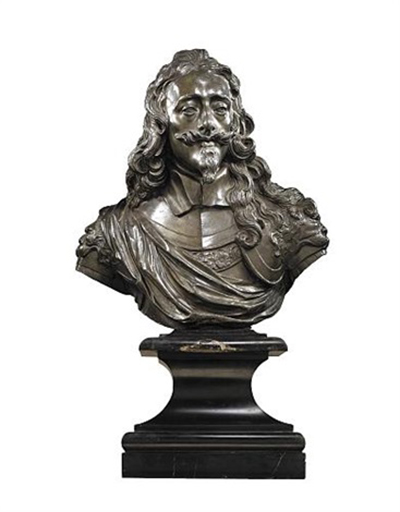
Bust of King Charles
Gian Lorenzo Bernini carved a marble portrait of Charles I in Rome in 1636. He worked from a painting sent from England, in which Anthony van Dyck showed the king from three angles on a single canvas. The bust was presented to Charles and Henrietta Maria at Oatlands in July 1637 and destroyed in the Whitehall Palace fire of 1698. Van Dyck’s painting survives in the Royal Collection. Together with the correspondence and records of the presentation, it shows how the commission was arranged and how a sculptor could study a likeness at a distance. [1][2]
At a Glance
- Date1636
- Location or statusDestroyed in the Whitehall Palace fire, 1698
- WorkMarble bust modelled from Anthony van Dyck’s triple portrait
The work in Bernini’s career
St Peter’s Baldachin
1624–33Bust of King Charles
1636Ecstasy of Saint Teresa
1647–52An exchange between England and Rome
On 17 March 1636 Charles wrote to Bernini about the project. As quoted in the Royal Collection catalogue, the letter anticipates a painted portrait being sent for Bernini to use in making the marble. The exchange involved more than the king and the two artists. Urban VIII arranged for the bust to be presented to Queen Henrietta Maria, and Cardinal Francesco Barberini was involved in the negotiations. The Royal Collection places the gift within a period when people in Rome hoped Charles might bring England closer to the Catholic Church. The sovereign in the portrait was also the subject of a diplomatic gesture addressed to his household. [1][2]
Charles already employed Van Dyck at court. The painter had represented him on horseback, standing and in other formats suited to different audiences. This assignment required a series of views that could be sent abroad together. A single formal likeness gives a viewer one selected aspect of the sitter. A sculptor needs to decide how the face projects, how the hair sits behind it and how those features change their relation as the head turns. Putting three views on one canvas gave Bernini a way to compare them without depending on three separately prepared pictures. The painting turned the prospect of a royal sitting into something portable. [1][3]
What the three views provide
Van Dyck painted Charles facing forward, in profile and at a three-quarter angle. The forward view establishes the proportions either side of the nose, including the position of the eyes and the extent of the moustache. The profile shows how far the nose and chin project. The three-quarter view lets the nearer cheek and the line of the farther side of the face be considered together. The Royal Collection also notes how the views show the fashion of wearing the hair longer on the left. A detail that might seem a passing effect in one view becomes a feature Bernini could identify across the canvas. [1]
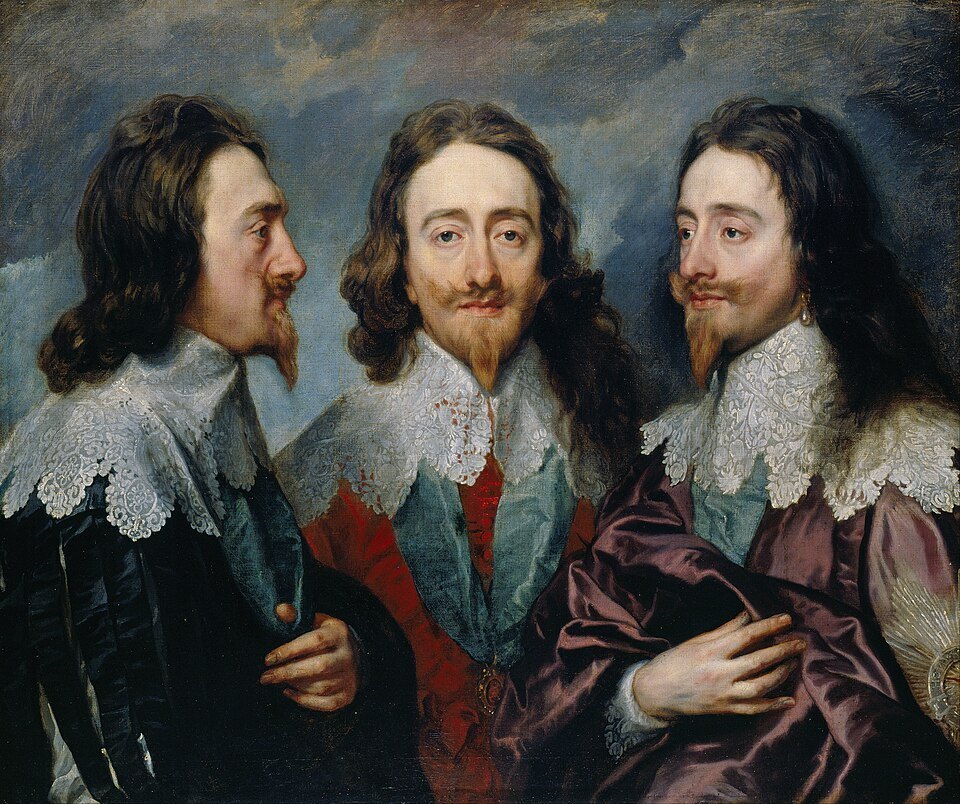
There are differences between the three appearances beyond the direction of the face. Van Dyck varies the colours of the clothes and the patterns of the lace collars, while the blue ribbon of the Garter gives the heads a common visual thread. The arrangement therefore presents several views of the same person without making them look mechanical. The Royal Collection proposes that Van Dyck knew Lorenzo Lotto’s portrait of a man in three positions, then in Charles’s collection. In the canvas sent to Rome, a similar arrangement served an identifiable task. It provided a set of likenesses for someone charged with turning a painted face into a solid object. [1]
The painting could offer views that complemented one another, while decisions about the bust remained with Bernini. The format gave him a choice about the direction of the finished head and a means of testing that choice against the other views. It could help him relate the outline of a feature to the planes seen from the front. A mould taken from life would have supplied a different kind of evidence. Van Dyck’s contribution was a series of selected and modelled appearances, so Bernini worked through another artist’s account of the sitter. The correspondence makes that division of labour unusually clear. [1][2]
Presentation and loss
The Royal Collection dates the carving to the summer of 1636 and the presentation to 17 July 1637. Its catalogue quotes a contemporary account that praises both the workmanship and the resemblance. That second point mattered particularly where the sculptor had worked abroad. The court was able to compare the result with the living king. The record establishes a favourable reception, while the bust’s loss prevents the same comparison today. In 1638 Bernini received a diamond ring valued at £800, another measure of how the commission was received. [1]
The sculpture’s destruction at Whitehall in 1698 left the picture that had served its preparation as the surviving object at the centre of the story. The painting had stayed with the Bernini family after being sent to Rome. It passed through later owners before George IV bought it in 1822. Its arrival in the Royal Collection was therefore a separate event from the arrival of the marble in England. The two objects travelled in opposite directions at the start of the commission. One carried information about the king to the sculptor, and the other brought the sculptor’s interpretation back to the court. [1]
Historic Royal Palaces dates the outbreak of the fire to 4 January 1698. The palace was still substantially timber-built, and the fire spread through its lodgings and royal apartments. Attempts to remove works of art went on while the fire was spreading. Conditions in one part of the palace could be quite different from conditions in another, as the survival of the Banqueting House shows. The history of a work in the royal collection therefore depends on where it was kept and what could be moved. For the bust, the Royal Collection records destruction. For the painting, the earlier journey to Rome had already put it on a different course. [1][5]
The plaster faces and Richardson’s drawing
A 1641 letter to Mazarin describes seeing a portrait of the English king in Bernini’s Roman studio alongside the newly finished bust of Richelieu and other portraits. Tomaso Montanari points out that Charles’s commissioned marble was already in England. He suggests that the visitor was looking at a large clay model. The letter therefore raises the possibility that a version of the likeness remained in Rome after the presentation at Oatlands. The visitor gives no material for the object, however, and the surviving English plasters have their own histories. The encounter in Rome supplies evidence independent of both the painting’s later provenance and the recorded casts in English collections. [13]
The fire destroyed the marble, but several collectors are recorded as having owned plaster likenesses associated with it. Gudrun Raatschen published two surviving plaster faces and compared them with a drawing in the Ashmolean Museum by Jonathan Richardson the Elder. Richardson’s inscription says he drew from a cast of Bernini’s portrait lost when Whitehall burned. The drawing and the two casts share details that can be compared independently of the inscription. Raatschen points to the line of the nose, the form of the upper lip and the way the small curls of the moustache grow from different points. A sharp termination at the neck also recurs. She argues from the combination that Richardson’s cast and the two she published came from the same mould. His label is evidence for how his cast was identified in his lifetime. The visual comparisons provide a way to test the relationship across the three surviving objects. [6]
One plaster was at Berkeley Castle when Raatschen studied it. She connects it with a visit in 1774 when Horace Walpole was shown a plaster face in the room associated with Edward II. Walpole rejected the identification he was given and recognised Charles I. In the condition Raatschen describes, the plaster is surrounded by gilded wings in a dark octagonal case, a presentation she connects with devotion to Charles as a royal martyr. The case belongs to the history of how the plaster was displayed. It gives little information about how Bernini finished the original neck and collar. [6]
An older candidate for the appearance of the lost bust is a marble at Windsor. Raatschen reviews the attribution of this marble as a copy of Bernini and Michael Vickers’s proposal that it follows François Dieussart instead. In the plasters the hair parts centrally and runs away in waves, with an arrangement quite different from that of the Windsor bust. Lavin’s Italian study still illustrates the Windsor marble with a tentative attribution to Thomas Adey and describes it as after Bernini. The different readings matter most below the head. Even accepting Raatschen’s argument for the plasters leaves the composition of the shoulders and the carving of the costume open. [6][7]
Roubiliac’s portrait for Matson House
In 1759 Louis François Roubiliac made a marble of Charles for George Augustus Selwyn. It was intended for Matson House, where Charles had lodged during the siege of Gloucester in 1643. The Wallace Collection describes the sculpture as a free interpretation of Bernini. Raatschen cites an early account associating it with Van Dyck’s paintings and a cast from Bernini, and notes a resemblance in the way the hair lies over the head. The Wallace also records that Roubiliac’s terracotta model survives in the British Museum. In his case the model and finished marble can be placed alongside one another. For Bernini the evidence runs from a reference painting, to a lost marble, to disputed casts and later interpretations. Roubiliac could use that tradition to commemorate a visit the king had made to a particular house. [6][8]
The proposed portrait of Henrietta Maria
Joachim von Sandrart’s German account describes Bernini’s reliance on Van Dyck’s views of Charles from the front and sides. The next commission shows that several views could also be prepared as separate paintings. Henrietta Maria wanted a companion bust and Van Dyck prepared views of her for it. A French account of Suzanne Sulzberger’s research describes the separate canvases and reports the frontal view as lost. Lavin illustrates a frontal picture and a profile at Windsor, alongside the right-facing likeness in Memphis. Royal Museums Greenwich also identifies the two Windsor views and the Memphis original as the surviving set, and describes its own picture as a studio version of the Memphis profile. [7][9][10][11]
The Memphis museum notes a faint trace near the edge that may indicate an altered canvas. Its catalogue leaves a material question about the original extent of that particular picture even where the separate views are recognised. The bust of Henrietta Maria was never completed. Her portraits survive as evidence of how the court planned to transmit a second likeness, while the casts and Richardson drawing offer a different kind of record of the first commission. Taken together, they make it possible to separate the stages of providing a likeness, interpreting it in sculpture and circulating it after the original is gone. [9][10][12]
A method used again
Another surviving triple portrait, of Cardinal Richelieu, shows that several painted views could serve other commissions across the same distance. The National Gallery identifies the triple portrait by Philippe de Champaigne and his studio as a work sent to Francesco Mochi for a statue. It distinguishes that picture from the sources used for the separate bust Bernini made of Richelieu. These distinctions matter because paintings made for sculpture can outlive the original purpose for which they were prepared. An attribution needs the history of the commission as well as a resemblance between a painting and a sculpted face. In the Charles I project, the king’s letter supplies the link between Van Dyck’s canvas and Bernini’s lost marble. [1][4]
Discussion
Van Dyck’s triple portrait survives while Bernini’s marble has been lost.
Reader Insights
What could Bernini learn by comparing the three views on the canvas?
Which features would still have required a sculptor’s interpretation?
How might a record of the bust’s reception help fill a gap left by the fire?
Join the Conversation
Share a detail, comparison or question about Bust of King Charles I by Gian Lorenzo Bernini below.
References
- Royal Collection Trust. Charles I (1600–1649), Anthony van Dyck, RCIN 404420. Includes Charles’s letter and the presentation record. View source
- Royal Collection Trust. The Art of Italy in the Royal Collection: Renaissance and Baroque, discussion of Francesco Barberini’s role. View source
- Royal Collection Trust. Charles I’s Lost Collection. View source
- National Gallery, London. Triple Portrait of Cardinal de Richelieu, NG798. View source
- Historic Royal Palaces. The Whitehall Palace Fire of 1698. View source
- Raatschen, Gudrun. Plaster Casts of Bernini’s Bust of Charles I. The Burlington Magazine, pp. 813–16.
- Lavin, Irving. Il dono regale. Discussion and plates of Charles and Henrietta Maria.
- Wallace Collection. Charles I, King of England, Louis François Roubiliac, S23.
- Royal Museums Greenwich. Queen Henrietta Maria, 1609–69. Collection record and discussion of the related portraits.
- Académie royale de Belgique. Meeting report on Suzanne Sulzberger’s study of triple portraits, 1989, pp. 171–72.
- Sandrart.net. Porträtbüste Charles I.. German text and annotation from the critical edition.
- Memphis Brooks Museum of Art. Portrait of Queen Henrietta Maria. Collection record and observations about the support.
- Montanari, Tomaso. Creating an Eye for Models, in Bernini: Sculpting in Clay, pp. 68–69 and note 38. Letter to Mazarin and discussion of the studio versions.








