


 by Tom Gurney
Tom Gurney BSc (Hons) is an art history expert with over 20 years experience
Published on June 19, 2020 / Updated on November 18, 2026
Email: tomgurney1@gmail.com / Phone: +44 7429 011000
Neptune and Triton
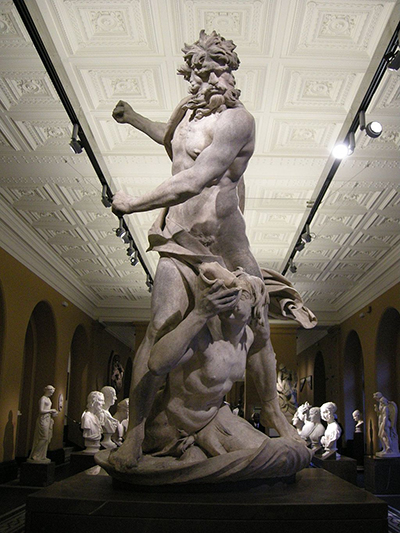
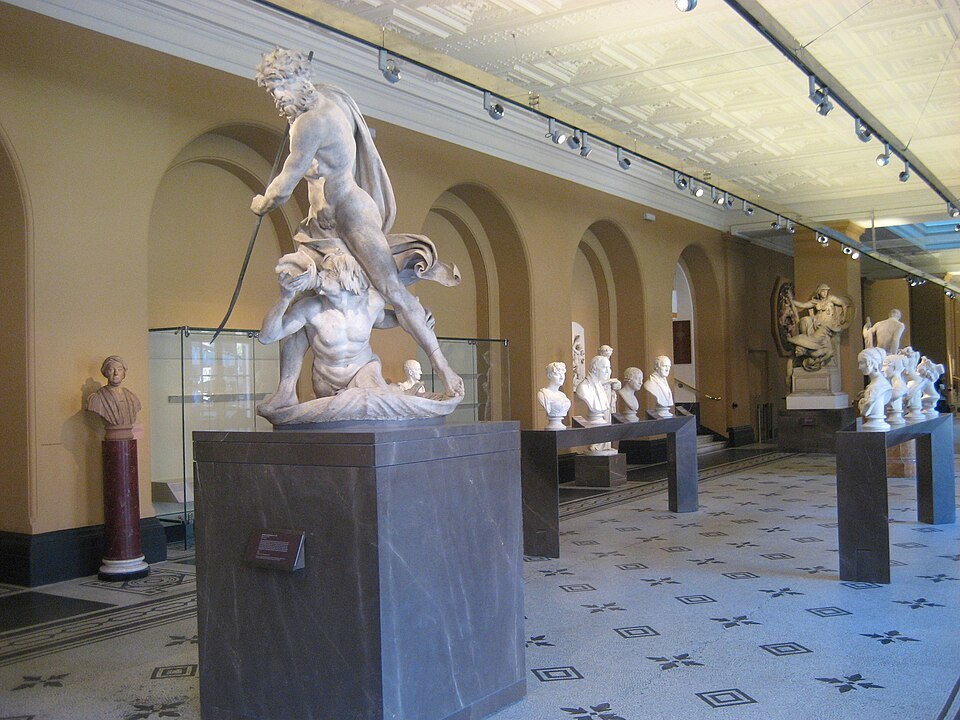
Neptune leans forward above his son Triton, who raises a shell to his mouth. Seen together, the two bodies extend the movement down through the marble, from the sea god’s shoulders to the figure below. Gian Lorenzo Bernini carved the group in 1622–23 for Cardinal Alessandro Peretti’s garden at the Villa Montalto in Rome. It presided over a fishpond and a system of fountains and cascades. The Victoria and Albert Museum now displays it indoors, where the carving can be seen at closer range. The form of the figures and a trace of the former water outlet help explain how the sculpture once worked as part of a garden. [1][2]
At a Glance
- Date1622–23
- Location or statusVictoria and Albert Museum, London
- WorkMarble fountain group from the Villa Montalto
The work in Bernini’s career
The Rape of Proserpina
1621–22Neptune and Triton
1622–23Apollo and Daphne
1622–25David
1623–24At the head of the fishpond
The Villa Montalto stood near the Baths of Diocletian, on land now associated with Rome’s Termini railway station. The house and gardens had been developed for Felice Peretti, later Pope Sixtus V, and passed to Alessandro Peretti. The property later became known as the Villa Negroni, a name encountered in accounts and images of the garden from after its change of ownership. The two names refer to successive owners of the same estate. The V&A places Bernini’s group at the upper end of a large oval basin, the Peschiera or Peschierone, where it formed part of a system of moving water. [1][3][4]
The garden setting gave the marble more than a place to stand. A person looking towards it across the basin could see the strong profile of Neptune first. Triton’s lower position kept him close to the water, where the carved subject and the operation of the fountain came together. The V&A’s conservators identified a fill in the top of Triton’s hair at the site of a former pipe outlet. The filled opening is easy to overlook in the gallery, but it connects the finished marble to a practical need of the fountain. In Rome a viewer encountered the forms of the figures alongside water moving through and around the work. [1][2]
The distance across the pond also helps explain the prominence of the larger forms. The shoulders of Neptune and the spaces beneath his arms can be read before the eye can pick out details such as the hair. Vigorously cut passages would take shadow in bright sunlight. Water could reflect light back into the scene while the deeper carving retained darker accents. The museum’s account emphasises how the sculpture was designed to register at that distance. The view in a gallery can make the small details clearer, but the large changes between the two bodies were already necessary to the garden composition. [1][3]
Two figures from the story of the sea
Neptune’s upper body bends over Triton. The sea god’s direction of movement is steep and forward, whereas the conch turns Triton’s action up towards his own face. The two movements take place close together. Their relation is especially clear when the shell and the upper body can both be seen against the open spaces around the group. A viewer can pass from Neptune’s broader gesture to Triton’s more concentrated one and still understand them as parts of a single event. [1][2]
The V&A suggests that Ovid’s account of the Flood in Metamorphoses may have inspired the sculpture. In the poem Neptune helps Jupiter unleash the waters and strikes the earth with his trident. Later, after the waters have abated, Neptune calls on Triton to sound his conch so that streams and rivers withdraw. The trident and conch therefore belong to actions at different stages in the text. The sculpture brings the two figures and their powers into the same garden fountain. Ovid helps make sense of their attributes, while the relation between the pose and the movement of actual water can be considered on its own terms. [1][5]
Bernini returned to the conch-blowing figure two decades later for the Triton Fountain in Piazza Barberini. There, Triton lifts the shell overhead and sits on a large open shell supported by dolphins. In the Villa Montalto group, the conch is part of an exchange between a lower figure and the sea god above him. The comparison shows what changes when Triton is given the principal position. In the later work the movement towards the shell directs the whole fountain upwards. In the earlier group the lower figure joins a more complex passage of movement through both bodies. [1][3]
The approach to the fishpond
Joseph Connors’s study of Alessandro Peretti’s patronage describes the oval basin as an existing work by Giovanni Fontana. Bernini’s group took its place in a setting that already had a shape, a scale and ways for visitors to approach it. Connors records twelve nude statues along the outer balustrade, ancient inscriptions on the steps and smaller tanks for breeding fish. Venturini’s engraving gives the basin and its boundary much more space than the marble group at its far end. Walking around that perimeter would have changed the angle between the group and the other figures along the rim. The engraving helps recover the scale of that sequence. The surviving marble gives a much closer view of what visitors were ultimately being led towards. [6]
Connors also records a grotto known as the Terme beneath the Neptune. An opening in the rock afforded a view towards Santa Maria Maggiore. The figure that stood above the basin thus marked an ensemble with a second possible line of sight at a lower level. The architectural view reached beyond the immediate garden. A much later drawing by Pierre de Valenciennes, made in 1778 and now in the Louvre, records part of the same estate under its Negroni name. The Louvre notes that discoveries of ancient buildings and frescoes in 1777 had drawn artists to the grounds. The sketch records that later phase of interest in the garden, whereas the Venturini print brings the fishpond and the fountain together in one view. [6][7]
A bronze that changes the water god’s companion
The Met’s small bronze Neptune with a Dolphin preserves the outline of the sea god while changing his support and companion. A rocky islet replaces the shell, and a dolphin turns between his legs where the marble has Triton. The drapery beside Neptune’s right thigh is also more apparent from the front. Those changes matter to the way the figure can be followed. The eye still descends through the bend of Neptune’s upper body, but the dolphin’s movement is concentrated between the feet. In the garden marble the eye reaches a second figure, with its own face, arms and conch. [8]
The Met compares four casts of the bronze variant. On the Getty and Corsini versions the dolphin’s tail touches Neptune’s left leg. In the V&A bronze the tail stands clear. The Met’s has an additional fin that makes contact, and its trident is missing. These differences help distinguish casts that look broadly alike. The catalogue suggests that some details changed when the wax intermediates for casting were prepared. The small objects therefore preserve choices made in reproducing the design as well as choices made when the fountain subject was adapted. Bernini’s authorship of the specific model for the bronze remains debated. [8]
The catalogue also points to a separate commission that may help explain the pairing of Neptune and a dolphin. A letter of 1677 says Bernini supplied a model for a fountain ordered for Portugal. Ercole Ferrata considered ways to conduct the water and agreed on a design with dolphins between Neptune’s feet. The fountain went to Lisbon in 1682. The Met raises Ferrata’s workshop as one possible context for the small bronzes, without identifying their maker. The letter establishes how the later fountain was designed. The comparison gives a reason to consider a connection even though it cannot tell us when any particular bronze was cast. [8]
Two commissions recovered in different collections
Anna Seidel places the fountain alongside Bernini’s portrait of Cardinal Alessandro Peretti. Baldinucci mentioned both works in 1682. Seidel records that the fountain group was rediscovered in an English private collection in 1905, whereas the bust entered the Hamburger Kunsthalle in 1910 as an anonymous portrait. In 1984 Jennifer Montagu and Irving Lavin independently identified it as Bernini’s likeness of Peretti. The two histories show how different kinds of evidence reunited works connected with one patron. For the fountain there were earlier garden views and a record of the move to England. For the portrait there was also the question of who the sitter was. Read together, they recover the patron’s role at a point when Bernini was establishing how a carved figure could address a garden as well as an interior. [6][9]
From an outdoor fountain to a museum sculpture
In the late eighteenth century the villa’s holdings passed through Thomas Jenkins, the British dealer and agent active in Rome. He arranged the sale of Neptune and Triton to the painter Sir Joshua Reynolds. The marble later entered the possession of Lord Yarborough and was kept in London and then at Brocklesby Park in Lincolnshire. The V&A acquired it in 1950. Its removal from the basin made it possible to transplant the group to several settings. The two figures continued to carry the subject with them, while the scale of the original waterworks survives through accounts and early views of the garden. [1][2][4]
The changing environment has also left evidence on the marble. The V&A’s account of the 1979 treatment describes extensive weathering and networks of cracks. Conservators found that some earlier repairs had loosened. Later work for the museum’s Europe galleries included rebuilding the plinth and cleaning surface deposits. Treatment records connect those practical interventions with what can still be seen of the fountain’s original use, such as the filled opening above Triton. They also show why the texture of the surface now includes the history of outdoor exposure as well as the marks Bernini and his workshop made. [2]
An engraving by Giovanni Francesco Venturini, reproduced in The Rijksmuseum Bulletin, puts the fountain and its basin back into a wider view of the estate. Its long horizontal format gives space to the water and the routes beside it. The finished marble fills the frame in many modern photographs, so the print restores a sense of how much of the original encounter involved looking across open ground and water. It is a historical view of the ensemble and complements the physical evidence of the outlet in the sculpture itself. [2][4]
In the gallery, begin at a distance where both figures remain in view. Observe how Neptune’s turn directs the eye downwards and how Triton brings it back to the shell. Closer in, the difference between the large planes of the bodies and the rougher, more deeply cut passages becomes easier to follow. The scene originally carried across a pool, where its figures had to be clear through changing daylight and moving water. Their close relationship sustains that movement even in the stillness of the museum. [1][2][3]
Discussion
The figures formed part of a garden fountain at the Villa Montalto.
Reader Insights
How do Neptune’s reach and Triton’s shell connect the two bodies?
Which part suggests the direction of the water in the original installation?
How does the museum setting change your understanding of the group’s scale?
Join the Conversation
Share a detail, comparison or question about Neptune and Triton by Gian Lorenzo Bernini below.
References
- Victoria and Albert Museum. Neptune and Triton by Gian Lorenzo Bernini, museum no. A.18:1-1950. View source
- Victoria and Albert Museum. A New Home for Neptune and Triton in the Europe 1600–1815 Gallery. Conservation and installation account. View source
- Victoria and Albert Museum. Bernini and the Baroque. View source
- The Rijksmuseum Bulletin. Jacques-Louis David’s ‘Thrones’ Identified, The Rijksmuseum Bulletin, pp. 54–56, on the villa and Jenkins’s sale of the sculpture. View source
- Ovid. Metamorphoses, book I, lines 274–347. Translated by A. S. Kline. View source
- Connors, Joseph. Sant’Andrea della Valle tra architetti, mecenati e teatini, fig. 13 and accompanying discussion of the fishpond.
- Musée du Louvre. Vue de la villa Negroni et esquisse d’un cheval, Pierre de Valenciennes, RF 12966, 103.
- Metropolitan Museum of Art. Neptune with a Dolphin. Catalogue comparison of the bronzes and the Portuguese commission.
- Seidel, Anna. Gian Lorenzo Berninis Büste Kardinal Alessandro Peretti Montaltos aus der Villa Montalto, pp. 395–396.








