


 by Tom Gurney
Tom Gurney BSc (Hons) is an art history expert with over 20 years experience
Published on June 19, 2020 / Updated on November 18, 2026
Email: tomgurney1@gmail.com / Phone: +44 7429 011000
Bust of Cardinal Richelieu
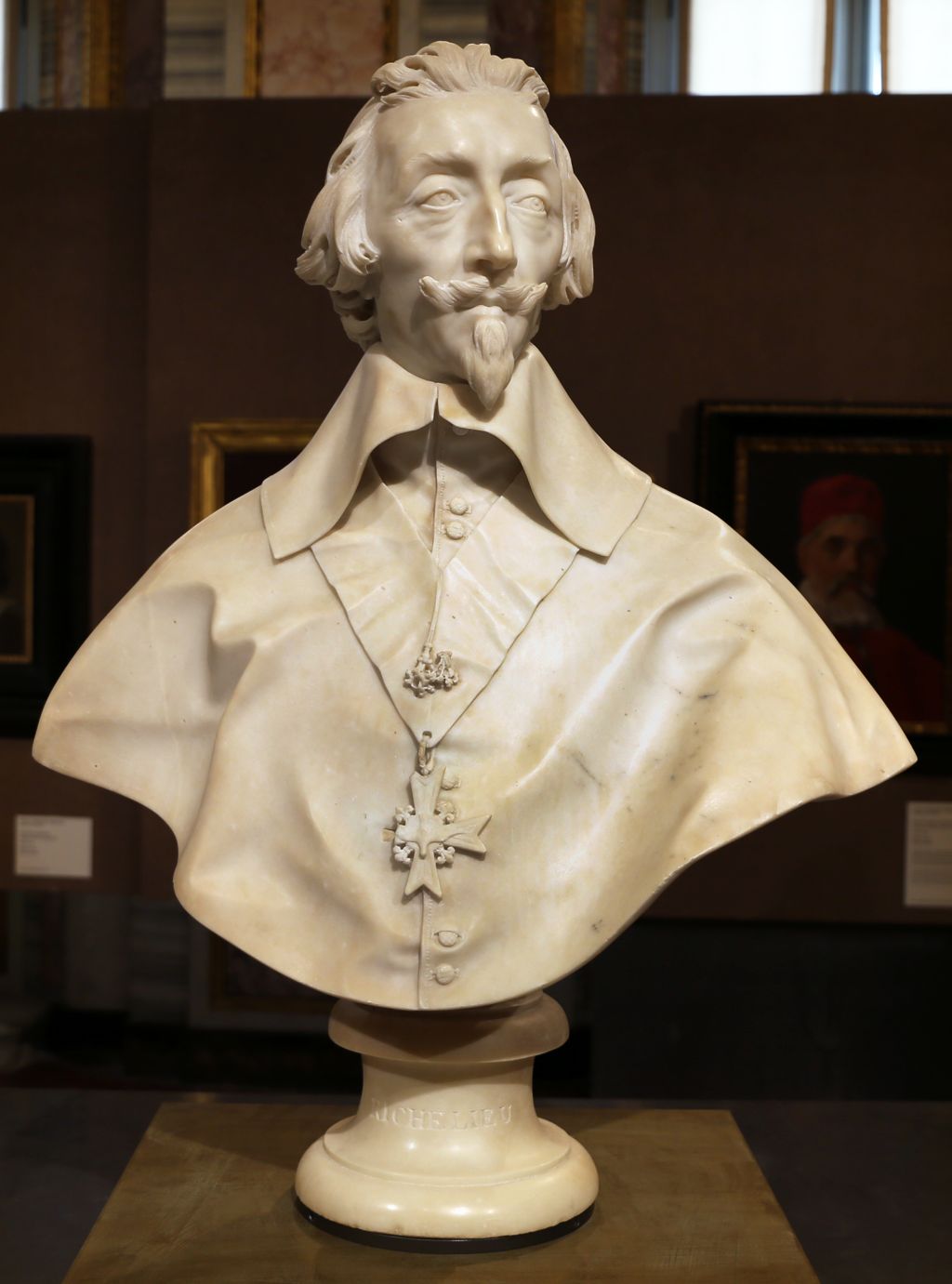
Gian Lorenzo Bernini’s Bust of Cardinal Richelieu gives a distant statesman a remarkably tangible presence. A long, narrow face rises above an enormous collar; the pointed beard hangs over its opening, while the shoulders spread into broad folds. The head seems poised to turn, yet the mouth remains firmly closed. This is a portrait whose movement belongs mainly to the clothes and the changing play of light across the marble. Made in 1640–41, the bust now belongs to the Louvre in Paris. It measures 83 × 70 × 32 cm and carries the inventory numbers MR 2165 and N 15306. [1]
The distance between sculptor and sitter is central to its story. Bernini made the portrait without meeting Richelieu, working through painted likenesses. That procedure produced both an imposing sculpture and a problem: how could a portrait fashioned in Rome satisfy people who knew the living cardinal in France? [2] [3]
At a Glance
The sculpture in Bernini’s career
Contents
- Looking at the face
- Portraits travelling between Paris and Rome
- Clothes, insignia and authority
- What visitors saw in Bernini’s studio
- Admiration and disappointment
- January 1641 and the problem of likeness
- The collar and the two bronze casts
- The authorship recorded in old catalogues
- From the cardinal’s collection to the Louvre
Looking at the face
Start with the outline of the head. The hair rises in separated locks above the forehead, then falls beside the cheeks and curls outward at the sides. Its irregular edges interrupt the smooth oval of the face. The small cap is easier to distinguish in profile, where it settles over the back of the head and leaves the surrounding hair exposed. Seen from the front, the raised locks can almost conceal it. [1]
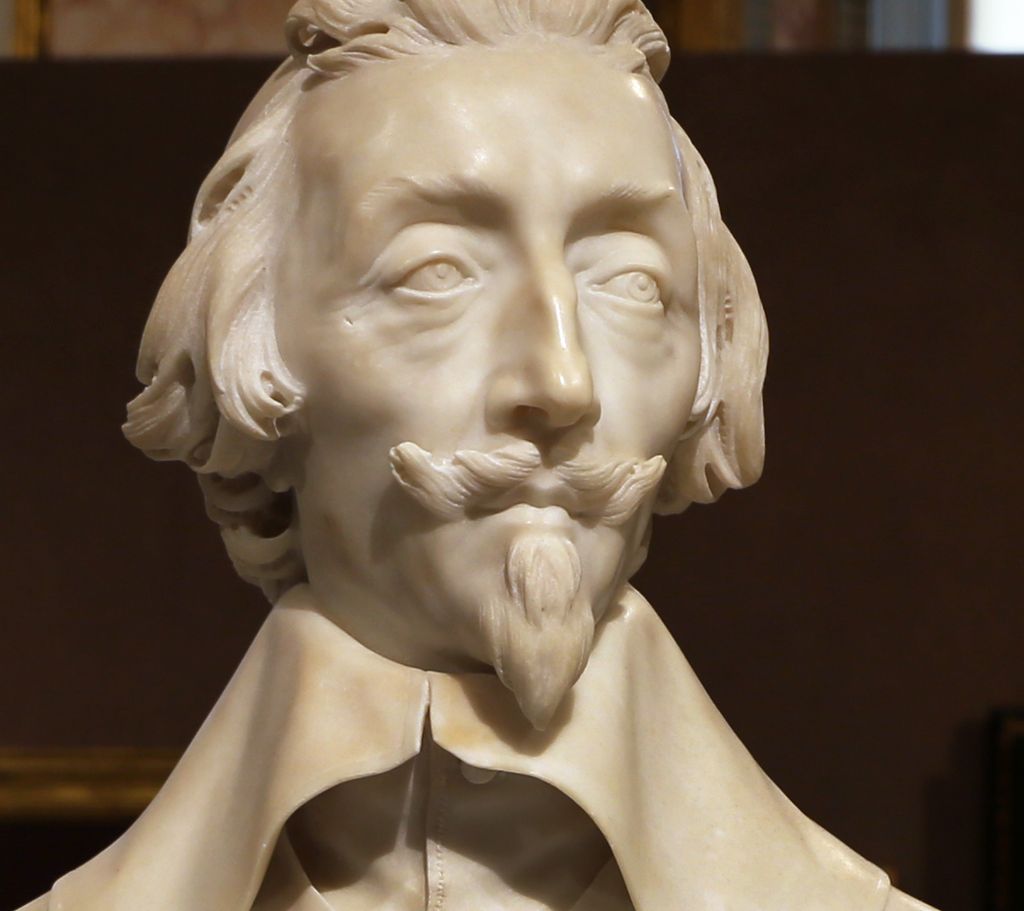
The moustache spreads sideways, drawing attention to the compressed mouth. Immediately below, the beard narrows to a long point. These two forms create different directions within a small area: the moustache widens the face, while the beard pulls the eye downward. Both carry fine lines that contrast with the relatively smooth cheeks and forehead. The carved strands make hair appear distinct from skin without any change of material.
The eyes deserve an equally slow look. They sit beneath clearly shaped brows, with hollows and ridges around the lower lids. Light catches their projecting edges and leaves the recesses darker. From one position the expression may appear alert; from another it can seem tired or remote. These are effects that a viewer can experience without assigning the cardinal a particular thought. The bust provides no secure access to his private feelings.
In profile, the long nose, projecting moustache and pointed beard become a sequence of sharply separated accents. The narrow neck emerges from a deep opening between the collar’s two wings. Moving around the sculpture changes the balance between the projecting face and the broad mass below. A frontal photograph gathers the costume into a symmetrical framework; a side view reveals how far the face advances beyond it. That change is especially important in a portrait made through representations of an absent sitter.
Annotated Details from Bust of Cardinal Richelieu
Move between the carved hair, the collar’s thin-looking wings and the small insignia set against the broad chest.
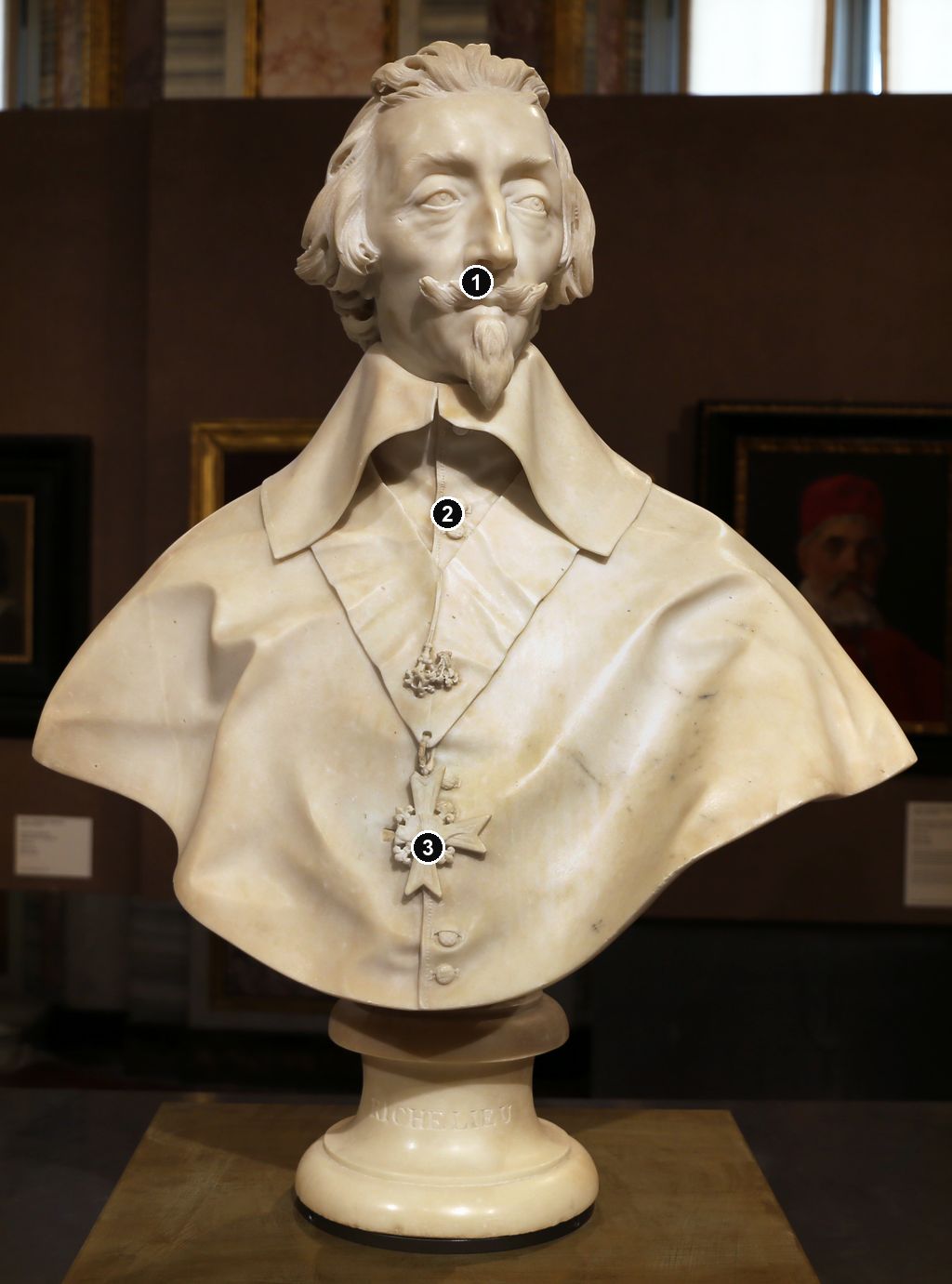
Details from BUST OF CARDINAL RICHELIEU
Photograph by Sailko, CC BY 3.0. Overview annotated and details cropped and resized from the unchanged photograph.
Hair, moustache and beard
Separated locks interrupt the smooth forehead and cheeks. The moustache spreads sideways while the pointed beard draws the eye downwards.
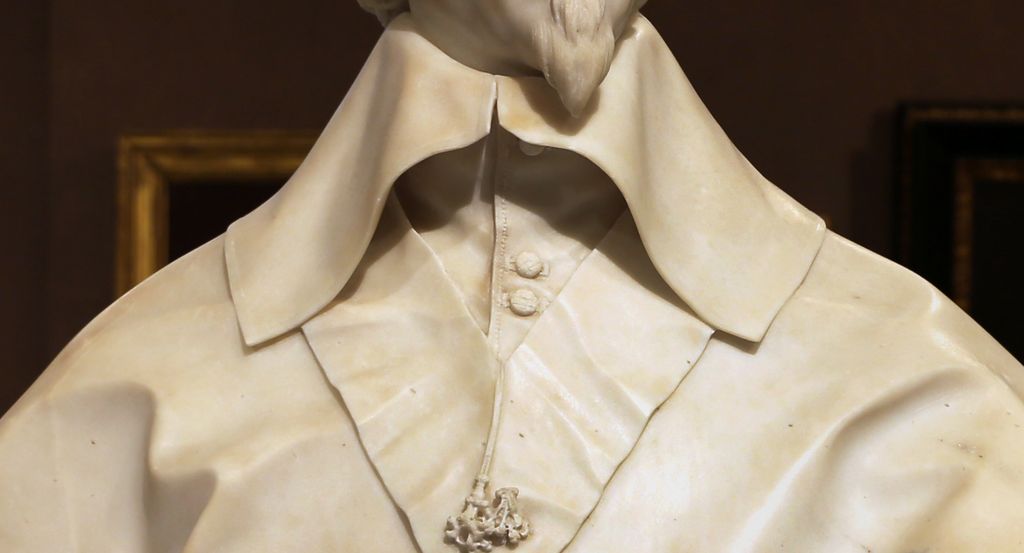
The collar and its layers
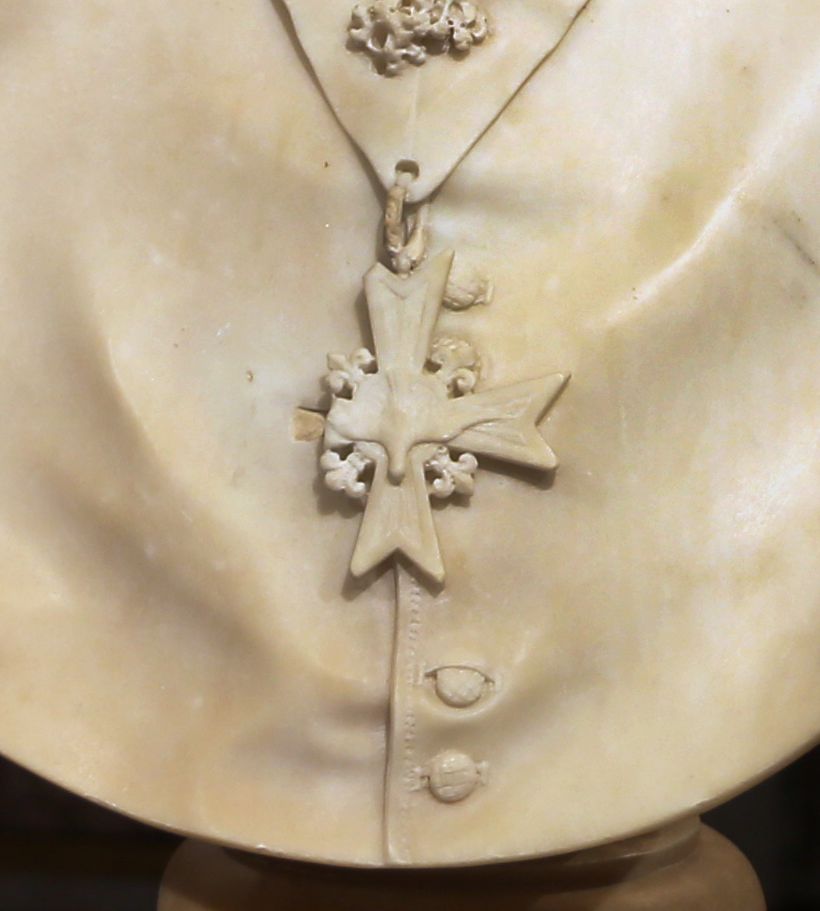
The collar opens into broad wings around the narrow neck. Buttons and the crossing ribbon make the costume read as overlapping layers.
Portraits travelling between Paris and Rome
Richelieu commissioned the bust in 1640 following negotiations involving Mazarin, Bernini and the Barberini. The Louvre records its completion in Rome and transport to Paris on 20 August 1641. Patronage and diplomacy accompanied the movement of painted models and finished marble. [1]
The familiar explanation of the commission needs a little care. The Louvre identifies Philippe de Champaigne’s triple portrait as Bernini’s painted source. Yet the National Gallery’s current account of its Triple Portrait of Cardinal de Richelieu, NG798, dates that painting to probably 1642 and connects it with Francesco Mochi’s subsequent commission. Its account says that Bernini worked from profiles by an unknown painter. The London picture should therefore be treated as evidence of the portrait-making process, with its precise relationship to Bernini’s marble left open. [1] [2]
Three views offer a practical response to absence. The frontal face provides the relationship between the eyes and the width of the cheeks. Profiles show the projection of the forehead, nose, lips and chin. A sculptor must bring those separate pieces of information together into a head that can be seen continuously from every direction. The painted views also leave unanswered questions about the depth and transitions between them. This helps explain why a convincing sculpture and an immediately recognised likeness are different achievements.
There was a prominent precedent. The Royal Collection Trust identifies Anthony van Dyck’s Charles I in Three Positions as a reference painting for Bernini. The sculptor’s international patrons could send an image across Europe even when a sitting was impossible. In his study of Bernini’s later bust of Francesco I d’Este, Irving Lavin places Charles I, Richelieu and the duke within this expanding practice of portraiture at a distance. He connects it with the prestige of an artist whom powerful rulers sought out beyond their own courts. [4] [5]
Lavin also discusses Bernini’s letter to Francesco I of 20 October 1651. There the sculptor explained the exceptional difficulty of giving white marble the likeness of a living, coloured person when only a painting stood before him. The letter concerns the duke’s portrait, rather than Richelieu’s, but it gives the earlier commission a useful context: Bernini himself recognised the limitations of the method. [5]
Clothes, insignia and authority
The face occupies only a small part of the bust’s total spread. Below it, the collar opens into two long, relatively smooth wings. Their thin-looking edges and clean angles frame the beard and create a clear interval between head and shoulders. Underneath, small rounded buttons establish the garment’s central fastening. Across this structure lie the ribbon and insignia associated with the Order of the Holy Spirit. [1] [6]
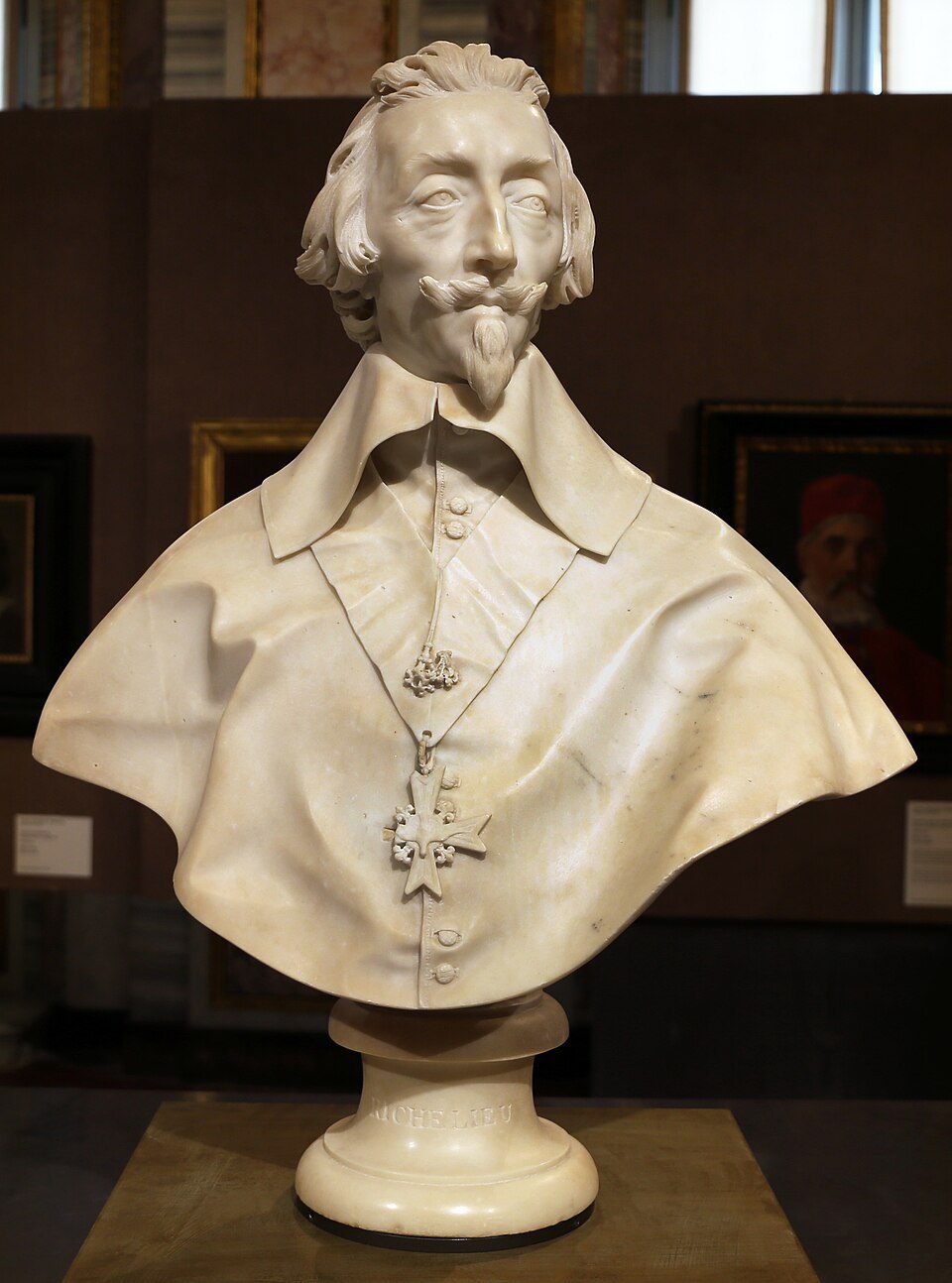
Look at how the different carved elements interrupt one another. The collar descends in broad planes; the ribbon crosses the chest diagonally; the ornament hangs against the front. The central line of buttons continues below it. Each detail establishes a different relationship with the body, so the clothing reads as layers rather than as one decorated surface.
The shoulders provide the largest contrasts of light and shade. On one side, a deep fold forms a dark pocket near the upper arm. On the other, the drapery bends in longer, gentler curves. Lower down, the outer contour draws inward towards the support. These uneven folds keep the broad shape from becoming a rigid triangle. They also make the torso feel substantial even though the bust ends well above the waist.
The ornament creates another shift of scale. Its small projections and recesses reward close inspection after the large silhouette has been grasped. Moving from shoulder to insignia to face, the viewer passes between expanses of cloth, intricate decoration and human features. The sculpture’s authority emerges through this organisation as much as through the cardinal’s expression.
Champaigne’s painted portraits offer a useful context for that costume. Heritage curator Morwena Joly-Parvex notes that Richelieu received the Order of the Holy Spirit in 1633 and repeatedly employed the painter to shape his public image. She places his ceremonial portraits alongside the gallery of distinguished figures at the Palais Cardinal. The marble belongs to this wider culture of carefully constructed representation, in which dress and honours helped identify a statesman’s position. [6]
What visitors saw in Bernini’s studio
The bust also had an audience before it reached France. Tomaso Montanari’s essay in Bernini: Sculpting in Clay discusses a correspondent of Mazarin who visited Bernini in 1641 and described the newly finished Richelieu portrait with intense admiration. The report placed it among several other portraits. This records enthusiasm in the studio, rather than a verdict from the sitter. [7]
Montanari suggests that the surrounding works were large clay models. An inventory after Bernini’s death recorded a fired-clay Richelieu portrait. Andrea Bacchi, writing in the same catalogue, adds a useful qualification: the recorded terracotta might have been a preparatory model or a replica. Its existence does not establish an exact sequence of stages for the surviving marble. [7]
The inventory does not reveal which passages changed between clay and stone or identify another sculptor as the marble’s carver. The Louvre attributes the bust to Bernini. [1] [7]
Admiration and disappointment
The National Gallery reports that the bust was criticised after reaching Paris because its resemblance was considered inadequate; the painted profiles were blamed. It also explains that the original ambition had been a full-length statue, before a bust was substituted in 1641. The negative response belongs to a commission already shaped by changes of plan. It should not be enlarged into an invented scene of Richelieu personally rejecting the sculpture. [2]
The contrast with the Roman visitor’s admiration is revealing. One response concerned the excitement of seeing Bernini’s portrait among his works; the other concerned resemblance to someone familiar. Both could arise from the same object. The sculpture can still offer a powerful sense of presence to a viewer who has never seen the sitter, while leaving the historical question of likeness unresolved. [2] [7]
There is also a bronze Cardinal Richelieu in the National Gallery of Victoria, catalogued under Bernini and dated about 1642. Its medium and dimensions distinguish it from the Louvre marble. Keeping the two objects separate prevents a bronze photograph or collection record from quietly taking the place of the sculpture in Paris. [3]
January 1641 and the problem of likeness
In a letter drafted in Rome on 6 January 1641, Cardinal Antonio Barberini told Mazarin that marble for a full-length Richelieu had arrived at the port of Ripa Grande. The block had taken time to obtain because of the size and quality required. Barberini then turned to the portrait head already made by Bernini and said he would send it to France when there was an opportunity. The distinction helps date the work. By early January the head could be shown and judged in Rome, while the marble for the larger statue had only just come ashore. The date of the letter and the August date recorded for the bust’s journey to Paris describe separate moments. [9][10]
Barberini praised Bernini’s work while assigning some responsibility for the likeness to the portraits sent from France. If there was more to capture, he wanted advice in words and further information from painters. That request shows what a parcel of painted views could leave unresolved. The paintings supplied a face and its outlines, but someone who knew the cardinal still had to judge whether the expression looked like him. Barberini’s praise also belonged to a negotiation. He was writing to an intermediary and looking ahead to a second sculpture, for which the response to the bust could still matter. [9]
The collar and the two bronze casts
The bronze in Melbourne has a close counterpart in the Picture Gallery at Sanssouci. The Prussian Palaces and Gardens Foundation traces the latter to Cardinal de Polignac’s collection, which Frederick the Great bought in 1742. Its itinerary after that purchase included Charlottenburg, the Antique Temple and rooms in the New Garden before it returned to the Picture Gallery. The cast thus acquired a German collection history quite apart from the journey of the original marble from Rome to Paris. [10][11]
When researchers examined the Sanssouci bronze in 2023, they could compare its construction with the Melbourne cast. Both busts were cast apart from their bases. The two joins use notably similar sleeves, a detail normally hidden when the bronzes are on display. The team also found some differences in work on the wax, especially around the cross suspended from the ribbon of the Order of the Holy Spirit. That is the same insignia a visitor can use to identify the cardinal’s status. For the researchers it was also a place to look for differences in making. The comparatively lighter patina of the Sanssouci cast made some traces of modelling and finishing easier to inspect. [11][12]
The joins and traces of working support the team’s suggestion that the two bronzes were made close together. The Prussian foundation leaves the foundry unnamed. It also records that conservators stabilised the interior of the Sanssouci base during this examination. The support visible in the gallery therefore carries evidence of two quite different operations. Its concealed join helps explain how the cast was first put together, while the recent reinforcement belongs to keeping it safely on display. Neither operation can be read from the shape of the sitter’s face. [11][12]
The authorship recorded in old catalogues
The Institut national d’histoire de l’art records that early museum catalogues assigned the Louvre bust to Antoine Coysevox. In the twentieth century, scholars also argued for Francesco Mochi. The same INHA record lists those proposals alongside the current attribution to Bernini. It also gives the number 276 from the early cataloguing sequence, a separate identifier from the Louvre’s MR 2165. The work’s history in France can therefore be followed through records that attached different names to it. That matters when using an old catalogue entry as evidence. Its details about where and how the bust was kept can help identify the object even when its attribution differs from the one in use today. [10]
From the cardinal’s collection to the Louvre
The Louvre traces the marble through Richelieu’s collection, his niece the duchess d’Aiguillon, and Notre-Dame in Paris. Seized in 1792, it passed through the Bibliothèque Mazarine and Musée des Monuments français before entering the Louvre on 3 April 1817. [1]
That history gives the small inscribed support a particular resonance. Beneath the expansive shoulders, the name identifies a man whose portrait has passed through domestic, ecclesiastical and museum settings. The face remains above those changes: enclosed by its collar, held forward over the chest, and continually altered for the viewer by a step to either side.
Bernini works directory
Frequently Asked Questions
It is in the Louvre, inventory MR 2165 and N 15306. The marble measures 83 × 70 × 32 cm. [1]
He made the portrait through painted likenesses rather than a sitting with the cardinal. The precise painted sources require care because museum accounts differ. [1][2]
No. The National Gallery of Victoria’s portrait is bronze, dated about 1642; the Louvre object discussed here is marble. [3]
Discussion
Look from the narrow face to the wide collar and shoulders, then consider the difficulty of making a likeness through painted models.
Reader Insights
Which carved texture first catches your eye?
What changes when the bust is seen from the side?
How might a painted profile help or limit the sculptor?
Join the Conversation
Share a detail, comparison or question about Bust of Cardinal Richelieu below.
References
- Musée du Louvre, Le cardinal de Richelieu (1585–1642), MR 2165; N 15306. Collection record, Description, Physical characteristics, History and photographic views; record updated 17 March 2025. Louvre collection record (in French). View source.Splash image: Cardinal Richelieu, 1640–41. Bernini’s marble portrait in the Louvre, MR 2165. Photograph: Sailko, via Wikimedia Commons; resized · CC BY 3.0
- National Gallery, London, Philippe de Champaigne and studio: Triple Portrait of Cardinal de Richelieu, NG798, probably 1642. “About the work,” including the in-depth account, and “Key facts.” National Gallery painting record. View source.
- National Gallery of Victoria, Cardinal Richelieu, Gianlorenzo Bernini, c. 1642, bronze, E1-1970. Collection record and “About this work.” NGV collection record. View source.
- Royal Collection Trust, Charles I’s Lost Collection, collection story, opening discussion and identification of Van Dyck’s Charles I in Three Positions, RCIN 404420. Royal Collection Trust collection story. View source.
- Irving Lavin, “‘Impresa quasi impossibile’: The Making of Bernini’s Bust of Francesco I d’Este,” in Visible Spirit: The Art of Gianlorenzo Bernini, vol. II, London: Pindar Press, 2009, pp. 757–788, especially pp. 758–765 and the letter illustrated on p. 762. Institute for Advanced Study PDF. View source.
- Morwena Joly-Parvex, Cardinal de Richelieu by Philippe de Champaigne, Centre des monuments nationaux, “Description of the work.” Curator’s account of Richelieu’s painted portraiture. View source.
- Tomaso Montanari, “Creating an Eye for Models,” in C. D. Dickerson III, Anthony Sigel and Ian Wardropper, Bernini: Sculpting in Clay, New York: Metropolitan Museum of Art, 2012, p. 69 and pp. 377–378, notes 38–39; and Andrea Bacchi, “The Role of Terracotta Models in Bernini’s Workshop,” p. 374, note 6. Contemporary correspondence and inventory discussed and reproduced through this scholarship. Metropolitan Museum catalogue and downloadable PDF. View source.
- Musei Capitolini, Statue of Carlo Barberini, 1630, MC1195. Used for the career comparison. Accessed 28 October 2026. View source.
- Pecchiai, Pio. Transcription of Antonio Barberini’s letter to Mazarin, 6 January 1641, Strenna dei Romanisti, 1949, pp. 185–86. Draft letter and archival reference.
- Institut national d’histoire de l’art. Le cardinal de Richelieu, AGORHA record for Louvre MR 2165. Commission, transport and historical catalogue attributions.
- Kiesant, Silke, and Birgit Morgenroth. Kardinal Richelieu zurück auf seinem Sockel. Stiftung Preußische Schlösser und Gärten Berlin-Brandenburg, 2024. Polignac provenance, display history and conservation.
- Bernini’s Bronzes research team. Sanssouci Palace, study visit of 11–12 July 2023. Comparative study of the two casts, with observations on wax, base construction and patina.








