


 by Tom Gurney
Tom Gurney BSc (Hons) is an art history expert with over 20 years experience
Published on June 19, 2020 / Updated on November 18, 2026
Email: tomgurney1@gmail.com / Phone: +44 7429 011000
Bust of Pope Gregory XV
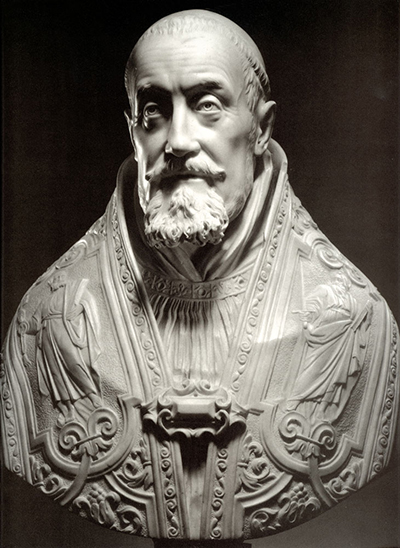
In Gian Lorenzo Bernini’s marble portrait of Gregory XV, the pope’s eyes look up under deeply marked brows. His beard projects over a high collar, and the patterned bands of a papal cope spread across his shoulders. The Art Gallery of Ontario dates the bust to 1621, the year Alessandro Ludovisi became Pope Gregory XV. The marble entered the gallery in 1997 as a gift from Joey and Toby Tanenbaum and is catalogued there as 97/152. Other versions of Bernini’s portrait circulated in bronze. The evidence for those casts makes it possible to follow the use of the likeness beyond the circumstances in which the marble was made. [1][2]
At a Glance
- Date1621
- Location or statusArt Gallery of Ontario, Toronto
- WorkMarble bust, inventory 97/152
The work in Bernini’s career
Bust of Pope Gregory XV
1621The Rape of Proserpina
1621–22Apollo and Daphne
1622–25David
1623–24The face above the vestments
The face is raised a little above the level at which the viewer might expect to meet its gaze. The effect depends on the shape of the eyelids and on the weight of the brows over them. The cheeks and the areas beneath the eyes carry different shadows from the broad, relatively open forehead. This way of shaping the face makes particular features visible even against the complex detail of the garment. A more direct light can make the pupils and lids especially clear, while light from the side brings the asymmetry of the cheeks into view. The sitter has a recognisable expression whether seen from the front or slightly to one side. [1][2]
At the base of the head, the curls of the beard break the light into much smaller areas. The moustache follows the width of the mouth and separates it from the volume of the beard. The collar then rises behind the jaw to frame the face. Below it, the cope spreads out across a much wider field. The sequence of textures leads from short marks in the hair to more defined curls, gathered fabric and the relief of embroidery. Changing the size and direction of the marks was one way to separate forms cut from the same material. [1]
A portrait of the office
The clasp across the front of the cope provides a point from which to follow the pattern of the vestment. The bands fall on either side, carrying small standing figures and ornament. Their course gives the work a strong frontal order, even where Bernini gives the face its own direction. The apostolic figures also place the likeness in a tradition of papal dress. A viewer can recognise the structure of the garment before studying the detail in its embroidery. This helps the portrait retain the formality appropriate to the office even though the eyes and mouth give the impression of an individual caught in a moment of attention. [1][2]
The Toronto gallery records an overall height of 83.2 centimetres with its base. At that scale the spread of the cope allows room for the embroidered figures and ornament to register as separate elements. The distance from the clasp to the face is large enough for changes in the fabric to be seen even before the viewer has approached close enough to follow the carving in the eyes. The scale also lets the cut across the bottom of the bust follow the shape of the vestments. The flare of the cloth makes a broad outline beneath the vertical development of the head. [1][3]
The Ludovisi commission
Gregory succeeded Pope Paul V in 1621. The Toronto gallery describes the portrait as a commission Bernini received from Gregory. A contemporary letter from the sculptor’s father, Pietro Bernini, gives the pope’s nephew Cardinal Ludovico Ludovisi a role in ordering the likeness. In November 1622 Pietro wrote that his son had made the portrait three times in marble and metal. The two accounts place the commission within the same papal household. The letter is particularly valuable because it records the making of multiple versions while Gregory was still pope. It gives a starting point for identifying surviving casts without settling the history of every piece that resembles the marble. [1][2]
The dating also establishes a different relationship between artist and sitter from the one involved in the full-sized portrait of Paul V. The Getty records that Cardinal Scipione Borghese ordered that marble after his uncle Paul died in 1621. Gregory’s portrait was made after his election. The two designs share the broad papal vestment, figured embroidery and a large clasp. Against those repeated features one can compare the direction of the eyes and the way the beard sits above the cloth. The shared costume makes the representations of the office comparable and brings differences of bearing into view. [1][2][4]
The marble in the Casino Ludovisi
An inventory of 1623 places a marble Gregory XV by Bernini at the head of the Sala della Fama in the Casino Ludovisi. As Philipp Zitzlsperger notes, the entry mentions a red satin cap and a red taffeta covering, as well as a gilded walnut stand. The entry changes what can be inferred from the appearance of the marble today. Bernini carved the head bare, but the prepared display clothed the likeness with actual fabric. The fall of the cloth would also have altered the transition from the marble to its support. The record preserves an arrangement in which colour and texture were supplied in part by objects placed around and on the figure. [2]
The bronzes in Paris and Bologna
The Musée Jacquemart-André dates its bronze to 1622 and records that Nélie Jacquemart bought it at Stefano Bardini’s London sale in 1899. Its catalogue draws attention to the separately articulated pedestal and its coat of arms. The museum also advances the possibility that this was the first cast and that Bernini sharpened its details himself. These claims matter for a medium in which the surface coming out of the mould could be worked further. A sharp edge around an apostle or fold can contribute to the appearance of the portrait without telling us, on its own, who worked on it after casting. The sale gives a firm date in the modern history of the bronze. The sequence of casting and the finishing hand remain questions of attribution. [7][8]
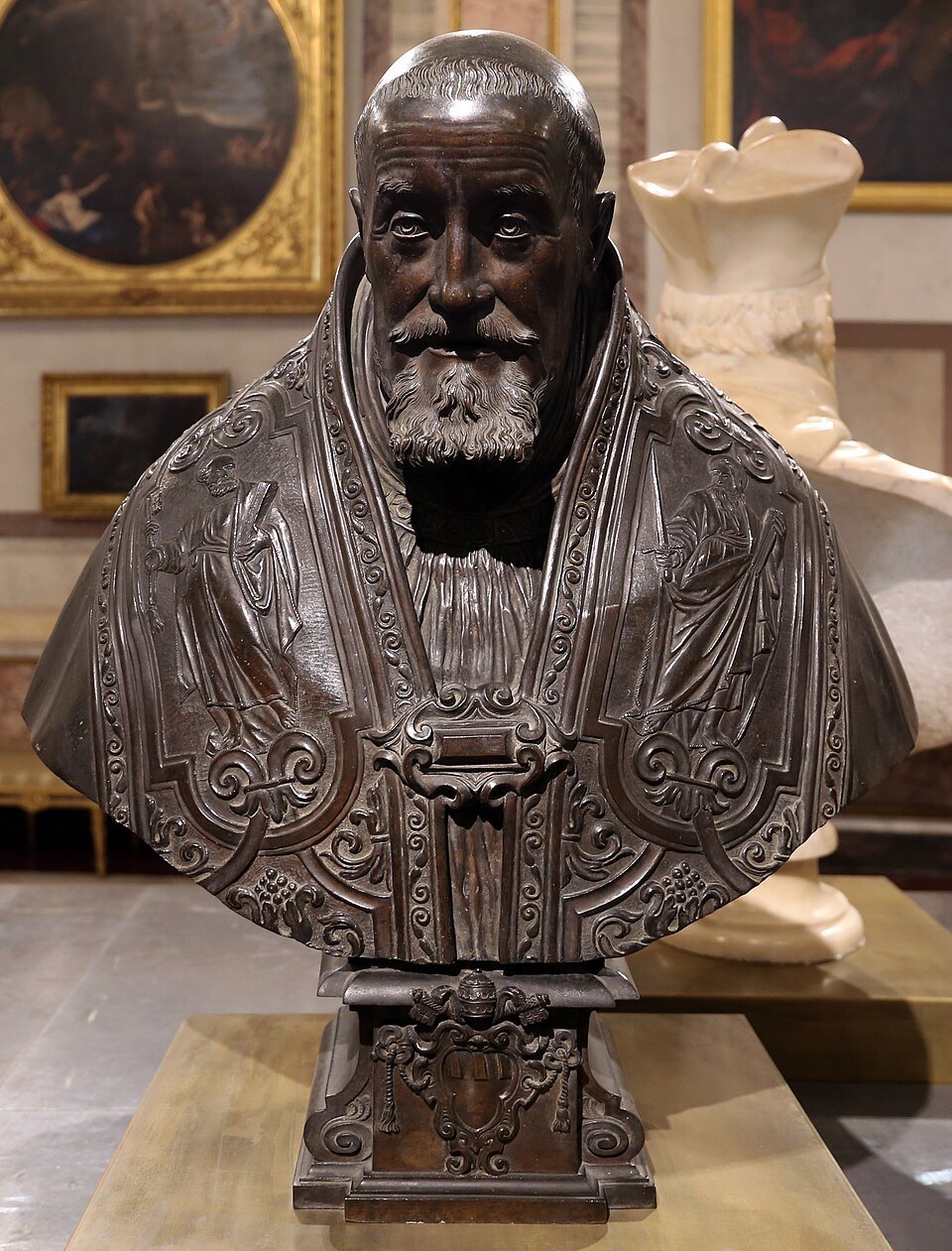
In Bologna, the Museo Civico Medievale’s version is recorded as inventory 1560 by the Fondazione Zeri. The Galleria Borghese’s exhibition list gives the measurements of the bronze and its support separately. Those entries help make the distinction between the scale of the likeness and the height at which its mounting presents it. Claudia Renzi traces the bust to the university collections in 1860, where it entered without an attribution. She raises the possibility of a Ludovisi destination but identifies a gap in the earlier record. The care with which the details correspond to the marble explains the interest in linking the objects. A patron or original room still has to be established through other evidence. [8][9][10]
An account of a cast in the Ludovisi palace
Another bronze enters the history through a description of the Ludovisi palace. Renzi cites Fioravante Martinelli’s account of two metal busts displayed in the same room as Bernini’s Rape of Proserpina. They represented Gregory and his father Pompeo. Martinelli credits Bernini with the models and Gregorio de Rossi with casting. The description gives the papal portrait a documented companion in a family setting. At Scipione Borghese’s, the proposed pairing of Gregory and Paul V connects two successive popes. In the Ludovisi display, the likeness of the same pope was paired with a member of his own family. [8]
The Pittsburgh bronze has been proposed as the surviving Gregory from the pairing Martinelli describes. Renzi notes its rounded pedestal and compares it with the rounded support visible in an earlier photograph of the Toronto marble. The resemblance is useful when clues such as family arms or a clear account of ownership are missing. The identification still depends on tying a surviving object to a description of an arrangement in a particular room. There is also a payment on account to Sebastiani for a bronze Gregory for Cardinal Giuseppe Acquaviva. Renzi finds no subsequent record to establish whether that work was completed. The accounts therefore include commissions and descriptions that cannot all be matched to surviving bronzes. [8]
What a repeated likeness could do
Evonne Levy places the Gregory portraits in a wider practice of making multiples. An artist could repeat a composition for another owner or produce it in another material. In this case the recurrent cut of the cope and disposition of the face made Gregory recognisable across a group of objects. The combination of another portrait, a different pedestal or a new room could change how the likeness was understood. An early statement that Bernini made the portrait three times establishes the scope of what the writer knew at that point. Connecting that statement to a specific list of objects requires evidence about which commission each version belonged to. [8][11]
There is disagreement over which marble furnished the design. The Toronto gallery dates the example in its collection to 1621. Renzi records a competing identification with a posthumous marble made in 1627 for Zagarolo. An inventory locating a marble in the Casino Ludovisi establishes that an example was there in 1623. Connecting that entry to the surviving marble is a further step. The uncertainty affects the sequence in which the bronzes and surviving marble can be placed, even when their shared design is evident. [8][14]
The association of Gregory and his nephew Ludovico eventually took a different form in the monument at Sant’Ignazio. The German REQUIEM project documents the pope’s tomb there, and the Klassik Stiftung Weimar’s record associates both names with the monument. In the palace, the coat of arms or a companion bust could establish family ties for an individual likeness. At Sant’Ignazio those ties belonged to the permanent setting of the tomb. That comparison helps distinguish what the movable busts could do for their owners from the role of a monument attached to one church. [8][12][13]
The portrait in bronze
Payments from Scipione Borghese in 1621 record the founder Sebastiano Sebastiani casting portraits of Gregory XV and Paul V on Bernini’s instructions. These were separate from the marble commission recorded by the Toronto gallery. Scholarship has associated a surviving Paris bronze of Gregory with the cast made for Scipione, as a companion to the Paul V bronze now in Copenhagen. A comparison advanced in support of the pairing concerns the detail of the pedestal. The arms of each family are set against a comparable square frame on the proposed pair. The resemblance helps distinguish these casts from other versions in circulation and gives the heraldry a role in identifying their history. [2][5][6]
Casting made it possible to move the likeness between houses and collections while preserving the larger arrangement of the marble design. In metal, the small changes of level around the embroidery can make narrow lines of reflected light. The effect is particularly noticeable at the edges of a fold or the break between a lock of hair and the face. In the marble those changes are visible as differences of modelling and shadow. The versions offer different views of a design that had to keep the head legible above a richly worked garment. [1][2][5]
The Toronto marble makes that relation easiest to follow from the figure outward. The signs of office spread across the chest and shoulders, while the raised eyes and narrow turn of the face retain their independence within the frame. The contemporary letter and the documents for the casts add another dimension to the portrait. They show how a representation conceived for a reigning pope became an object that other patrons could order, pair with another likeness and display under the arms of the families involved. [1][2][5][6]
Discussion
Deeply modelled brows and the high collar frame Gregory’s gaze.
Reader Insights
How does the gaze change when seen from the side?
How much of the portrait’s public role is carried by the cope?
What would you look for when comparing this marble with another version?
Join the Conversation
Share a detail, comparison or question about Bust of Pope Gregory XV by Gian Lorenzo Bernini below.
References
- Art Gallery of Ontario. Lasting presence. Collection record and photograph of the 1621 marble, inventory 97/152. View source
- Zitzlsperger, Philipp. “Bernini’s Bust of Pope Gregory XV: The Reception of a Magic Portrait Cult”. Includes Pietro Bernini’s letter and discussion of the versions. View source
- Art Gallery of Ontario. From Renaissance to Rodin: Celebrating the Tanenbaum Gift. Dimensions and display context for the marble. View source
- J. Paul Getty Museum. Recently Rediscovered Bernini Acquired by Getty Museum. Commission and vestments of the Paul V marble. View source
- “Gregorio XV nella ritrattistica berniniana, nuovi spunti e precisazioni”. Documentary discussion of the Borghese payments and comparison of the bronze pedestals. View source
- Statens Museum for Kunst. Bust of Pope Paul V Borghese. Inventory DEP47 and the relationship to the Gregory XV commission. View source
- Musée Jacquemart-André. Buste de Grégoire XV. French catalogue of the Paris bronze.
- Renzi, Claudia. Gregorio XV nella ritrattistica berniniana, nuovi spunti e precisazioni. Italian study of the versions and documentary sources.
- Fondazione Federico Zeri. Ritratto di papa Gregorio XV. Catalogue of the Bologna bronze.
- Galleria Borghese. Bernini, exhibition materials. Italian checklist, no. 47.
- Levy, Evonne. Repeat performances: Bernini, the portrait and its copy. Sculpture Journal 20, no. 2 (2011), pp. 239–49.
- REQUIEM project. Die römischen Papst- und Kardinalsgrabmäler der frühen Neuzeit, database documentation. German record and overall view of the grave monument at Sant’Ignazio.
- Klassik Stiftung Weimar. Gregor XV., Papst. German catalogue authority, with link to the joint monument.
- Art Gallery of Ontario. Lasting presence. Toronto marble, dated 1621 by the gallery.








