



 by Tom Gurney
Tom Gurney BSc (Hons) is an art history expert with over 20 years experience
Published on June 19, 2020 / Updated on November 18, 2026
Email: tomgurney1@gmail.com / Phone: +44 7429 011000
The Ecstasy of Saint Teresa
A marble angel bends towards a woman who seems to have lost the strength to hold herself upright. Her head falls back, her lips part, and the deep folds of her habit spread across a cloud. Behind them, golden rays descend through the shadow. Gian Lorenzo Bernini's Ecstasy of Saint Teresa turns a private religious experience into something a visitor can encounter almost at bodily scale. Its setting is the Cornaro Chapel in Santa Maria della Vittoria, Rome, where Bernini worked on the commission between 1647 and 1652. Sculpture, coloured stone, architecture and light surround the central encounter. The chapel is essential to understanding what the figures do. [1]
The first impression is of a sharp difference between the two bodies. The angel stands lightly, with a composed face and a small, almost smiling mouth. Teresa's face is lifted towards him, but her body subsides beneath the spreading cloth. One figure acts with delicate precision; the other receives an experience that appears overwhelming. This unequal exchange gives the scene its extraordinary tension, even before the viewer knows the story. [6]
At a Glance
The sculpture in Bernini’s career
Contents
Teresa and the angel
The subject comes from Teresa of Ávila's account of a vision in chapter XXIX of her Life. In David Lewis's English translation, she describes a small, beautiful angel and a golden spear tipped with fire. He repeatedly pierces her heart, leaving her filled with love for God. Her description joins intense pain with sweetness. Crucially, she calls the pain spiritual while insisting that the body participates in it. [2]
This episode is often called the transverberation, or piercing of the heart. Bernini makes the invisible encounter legible through pose, expression and gesture. Teresa's own writing does not offer a simple opposition between spiritual experience and bodily sensation. That distinction alone misses her account's difficulty: a suffering she does not wish to escape. The sculpture's sensuousness belongs within this problem of expressing an inward experience through outward form. [2]
Looking at the marble
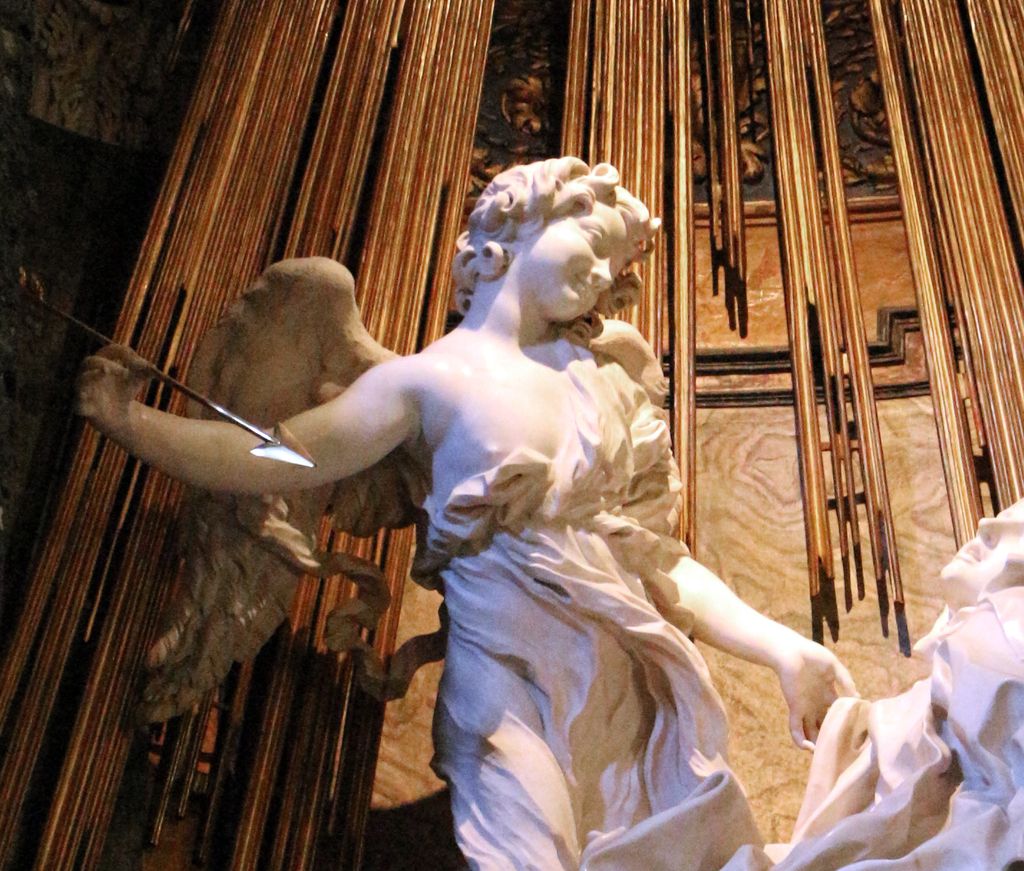
Look first at the angel's hands. One reaches towards the folds around Teresa's upper body; the other extends outwards with the dart. The interval between the figures remains open enough for the action to register. There is no crowded struggle and no obvious resistance. The fine, controlled gestures are more unsettling because they meet so little visible effort from the saint. Her lowered arm and relaxed hand offer a different kind of bodily language from the angel's poised fingers. [6]
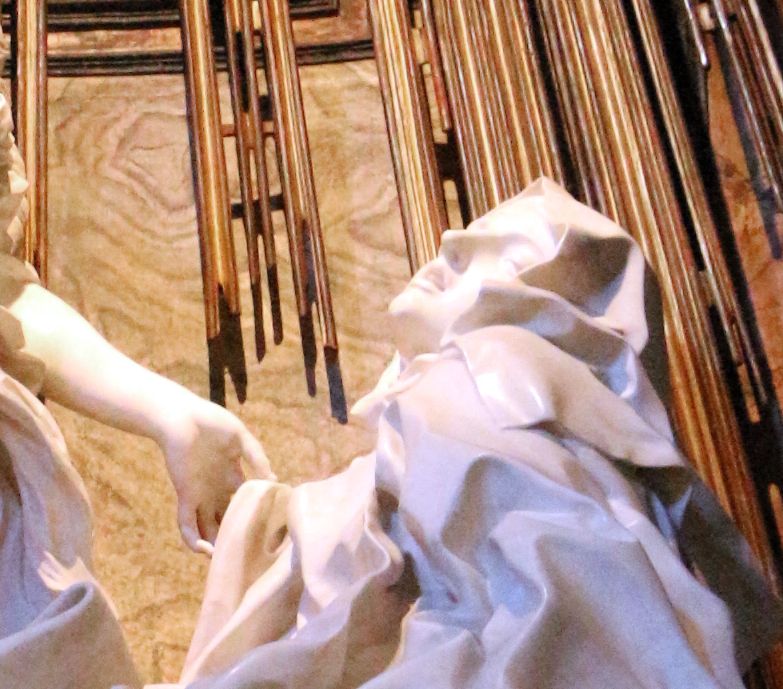
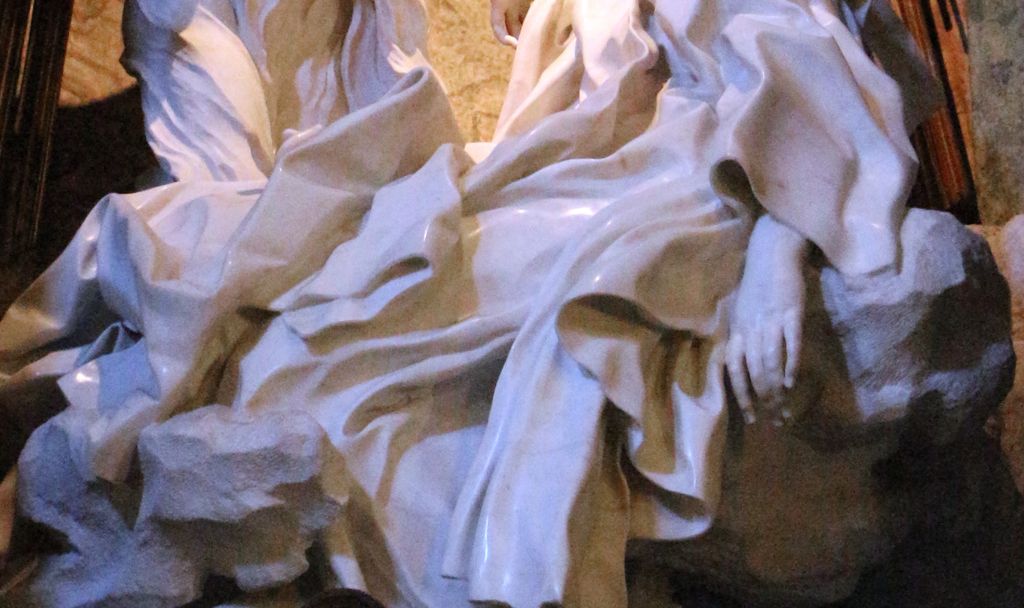
Teresa's habit conceals much of her anatomy, but it does not make her an inert mass. Across her lap the cloth forms great angular ridges, with dark hollows between them. These folds seem to move in several directions at once. A broad diagonal carries the eye down from her shoulders, while sharper breaks interrupt that descent. Her face, comparatively small and smooth, emerges from this turbulent covering. The eye repeatedly travels from the cloth back to the mouth and eyelids, searching for a stable expression. [6]
The angel's garment behaves differently. Its narrower folds curl around the upright body, leaving the chest and one shoulder exposed. The contrast is visible in both silhouette and surface: the angel is slender and rising, Teresa broad and reclining. Neither figure needs a literal gust of wind to explain this movement. The carving itself creates different rhythms around the two participants, and those rhythms help distinguish the measured action from its overwhelming effect. [6]
The cloud beneath Teresa also deserves attention. Its irregular, rounded masses do not resemble an ordinary seat or bed. At the lower edges, pieces project into shadow, making the support difficult to read at a glance. The group seems to occupy a space just beyond everyday gravity. Yet the stone remains visibly weighty: the thick cloth has depth, and the cloud has a substantial, uneven underside. Much of the sculpture's force comes from holding these impressions together, allowing heavy material to suggest a body released from normal support. [6]
Annotated Details from The Ecstasy of Saint Teresa
Compare the angel’s controlled movement with Teresa’s tilted head and the broken folds of her habit.
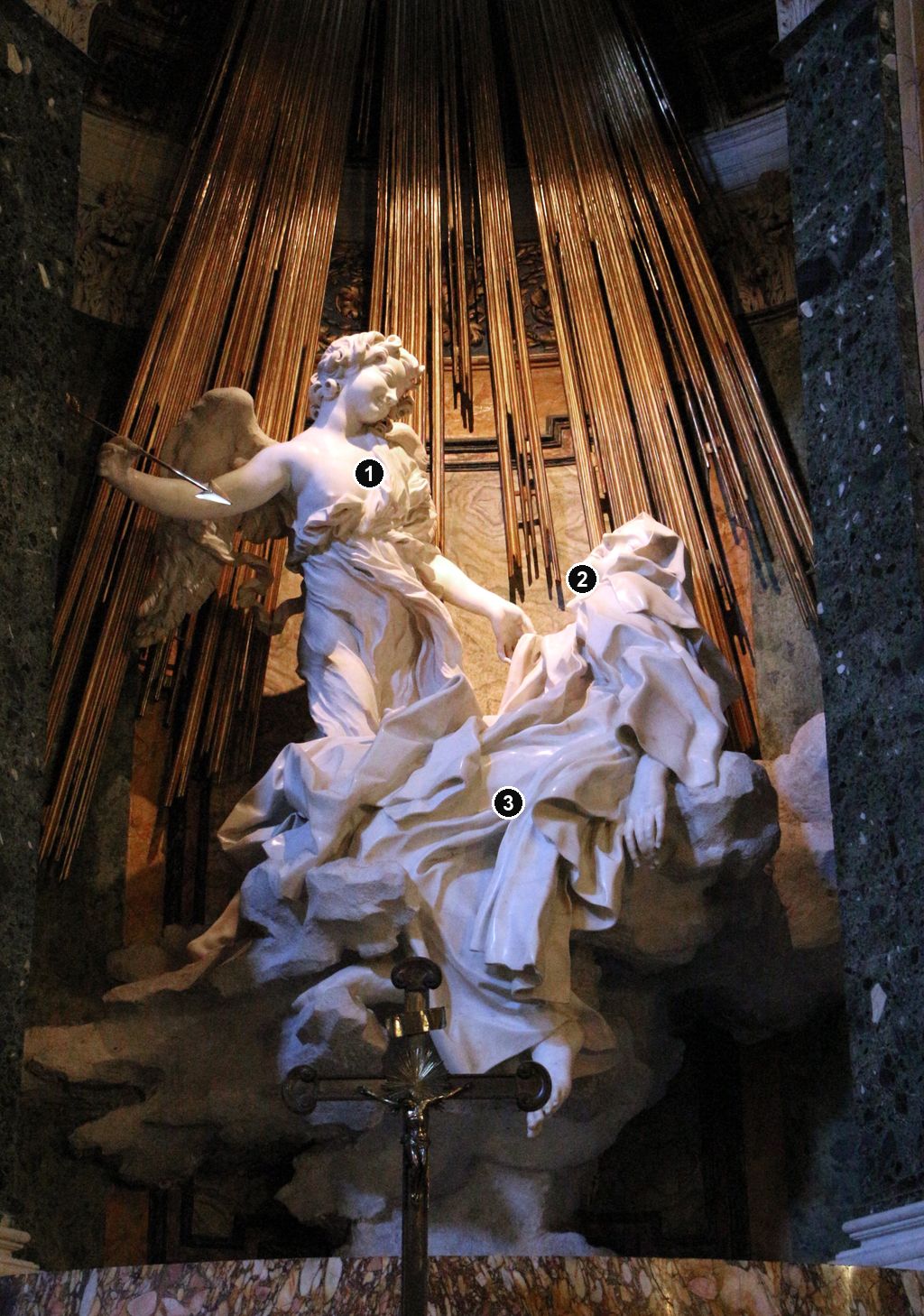
Details from THE ECSTASY OF SAINT TERESA
Photograph by Sailko, CC BY 3.0. Overview annotated and details cropped and resized from the unchanged photograph.
The poised angel
The angel’s extended arm and small inward gesture give the action a delicate precision. His upright body contrasts with Teresa’s reclining figure. [6]
Teresa’s tilted head
The head falls back above a covering of turbulent cloth. The comparatively smooth face becomes a small point of concentration within those angular folds. [6]
The habit’s broken folds
Ridges and dark hollows send the fabric in several directions. The carved mass remains visibly weighty while the reclining pose seems released from an ordinary seat. [6]
A chapel made for the encounter
Bernini framed the white group with pairs of dark, richly patterned columns. Their upright shafts and elaborate capitals establish a firm architectural order around the restless folds. Above the figures, the rays gather into a bright field; below them, the altar brings the vision back towards the level of worship. Seen together, these elements create a carefully layered progression from the church interior to the recess containing the sculpture. [6]
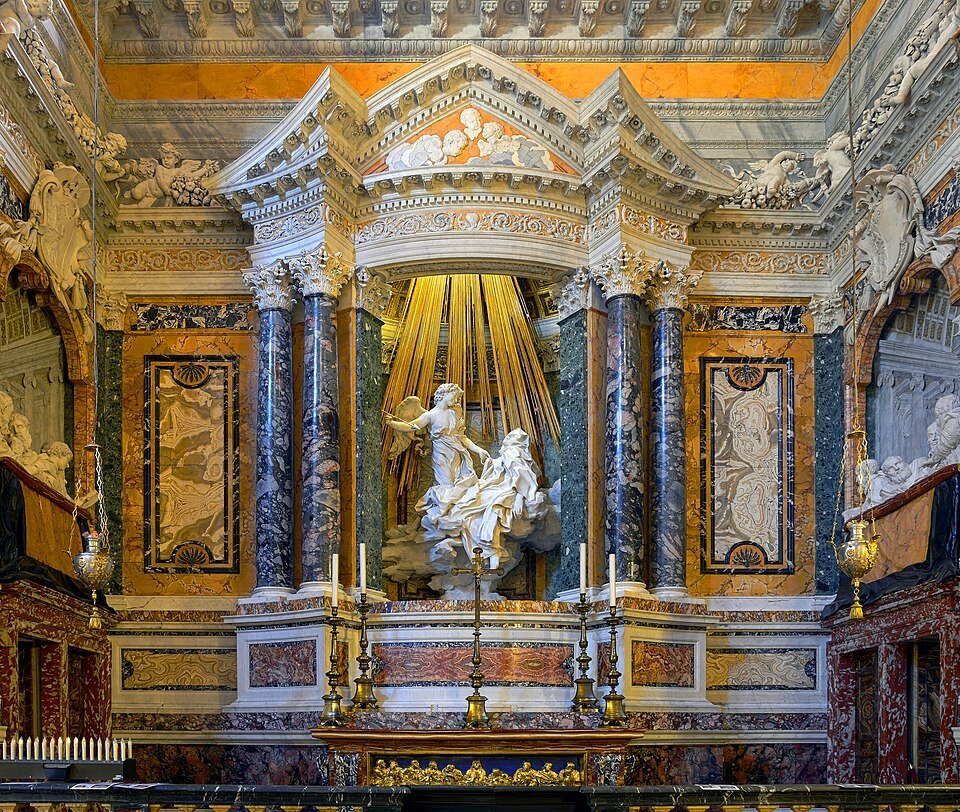
The contrast of materials changes the way the white marble reads. Against the veined columns, Teresa and the angel appear unusually clear, almost detached from the coloured setting. Within the group, however, shadows divide the cloth into abrupt patches of brightness and darkness. The figures are neither evenly illuminated museum objects nor flat silhouettes. Their visibility depends on the setting around them, which alternately frames, conceals and reveals their forms. [6]
At either side, members of the Cornaro family appear in carved architectural boxes. The Ministry of the Interior's account of the chapel identifies eight family figures and names Cardinal Federico Cornaro as the patron. The arrangement resembles spectators gathered around a performance, although these portraits also establish the family presence within its own chapel. Commission and commemoration become visible alongside the saint's experience. [3]
Witnesses, worship and theatre
The theatre analogy is useful, but it does not explain everything. Art historian Irving Lavin reads the Cornaro Chapel as a unified religious environment extending from its pavement to its vault. In his account, the family figures encourage participation through their varied gestures of study, discussion and attention. He also connects the scene above the altar with the Eucharistic imagery on its front. This reading places the sculpture within the purposes of a mortuary chapel and the Christian hope of salvation. [4]
The difference matters when looking at the central group. A tightly cropped photograph encourages an intimate encounter with two figures, while a wider view reveals the structured space in which that encounter is displayed. The portraits, columns and altar change the scale of the subject. What initially seems private acquires a public setting. Visitors see both the saint and the surrounding apparatus of looking, with its repeated openings, frames and viewpoints. [6]
Lavin also addresses the work's erotic force through the long religious tradition of describing divine love in the language of human love. His interpretation acknowledges physical feeling without treating it as a diagnosis of Teresa. The sculpture can sustain this tension because it gives the viewer bodily signs to recognise while placing their cause beyond ordinary sight. [4]
Light and the history of the surface
The golden rays provide a visible image of radiance, but actual illumination is also part of the chapel. The 2021 restoration included work on the glazing behind the sculpture, as well as cleaning marble and recovering stucco and fresco decoration. The official account treats these surfaces and the light entering the recess as interdependent parts of the ensemble. Looking at the work therefore means looking at an environment whose appearance has required care over time. [3]
An Italian report from Rome's tourism authority adds an illuminating qualification. The yellow screening glass examined during the restoration proved to be twentieth century. Small fragments of older glass were found, and the report considers the later glazing probably faithful to Bernini's original. That distinction prevents a pleasing effect from being mistaken for untouched seventeenth-century material. The same report describes the removal of soot from the fresco of the heavenly realm, associated with the church fire of 1833. [5]
These findings make the coloured surround worth a second look. The chapel's effect depends on more than the carved faces: clear surfaces, readable decoration and the character of the light all contribute. Restoration history does not diminish the encounter. It helps explain why a famous sculpture must also be understood as part of a vulnerable architectural whole.
Why the chapel moved across the church
On 22 January 1647 Federico Cornaro obtained patronage rights over the last chapel and the left transept of Santa Maria della Vittoria. The date records the cardinal’s acquisition of a place in the church. The restored chapel’s official dossier traces work on the full ensemble to 1653, while the Kunsthistorisches Museum dates the marble group to 1652. The two dates apply to different things. The group could be substantially complete while work on its surroundings continued. [8][10]
The site was already part of the Carmelites’ programme. Oskar Bätschmann reconstructs a succession of dedications in which Teresa’s chapel moved from the right transept to the left, the Gospel side. That shift displaced the dedication to Saint Paul and the associated painting by Gerrit van Honthorst. Bätschmann also traces Cornaro’s links to the Discalced Carmelites back to 1633, when they were introduced in Venice during his patriarchate. By the time he commissioned Bernini in Rome, Cornaro had already supported the order in another city. The dedication brought that history into the place where he wished to be buried. [8][11]
These decisions help explain the proportions of the commission. Cornaro acquired rights in an existing church with its own paintings, altars and devotional traditions. Bernini could turn the visitor’s attention across the transept, but the chapel still had to serve within that church. The placement of the family reliefs becomes particularly telling in this light. Their openings seem to extend the chapel sideways, as though the family occupied rooms off its walls. The cardinal’s patronage takes visible shape as a place within a religious interior that he shared with the Carmelites. [8][11][12]
What the vault adds to the altar
Guidobaldo Abbatini painted the vault, where musical angels surround the dove of the Holy Spirit. Below that painted company, Marc’Antonio Inverno made four stucco reliefs with episodes from Teresa’s life. Baldassare Mari and Giacomo Antonio Fancelli worked on the stucco angels over the arch. Fancelli also worked on the Nile figure for the Fountain of the Four Rivers. That connection gives a sense of the range of work available to Bernini’s collaborators. The chapel required the coordination of people who could model figures against an arch, lay out small scenes in relief and paint a ceiling intended to appear open. [8]
Follow those levels from the altar upward. At the centre, the angel and Teresa occupy a sharply defined recess. The episodic reliefs extend her story beyond the single moment in marble. The painted sky then invites the eye to travel farther than the building physically allows. The succession gives the viewer more than one way to look. You can pause over an exchange between two figures, move on to the incidents in the reliefs, and then take in a company of angels whose music is suggested by their instruments. The separation between the levels makes their links easier to read. [8][12]
The conservation team counted seventeen giornate in the fresco. These are working areas defined by the application of fresh plaster. The finding gives a material counterpart to the apparent continuity of Abbatini’s sky. On the ceiling the groups seem to inhabit one luminous field. In execution the artist had to divide that field into sections that could be painted while the relevant plaster was fresh. Looking for the overall flow and considering how it was made lead to two different readings of the same surface. [8]
A model in clay and an engraving on paper
The Kunsthistorisches Museum’s German-language exhibition places a photograph of the installed marble alongside the Hermitage’s terracotta of Teresa and the angel. It catalogues the clay as a Roman work of 1647, 47 centimetres high, inventory 619. A clay figure at that scale gives the sculptor a way to judge how the two bodies read together. It also lets a later viewer see the arrangement in isolation. The doorway, altar and vault that determine the scale of the encounter in Rome are separate from the small object. The museum’s juxtaposition makes it possible to ask which effects the pose can carry by itself and which only emerge in the chapel. [10]
The Strasbourg Cabinet des estampes et des dessins holds a different translation of the group, by Benoît Thiboust. The work is on paper and combines etching and engraving. It measures 44.4 by 29.4 centimetres. The printed marks have to make the bodies, folds and clouds distinguishable across one sheet. The chapel can present the group with light entering from above and with other figures appearing at the edges of a visitor’s view. The engraver works with the tonal range available between ink and paper. Comparing the two versions helps explain both what a print can communicate about the central episode and why seeing an image of the group leaves open the question of how the chapel itself works. [9][10][12]
From Apollo and Daphne to Teresa
Bernini had already explored transformation through marble in Apollo and Daphne, made in 1622–1625 and now in the Galleria Borghese. There, a pursued woman's fingers and hair become laurel, while her feet turn into roots. The collection's catalogue stresses the unfolding, theatrical character of the action and explains that the original placement beside a wall shaped the observer's encounter. [7]
The comparison makes the later chapel's particular achievement clearer. In the earlier group, metamorphosis becomes visible through changes to the body itself. In Teresa's case, face, hand, cloth and support carry the burden of expressing an inward event. The surrounding architecture gives that event a place to appear. Both works invite close attention to a moment of change, but the Cornaro Chapel extends the encounter across an entire setting.
Bernini works directory
Frequently Asked Questions
It is in the Cornaro Chapel of Santa Maria della Vittoria in Rome. The church's address is Via XX Settembre, 17. [1]
Rome's official church account dates the work to 1647–1652. [1]
It refers to Teresa's description of an angel piercing her heart with a fiery golden spear, leaving her consumed by love for God. She describes the pain as spiritual, with bodily participation. [2]
Discussion
Compare the angel’s poised gesture with Teresa’s reclining body, then consider how the chapel directs the visitor’s looking.
Reader Insights
Where does the marble seem lightest?
How does the cloud alter your sense of weight?
What would be lost if the group were seen without its chapel?
Join the Conversation
Share a detail, comparison or question about The Ecstasy of Saint Teresa below.
References
- Turismo Roma, The Church of Santa Maria della Vittoria: Cornaro Chapel, commission, dates and location. Rome's official tourism authority, English church entry; accessed 28 October 2026. View source.Splash image: The Ecstasy of Saint Teresa in the Cornaro Chapel, Santa Maria della Vittoria, Rome. Photograph: Sailko, via Wikimedia Commons; resized · CC BY 3.0
- Teresa of Ávila, The Life of St. Teresa of Jesus, chapter XXIX, especially §§16–19, translated from Spanish by David Lewis, third enlarged edition with introduction and notes by Benedict Zimmerman (London: Thomas Baker; New York: Benziger Brothers, 1904), pp. 255–257. Digital text, Christian Classics Ethereal Library; accessed 28 October 2026. View source.
- Ministero dell'Interno, Concluso il restauro della cappella Cornaro in S. Maria della Vittoria, 22 October 2021, updated 23 October 2021. Italian official account of restoration, patronage and chapel arrangement; accessed 28 October 2026. View source.
- Irving Lavin, Gianlorenzo Bernini—The Chapel of St. Teresa, in Art of the Western World, episode 5, Realms of Light: The Baroque, PBS Channel 13, 30 October 1989, typescript pp. 4–8 (PDF pp. 5–9), illustrations 4–7. Institute for Advanced Study digital archive; accessed 28 October 2026. View source.
- Turismo Roma, Dopo il restauro, torna a splendere la Cappella Cornaro, 2021. Italian restoration report, including yellow glazing and fire damage; accessed 28 October 2026. View source.
- Turismo Roma, Official photograph of Teresa and the angel and wider view of the altar setting, credited to interno.gov.it. Visual evidence for the close descriptions; accessed 28 October 2026. View source 1. View source 2.
- Galleria Borghese, Apollo and Daphne: collection catalogue entry, inventory CV. Dates, subject and original placement; accessed 28 October 2026. View source.
- Soprintendenza Speciale di Roma. La Cappella Cornaro di Bernini, conservation and historical dossier, October 2021. Patronage date, division of work and evidence for the fresco.
- Musées de Strasbourg, Cabinet des estampes et des dessins. Benoît Thiboust, L’Extase de sainte Thérèse, 77.2023.0.275. Print technique, dimensions and attribution.
- Kunsthistorisches Museum Wien. Visione, German-language exhibition essay. Catalogue information for the Hermitage terracotta and date of the installed marble.
- Bätschmann, Oskar. Römische Kult- und Kunstmacht, in 1648 – Krieg und Frieden in Europa, 1998. Dedications, chapel position and the patron’s relationship with the Carmelites.
- Lavin, Irving. Fischer von Erlach, Tiepolo, and the Unity of the Visual Arts, figs. 21–1 and 21–2. Documentary views of the altar, vault and family reliefs.
Related videos
Choose from five films: close studies of Bernini’s works alongside wider context on his methods and career.
Bernini, The Ecstasy of Saint Teresa
Explore sculpture, architecture and spiritual experience in the Cornaro Chapel.
Watch on YouTube







