



 by Tom Gurney
Tom Gurney BSc (Hons) is an art history expert with over 20 years experience
Published on June 19, 2020 / Updated on November 18, 2026
Email: tomgurney1@gmail.com / Phone: +44 7429 011000
The Rape of Proserpina
Proserpina presses a hand against Pluto’s face as he carries her away. Her arm is almost straight, and the force of her resistance travels through the shoulder into her turning body. One of Pluto’s hands grips her thigh. The stone seems to yield around his fingers. These points of contact give two very different actions a place in the same block of marble. Gian Lorenzo Bernini carved the group in 1621–22. The Galleria Borghese in Rome lists it under inventory number CCLXVIII. The figures rise to 255 centimetres above the base. [1]
At a Glance
- Date1621–22
- Location or statusGalleria Borghese, Rome
- WorkMarble group
The work in Bernini’s career
The Rape of Proserpina
1621–22Apollo and Daphne
1622–25David
1623–24St Peter’s Baldachin
1624–33The title also appears in English as The Abduction of Proserpina. Both titles describe a seizure. Bernini makes the woman’s resistance as material to the story as the god’s strength. His carving gives unusually close attention to the pressure of each person’s hands, and their faces make clear how differently they experience the same instant. [1]
The story above and below ground
In Book V of Ovid’s Metamorphoses, Proserpina gathers flowers near a lake in Sicily. Dis, another name for the god more often called Pluto in accounts of the sculpture, sees her and carries her away. Proserpina cries out, calling especially for her mother, Ceres. Later, Ceres searches for her daughter and appeals to Jupiter. The episode ends with Proserpina dividing her time between the two worlds. The abduction is the beginning of that history. Bernini presents the moment before the search and negotiations that will follow. [1][2]
The marble exchanges Ovid’s chariot and moving landscape for a struggle carried directly by two bodies. Pluto has to keep his footing while holding a woman who turns away from him. Proserpina has to find leverage while her own feet are off the ground. Each bears against the other. Her hand at his face does something different from the fingers that hold her leg. It redirects his head and gives her a momentary purchase, bringing her effort into view in a part of the sculpture where her face is also exposed. [1][2]
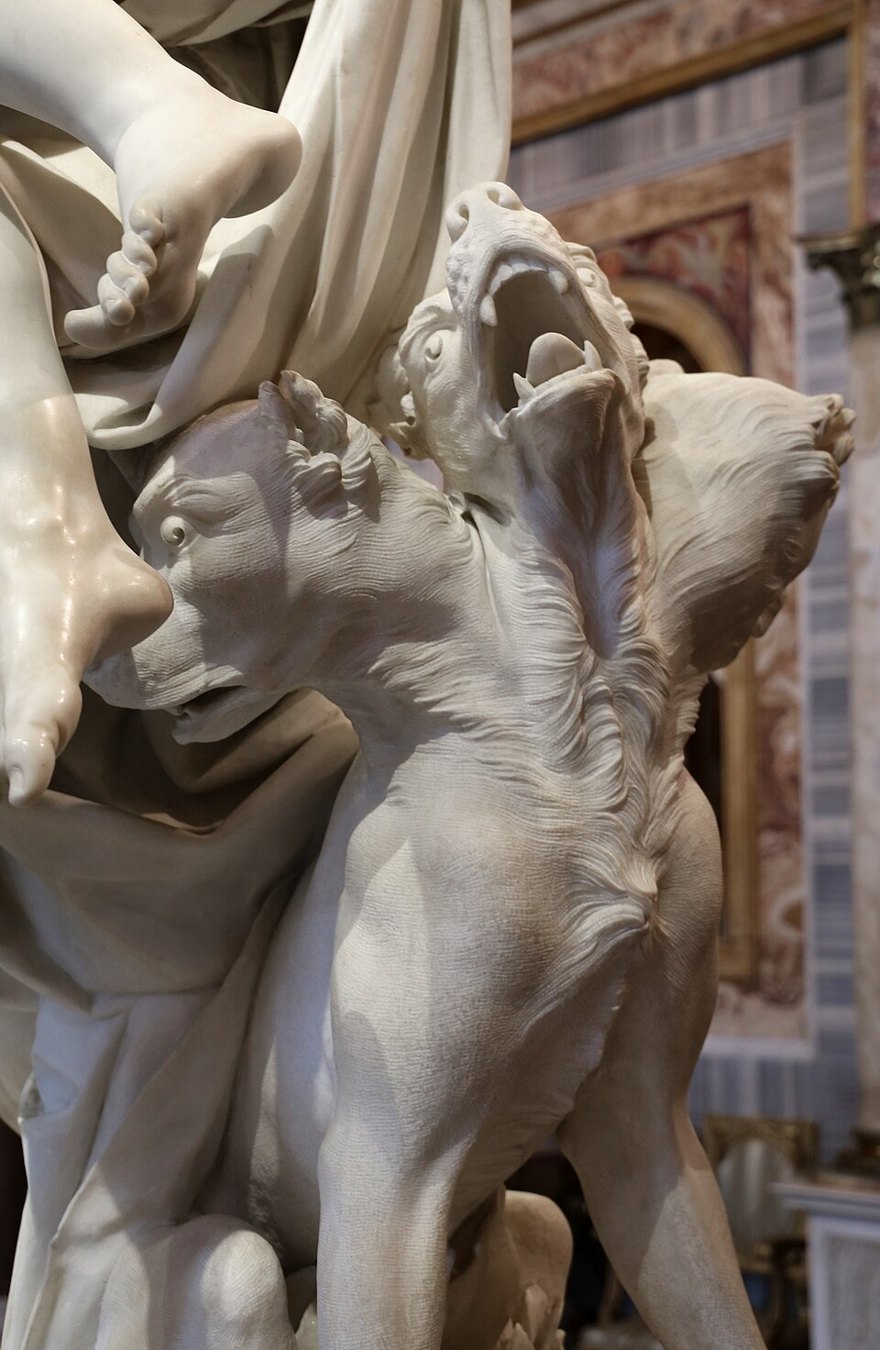
Look below the two figures for Cerberus, the three-headed guardian of the underworld. The dog supplies a clue to where Pluto is taking Proserpina. He also makes the lower part of the composition more crowded and shifts the direction of the movement there. The eyes and mouths of the dog draw the viewer down from the human faces. At that level, the shapes of the legs and feet make the god’s footing and the woman’s lack of it easier to read. [1]
Hands, weight and expression
Pluto’s grip on the thigh is the passage that tends to dominate reproductions. In the group as a whole, the impression of softness is closely tied to the weight he carries. Smooth marble rounds out the surface of the leg, and the hollows beside the fingertips catch a different light. There is a comparably sharp change where Proserpina’s hand pushes into his face. The two passages use pressure in opposite directions. Each makes a small change in the surface do narrative work that can still be understood from farther away. [1]
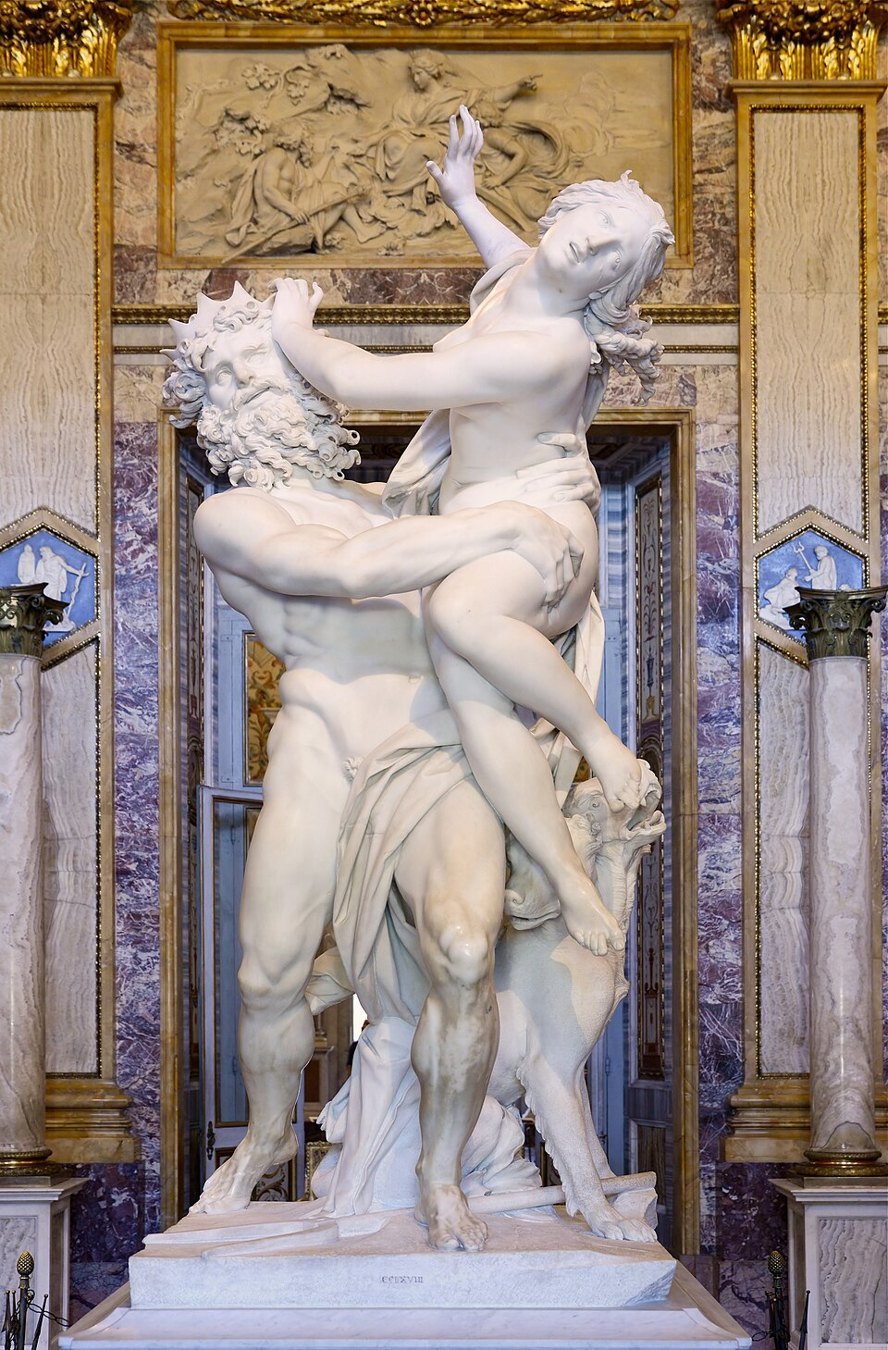
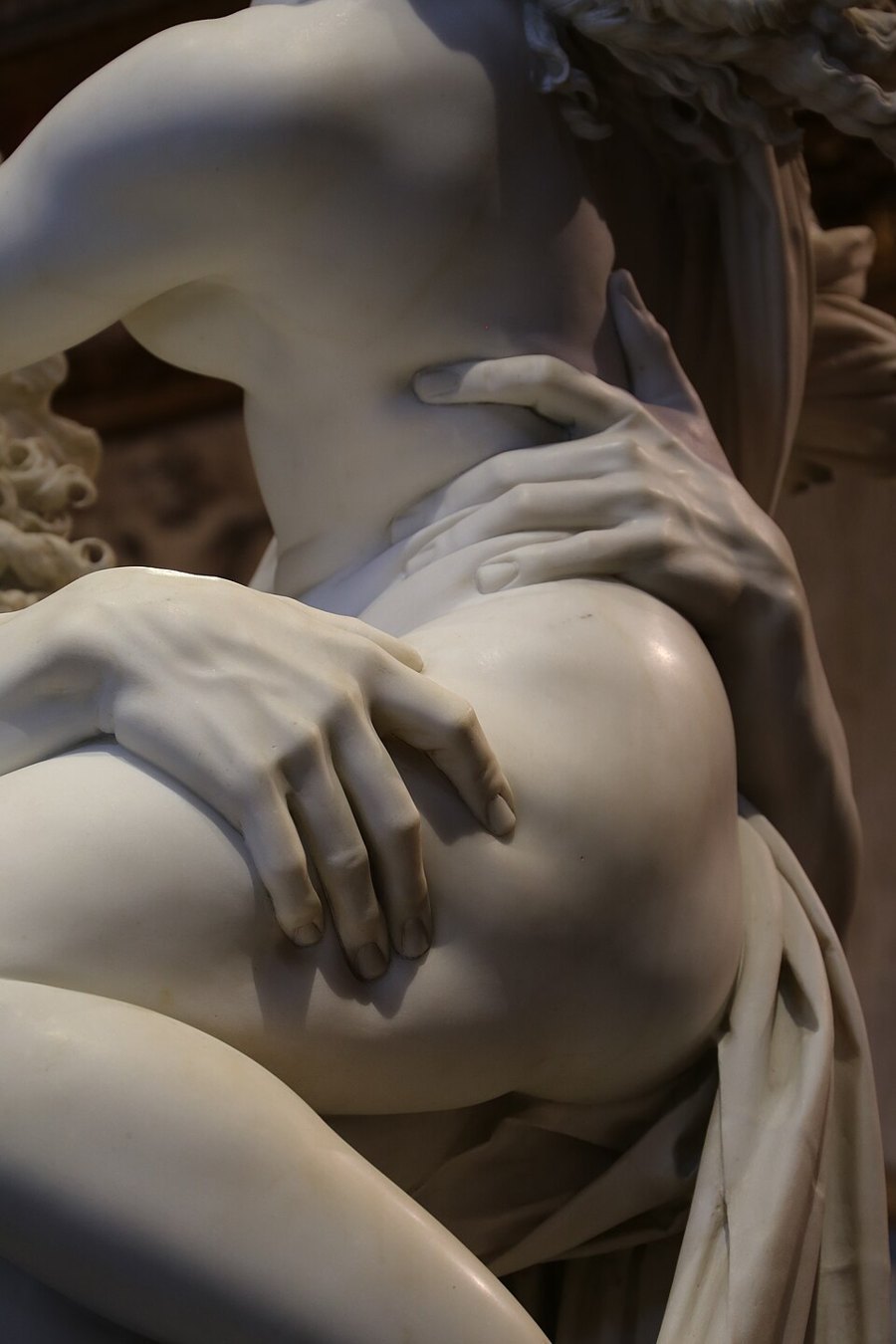
The outlines tell a related story. Pluto has a broad stance and the powerful legs of a figure shifting weight under a load. Proserpina’s upper body extends away from the region where he holds her. Look along the line of her arm and then follow the curve down across her breast and waist. The far end of that movement is anchored by the grasp it is trying to escape. The pose is compelling because the two forces remain visible together. The marble preserves the lift and the struggle at once. [1]
The Galleria Borghese’s catalogue relates the group’s twists to sixteenth-century sculpture and connects the posture of Pluto’s legs with the ancient statue known as the Borghese Gladiator. In the ancient marble, a bent and extended leg open up the stance for a different kind of struggle. Bernini makes that breadth of support available to a figure who has to manage another person’s weight. The comparison helps explain what is going on low in the group, away from the much reproduced encounter of the hand and thigh. [1][3]
From the chalk study to the marble
An early red-chalk sheet in Leipzig gives a view of the group while Bernini was still deciding how the figures should fit together. The drawing holds Proserpina close against Pluto’s middle. She uses one hand against his head while trying with the other to disengage his grip. The strong diagonals meet near their intertwined arms and legs. A few strokes establish the direction of a head or the position of the fingers. Bernini used the chalk to make the outlines of limbs legible before he needed to give the faces their individual expressions. [5]
The hand pushing against Pluto’s head carries through to the finished sculpture. Much around it changes. In the marble, Proserpina’s body curves farther away and the limbs are dispersed. Where the figures in the drawing seem to close around their point of contact, the marble projects an arm and leg into the open space. The contrast makes it possible to follow a particular decision: the gesture of pushing away stays effective after the rest of the body has acquired a different shape. The sheet is evidence of a design under revision. [1][5]
What the clay head can tell us
A small terracotta Head of Proserpina survives in the Cleveland Museum of Art. It gives a closer view of the tilt of the head, the open mouth and the lightly modelled cheek. For some time it was described as part of a clay study that preceded the marble. Cleveland now dates it to 1650–1700 and catalogues it as after Bernini. The museum cites marks on the surface that are unlike the work seen on his finished studies. The piece also has a history in the possession of Bernini’s heirs. [4]
The later dating changes what the head can tell us. Its value lies in the evidence that someone revisited the expression, perhaps in the sculptor’s circle. A viewer can compare the clay head with the marble and see which aspects of Proserpina’s distress remain legible when there is no body, gesture or grip to explain it. The comparison also shows how much of the marble’s effect depends on the context around the face. [1][4]
Working around the hair and the hidden surfaces
The small gaps between locks of hair tell a different story about carving from the broad depression made by Pluto’s grip. In a conservation comparison of Bernini’s early marbles, Maria Grazia Chilosi records a concealed marble insert in part of Proserpina’s hair. She also notes places where drilling went deeper than intended. Both observations matter because it is tempting to imagine the entire surface developing smoothly from one block. In practice, freeing one strand could remove support for the next, and a local insert could restore the continuity of a passage once some of the stone was gone. The conservation account does not establish what happened at every join. It gives us a way to recognise adjustments that the finished composition would otherwise hide. [6]
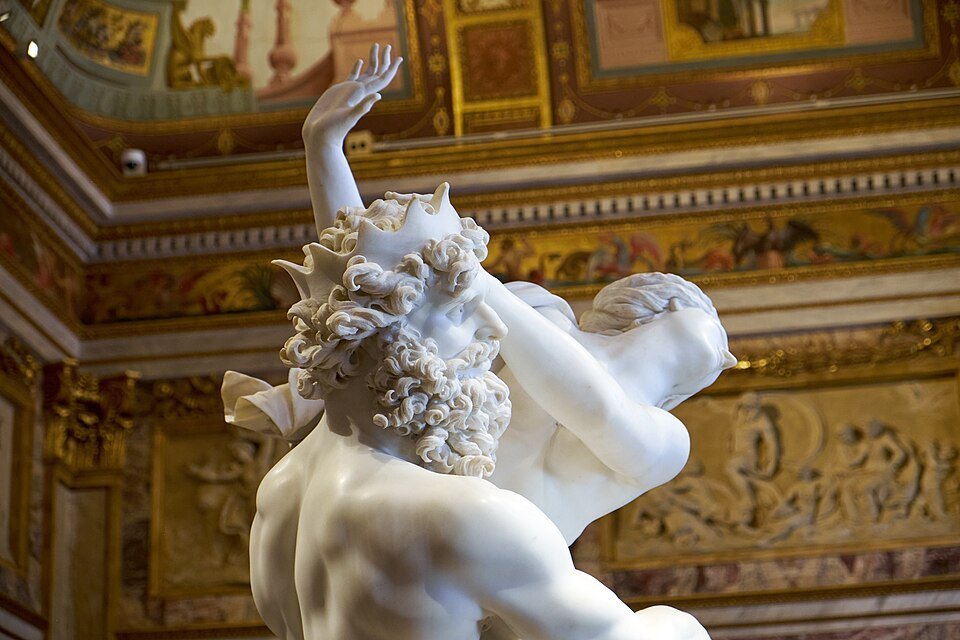
Chilosi also distinguishes passages hidden from a viewer below, where the modelling could stop at a rougher stage. That difference helps make sense of a group that appears to invite movement but still gives special weight to a set of views. Look at how the light separates the nearer locks from the face, then consider which surfaces recede behind that outline. A finish effective at the edge does not need to carry evenly back into every recess. The technical evidence connects the completion of individual surfaces with the way visitors were expected to look up at the whole. [6]
What a gift can tell us about the commission
The delivery to Ludovico Ludovisi is better documented than Scipione Borghese’s intention when the commission began. Christina Strunck proposes that the group may have been conceived for Ludovisi from the outset and that the choice of myth could have carried an unwelcome political meaning. This is a different question from whether Borghese later had reason to cultivate the new papal family. A payment or a date of delivery helps establish what changed hands. It cannot by itself show whether praise, rivalry or both shaped the choice of subject. Strunck’s argument gives the reader a reason to consider the abduction as a subject offered by one powerful patron to another. It leaves the donor’s precise intentions open. [7]
Two other ways to stage the abduction
The sculpture collection in Berlin dates Adriaen de Vries’s bronze of the same subject to 1621. Prince Ernst of Schaumburg-Lippe placed it at the approach to his castle at Bückeburg alongside a bronze of Venus and Adonis. The Berlin catalogue compares the resisting figure with Bernini’s Proserpina and relates the figure of Pluto to Giambologna. The chronology makes the comparison especially useful. These are almost contemporary works confronting the same problem of balance and resistance in different materials. The resemblance offers a way to compare the figures without establishing that De Vries saw Bernini’s finished marble. [8]
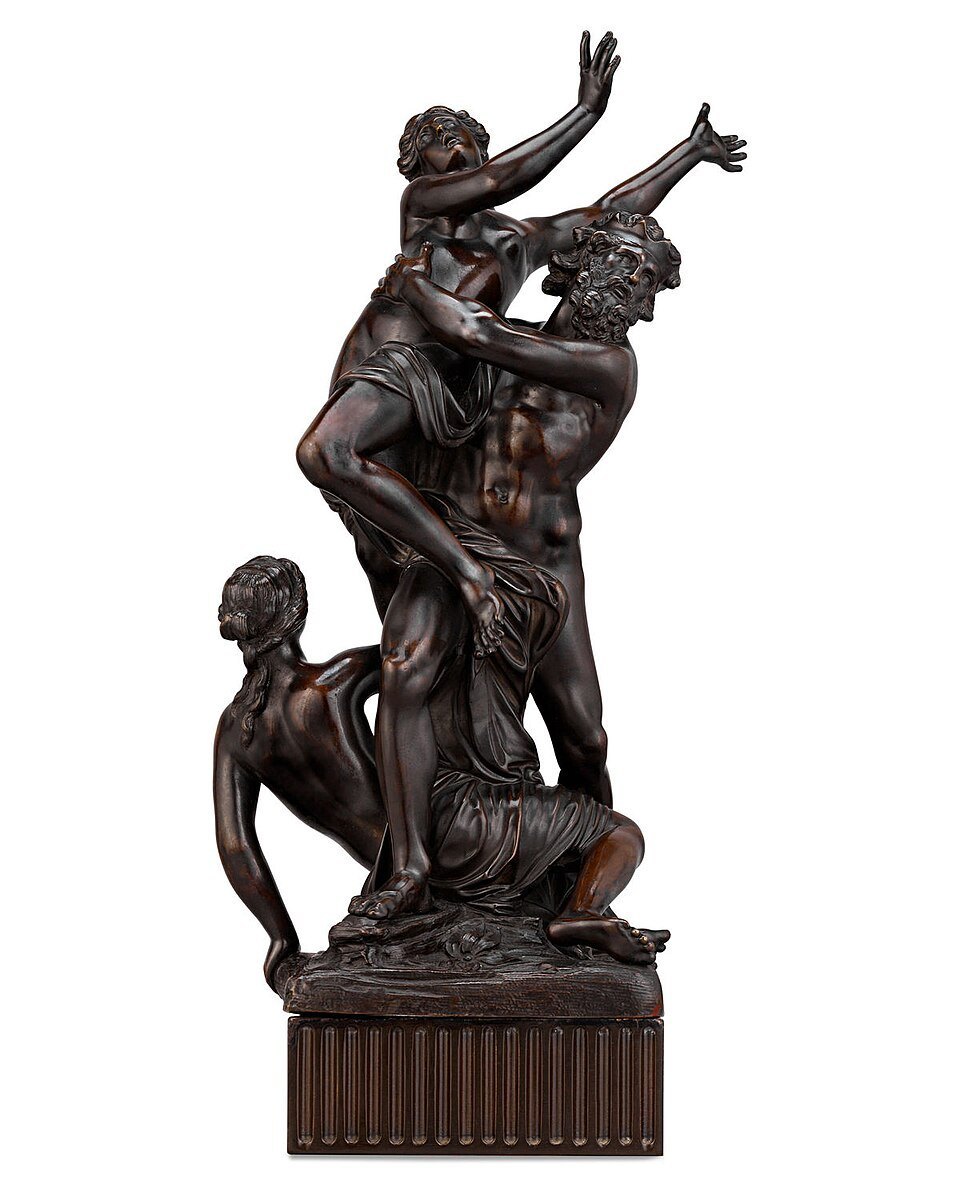
François Girardon’s later marble was provisionally placed at the end of the Allée Royale before reaching the centre of the Colonnade at Versailles in 1699. The Versailles catalogue records that the bottom of the group was cut back to fit its new circular support. The change gives a particularly concrete example of the work required to make a version of this myth fit a chosen place. At Bückeburg the subject belonged to a pair at an entrance. At Versailles the setting made the sculpture the focus of a circular enclosure. Neither setting reconstructs how Bernini’s marble was seen at Villa Ludovisi. Together they show how the same episode could be made to address visitors arriving in different ways. [8][9]
From the Borghese commission to Villa Ludovisi
Scipione Borghese commissioned the group, but the work was transported from Bernini’s studio near Santa Maria Maggiore to Villa Ludovisi in 1622. The Borghese catalogue names Giovanni Battista Soria as the architect who planned the wooden structure for moving the marble and oversaw the operation. The original white marble pedestal was ready by September. The museum identifies Agostino Radi as its stonecutter and records a verse by Maffeo Barberini that once appeared on it. The verse puts the appeal to the viewer in Proserpina’s voice. She addresses someone bending to pick flowers, the same action that occupied her when Pluto arrived. That invitation to look would have met the visitor at the base of the group, where the sculpture gives clues to a destination beneath the ground. The original pedestal is lost, so the surviving accounts establish an aspect of the encounter that the present display cannot reproduce by itself. [1]
The transfer took place before the last account for the work was settled. The 1624 payment covered several sculptures, including David and the Aeneas group, so it does not establish a separate price for Proserpina. [1]
The catalogue links the gift to a change of power in Rome. Gregory XV had been elected in 1621, and Ludovico Ludovisi was the new pope’s cardinal-nephew. The transfer of an ambitious piece of marble sculpture between collectors could therefore have a purpose beyond furnishing a villa. Its long residence with the Ludovisi gave the work a different history from the other three famous Bernini groups associated with Scipione Borghese. [1]
Late nineteenth-century development led to the demolition of Villa Ludovisi, and the group was moved to the new Boncompagni Ludovisi palace. The Italian state bought it in 1908 and brought it to the Galleria Borghese, where it stands in the Room of the Emperors. Its present pedestal was made by Pietro Fortunati in 1911. The room gives visitors several angles on a work whose conditions of display have changed more than once. Take the chance to see Proserpina’s open hand as attentively as Pluto’s grip. Each makes a different kind of force visible. [1]
Related videos
Choose from five films: close studies of Bernini’s works alongside wider context on his methods and career.
Bernini, Pluto and Proserpina
A close look at movement, touch and marble carving in Pluto and Proserpina.
Watch on YouTubeDiscussion
The pressure of fingers and palms makes the struggle visible in the marble.
Reader Insights
How do Proserpina’s free arm and turned face extend the action?
What does Cerberus contribute to the scene from below?
How would a wall behind the group affect what you notice first?
Join the Conversation
Share a detail, comparison or question about The Rape of Proserpina by Gian Lorenzo Bernini below.
References
- Felici, Sonja. Rape of Proserpine. Galleria Borghese collection catalogue, 2024, inv. CCLXVIII. View source
- Ovid. Metamorphoses, Book V, lines 332–571. Translated by A. S. Kline, University of Virginia Ovid Collection. View source
- Musée du Louvre. Le gladiateur Borghèse. View source
- Cleveland Museum of Art. Head of Proserpina, accession 1968.101. View source
- Wardropper, Ian. “Sketching on Paper and in Clay.” In Bernini: Sculpting in Clay, pp. 34–35, fig. 37 and cat. D.1. View source
- Chilosi, Maria Grazia, et al. Conservation study of Bernini’s Santa Bibiana, Bollettino d’Arte, notes 6, 9 and 10. Comparison of inserts, incomplete modelling and drilling in the Borghese marbles.
- Strunck, Christina. “The Poisoned Present: A New Reading of Gianlorenzo Bernini’s Rape of Proserpina”, in Critical Perspectives on Roman Baroque Sculpture, 2014, pp. 185–201. See also the publisher’s summary of the argument.
- Staatliche Museen zu Berlin. Adriaen de Vries, Raub der Proserpina, inv. 8517. German object record, date, original site and comparative interpretation.
- Château de Versailles. François Girardon, L’Enlèvement de Proserpine par Pluton. French catalogue history of the installation and pedestal.









