


 by Tom Gurney
Tom Gurney BSc (Hons) is an art history expert with over 20 years experience
Published on June 19, 2020 / Updated on November 18, 2026
Email: tomgurney1@gmail.com / Phone: +44 7429 011000
Saint Andrew and Saint Thomas
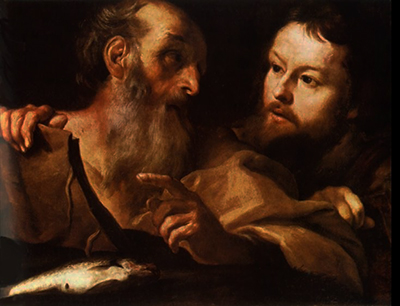
An older man holds open a book and points to a passage. Beside him a younger man follows his explanation, his attention divided between the page and the person speaking. The fish identifies the older figure as Saint Andrew and the carpenter’s square identifies the other as Saint Thomas. Gian Lorenzo Bernini painted them in oil on canvas before 1627. The picture is his earliest documented painting and belongs to the National Gallery in London. It was recorded in the Barberini collection long before it can be securely placed alongside the Andrea Sacchi painting with which it was eventually paired. [1][2]
At a Glance
- DateBefore 1627
- Location or statusNational Gallery, London
- WorkOil on canvas, inventory NG6381
The work in Bernini’s career
Apollo and Daphne
1622–25Ecstasy of Saint Teresa
1647–52St Peter’s Square
1656–67Saint Andrew and Saint Thomas
Before 1627Reading the faces and hands
Andrew’s balding head and grey hair distinguish him from the younger Thomas before the viewer has had time to identify either saint. Andrew gives weight to what he is saying by turning towards Thomas while keeping a finger on the text. Thomas’s face is animated by the effort of following. The different directions taken by the heads and hands are essential to the picture. The book receives Andrew’s pointing gesture, but the attention he gives Thomas takes the action beyond the page. The position of Thomas’s head draws the eye back towards the lower part of the picture, where the reason for the conversation becomes clear. [1]
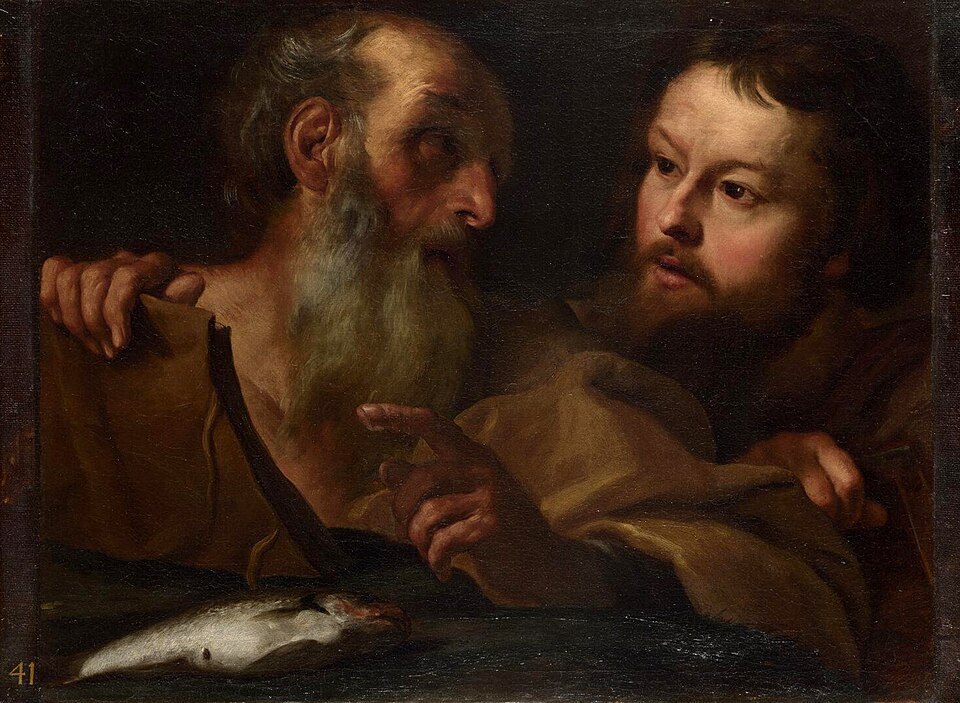
The objects explain who the men are and help Bernini construct the conversation. Andrew was a fisherman. The National Gallery suggests that the book may refer to the apocryphal Acts of Andrew. The open pages offer the two men something to examine together even if the viewer cannot identify the words. Thomas carries a set square, associated with his work as a carpenter. Its rigid angle differs from the turns of the fingers around it. While Andrew uses his hand to direct attention to the passage, Thomas’s hand holds the tool close. The pair of gestures distinguishes speaking from listening through what each figure is doing at that instant. [1]
Both figures are apostles, but the scene has no established narrative in which one is known to have explained a text to the other. Bernini gives them a credible reason to share a canvas by making visible an act of teaching. The delay between pointing to something and understanding it supplies the picture with a sense of time. The book is already open and Andrew has reached the point he wishes to show. Thomas appears to have caught part of the explanation and to be working through it. There is room for the viewer to imagine the moment before and the moment after without having to place the action in a known episode from either saint’s life. [1]
Painting at close range
The figures are shown at half length in a canvas now measuring 61.5 by 78.1 centimetres. There is little room around them for an architectural setting. The dark background allows the shapes of heads and hands to be picked out first, and the parts farther from the light sit close together in tone. The National Gallery connects the format and lighting with the example of Caravaggio, whose paintings in Rome had shown what could be done by letting strong illumination fall on figures seen at close range. Here the framing also keeps the two men near enough to make a slight turn of a head consequential. A wider field of view would have placed more of the story in the room around them. [1]
Bernini’s use of bodies to direct a viewer’s attention has a parallel in his sculpture. The National Gallery points to the animation of these figures when discussing his later career. In this picture he has control over where light falls and how much of the figures the frame permits us to see. He can bring the turn of Andrew’s face into view at the same moment as the finger on the page. He can also let the background disappear into darkness at the side of a head. A sculpture encountered from successive positions must maintain relationships between its members as the viewer moves. In the painting the fixed viewpoint gives Bernini a different way to coordinate gestures, the book and the space between the faces. [1][3]
The cropping of the canvas changes how much can be said about its original effect. In the present version the proximity of the men to the vertical edges increases the sense that they have been caught in conversation at close quarters. Some of that impression may be the consequence of later trimming. The picture still shows how Bernini coordinated the internal distances, from one face to the other and from those faces to the pages. Those intervals work without the surrounding darkness having to describe a particular room. The evidence of the trimmed sides lets the viewer distinguish a decision that belongs to the later display from relationships that are still legible within the painted group. [1][2]
The Barberini inventory
The inventory dated 1 June 1627 supplies a point by which the canvas was already in Barberini hands. An inventory records what was present in a collection and can also be compiled from information gathered earlier. The gallery therefore dates the painting to before 1627 and leaves open how it entered the family’s possession. Maffeo Barberini had become Pope Urban VIII in 1623 and was a major patron of Bernini. Their long association provides a context for the picture. The surviving record leaves the original terms of acquisition uncertain. [1]
The painting remained in Barberini possession until it passed to P. & D. Colnaghi in 1967, when the National Gallery bought it. The gallery received Andrea Sacchi’s Saints Anthony Abbot and Francis of Assisi from the same dealer that year. The works’ passage into one museum allows the history of both canvases to be studied alongside their similarities in composition. [1][2]
The attribution in the collection and photograph records
The National Gallery’s records give the width as 78.1 centimetres and identify the support as oil on canvas. These details and the number NG6381 connect the painting in London with the record for it in the Fondazione Federico Zeri. That photographic catalogue includes an attribution to Andrea Sacchi in addition to recording Bernini. Its entry points to Valentino Martinelli’s work on the paintings in 1950. Such information helps place an older attribution without confusing it with the related painting by Sacchi, which the National Gallery numbers NG6382. A search by title or painter can bring both pictures into view. The inventory numbers identify which object was being discussed in each record. [4][5]
The archive at the National Gallery has a separate acquisition file for Bernini’s painting. The gallery’s published provenance traces the work from the Barberini collection through Colnaghi in 1967. The acquisition record and the early inventory consequently give two dates at very different stages of its history. One establishes its place in a Roman household by 1627. The other shows when the object entered a public gallery where its physical edges, painting and documentary record could be considered alongside Sacchi’s picture. Publication of the acquisition file’s catalogue entry gives a location for that later record. The online description leaves the original circumstances of the painting’s commission unresolved. [4][6]
Conversation in paint and marble
In a French conference abstract, Tomaso Montanari relates the painting to two of the cardinals in the lateral boxes of the Cornaro Chapel. The comparison draws attention to a particular arrangement of two figures. In the painting, one apostle directs the other’s attention to a book, and the other turns towards him. In a Cornaro box, the turns of the heads and the direction of the gestures allow separate portraits to read as an exchange. The two works put that exchange to different ends. The painting concentrates the action within the dark ground of a single canvas. The carved cardinals occupy an architectural enclosure to the side of the chapel and can be seen with the rest of the decoration. [4][7]
The differences of setting also matter for the gestures. A hand aligned with the book offers a point from which the eye can move between the apostles. In the chapel, the depth of a box and the angle from which a visitor sees it affect the visibility of the heads and hands. Both works give the viewer part of a conversation through where the figures look and what they do with their hands. Their comparison can account for the strong sense of an encounter in the painting without requiring the Gospel sources to provide a record of what Andrew and Thomas said to one another. [4][7]
How the Sacchi became a companion
Sacchi also gives the viewer two figures at half length, close to the picture plane and lit against a dark ground. Anthony Abbot and Francis of Assisi belong to different centuries. Sacchi shows them in separate acts of devotion, so the presence of a second figure adds a parallel spiritual activity within a single frame. In Bernini’s painting each man’s attention gives meaning to the other’s. The shared format makes it easier to see how differently the two artists distribute attention among their figures. [1][2]
The National Gallery examined documentary and physical evidence for the apparent pairing. A payment in 1627 for a Sacchi depicting two apostles is a poor fit for the identifiable Anthony and Francis, neither of whom was an apostle. An inventory made after Sacchi’s death in 1661 offers a likelier early reference to his canvas. The gallery dates secure evidence of the pair together to 1692 in Cardinal Carlo Barberini’s collection. The canvases themselves help explain their close resemblance in size. Both vertical edges of Bernini’s painting were cut back and Sacchi’s canvas was extended slightly. The gallery considers it likely that the paintings were brought into agreement for a later display. [1][2]
It is possible to look at the pictures together today and see what made such a display attractive. Their dimensions and colour invite the eye to move easily between them. In one picture two figures share a text and in the other two acts of devotion run alongside each other. The surviving edges carry evidence of a collector’s intervention, while the gestures within the pictures preserve the distinct approaches that made the comparison worth arranging. [1][2]
Discussion
The open book directs the exchange between the two saints.
Reader Insights
How do their hands and eyes distinguish reading from listening?
Which attributes identify Andrew and Thomas?
What changes when you compare their faces with Head of an Apostle?
Join the Conversation
Share a detail, comparison or question about Saints Andrew and Thomas by Gian Lorenzo Bernini below.
References
- National Gallery. Saints Andrew and Thomas. NG6381, object record, interpretation and provenance. View source
- National Gallery. Saints Anthony Abbot and Francis of Assisi. NG6382, object record and collection history. View source
- National Gallery. Gian Lorenzo Bernini. Artist biography and discussion of the painting in relation to Bernini’s sculpture. View source
- National Gallery. Saints Andrew and Thomas. Object record NG6381 and historical account.
- Fondazione Federico Zeri. Sant’Andrea e san Tommaso. Italian photographic catalogue, record 50775.
- National Gallery Archive. Acquisition: Bernini, Saints Andrew and Thomas. Acquisition record NG14/240.
- Montanari, Tomaso. La liberté de Bernin, conference abstract, 2013. French summary comparing the painted apostles with a group of cardinals in the Cornaro Chapel.








