


 by Tom Gurney
Tom Gurney BSc (Hons) is an art history expert with over 20 years experience
Published on June 19, 2020 / Updated on November 18, 2026
Email: tomgurney1@gmail.com / Phone: +44 7429 011000
Medusa
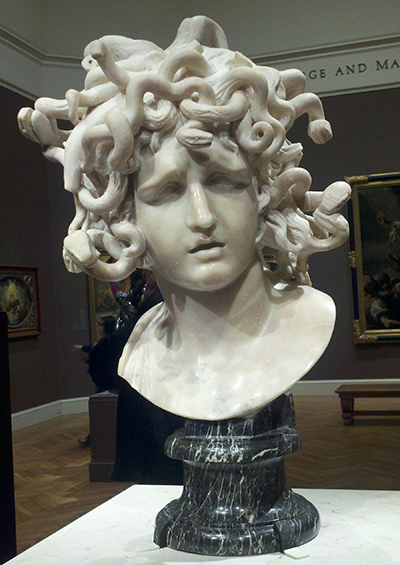
The first thing to look at in Gian Lorenzo Bernini’s Medusa is the face. The brow draws in, the mouth opens, and the head turns slightly within a mass of snakes. The shoulders give the character the form of a portrait bust. The snakes identify the Gorgon, whose gaze could turn a person to stone. By portraying her as alive and visibly disturbed, Bernini makes the effects of looking part of the subject. The Musei Capitolini dates the marble to 1644–48 in its object record. Its documented history on the Capitol begins in 1731, and the museum distinguishes that history from the less certain circumstances in which Bernini made it. [1][2]
At a Glance
- Date1644–48, Musei Capitolini dating
- Location or statusMusei Capitolini, Rome
- WorkMarble bust of the Gorgon
The work in Bernini’s career
Medusa
1644–48, Musei Capitolini datingEcstasy of Saint Teresa
1647–52Fountain of the Four Rivers
1648–51St Peter’s Square
1656–67What the myth supplies
In Ovid’s Metamorphoses, Perseus recounts how he used the reflection in a bronze shield when he approached Medusa. It allowed him to see her without meeting her gaze. After he cut off her head, it continued to turn people to stone. The continued power of the severed head helped make it an appropriate image for a shield, where it could face enemies directly. The inscription on the Roman bust’s eighteenth-century base refers to that older use. It also records the name of the donor who gave the marble to the Capitol. The inscription connects the object’s arrival in a public collection with an ancient tradition about how the image could affect the person who looked at it. [2]
Caravaggio’s Medusa at the Uffizi makes the shield itself the support for a painted head. The face seems to cry out at the moment of decapitation. The circular edge contains the twisting snakes and makes the object resemble the kind of shield ornament evoked by the Capitoline inscription. Bernini chose the form of a bust, where the shape of the neck and shoulders relates the head to a living body. A spectator can move far enough to see the direction in which the head turns. The work therefore makes movement through space part of an encounter that the painted shield locates within a single image. [1][2][3]
The expression within the snakes
The snakes can be seen as a mass from a distance and as individual bodies closer up. Their coils spread across the top and sides of the face. Open spaces between the loops make dark accents in the pale stone, and the curves draw the eye away from the centre in several directions. The uninterrupted passages of the cheeks and the smaller shadow at the mouth bring it back. Bernini uses the change in scale from the coils to the eyelids to give both the serpents and the face room in a relatively compact marble. [1][2]
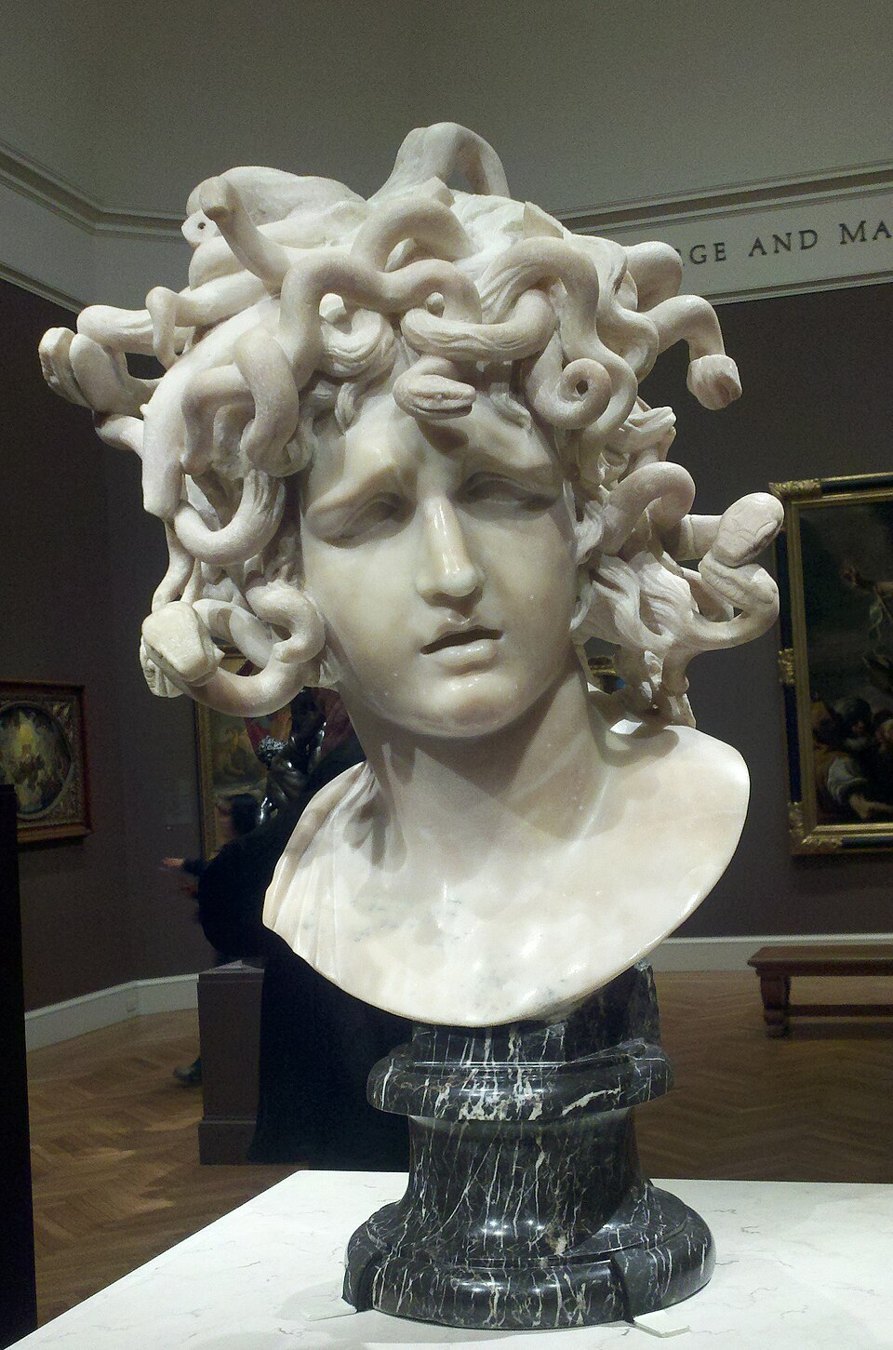
Change position and the layers of the sculpture become clearer. A snake that looks as though it follows the edge of the head may curve forward or back, overlapping one seen beside it. The contours of the jaw and shoulders remain comparatively broad. They help a viewer keep track of the underlying pose while the silhouette of the snakes keeps changing. The face, meanwhile, remains the place where a turn or an interruption is most intensely felt. The eye reads the brow, eyes and mouth together, looking for the cause of the expression beyond the marble. [1][2]
One response proposed by the Capitoline catalogue comes from a poem by Giovan Battista Marino. The Medusa of the poem wonders whether a sculptor made her or whether the sight of her own reflection turned her into stone. The museum associates Bernini’s face with that moment of discovery, imagining a mirror beyond the edge of the sculpture. This is an interpretation of the work. The marble shows a turning face and a look of distress, and the mirror gives the expression one possible cause. It also shifts the story away from the ingenuity of Perseus and towards what Medusa might experience when confronted with her own image. [1][2]
The mirror reading has a further consequence. In the myth, stone is ordinarily the end condition for someone who sees Medusa. Here a sculptor has used stone to give Medusa the signs of a living face. A spectator looking at the marble moves between those two ideas. The material is apparent at once, but its folds, hollows and differences of finish convey the impression of a change still in progress. The Capitoline museum reads that double effect as a reflection on sculpture’s ability to arrest the attention of an audience. [1]
The object in the Capitoline collection
The Marquis Francesco Bichi, a Conservator of Rome, gave the bust in 1731. The museum records the bust and base in the 1734 inventory of the Palazzo dei Conservatori, in the Sala delle Oche, or Hall of the Geese. The collection record lists the marble under inventory MC1166 and gives a height of 68 centimetres. The conservation account separately describes the Carrara marble bust and an 18-centimetre support in dark Portoro stone. That distinction matters when comparing descriptions, because the inscription and support belong to the history of the bust’s display. The lower part of the object as seen in the room helps explain how visitors came to encounter it on the Capitol. [1][2]
The museum’s exhibition and conservation accounts treat Bernini as the maker, while discussing varying dates and readings. The date of the gift gives a firm point in the bust’s provenance. The suggested date of carving concerns a different question, to be considered through the sculpture and the history of Bernini’s work. The restoration account also discusses Irving Lavin’s proposed relationship to the Bust of Costanza Bonarelli. That proposal gives one explanation for the unusually personal character of the expression. It remains a scholarly interpretation alongside the reading through Marino’s poem. [1][2]
What the inscription establishes about the artist
The base praises a celebrated sculptor without naming him. Irving Lavin traces the Bernini attribution through Antonio Nibby’s nineteenth-century account and Stanislao Fraschetti’s publication of 1900. He notes that Antonia Nava Cellini initially doubted the attribution and later defended it. Lavin’s own argument relies on the treatment of the face and on the slender, undercut coils that seem to hang in space. Rome’s collection database describes the attribution as traditional and acknowledges continuing debate about whether Bernini carved the work himself. The date in the object catalogue is consequently best read as an estimate within a proposed body of work. The gift inscription is direct evidence for a different date, March 1731. [5][6]
Lavin considered Cardinal Alessandro Bichi, who died in 1657, a plausible early recipient because of the family’s links to Bernini’s patrons, including Urban VIII and Alexander VII. He also reports that his search for evidence of the bust in the Bichi family archive was unsuccessful. Alessandro and Francesco occupy different positions in the argument. A family connection suggests one route by which the bust could have come to Francesco. Only the later donor is named on the stone. The suggestion leaves open who commissioned the marble, whether it began as a private undertaking and how it reached the marchese. [5][6]
From the antique mask to a figure on a base
Lavin places the bust alongside the ancient Medusa Rondanini, a marble mask named for the Roman collection that formerly held it. The Munich collections present the Rondanini type in their account of the Gorgon and the ways ancient art gave a monstrous figure a more regular face. Its frontal arrangement keeps the gaze directed outward. In the Capitoline marble the uneven distribution of the coils and the inclination of the head make the figure respond differently as a viewer moves from one side to the other. Lavin treats the ancient mask as an example of a tradition that could make beauty part of the danger. His comparison does not establish that Bernini used this specific marble as a model. [5][7]
The differences extend to the way the snakes identify the figure. The Munich catalogue draws attention to the snakes knotted beneath the antique face and to the wings above it. These signs leave the wide eyes and slightly open mouth unobstructed. At the Capitol the snakes occupy much more of the space around the head and supply much of its irregular contour. The places where they stand clear of the marble are part of what makes the frontal aspect give way to different silhouettes from the side. [5][7]
Lavin also compares Cellini’s bronze in Florence. The French national bibliography identifies it as a commission from Cosimo I de’ Medici and records its position in the Loggia dei Lanzi. Cellini makes the Gorgon’s head visible as something Perseus is holding up. Its separate shape is integral to the larger figure’s action. The Capitoline sculpture gives Medusa a neck and shoulders, so the eye can read a turn through the body and a change of expression at the same time. Taken together, the ancient mask, Cellini’s group and the bust show three ways of making the Gorgon’s face project into the space of someone looking at it. [5][7][8]
Two marble copies at the Louvre
The Louvre catalogues two marble copies of the Capitoline work. Each bust measures fifty-one centimetres in height before its accessory is counted. The museum tentatively connects them with the Comte d’Artois’s collection at the Château de Maisons and records an inventory of the château’s marbles dated June 1791. A separate inventory documents their revolutionary seizure in 1793. The date assigned to their carving is much broader and marked as uncertain. The two records establish that the museum considers these separate objects, even where their subject, size and much of their recorded history coincide. [9][10]
The copies carry the outline of the snakes, the distressed face and the shortened shoulders into marbles associated with a different collection. Their recorded dimensions also separate each carving from its support, just as the Capitoline conservation record distinguishes the Roman bust from the inscribed base. Their presence in France shows that the form circulated independently of the eighteenth-century display on the Capitol. The dates in the Louvre catalogue leave room for different accounts of when and where the two copies were made. [6][9][10]
What conservation adds
The restoration treated both the bust and its eighteenth-century base. The team documented tool marks and studied the finish before cleaning. Infrared, ultraviolet and spectrophotometric investigations helped assess differences across the surface. The conservators tested the cleaning in stages to reduce the risk of removing the original finish with later deposits. This work matters to the way the piece is seen. A sculpture whose expression depends on shadows at the eyes and the depth of the coils can lose distinctions when very different surfaces are treated as though they were the same. The museum allowed visitors to watch the work during the intervention, making the process visible alongside the finished object. [2]
The Rijksmuseum later included the bust in Caravaggio-Bernini: Baroque in Rome, where it appeared with other examples of Bernini’s marble portraiture. That context and the Capitol’s setting encourage different kinds of comparison. In the portrait group, Medusa’s shoulders, turn and expression come forward as artistic choices shared with representations of living sitters. In the Hall of the Geese, the inscribed support recalls the uses of the Gorgon’s face in antiquity and identifies the eighteenth-century gift. Both settings draw attention back to a bust that looks as though it might meet a viewer’s gaze and whose subject makes that possibility unsettling. [1][2][4]
Related videos
Choose from five films: close studies of Bernini’s works alongside wider context on his methods and career.
Bernini, Bust of Medusa
Explore expression, myth and the portrait bust through Bernini’s Medusa.
Watch on YouTubeDiscussion
Medusa’s face turns within the larger mass of snakes.
Reader Insights
Which feature makes her look most alert or disturbed?
What changes when the mythological figure is presented as a portrait bust?
How does the sculpture make the act of looking part of its subject?
Join the Conversation
Share a detail, comparison or question about Medusa by Gian Lorenzo Bernini below.
References
- Musei Capitolini. Bust of Medusa, inv. MC1166. View source
- Musei Capitolini. Restoration of the Bust of Medusa by Gian Lorenzo Bernini. View source
- Uffizi Galleries. Views from around the World, section on Caravaggio’s shield. View source
- Rijksmuseum. Caravaggio-Bernini: Baroque in Rome. View source
- Lavin, Irving. Bernini’s Bust of the Medusa, especially pp. 795–799 and notes 14–16.
- Musei Capitolini. Busto di Medusa, civic collections database. Italian catalogue entry and attribution discussion.
- Staatliche Antikensammlungen und Glyptothek. Antike Troublemaker. German exhibition material on the Medusa Rondanini.
- Bibliothèque nationale de France. Persée tenant la tête de Méduse. Record of Cellini’s bronze.
- Musée du Louvre. Méduse, MR 2126. Marble copy, dimensions and provenance.
- Musée du Louvre. Méduse, MR 2127. Marble copy, dimensions and provenance.








