


 by Tom Gurney
Tom Gurney BSc (Hons) is an art history expert with over 20 years experience
Published on June 19, 2020 / Updated on November 18, 2026
Email: tomgurney1@gmail.com / Phone: +44 7429 011000
Bust of Pope Urban VIII
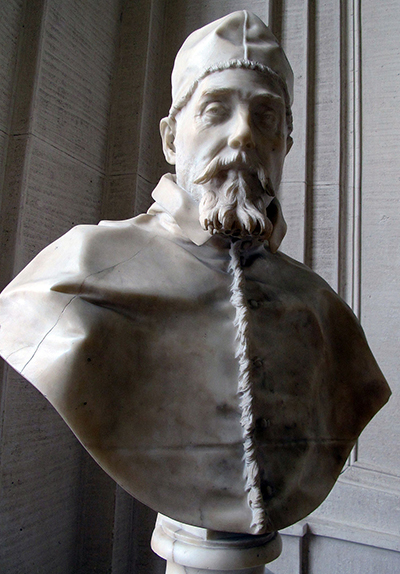
In the marble bust of Urban VIII at Palazzo Barberini, a short cape spreads broadly beneath the pope’s narrow face. A fitted cap covers his head, and the textured edge of the cape descends from beneath his beard. The Gallerie Nazionali di Arte Antica records the marble as inventory 2521. It belongs to the early 1630s, in the middle of Urban’s pontificate, when Gian Lorenzo Bernini was developing a portrait format that he and his workshop could use again. A closely related bronze was placed in the Barberini library. Other portraits of the same pope use a stole, different materials or a different treatment of the face, and have histories of their own. [1][2][3]
At a Glance
- DateEarly 1630s
- Location or statusPalazzo Barberini, Rome
- WorkMarble bust, inventory 2521
The work in Bernini’s career
Apollo and Daphne
1622–25Ecstasy of Saint Teresa
1647–52St Peter’s Square
1656–67Bust of Pope Urban VIII
Early 1630sThe cap, face and cape
The pope wears a camauro, a fitted cap with a visible band around its lower edge, and a mozzetta, a short cape worn over the shoulders. The cap narrows the outline above the forehead. The cape does something very different below, spreading towards the sides before curving back to the support. The position of the face between these two forms gives the head prominence even from a viewpoint where the eyes are in shadow. The breaks in the outline are particularly clear at the raised opening around the neck, where the cloth falls away from the jaw and the beard projects in front of it. [1][2]
The central fastening of the cape divides the lower part of the bust. Its textured edge runs almost vertically, providing a measure against which the folds can be seen changing direction. On one shoulder a broad surface catches the light before it falls into a crease. The opposite shoulder turns the cloth away. A visitor following the front edge of the garment can see the cape opening around the neck, then continuing beneath the chin as the beard interrupts its course. The clothing makes the upper body broad enough to set the head apart while still providing lines that lead up to the face. [1][2]
The hair, moustache and beard carry shorter and more irregular marks than the cape. At the brow the transition into shadow can be quite abrupt. Lower down, the separate points of the beard give the areas beneath the mouth and chin a more broken contour. Short marks along the cap’s lower edge provide another texture, closely following the boundary above the face. Bernini concentrated surface detail where the sitter’s features and dress meet. That distribution explains why the photograph can register fur, hair and flesh even though the light falls across all three from the same direction. [1][2]
An image of a reigning pope
Maffeo Barberini became Urban VIII in 1623 and reigned until 1644. He had acquired work from Bernini before his election and commissioned major projects from him during his pontificate. A bust gave this patronage a format different from the large works at St Peter’s. The sitter could be represented at the scale of an encounter within a room, and the sculpture could become part of a family collection. The early marble’s clothing is far simpler than the figured cope used in Bernini’s full-sized bust of Paul V. The broad sweep of fabric around Urban gives the face much of its character through the difference in scale between small details above and the large folds below. [2][4]
The Vatican Museums relates the bust to a period of sustained portrait work that also produced the likenesses of Cardinal Scipione Borghese and Costanza Bonarelli. Those commissions differed in their patrons and purposes. What can be compared is the emphasis on the transition between a person’s face and the clothing below it. Urban’s cap and cape provide a recognisable arrangement that can be repeated. Within it Bernini gives the brow, eyes and openings around the mouth enough definition to suggest a particular expression. The discernible structure of the clothes and the precision of the face make different contributions to the identity of the figure. [2][4]
The fold of cloth beneath the cheek is consequential in a bust intended for a room. It catches the light separately from the face and marks the interval between the head and shoulder. From the front it reads as part of the frame around the beard. From the side it gives depth to the opening of the cape. [1][2]
A bronze for the Barberini library
The Vatican Museums identifies a bronze dating to about 1632–33 that derives directly from the early Palazzo Barberini marble. The family kept it in a niche in a wooden bookcase made in 1633 by Giovanni Battista Soria. In 1902 the bronze, bookcase and Barberini library passed to the Vatican Library. The record connects the cast with a specific piece of furniture. In the niche, the opening would have framed the spread of the shoulders and controlled the angles from which the bust could be seen. The sculpted clothing was therefore a way of occupying the width of the opening as well as a way of identifying the sitter. [2]
Comparison with the marble shows how a design can survive a change of material without giving quite the same impression. In bronze, a narrow highlight can pick out the crest of a fold against a darker surface. In marble, areas beside a sharply cut line can remain light enough for a visitor to see the shape of the larger surface at the same time. The Vatican study calls attention to the bronze’s varied finish and its effect on the light. The casting preserves a scheme of broad shoulders, the fastening down the front and the detailed head, while the surface allows those parts to register differently in its setting. [1][2]
A portrait assembled from bronze and porphyry
Another portrait made for the Barberini in the early 1630s separates the pope’s head from his garment in material as well as in form. The head is bronze and the cape is porphyry. Stefano Pierguidi follows the Barberini accounts and the record of payments to Tommaso Fedeli for the porphyry. Taddeo Barberini ordered the work, and Fedeli was paid in three instalments between August 1630 and March 1631. Pierguidi also finds evidence of Bernini’s contribution to the portrait and connects him with the bronze head. These records give separate names to two parts of a likeness that would have been experienced as one object. [7]
In the early marble, the border between face and cape depends on changes in carving, including the raised edges around the collar. In the composite portrait, the different materials establish the division before the viewer has traced the details. A written account extends the history of that effect beyond the payments. Pierguidi records that Nicodemus Tessin the Younger noted the portrait during his visit in 1687–88 and that later guides treated it as a noteworthy Barberini possession. The records establish both the commission and later attention to the work. They concern a separate bust, whose use of two materials enlarges the range of ways Bernini’s workshop presented the pope. [7][8]
Urban’s portrait at the front of his poems
The portrait of Urban also appeared where readers might open a book. The Rijksmuseum catalogues the 1631 engraving by Claude Mellan after a drawing by Bernini and connects it with Urban’s Poemata. The Metropolitan Museum holds an impression of the same portrait. The paper format fixes a single angle from which to see the head and outfit. The likeness could therefore circulate consistently with the text, even when a reader was far from the Barberini library where another version of Urban’s image stood. [9][10]
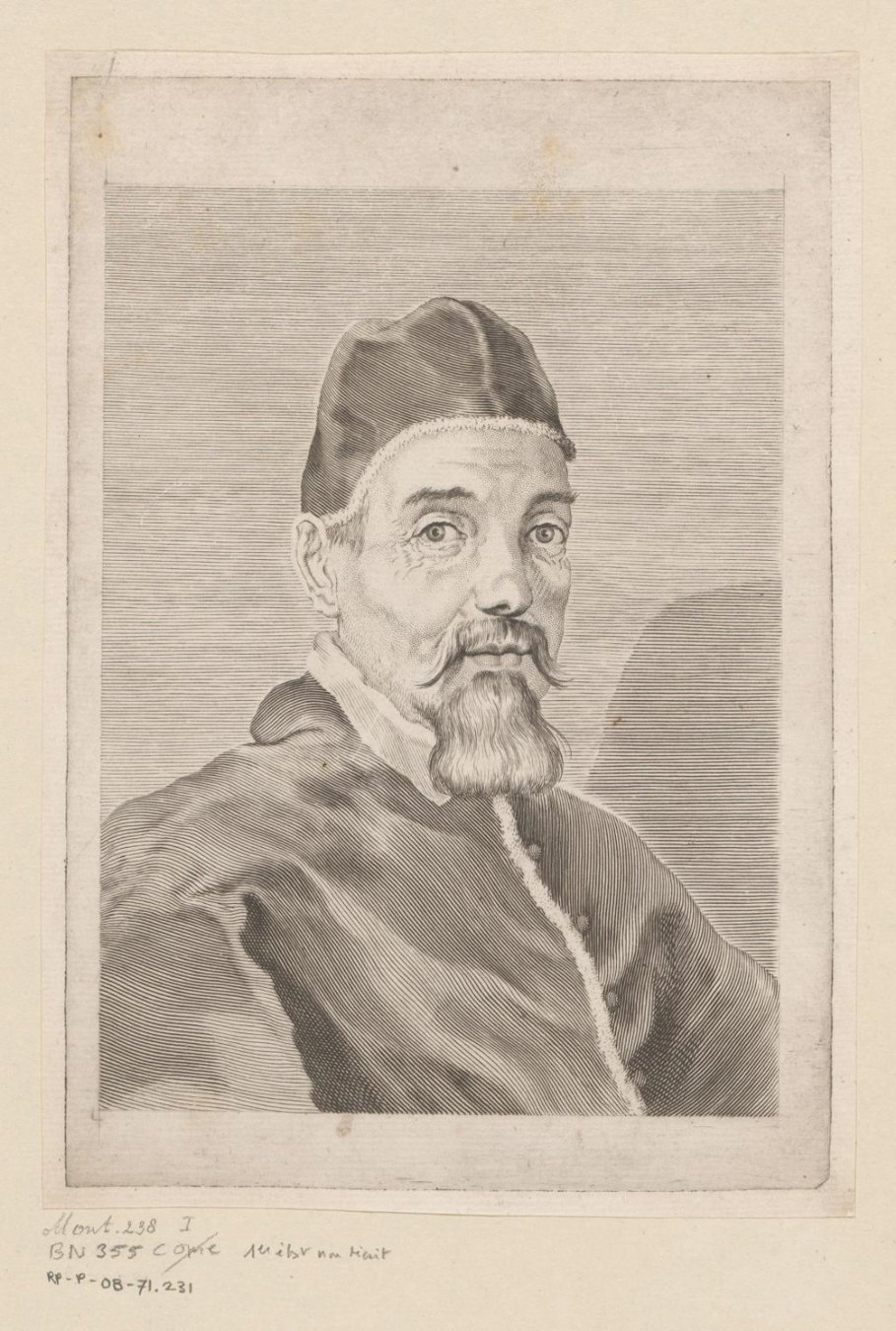
The contrast concerns how the two objects frame a face. The bronze in the bookcase was placed in a physical recess. The engraving could carry its framing with it and give the portrait a specific place within a printed volume. In the German account of the 2023 Palazzo Barberini exhibition, the bust and the papal poetry appeared in adjoining rooms devoted to the court’s portraits and writing. That account documents a modern curatorial comparison. The seventeenth-century print supplies the earlier link between an image of the pope and the circulation of his verse. [8][9][11]
A commission and a bequest in different records
The Corsini bronze and the Louvre bronze have often been discussed together because both have been associated with Cardinal Antonio Barberini. In his study of the Corsini bust, Andrea Bacchi cites a payment that Bernini ordered in July 1658 to the cabinetmaker Jacomo Erman for ebony and work on a stand for a bronze half-length figure. Bacchi connects the record with the late bronze commissions. It shows that furnishing and mounting could have costs and makers of their own, just as they had in the earlier library arrangement. The receipt describes a piece of furniture for a sculpture and leaves its exact correspondence with the surviving bronzes open. [12]
The French catalogue for the Louvre bronze gives another view of the chronology. It proposes a date around 1640 and records the bequest from Antonio Barberini to Louis XIV in 1672. It gives possible circumstances for Antonio’s acquisition or movement of the bust. Bacchi associates the Louvre portrait with a later commission. The securely documented arrival in the French royal collection is a different event from the casting. Keeping those dates distinct helps explain how one bronze can have a clear place in the history of collecting while its relationship to other casts remains under discussion. [12][13]
A letter from Antonio Barberini dated 10 March 1656 refers to a second casting of the head of the late pope. Sandra Bandera reproduces the letter and connects it with the portrait that reached France. Bacchi also notes that the French royal inventory describes an ebony stand with three metal bees, and that a bronze still in Rome in 1692 had a matching support. The two inventories make the stands useful evidence for the taste of the patron and the presentation of the pair. The same details on both supports make it harder to use the cabinetmaker’s receipt to assign one particular cast to France. [12][14]
Recognising the other versions
A later Palazzo Barberini marble, inventory 2258 in the Italian heritage records, belongs to a related type in which a stole bearing papal emblems runs down over the cape. The record attributes the execution to Bernini’s workshop and relates it to the Louvre’s bronze. The Louvre places its own version around 1640 and considers it likely to have been made during Bernini’s lifetime for a Barberini family member. The two parallel bands of the stole give a different structure to the front of the bust from the single fastening visible in the early marble. That feature is a practical way to begin identifying which design is illustrated when a photograph is captioned simply as a bust of Urban VIII. [1][3][5]
The Barberini galleries have also exhibited the bronze from the Corsini collection, dated 1658, beside a marble they described as an earlier model for that particular casting. That pairing belongs to the history of commemorating Urban after his death. The early marble in this article and the bronze set into the Barberini bookcase belong to a different moment, during his pontificate. Keeping those relationships in view makes the common features more informative. A cap can persist across several versions, while the folds, ornament, documented setting and history of the cast help identify individual objects. [2][3][6]
Discussion
The broad cape directs attention towards the fitted cap and narrow face.
Reader Insights
Which texture helps you distinguish the cape from the beard?
How does the expression compare with the painted portrait of Urban?
Which features could an assistant repeat in a second version?
Join the Conversation
Share a detail, comparison or question about Bust of Pope Urban VIII by Gian Lorenzo Bernini below.
References
- Ministero della Cultura. Urbano VIII Barberini, inventory 2521. National catalogue record for the early Palazzo Barberini marble. View source
- Vatican Museums. Portrait of Urban VIII. Early marble, related Vatican Library bronze and its original furnishing. View source
- Ministero della Cultura. Urbano VIII Barberini, later Palazzo Barberini marble. Workshop attribution and relationship to the Louvre version. View source
- Gallerie Nazionali di Arte Antica. Bernini e i Barberini. Research exhibition on Urban VIII’s patronage and Bernini’s portraiture. View source
- Musée du Louvre. Le Pape Urbain VIII, Maffeo Barberini. Catalogue record for the Louvre bronze and related versions. View source
- Gallerie Nazionali di Arte Antica. Gian Lorenzo Bernini. Il busto di Urbano VIII. Exhibition dossier on the 1658 Corsini bronze and its comparison with the marble in Rome. View source
- Pierguidi, Stefano. The bronze and porphyry portrait of Pope Urban VIII by Gian Lorenzo Bernini and Tommaso Fedeli. The Burlington Magazine 157 (2015). Workshop payments and early descriptions.
- Musei Vaticani. Ritratto di Urbano VIII. Italian study of the early marble and related library bronze.
- Rijksmuseum. Portret van paus Urbanus VIII. Claude Mellan after Bernini, dated 1631.
- Metropolitan Museum of Art. Urban VIII. Claude Mellan engraving.
- Finestre sull’Arte. Rom, die große Ausstellung über Urban VIII. und die Familie Barberini im Palazzo Barberini. German account of the exhibition arrangement.
- Bacchi, Andrea. The Bust of Pope Urban VIII Barberini. 2019 study of the Corsini bust and the later casting records.
- Musée du Louvre. Le Pape Urbain VIII (1568–1644), Maffeo Barberini. French catalogue, provenance and proposed dating.
- Bandera, Sandra. Reading Bernini Texts: Some Discoveries and New Observations. In The Art and Influence of Gianlorenzo Bernini, 1980, pp. 96–97, on Antonio Barberini’s 1656 letter.







