


 by Tom Gurney
Tom Gurney BSc (Hons) is an art history expert with over 20 years experience
Published on June 19, 2020 / Updated on November 18, 2026
Email: tomgurney1@gmail.com / Phone: +44 7429 011000
Bust of Cardinal Roberto Bellarmine
Bernini’s marble portrait of the Jesuit theologian Roberto Bellarmine brings the cardinal’s hands together high across his chest. His body and hands turn towards one side, and his eyes address a point on a different line. Those directions mattered when the bust stood over the inscription of his tomb in the Church of the Gesù in Rome. The figure could appear to pray towards the altar while looking out towards the congregation. The portrait was made in 1623–24, after Bellarmine’s death. It survives in the church, where its present surround belongs to a nineteenth-century remodelling. [1][2][3]
At a Glance
- Date1623–24
- Location or statusChurch of the Gesù, Rome
- WorkMarble portrait of the Jesuit theologian
The work in Bernini’s career
Apollo and Daphne
1622–25David
1623–24Bust of Cardinal Roberto Bellarmine
1623–24St Peter’s Baldachin
1624–33Bellarmine’s burial and Farnese’s commission
Bellarmine died on 17 September 1621 at the Jesuit novitiate of Sant’Andrea al Quirinale. He had asked to be buried among his fellow Jesuits without a memorial setting him apart, and the order initially complied. In September 1622 the superior general, Muzio Vitelleschi, directed that the body be exhumed in preparation for a more prominent burial. The Jesuits were also interested in advancing his cause for canonisation. The transition from the common burial to the elaborate wall monument changed who could encounter his likeness and where they could do so. [1][2]
Cardinal Odoardo Farnese, a friend of Bellarmine and benefactor of the Society of Jesus, paid for the monument. Alessandro Angelini’s account for the Pontifical Gregorian University names the architect Carlo Rainaldi alongside Pietro and Gian Lorenzo Bernini. The commemorative inscription, which survives independently of the original architectural setting, describes the dead man in terms of Farnese’s affection for him and the esteem in which he held him. It gives a personal reason for the commission within a project that also reflected the Society’s public commemoration of one of its theologians. [1]
The chronology depends on records of the burial and of work in the church. Irving Lavin cites the diary of the Gesù for the start of the new sepulchre on 3 August 1623 and a contemporary dispatch for its unveiling on 3 August 1624. Those documents place the making of the portrait within a year. They also distinguish the design and carving from earlier events in Bellarmine’s burial history. The church’s own guide uses the broader range 1622–24. [1][2][3]
Why the hands matter
The bust extends down the torso far enough to include both forearms. The sleeves form weighty shapes at either side of the chest. They gather into folds near the wrists, where the hands meet. This lets the movement be read from the outline of the arms before the position of individual fingers is clear. The gap between the hands and the head keeps the face visible and separates two directions in the pose. The inclination of the joined hands belongs to the body’s turn. The position of the eyes gives the figure a further point of attention. [1][2]
Angelini argues that the torso and hands originally faced towards the altar, while the eyes took in the people in the nave. The gesture can therefore be understood through the building. A worshipper standing below would have a relation to the sculpture different from that of the altar on the other side. The cardinal’s role in the design was to appear to conduct an act of prayer in the same space in which other people worshipped. The original position helps explain the decision to carve hands in a portrait that could otherwise have ended near the shoulders. [1]
Lavin also connects the unusual extent of the bust with accounts of the exhumation. The report describes the head and torso and much of the arms and hands as preserved. Some contemporaries read that partial preservation as evidence of divine favour. Lavin proposed that the inclusion of the arms and hands alluded to the report, and he also discussed earlier funerary portraits that show the deceased praying. The sculptural gesture has a history of its own. The surviving records allow interpretation of the gesture in the light of the reburial without establishing that Bernini observed the exhumation or used the body as a direct model. [1][2]
The face of an elderly churchman
The upper part of the face is wide above the more drawn planes of the cheeks. The ear comes close to the edge of the visible head, where the carving is thin and the contour small enough to change noticeably with the light. The folds across the forehead and the hollows near the eyes fix the figure’s age more precisely than the general shape of the head could. The density of the cloth lower down gives the shoulders and elbows visual weight. Against those volumes, the cheeks appear particularly lean. Bellarmine’s frailty is legible even when the details of the costume are the first part to catch the eye. [1][3]
Bernini had an earlier example of the praying cardinal in Giovanni Peracca’s monument to Giovanni Girolamo Albani in Santa Maria del Popolo. Angelini and Lavin both discuss that comparison. The position of hands and face can be related to the direction of an altar in both monuments. The treatment of Bellarmine’s cheeks, brow and eyes gives the inherited pose an individual physiognomy. A comparison with Bernini’s contemporary portrait of the Archbishop of Pisa, Carlo Antonio dal Pozzo, also shows how much range he found in the turn of a head. Here the addition of arms gives that turn a place in a sustained act. [1][2]
Reconstructing the wall monument
The Fondazione Federico Zeri catalogues the surviving drawing of the tomb under an anonymous seventeenth-century hand. It distinguishes the draughtsman from the artists associated with the monument. That distinction matters because the drawing gives evidence of the monument’s arrangement even though it cannot be treated as a signed design by Bernini. It preserves the vertical connection between the praying figure and the dedication below it. The bust’s sleeves and joined hands occupy a substantial part of the opening. The design leaves room for a worshipper to read the movements of the body within a framed space above the inscription. [5]
An early painted view offers a different kind of evidence. Lavin noted that the tomb is faintly visible in the large painting of the interior of the Gesù associated with Andrea Sacchi. The Italian national catalogue dates the canvas to 1641 and cites a Barberini inventory describing the subject as the Jesuit centenary and distinguishing the architectural perspective by Filippo Gagliardi from the principal figures by Sacchi. The painting therefore offers a view of the church in use. Its architectural setting helps place the wall monument in relation to the larger interior. For the shape of a specific moulding or the exact proportions of the tomb, the drawing of the monument gives the more legible evidence. [5][6][7]
The dates in the records for dismantling also require care. The church history describes the opening of the burial during the removal of the monument in 1841. The Zeri record gives 1843 for the destruction of the tomb. The first date anchors the account of the works and the inspection of the remains. The second is the date attached to the loss of the structure in a modern catalogue. The surviving portrait lets us study the carving directly, while the drawing and descriptions carry much of the evidence for its former setting. [5][8]
What the exhumation accounts can tell us
When Lavin returned to the subject in a later essay, he clarified that his reading of the carving did not depend on Bernini attending the 1622 exhumation. He drew a correspondence between the parts reportedly preserved and those represented in marble, particularly the head, torso, arms and hands. He also cited the 1841 report, which compared the pose of the remains in cardinal’s dress with that of the bust once set above them. These were observations made at different times and for different purposes. The nineteenth-century observers could already see how Bernini had represented Bellarmine, while the 1622 description predates the commission. The correspondence is evidence for an interpretation of the extended bust as an image of bodily preservation. It leaves the sculptor’s immediate source for the facial likeness uncertain. [7][8][9]
The praying likeness in print and stone
Images of Bellarmine circulated in print while the tomb was being made. The Bibliothèque nationale de France describes a French translation of Giacomo Fuligatti’s biography with a copper engraving of the cardinal signed by Crispijn van de Passe. The royal printing privilege recorded in the copy is dated 3 August 1624, the date of the monument’s unveiling given by Lavin. The coincidence puts the two forms of commemoration in the same period. The printed portrait could accompany an account of Bellarmine’s life to readers beyond Rome. The marble asked the visitor to read an act of prayer within the church where he was buried. The records give each image its own setting and do not establish that the engraving served as a model. [7][10]
A different engraved portrait, by Schelte Adamsz. Bolswert, is documented in the German catalogue of Hessen Kassel Heritage. Its inscription names Bellarmine, gives his age as seventy-nine and refers to a companion from his household. That inscription makes a claim for the likeness through printed words. In the Gesù, Farnese’s dedication likewise identifies a close personal relationship, but it is set below a figure whose hands and gaze address the church interior. The print and bust offer distinct ways to place the elderly theologian before a viewer. [5][11]
The surviving bust and its later surround
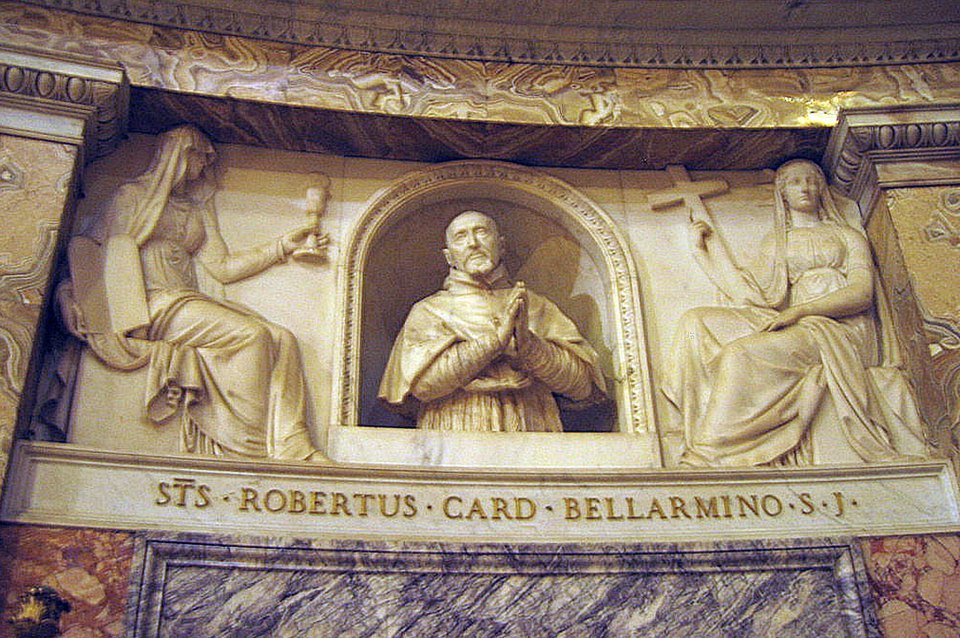
A drawing published by Stanislao Fraschetti preserves evidence of the old monument. Angelini describes a two-level wall design. The bust occupied the niche above the inscription, with the personifications of Faith and Wisdom to either side. The space below gave Farnese’s dedication a substantial field of its own. The upper niche drew attention to the living presence of the figure, while the lower inscription set out the names and relationship of the patron and the deceased. [1]
The original monument combined sculpture with inlaid and coloured stone. The opening of the niche would have given the pale figure a defined field in the upper part of the wall. Its sides framed the sleeves and the head, while the two virtues widened that part of the composition. The long dedication underneath ran on a different axis from the cardinal’s prayer. It gave visitors a stationary surface to read after they had followed the implications of the pose. [1]
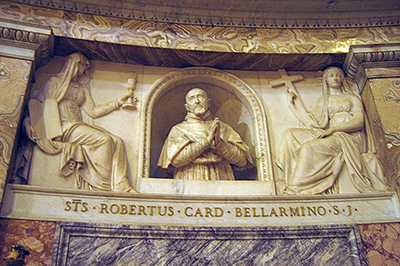
The original structure was dismantled during work on the sanctuary in 1841. The two figures now flanking Bernini’s bust are replacements by Adamo Tadolini. The view of the three figures together shows the nineteenth-century arrangement and the continuing place of the seventeenth-century portrait within it. The bust has also been exhibited separately, at Fairfield University Art Museum in 2018. Seen by itself, the reach of the arms and the shape of the drapery are easier to study. In the Gesù the high frame and the space below it give a sense of the viewing conditions for which the gesture was devised. [1][3][4]
Discussion
Bellarmine’s gaze and folded hands point in slightly different directions.
Reader Insights
Where would you stand to follow the direction of the hands?
How might the original tomb placement have helped distinguish the gaze from the gesture?
What did the nineteenth-century surround change for the viewer?
Join the Conversation
Share a detail, comparison or question about Bust of Cardinal Roberto Bellarmine by Gian Lorenzo Bernini below.
References
- Angelini, Alessandro. Il busto di G. L. Bernini. Pontifical Gregorian University, Historical Archive. Monument, inscription, prayer gesture and nineteenth-century work. View source
- Lavin, Irving. Five New Youthful Sculptures by Gianlorenzo Bernini and a Revised Chronology of His Early Works. The Art Bulletin, 1968. Documentary chronology and comparison with Albani. View source
- Chiesa del Gesù. Church of the Gesù. Church guide and location of the bust. View source
- Fairfield University Art Museum. Art of the Gesù Symposium Brochure. 2018 exhibition and symposium record. View source
- Fondazione Federico Zeri. Monumento funebre del cardinale Roberto Bellarmino. Anonymous drawing and catalogue history of the lost structure.
- Ministero della Cultura. Ingresso di Urbano VIII al Gesù. Painting and Barberini inventory.
- Irving Lavin. Five New Youthful Sculptures by Gianlorenzo Bernini. Visible Spirit reprint, notes on the dispatch and the Sacchi painting.
- Pio Pecchiai. Il Gesù di Roma. Chapter on the tribune and the 1841 inspection.
- Irving Lavin. “The Silence of Bernini’s David”. Discussion of the 1622 and 1841 reports.
- Bibliothèque nationale de France. La vie du cardinal Bellarmin. French edition, engraving and privilege.
- Hessen Kassel Heritage. Robert Bellarmin. German catalogue of Bolswert’s engraving.








