



 by Tom Gurney
Tom Gurney BSc (Hons) is an art history expert with over 20 years experience
Published on June 19, 2020 / Updated on November 18, 2026
Email: tomgurney1@gmail.com / Phone: +44 7429 011000
Apollo and Daphne
Apollo has caught up with Daphne. One of his feet is still off the ground, and the cloth he wears has yet to settle. Daphne’s arms reach upwards as if they might carry her clear of his hand. Instead, her fingers end in leaves and her feet begin to root in the earth. Both figures retain the movement of the chase at the moment when its outcome changes. Gian Lorenzo Bernini carved Apollo and Daphne between 1622 and 1625 for Cardinal Scipione Borghese. The marble is in the Galleria Borghese in Rome, where a visitor can follow the transformation across the surface of the stone. [1]
At a Glance
- Date1622–25
- Location or statusGalleria Borghese, Rome
- WorkMarble group
The work in Bernini’s career
The Rape of Proserpina
1621–22Apollo and Daphne
1622–25David
1623–24St Peter’s Baldachin
1624–33The group asks for two kinds of attention. From a distance, the intertwined outlines of the figures give the pursuit a direction. At closer range, the change can be read in the difference between skin, bark, hair and leaves. Each material has a distinct surface even though all are carved from marble. The arrangement of those surfaces also tells us where to look next. [1]
Daphne’s appeal
The story appears in the first book of Ovid’s Metamorphoses. Apollo provokes Cupid by belittling his use of the bow. Cupid answers with two arrows that produce opposite impulses. Apollo desires Daphne. Daphne rejects desire and asks to remain unmarried. Apollo pursues her. When her strength fails, she appeals to her father, the river god Peneus, for a transformation that will take away the form in which Apollo seeks to possess her. The motion of the passage changes abruptly: a body that has been running grows heavy and takes root. [2]
Bernini chooses the moment when Apollo reaches her and the transformation is already under way. The god’s arm extends around Daphne, and bark rises between him and the living figure. Daphne’s appeal has an immediate physical cost. She escapes his grasp as a woman by losing the ability to leave on foot. Looking at her upturned face and extended arms gives her fear a place within a work that can easily draw all the attention to the delicacy of its leaves. The change in material appearance and the violence of the pursuit belong to the same moment. [1][2]
Ovid continues the episode after the chase. Apollo makes the laurel his own tree, associated with his hair and lyre and with public honours. That association gives museum visitors a way to understand why the leaves matter beyond identifying Daphne as a tree. They are the form in which she survives and the emblem Apollo claims once the encounter has ended. Bernini places them high above the two bodies, where a visitor first sees them as the outcome of her changing hands. [1][2]
Finding the change by moving
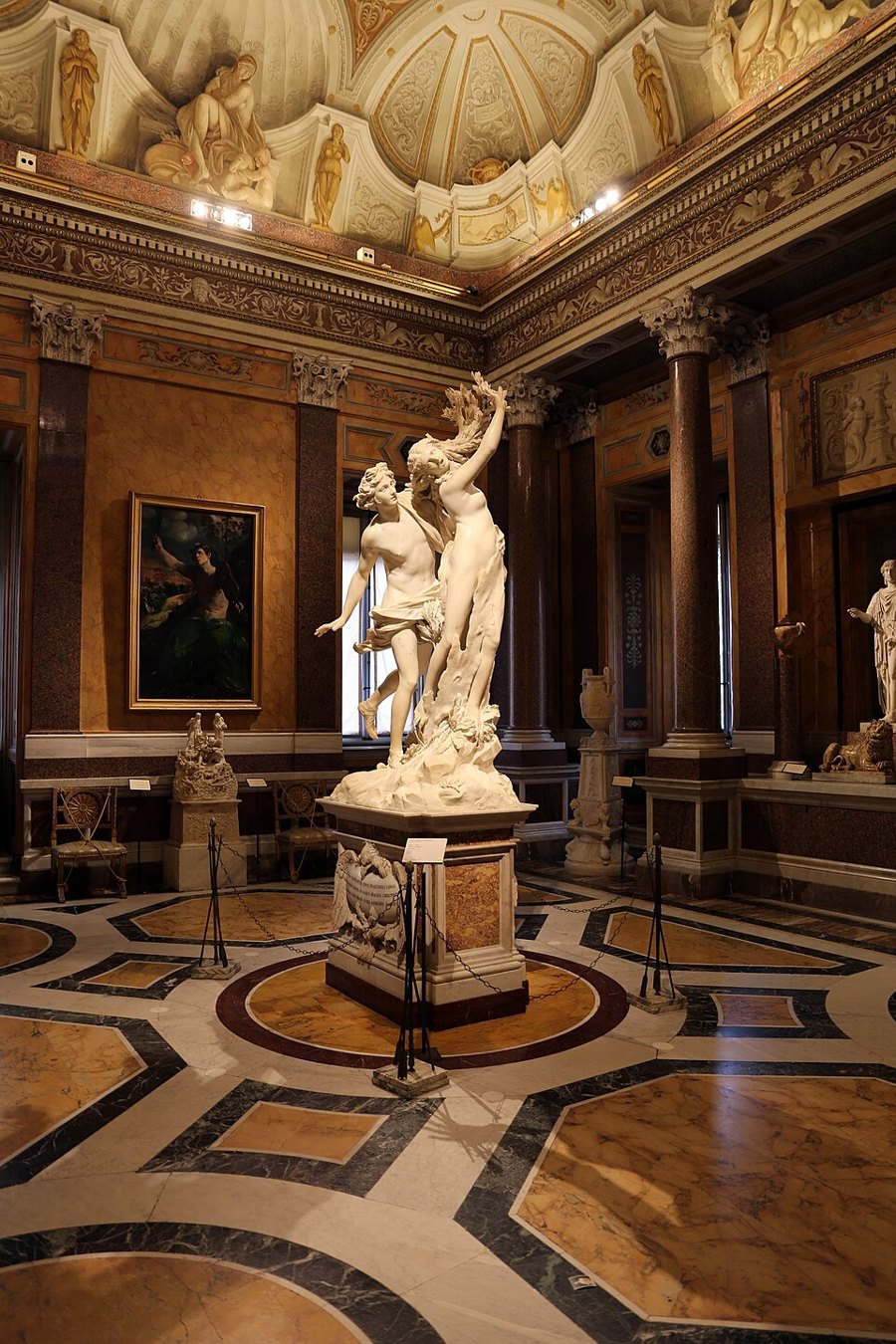
The group once stood near a wall in the villa, beside the chapel and spiral staircase. The documented arrangement brought visitors along Apollo’s right side. They could follow him towards Daphne, then see the change that overturns his expectation of catching her. The gallery’s catalogue uses that approach to explain why differences in Apollo’s expression and the evidence of metamorphosis become apparent in succession. The marble remained still. What the visitor knew about the figures changed from one step to the next. [1]
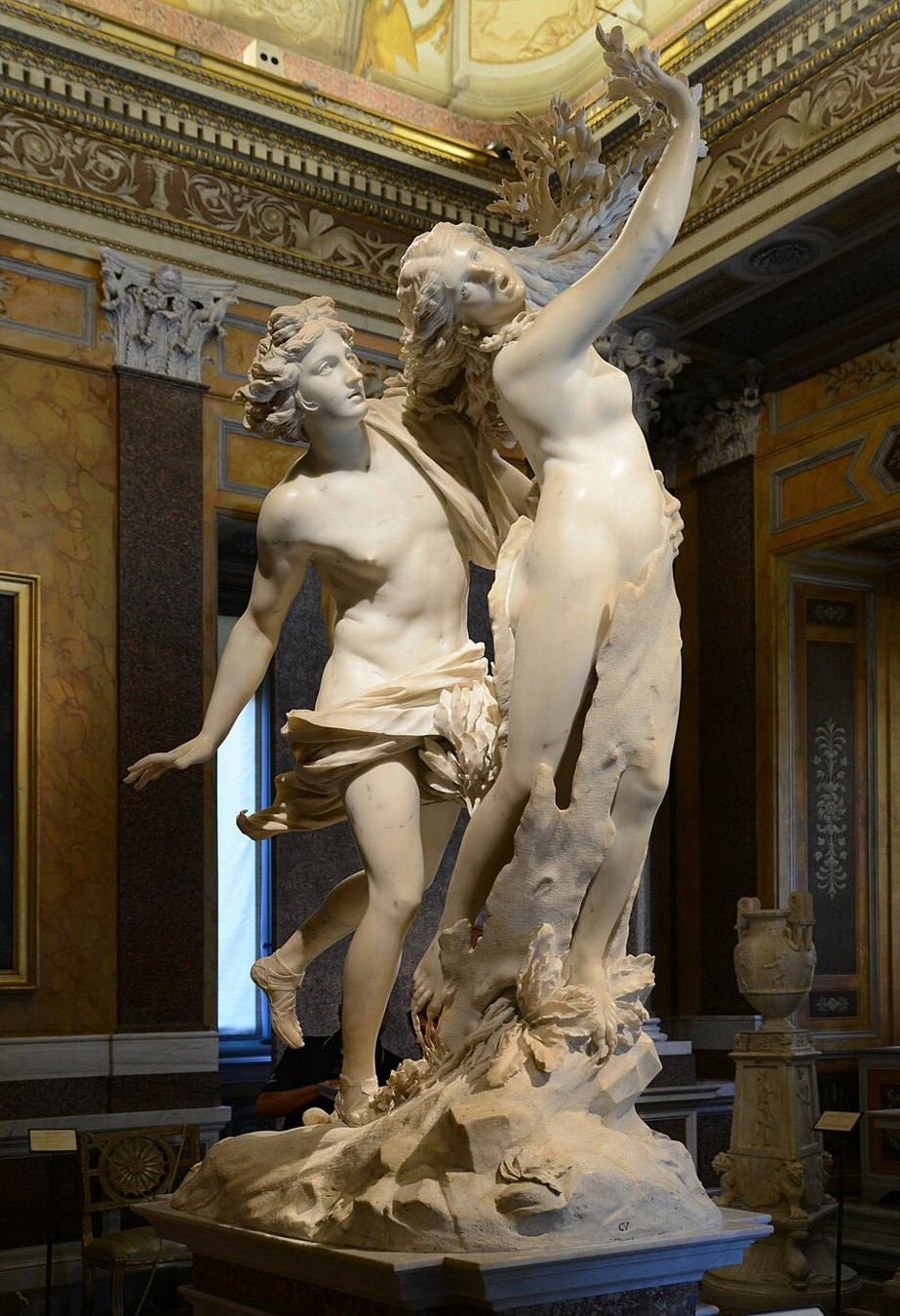
At the end of the eighteenth century, the Borghese collection was rearranged under Marcantonio IV. The group was moved into the centre of the room and shown alongside important ancient sculpture. Its new position made the back and additional angles available to visitors. The older sequence became harder to reconstruct. The catalogue records a further adjustment following Vincenzo Pacetti’s recommendation in 1785. The new approach called for another inscription on the base, supplied by Lorenzo Cardelli in the form of an eagle bearing verses from Ovid. The family’s rearrangement changed both the first view of the group and the words that greeted the visitor. [1]
The published catalogue notes that some areas are less finished, a feature it connects to the old arrangement. A viewer able to circle the marble today can study details that would have been hard to see in that position. That freedom also makes it worth deliberately retracing the more limited view. Start with Apollo’s movement and look towards his hand before seeking out the leaves. That route makes the two faces and the interrupted contact easier to read as parts of one action. [1]
What Bernini took from earlier art
The museum compares Apollo with the ancient Apollo Belvedere, down to the treatment of the sandals. The reference gives the viewer a point of comparison between a familiar standing figure and Bernini’s god in pursuit. Bernini keeps the impression of a body capable of balancing and turning even as one foot lifts clear of its support. A second comparison in the museum’s catalogue is Annibale Carracci’s Acis in the Palazzo Farnese frescoes. The museum relates that painted figure in flight to the movement of Bernini’s Apollo. These comparisons explain particular choices in the running figure without treating a single earlier work as the source of the whole group. [1]
The catalogue also points to the expression of a fleeing mother in Guido Reni’s Massacre of the Innocents as a comparison for Daphne. The look of distress belongs to each figure’s own story, though the direction of the face and the tension of the open mouth can be compared. The painter could give the mother a setting, a crowd and a reason to run within a single view. Bernini had to give Daphne a convincing expression for a viewer moving past her. Her open mouth and the raised arms together carry the urgency of the appeal into the space above the stone body. [1]
How the marble was worked
The strongest differences in the group often occur within a few inches. Along Daphne’s lower body, the smoothness of flesh gives way to the lines in the emerging bark. Some of the ends of Daphne’s hair are separated from the mass behind her head, so they can suggest motion in the same upward direction as the branches. At the top, the cut edges of the leaves divide the light into smaller accents. Farther down, the surface of the roots has to read against the base. An even degree of finish would leave these transitions harder to distinguish. The differences give the transformation a direction from feet to hands. [1]
The most exposed details are also the ones a carver would risk damaging while continuing to work nearby. During restoration in 1997, examination produced evidence of plaster used to protect delicate passages. The Borghese catalogue explains the plaster as a temporary cushion against vibration during subsequent stages of carving. The traces help explain how vulnerable details could survive the making of the surrounding forms. They give a glimpse of the problem facing the sculptor while the work was under way. [1]
The precision of the foliage has long raised questions about who carved it. The early biographer Giovanni Battista Passeri names Giuliano Finelli, an accomplished collaborator in Bernini’s circle. The Borghese catalogue cites more recent examination and scholarship that favour Bernini’s sole execution of this group. The historical account and the modern assessment are evidence of different kinds. The question is best approached through the surviving work and its documentary history, while recognising that Finelli’s collaboration with Bernini is documented on other projects. [1][3]
What the laurel reveals about the workshop
The projecting leaves can make the marble seem to lose weight at the very point where the work was most vulnerable. A branch already cut free can vibrate while tools are still at work on the stone next to it. In comparing Bernini’s early marbles, conservator Maria Grazia Chilosi cites Elisabetta Zatti’s discovery of plaster in a recess among Daphne’s hair. The plaster is interpreted as protection for fragile areas during carving. What survives is a trace of support that mattered while the rest of the surface was being worked. The support was part of the making, even though the effect depends on the viewer seeing gaps between leaves and locks. [5]
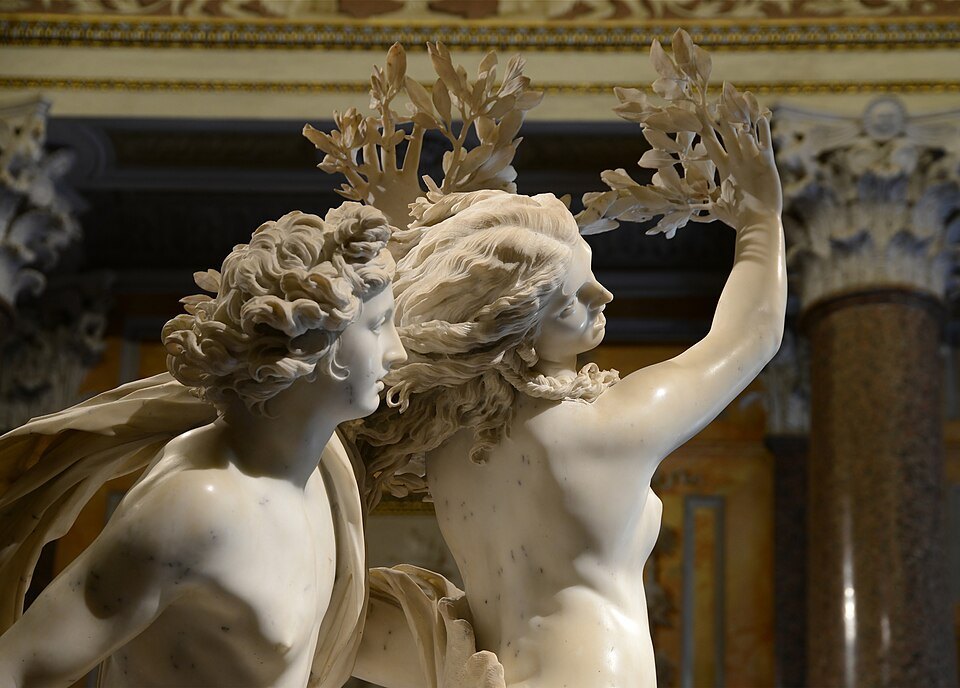
Chilosi’s comparison with the foliage at the feet of Saint Bibiana makes the laurel worth looking at more closely. The leaves on Daphne’s branches are long and smooth-edged, clustered in upright groups with small berries among them. Bibiana’s foliage has wider leaves with pointed tips and uneven edges. Both plants are worked in white marble, but one pattern cannot simply be substituted for the other. Around Daphne’s fingers the narrow leaves are an extension of the movement of her hands. In the statue of Bibiana they belong to a plant at ground level. The forms distinguish two kinds of foliage as well as two ways of placing a plant in a sculpture. [5]
The same conservation comparison records that parts of the group above an ordinary line of sight were left at an earlier stage of finish. The distribution of work matters more than whether the whole appears polished today. A small passage visible from below could require cutting almost all the way around a leaf. A surface farther inside the group could retain evidence of earlier work because it disappeared from that view. This difference relates the handling of the stone to the position from which the sculpture was expected to be seen. [5]
A drawing that changes the story’s setting
The Louvre catalogues an Apollo and Daphne by Girolamo Troppa that Catherine Loisel tentatively connects with a fresco at Palazzo Montani in Terni. Loisel points to the movement of the scene and the hands becoming laurel as possible memories of the Borghese marble. That wording matters because the drawing is not an inventory view showing where the statue once stood. It reworks a motif that could be useful in another medium. The hands remain a quick way to identify the subject even when the original relationship between the stone figures and the room has disappeared. [6]
Troppa’s sheet also suggests a different way to recognise Bernini’s invention. When a figure is copied as a figure, the pose can be checked against the marble. When an artist reworks the instant at which a body begins growing leaves, what carries across can be a choice about timing. The drawing gives us a way to ask whether the marble’s strongest influence lay in a particular outline or in how Bernini made the change recognisable within the chase. [6]
Liotard puts the marble in a landscape
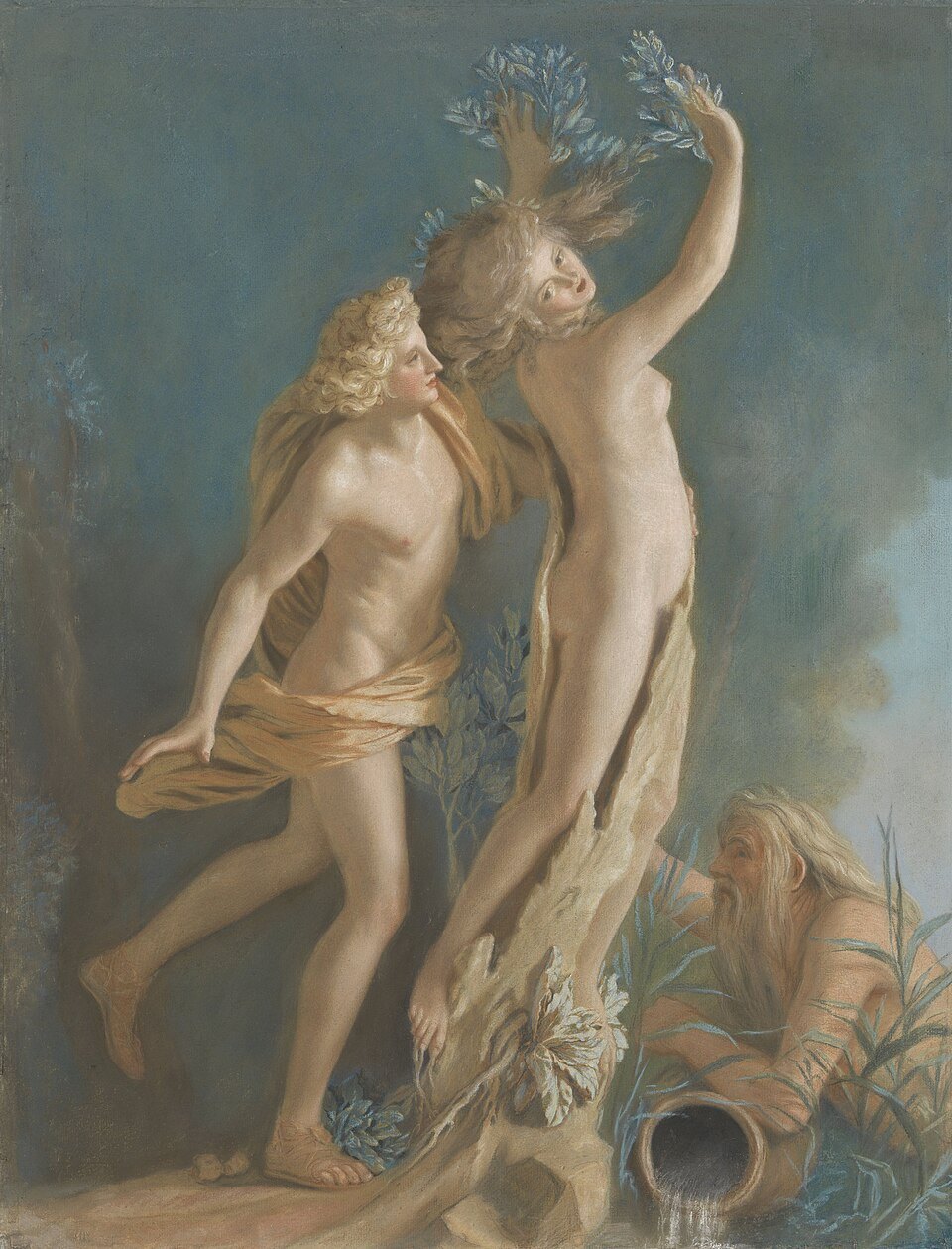
Jean-Étienne Liotard’s treatment in the Rijksmuseum names the Borghese group as its model and gives the action a landscape, a stormy sky and the river god Peneus. The addition makes Daphne’s appeal visible within the image. In the marble we have to supply the father from the story. In Liotard’s version he can occupy a place alongside the action, while the landscape supplies the natural space towards which Daphne is reaching. The museum reads Liotard’s work in the context of the comparison between painting and sculpture. His additions show what that comparison can mean in practice. A picture can put separate figures and places together on one surface. Bernini’s marble leaves room for those connections to develop as the spectator moves and reads the changes in Daphne’s body. [7]
A commission interrupted
The records begin with the purchase of the marble on 2 August 1622. Bernini interrupted the work for nearly a year while making David. In March 1625 Agostino Radi received payment for the base. The group was completed in August, and the last payment to Bernini followed in November. The sequence shows that the date on a museum label covers a series of decisions, including when to set one commission aside and when to prepare for its installation. [1][4]
The two projects invited different encounters from their original visitors. In David, the viewer in front of the sculpture could occupy the direction in which the stone would fly. In Apollo and Daphne, the visitor needs time to move along the figures and discover what Apollo is reaching towards. A comparison of the original positions brings out different uses of narrative and space within work made for the same collection. It also helps explain why photographs of the two works from their most familiar angles can give a narrower impression than standing in front of either marble. [1][4]
The patron’s circle also supplied the group with a written interpretation. The Borghese catalogue connects the work with a moralising couplet by Maffeo Barberini, the future Urban VIII. Its warning concerns pursuit of a beauty that slips away. It shows one way a seventeenth-century viewer might make sense of a pagan story in a cardinal’s villa. Ovid gives readers another way in, through Daphne’s refusal and appeal to her father. Returning to the sculpture after considering both accounts draws attention to the reach of Apollo’s hand and to the figure whose body is already changing when that hand arrives. [1][2]
Related videos
Choose from five films: close studies of Bernini’s works alongside wider context on his methods and career.
Bernini, Apollo and Daphne
Examine the transformation, viewpoints and delicate carving of Apollo and Daphne.
Watch on YouTubeDiscussion
Daphne’s fingers reveal her transformation before the whole silhouette does.
Reader Insights
At what point around the group can you see hand, branch and leaf together?
What does Apollo’s raised foot contribute to the timing of the scene?
How might the original wall have controlled a visitor’s first view?
Join the Conversation
Share a detail, comparison or question about Apollo and Daphne by Gian Lorenzo Bernini below.
References
- Galleria Borghese. Apollo and Daphne, object catalogue. View source
- Ovid. Metamorphoses, Book I, lines 452–567. Translated by A. S. Kline, University of Virginia Ovid Collection. View source
- Bacchi, Andrea. “The Role of Terracotta Models in Bernini’s Workshop.” In Bernini: Sculpting in Clay, pp. 47–61. View source
- Galleria Borghese. David, inv. LXXVII. View source
- Chilosi, Maria Grazia, et al. Conservation study of Bernini’s Santa Bibiana, Bollettino d’Arte, notes 9, 11 and 15. Comparison of foliage and finish, and summary of Elisabetta Zatti’s examination of the plaster.
- Musée du Louvre. Apollon et Daphné, Girolamo Troppa. Catalogue discussion by Catherine Loisel about the sheet’s possible relation to a fresco and its debt to Bernini.
- Rijksmuseum. Jean-Étienne Liotard, Apollo and Daphne, after Lorenzo Bernini’s Marble Group in the Galleria Borghese, Rome. Account of the landscape, figure of Peneus and comparison of media.









