


 by Tom Gurney
Tom Gurney BSc (Hons) is an art history expert with over 20 years experience
Published on June 19, 2020 / Updated on November 18, 2026
Email: tomgurney1@gmail.com / Phone: +44 7429 011000
Pasce Oves Meas
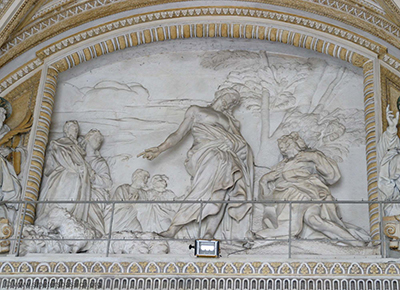
Above the central door into St Peter’s Basilica, Christ extends an arm towards a flock while Peter kneels before him. The white marble relief is known as Pasce oves meas, Latin for “Feed my sheep.” The Fabbrica di San Pietro dates it to 1633–46 and credits Gian Lorenzo Bernini and assistants. The subject comes from the Gospel of John. Its position in the portico gives the episode a role in the approach to the church, and its companion across the passage, the Navicella mosaic, gives visitors another scene in which Peter’s relationship with Christ is at stake. [1][2][3]
At a Glance
- Date1633–46
- Location or statusCentral entrance, St Peter’s Basilica
- WorkWhite marble relief by Bernini and assistants
The work in Bernini’s career
Christ’s charge to Peter
In John 21, the risen Christ asks Peter three times whether he loves him and gives him responsibility for his flock. The repetition recalls Peter’s three denials during the Passion. The Fabbrica describes the sheep as a symbol of the Church entrusted to Peter. This reading gives significance to the two directions in which Christ acts in the relief. He faces the kneeling apostle, making the encounter personal, and reaches towards the flock, making the terms of the responsibility visible. A viewer can follow the line of the arm away from the exchange between the two figures to see for whom that responsibility is exercised. [1][2]
Bernini’s choice of a kneeling pose for Peter allows the two figures to be distinguished through their heights and the directions of their bodies. Christ remains upright and able to turn across the panel. Peter’s lowered posture directs his attention upward. Irving Lavin reads the composition as an expression of obedience and forgiveness alongside the conferral of authority. The position of the two figures gives those ideas a physical counterpart. Peter receives the charge from below, and the gesture from Christ towards the flock leads away from Peter himself. The sheep give the eye a place to finish following the gesture. [1][2]
A pastoral landscape in marble
The relief sets the encounter in a landscape. Sheep can occupy a smaller scale and greater distance than the principal figures and can still be recognised as a group. Trees and the recession of the ground give the flock a place within the scene. For Lavin this pastoral setting evokes classical art and poetry. It makes the command intelligible through a familiar image of care for animals while placing it within a scene the basilica treats as foundational. The setting thus plays a part in the subject, since the flock is simultaneously the object of the command and the sign through which a visitor understands it. [1][2]
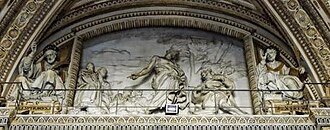
The difference between the projecting bodies and the shallower setting helps organise a scene that has to be read from the floor of the portico. Light catches the more prominent forms first. The vertical line of Christ and the lower mass of Peter register at a distance where the details of the sheep and trees take more time to distinguish. The architecture requires the visitor to look up, and a broad gesture remains clearer under those conditions than a small change of expression. Considering the panel in its installed position explains why the turn of a body, the opening of a space and the line of an arm have so much responsibility for the narrative. [1][2][3]
The door and the facing mosaic
The relief belongs to the basilica’s portico, on the side facing the square’s entrance to that covered passage. The visitor sees it above the door leading into the church. Turning around in the portico reveals the Navicella on the opposite wall. The mosaic shows the scene of Christ walking on water and Peter leaving the boat. The facing position lets the worshipper see Peter at different points in his relationship with Christ, first in an episode of faith and rescue and again in one of responsibility after the Resurrection. The two images are high above the places at which visitors pass from the square to the portico and from the portico to the interior. [2][3][4]
The relationship has a history of rearrangement. Lavin traces the medieval mosaic, associated with Giotto, to the atrium of the old basilica. It was moved and substantially remade during the changes to St Peter’s. Urban VIII had it installed high on the inner entrance wall during his pontificate. The version now facing the relief in the portico belongs to the later history of the mosaic, which Lavin dates to its placement there in 1675. The two scenes are connected by their subject and by the positions they eventually occupied. The dates help distinguish the first plans concerning the entrance wall from the arrangement through which the works can be read together today. [3][4]
The material of each work also affects what the comparison offers. The mosaic can use differences in colour to keep an episode intelligible across the passage. The marble has to make its figures distinct by the amount of stone standing away from the surface and the shadows that result. Both are designed to be seen from below, but a visitor turning between them moves between two ways of establishing space and directing the eye. That physical turning is part of the present encounter with the two stories of Peter. [1][3][4]
The Tomb of Matilda of Tuscany, begun around the same time under Urban VIII, offers another encounter with a kneeling figure inside the basilica. Lavin compares Peter before Christ in the portico with Henry IV before Gregory VII in the tomb relief. At Canossa the plea belongs to a medieval confrontation between ecclesiastical and secular powers. The likeness between the two postures gives the historian a way to connect the two commissions without treating them as scenes from the same story. [2]
An entrance wall that told two histories
Lavin reconstructs an arrangement completed in 1646 in which the marble relief stood over the central portal on the inside of the basilica. The Navicella mosaic was higher up on the same wall, while inscriptions flanked the central doorway. The images gave two episodes in the story of Peter a vertical relationship. The texts beside them told a history of the church building and the popes who had commissioned and consecrated it. This gave the congregation two different ways to read the wall. The two scenes could be understood in relation to the authority given to Peter, while the inscriptions traced the basilica’s history from its earlier foundation to the seventeenth-century building. [6]
A drawing by Borromini that Lavin reproduces gives another indication of what the wall might have become. It includes seated figures of Peter and Paul between the portals. The proposed placement of the older bronze Saint Peter and a companion Paul would have brought recognisable figures of the apostles closer to the level of the doors. The pair was never installed as drawn. Borromini’s drawing records a stage in the design and helps account for how much more than a single relief was under consideration. It is evidence for the proposed wall, while the engravings of the later arrangement record what people could actually see. [6]
The move into the portico
The carving took much longer than its first commission might suggest. Lavin records payments in September and December 1633, an interruption and a resumption of work in 1639. Urban VIII died before the carving was complete. It was installed in 1646 under Innocent X, who soon proceeded with changes to the nave and the entrance. Lavin places the removal of the relief to the portico by 1649. An engraving published with Filippo Bonanni’s account of the basilica shows the reworked interior wall with the commemorative plaque that replaced it. The change explains why the carving survives at the threshold but outside the interior arrangement for which it had been made. [6][7]
The present placement also changes how the two images are read. In the first arrangement a viewer could glance up from the marble to the mosaic without shifting to another wall. In the portico, the two scenes face each other across the passage. A person can see the door below the relief, then turn towards the mosaic on the side by which they entered. The sequence depends on movement through the portico. The Gospel subjects retain their relationship, while the historical inscriptions no longer frame both works as they once did. [6][8]
The same subject at the other end of the basilica
The Pasce oves meas episode can be seen again on the back of the throne in Bernini’s monument to the Chair of Saint Peter. The Fabbrica identifies that image and distinguishes it from the scenes on the sides of the chair, which show the giving of the keys and the washing of the feet. The later monument in the apse was completed in 1666. The portico relief was finished two decades earlier and places the figures in a broad landscape above the path into the church. At the chair the subject belongs to the surface of the throne itself, where it has an immediate association with the office and teaching authority represented by the chair. [1][2][5]
These two placements give separate architectural functions to the one Gospel narrative. At the entrance a visitor can see what happens between Christ and Peter before walking the length of the nave. At the apse the episode is contained within an object which represents continuity in that responsibility. Lavin sees the articulation of this long axis as a concern running through Bernini’s work at St Peter’s. The marble scene is an early part of that work, bringing a story of how the charge to Peter began to the threshold of the building dedicated to him. [2][5]
Discussion
The relief places a scene of instruction over the basilica’s central entrance.
Reader Insights
Which gesture remains clear when you view the relief from below?
How do the sheep and Peter’s posture help tell the story?
How does encountering the subject above a doorway differ from seeing it near the Cathedra?
Join the Conversation
Share a detail, comparison or question about Pasce Oves Meas by Gian Lorenzo Bernini and Assistants below.
References
- Fabbrica di San Pietro. Digital Experience of St Peter’s Basilica. Entry for the marble relief in the portico, attribution, date and subject. View source
- Lavin, Irving. Bernini at St Peter’s, “The Nave: Continuity”. Section on Feed My Sheep and its role in the basilica. View source
- Holy See. Il Braccio di Carlo Magno. Description of the portico and the facing relief and mosaic. View source
- Lavin, Irving. “Bernini’s ‘Pasce oves meas’ and the Entrance Wall of St Peter’s” and Footsteps on the Way to Redemption. Studies of the entrance wall and the movements of the mosaic. View source: “Bernini’s ‘Pasce oves meas’ and the Entrance Wall of St Peter’s” View source: Footsteps on the Way to Redemption
- Fabbrica di San Pietro. The Cathedra of Saint Peter. Description of the throne and its reliefs. View source
- Lavin, Irving. Bernini’s “Pasce oves meas” and the Entrance Wall of St Peter’s, pp. 21–25. The drawings, inscription programme and move.
- Riegl, Alois, ed. Filippo Baldinucci’s Vita des Gio. Lorenzo Bernini. German commentary on the payment and location.
- Holy See. Il Braccio di Carlo Magno. The portico and facing works.








