


 by Tom Gurney
Tom Gurney BSc (Hons) is an art history expert with over 20 years experience
Published on June 19, 2020 / Updated on November 18, 2026
Email: tomgurney1@gmail.com / Phone: +44 7429 011000
Bust of Cardinal Melchior Klesl
A portrait of Cardinal Melchior Klesl occupies the centre of his wall memorial in the Cathedral of the Assumption of Mary at Wiener Neustadt. The monument stands on the right side of the choir near the high altar. The pale marble likeness is set among coloured stones and beneath the cardinal’s arms. The Lower Austrian monument register attributes it to Gian Lorenzo Bernini and connects it with Klesl’s stay in Italy. Other scholarship assigns the carving to Giuliano Finelli, who worked with Bernini in Rome. The surviving monument offers a firm point of reference for an attribution that has changed over time. [1][2][3]
At a Glance
- Location or statusCathedral of the Assumption of Mary, Wiener Neustadt
- WorkMarble memorial portrait with a disputed attribution
The work in Bernini’s career
Apollo and Daphne
1622–25Ecstasy of Saint Teresa
1647–52St Peter’s Square
1656–67Bust of Cardinal Melchior Klesl
Date discussed in the articleKlesl in Austria and Rome
Melchior Klesl, also written Khlesl or Klesel, was born in 1552 and died in 1630. He held office in Vienna and administered the diocese of Wiener Neustadt. He worked to advance Catholic reform in the Habsburg lands and became an influential adviser to Matthias. At Wiener Neustadt, the cathedral preserves another record of his patronage in its early Baroque pulpit. The wall memorial belongs to a later act of commemoration, but the pulpit helps explain why this particular church was an appropriate setting for his likeness. [1][2][3]
Klesl’s career also took him to Rome. After his imprisonment and transfer into papal custody, he participated in the conclave that elected Urban VIII in 1623. He returned to the Habsburg lands in 1627. The Roman years make a commission from a sculptor there plausible. They are also a better starting point for dating the portrait than the date on the memorial to the deceased cardinal. The regional register associates the work with the Italian stay in general terms. That connection gives an interval for considering the circumstances of the portrait, while the date of the finished wall memorial depends on the history of Klesl’s death and burial. [1][2][3]
The bust in its architectural setting
The pale likeness sits in a medallion at the centre of an arrangement made with different coloured Salzburg marbles. This places it between two other ways of identifying the cardinal. His coat of arms and the cardinal’s hat occupy the upper part of the memorial. Beneath the portrait, the tablet sets out his titles and offices and records his death. The coat of arms identifies him through heraldry, the text through public acts and offices, and the bust through his face and bearing. Each of those elements can be read on its own, though the wall design gives them a common vertical order. [1][2][4]
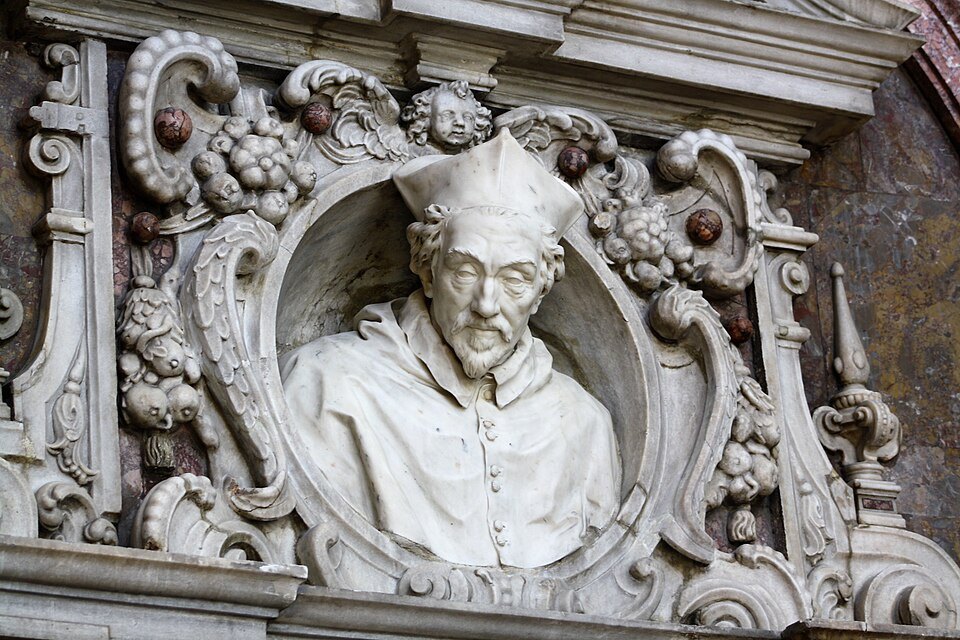
The raised stonework around the medallion defines the area occupied by the likeness. Viewed from the choir, the contrast of the pale face with the frame helps pick it out within the larger surface of coloured stone. The head and chest project differently from the relief forms around them, so they respond to light without breaking the outline of the surrounding monument. A study of the face alone shows the carving of an individual. A view of the entire wall shows how the portrait works at the scale of the church, alongside lettering and ornament that can be recognised from different distances. [2][4]
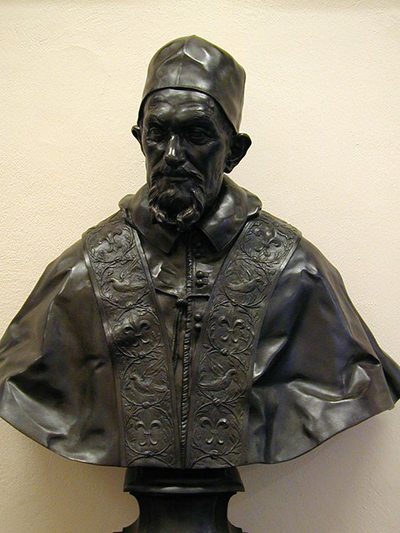
The illustration on this page shows a dark-surfaced portrait of Klesl. The documented cathedral bust is the pale marble set into the wall memorial. The photograph here gives a separate view of the sitter’s likeness, with the tall cap, angular collar and decorative bands visible, but the object photographed has yet to be securely identified. Details of the cathedral’s frame, materials and placement are described from the monument records and the photograph of the epitaph in situ. [1][2][4]
The other portrait at St Stephen’s
The monument at Wiener Neustadt can be compared with a separate wall tomb in the north choir of St Stephen’s Cathedral in Vienna. The architectural survey of St Stephen’s digitised by Graz University of Technology records that Klesl’s successor as Bishop of Vienna, Anton Wolfradt, commissioned the Vienna monument shortly after Klesl’s death. The Vienna portrait projects from a round niche. The survey draws attention to the way the softer modelling of the face takes light as the head emerges from the recess. In both cathedrals the face can be seen above the viewer’s ordinary eye level, but each portrait belongs to a different memorial and a different site of burial. [7]
The survey connects the two portraits with a common model. It recounts Hans Tietze’s proposal that Giuliano Finelli made the Vienna monument and reports that Karl Ginhart assigned the Wiener Neustadt portrait to Bernini himself. Those are judgements about different carvings. Even if the two likenesses derive from a common model, one maker need not have carved both. A model could establish the proportions of the head and the principal folds without determining the depth of the cuts or the final finish of the marble. The claims of a common model and of separate hands should therefore be examined against the two objects, with the site attached to each attribution. The survey does not identify a surviving model or establish which marble was carved first. [7]
Andrea Bacchi and Catherine Hess illustrate the Wiener Neustadt portrait in their study of Bernini’s busts, dating it to around 1627 and including it among the portraits that might involve collaborators. Their account places the bust in a period when several sculptors were working on Bernini’s commissions. At Wiener Neustadt they single out the modelling around the eyes and hairline alongside more summarily treated facial hair. The descriptive emphasis helps explain why attribution by comparison is difficult. Within the same head, some passages are defined with precision and others are left broad enough to read from the choir. Differences in finish can result from the demands of viewing height as well as the division of work. [8]
Klesl in print and marble
An engraving by Aegidius Sadeler, dated 1615 by the Wien Museum, records Klesl’s likeness before his Roman years. Its treatment of the face can be compared with the marble likenesses, but the print also makes use of devices available to an engraver. Lines of varying density distinguish the areas of shadow beneath the chin and around the eyes. In the marble at Wiener Neustadt, shadows instead arise where the stone recedes, and the depth of those shadows changes with the light in the choir. The engraving demonstrates that Klesl’s image was already circulating before the period proposed for the bust. The published evidence connecting the two marble portraits does not identify Sadeler’s engraving as their model. [7][8][9]
The Vienna memorial adds a further caution when comparing reproductions. A close photograph may show the likeness and circular recess while cropping out the lettering and the rest of the architecture. That view retains little information about which cathedral provided the setting. The two ensembles can be distinguished by reading the portrait with the tablet and heraldry beneath or around it, and by consulting the location attached to the record. The resemblance of the faces is precisely what makes those additional identifiers important. [7][8]
Bernini and Finelli
The association with Bernini persists in the Lower Austrian register and in the city’s account of the cathedral. The regional historical study distinguishes that traditional attribution from scholarship assigning the bust to Finelli. The entry for Klesl in the Neue Deutsche Biographie also lists the Wiener Neustadt portrait under Finelli’s name. Finelli was active in the Bernini workshop in the 1620s and developed an independent career as a portrait sculptor. The overlap makes it important to distinguish an association with a workshop from evidence of who executed the carving. [1][2][3][5][6]
The attribution problem concerns the white marble bust, which is one component of a larger wall monument. A sculptor could make a likeness in Rome that was later given a new architectural setting in Austria. The patron’s movements make that sequence possible, but the epitaph’s inscription chiefly records the man and his public career. It provides firmer grounds for identifying the sitter and understanding the memorial than for assigning the carving to a specific sculptor. The two attributions reflect different readings of the bust’s place in Roman portraiture. [1][2][3]
The issue of authorship can also arise when a nineteenth- or twentieth-century catalogue records the portrait under a different spelling. The Latin burial text uses a form of the surname recognisable as Klesel, while the modern monument register and municipal material use Klesl and Khlesl. Those forms refer to the same cardinal. The useful identifiers for the sculpture are the choir location, the marble medium and the relationship to the epitaph. They distinguish the work from other representations of Klesl in a way that matching the spelling of a name cannot. [1][2][3][5]
The wall memorial and the heart burial
After Klesl’s death, his body was buried at St Stephen’s Cathedral in Vienna. His heart remained at Wiener Neustadt. The regional historical study specifies that it rests beneath a marble slab immediately before the high altar, a short distance from the wall memorial. The two positions have different functions. The slab marks the place of burial, while the upright memorial gives the church a visible likeness and a substantial space for a dedication. Calling the wall structure an epitaph describes the object that a visitor sees beside the altar. [2][3]
The two cathedral settings reflect Klesl’s ties to both dioceses. In Wiener Neustadt the heart was placed in the floor where the altar could be approached, while the portrait remains elevated at the side. The positions separate the physical remains from the visible image and give each its own inscription. A viewer can follow that arrangement without assuming that the slab and the wall carving were produced at the same time. [1][2]
The base of the monument bears Klesl’s motto, Fortiter et suaviter, which can be rendered as “with strength and gentleness.” Set below the inscription and portrait, the words add a statement of character to the list of honours above them. The heart burial, the portrait, the heraldry and the text together sustain his commemoration in a church where he had held office. The marble is still encountered within that ensemble. Its scale and projection can therefore be understood through the surroundings for which the memorial was arranged, even as the name of the sculptor remains disputed. [1][2][4]
Discussion
The portrait is part of a larger wall memorial at Wiener Neustadt.
Reader Insights
Where does the surrounding monument direct attention towards the face?
How would you compare the catalogue attribution with an argument for Finelli?
Which aspects of the setting matter when comparing a reproduction with the original?
Join the Conversation
Share a detail, comparison or question about Bust of Cardinal Melchior Klesl below.
References
- Museum Niederösterreich. Dom Mariä Himmelfahrt von Wiener Neustadt. Monument register, cathedral setting and attribution. View source
- Verein für Landeskunde von Niederösterreich. Jahrbuch für Landeskunde von Niederösterreich, vol. 52. Pages 31–32 on the heart burial, memorial materials and attribution. View source
- Historische Kommission bei der Bayerischen Akademie der Wissenschaften. Klesl (Khlesl, Klesel, Cleselius), Melchior. Neue Deutsche Biographie. Biography and portrait attribution. View source
- Fusil. Wiener Neustadt – Dom – Epitaph Melchior Khlesl (detail). Photograph of the white marble portrait in its frame. View source
- Stadt Wiener Neustadt. Wiener Neustadt walking guide. Cathedral entry 19, p. 14, on the memorial’s position and local attribution. View source
- Istituto della Enciclopedia Italiana. Finelli, Giuliano. Dizionario Biografico degli Italiani. Finelli’s workshop career. View source
- Sonstige Barockausstattung: Barocke Grabdenkmäler. Architectural survey of St Stephen’s, p. 142, digitised by Graz University of Technology. The two Klesl memorials and their proposed common model.
- Bacchi, Andrea, and Catherine Hess. Creating a New Likeness: Bernini’s Transformation of the Portrait Bust, 2008, fig. 12 and pp. 19–20. The Wiener Neustadt carving and its workshop context.
- Wien Museum. Melchior Khlesl (1552–1630), Kardinal, Bischof von Wien. Catalogue entry for the 1615 copper engraving.








