


 by Tom Gurney
Tom Gurney BSc (Hons) is an art history expert with over 20 years experience
Published on June 19, 2020 / Updated on November 18, 2026
Email: tomgurney1@gmail.com / Phone: +44 7429 011000
Saint Sebastian
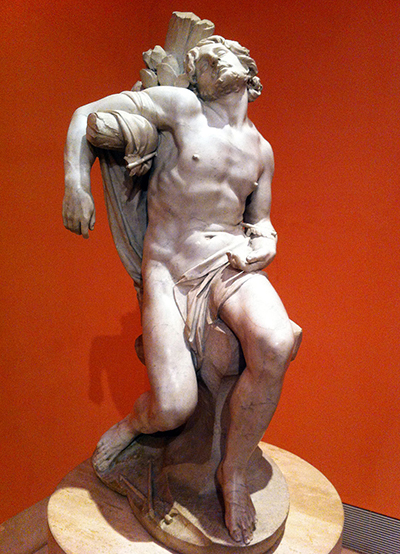
Gian Lorenzo Bernini’s Saint Sebastian shows a wounded man losing the strength to hold himself upright. A tree trunk supports his back, one arm rests against a branch and a bent leg braces the body on the rock below. Bernini made the sculpture in 1616–17, early in his relationship with Cardinal Maffeo Barberini, the future Pope Urban VIII. The marble is held in a private collection and is on deposit at the Museo Nacional Thyssen-Bornemisza in Madrid, which gives its dimensions as 98 by 42 centimetres. The old connection with the Barberini chapel in Rome remains a proposal about its intended setting. The family’s ownership is documented. [1][2]
At a Glance
- Date1616–17
- Location or statusPrivate collection, on deposit at Museo Nacional Thyssen-Bornemisza
- WorkMarble statue
The work in Bernini’s career
Saint Sebastian
1616–17The Rape of Proserpina
1621–22Apollo and Daphne
1622–25David
1623–24The interval before Irene arrives
In the legend Sebastian was a Roman soldier who professed Christianity in the reign of Diocletian. He was tied to a tree and shot with arrows. Irene came to attend to his body and found him still alive. After her care allowed him to recover, he confronted the emperor again and was executed. The sculpture selects a moment after the archers have left and before Irene comes to help. Sebastian’s eyes are closed and his mouth is slightly open. The description of his ordeal comes from the support and the remaining binding, while the empty space around him is consistent with the pause between the departure of the soldiers and Irene’s arrival. [1]
The difference between the two arms helps fix that moment. Sebastian’s right arm rests on a dry branch, where the binding can still be seen. The other hangs down by the trunk with the hand at the thigh. These positions give the viewer two measures of what is happening to the body. One arm preserves a trace of the position imposed by the soldiers. The other follows the pull of its own weight. The hands are at different heights and have different relations to the wood. The space between them makes it possible to see the change in the body without representing a sequence of actions. [1]
The weight of the figure
Sebastian’s left leg comes forward and still offers support. The right leg and the angle of the pelvis suggest how close that support is to failing. The saint is already partly seated, but the placement of the limbs shows that the rock does not receive his weight evenly. From the front, the torso and legs make a series of shifts away from the trunk. Look along the side and the distance between the tree, the shoulders and the position of the hips becomes easier to judge. The figure could slip farther down even though the trunk continues to hold his upper body. [1][2]
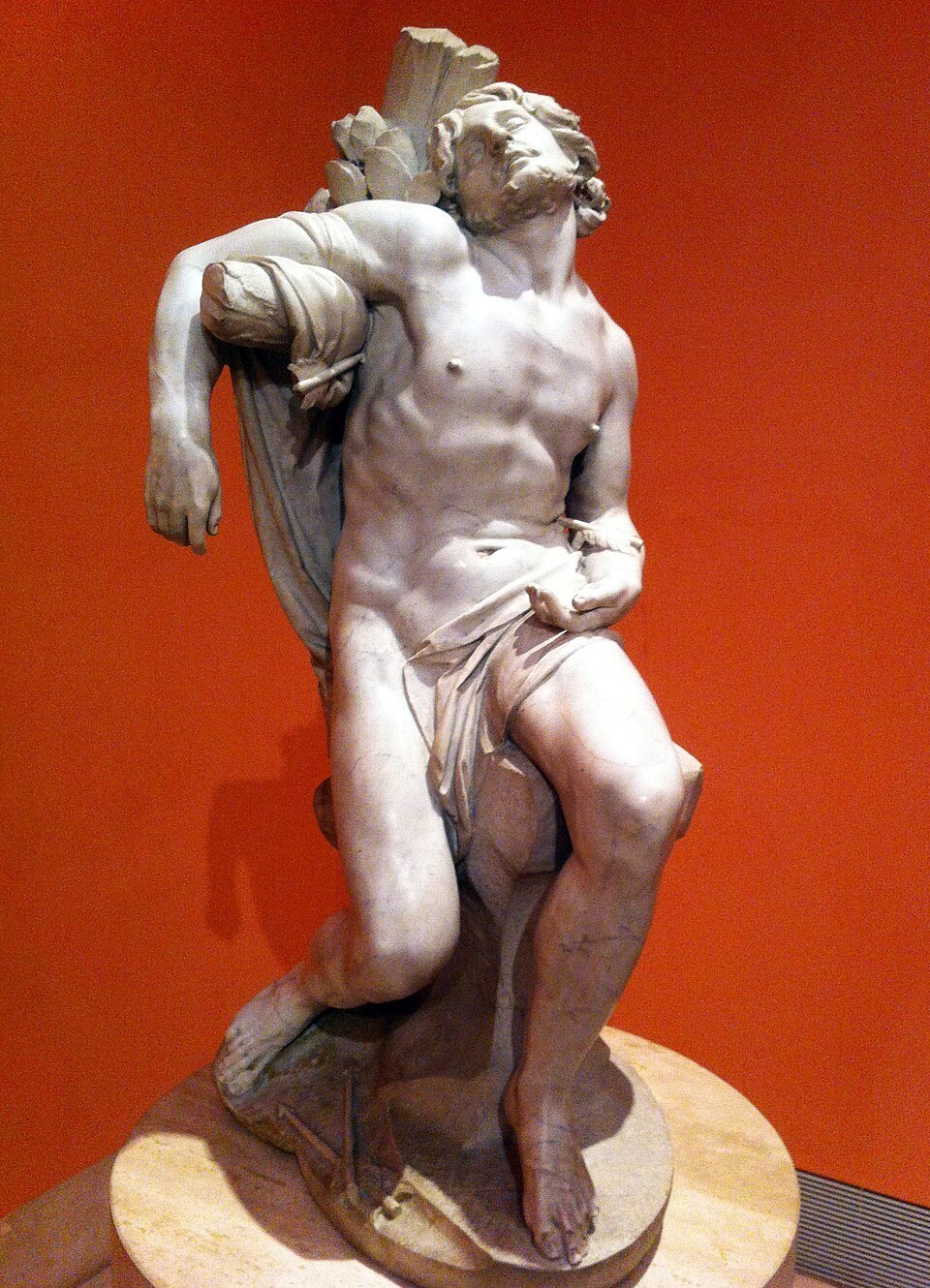
The sculpture distinguishes the remaining tension in the flesh from the slackness of the pose. The museum calls attention to veins and muscles that retain their definition beneath the closed eyes and parted lips. A twitch or a cry would make it easier to identify where the pain is felt. Bernini lets the expression remain quiet and distributes much of the evidence through the angles of the body. The light falling across a knee or the upper surface of a shoulder can show what is under strain. In the lower part of the figure the transition between the flesh and the rocky seat shows where the weight comes to rest. [1]
Michelangelo and an early companion in subject
The Thyssen catalogue connects the marble with images of Christ’s Passion and with Michelangelo’s sculpture. It identifies the Vatican Pietà and the Pietà now in the Museo dell’Opera del Duomo in Florence as comparisons proposed by critics. The Florentine group was in Rome in Bernini’s time. What can be followed across the works is the disposition of a body that depends on support. Sebastian still has a task for his bent leg, and the tree keeps the rest of his weight from falling. In the Pietà the body of Christ is held by other figures. The comparison draws attention to the several ways a sculptor can make a limp limb and a point of support visible together. [1]
Bernini’s Saint Lawrence in the Contini Bonacossi Collection provides a closer comparison in date. The Uffizi dates the work to 1617 and also identifies Michelangelo’s influence. Lawrence is extended over the gridiron where he suffers martyrdom. The turn of his body and the upward direction of his face are set against the horizontal support beneath him. Sebastian is organised around a trunk, and his head and hanging arm show a different kind of abandonment. The near-contemporary marbles show Bernini adapting the nature of the support to the particular bodily condition and moment he chose for each saint. [1][3]
Michelangelo’s Pietà in a Roman garden
The cathedral museum in Florence traces the Bandini Pietà to Francesco Bandini, who placed it in the garden of his Roman villa at Montecavallo. It was available to be seen in Rome in the period when Bernini made the Saint Sebastian. Before Bandini installed it, Tiberio Calcagni reassembled parts of the damaged group and worked on the figure of Mary Magdalene. The Michelangelo that a seventeenth-century visitor could have encountered was therefore already a composite of Michelangelo’s carving and Calcagni’s intervention. The appeal of the comparison with Bernini lies in the way the still body is made legible through the things that hold it up. [5]
The two works give the viewer different points from which to follow that support. In the Pietà the figures cluster around Christ, whose head drops and whose arm extends across the group. Those attending him take responsibility for the weight of the body. With Sebastian, the branch catches one arm and the bent leg continues to bear on the rock. Nearby stone has to appear as wood, flesh and rock within a single figure group. Borrowing a way of showing slackened muscles would still leave Bernini the problem of showing a person who is alive and whose posture could change as his strength fails. The Roman location establishes a possibility of access. The comparison supplies no record of a visit or a preparatory drawing from the group. [5][6]
Two marbles of the same saint in Rome
A second marble of Sebastian, kept at the church of Saint-Martin in Jouy-en-Josas, was displayed alongside the Barberini example in the 2026 exhibition at Palazzo Barberini. The German edition of L’Osservatore Romano records the pairing and the presence of the Uffizi Saint Lawrence among the early sculptures. Visitors could compare three marbles in which the support affects how a wounded saint appears to bear his own weight. In the Jouy figure the bound arm rises. In the Barberini marble, the branch supports an arm whose weight appears to have settled onto it. The subject in common makes the different decisions about the arm and trunk easier to see. [6][7][8]
The French conservation and fundraising dossier traces the Jouy marble to an 1836 reference in the parish and quotes Tomaso Montanari’s argument for an attribution to Gian Lorenzo. He points in particular to the binding and raised arm as details that recall Michelangelo. The earlier ownership proposed for the Jouy figure is much less firmly documented than Maffeo’s purchase of the Barberini figure. Palazzo Barberini devoted part of a study day to the difficulty of assigning the Jouy work. Comparing the pieces helps isolate features that might matter to the attribution, while the documented Barberini acquisition applies specifically to the marble on deposit at the Thyssen. [6][7][9]
A block recorded in the workshop
The Barberini accounts also record a block of marble that Nicolas Cordier had roughed out for a figure of John the Baptist. Pietro Bernini accepted it as part payment for his own statue of that saint. Irving Lavin notes that the earlier block was in the Bernini workshop by June 1615 and proposes that Gian Lorenzo may have cut it down for Saint Sebastian. If so, the block would have set limits on the new pose before the sculptor began. The documents establish that the workshop had the stone. Its identification with the marble now in Madrid remains a proposal. [11]
How the Barberini marble was recorded in Madrid
Factum Foundation describes two kinds of recording used on the sculpture in September 2022. Structured white light supplied shape data from the surface, while photographs taken from different positions supplied a second record through photogrammetry. Both approaches let the team document areas where a change of angle carries useful information, such as the hollow between a limb and the trunk or the edge of a fold seen against the rock. The team processed the recordings into a three-dimensional model, printed it, and used moulding and casting to produce the full-size version in synthetic marble. The cast was finished by hand in Madrid. [10]
The two outcomes of this work serve different purposes. Visitors to the 2023 exhibition could see at full scale how the figure bears on the tree and rock. The exhibition copy’s colour and finish were adjusted by hand to recover the appearance of the figure. The digital surface record can also serve as a reference for the condition of the private-collection original at the time it was recorded. Those details clarify what can be learnt from the facsimile and what would require examination of the original marble. For the dating of that original, the Thyssen’s 1616–17 catalogue date and the late 1617 acquisition record give the chronological framework. [6][10]
From the Barberini collection to Madrid
On 29 December 1617 Maffeo Barberini paid Pietro Bernini fifty scudi for the work. The payment helps date the sculpture and places its acquisition within the dealings of the Bernini workshop before Maffeo became pope. Irving Lavin discusses the possibility that it was conceived in connection with the shrine beside the Barberini chapel in Sant’Andrea della Valle. The church commemorated the site traditionally associated with the discovery of Sebastian’s body after his death. Lavin notes the absence of the marble from the chapel documentation and compares the possibility of a work conceived for that setting with the record of where it eventually went. [1][2]
The adjoining shrine had its own image of the recovery of the saint’s body, painted by Domenico Passignano. That subject and Bernini’s sculpture belong to different episodes of the legend. Passignano’s subject commemorates the finding of the body after the final execution. Bernini depicts the earlier attack that Sebastian survived. A connection with the chapel thus makes sense through the identity of the saint and the local devotion, with each image addressing a distinct event. [1][2]
The first known inventory entry dates from 1628. It belongs to the period when the family’s possessions were moved from the house on Via dei Giubbonari to the palace on Via delle Quattro Fontane. The marble passed to Cardinal Francesco Barberini, Maffeo’s nephew. Lavin cites the 1632 inventory as the first to name Bernini as its maker. The family retained the sculpture until Heinrich Thyssen-Bornemisza acquired it from their heirs in 1935, when his collection was housed at Villa Favorita in Lugano. The record of ownership shows how long the sculpture remained in the collection for which it is first documented, whether or not an ecclesiastical setting was considered earlier. [1][2]
The sculpture was recorded digitally in 2022 for a full-scale facsimile shown at Palazzo Barberini in 2023. The project’s account distinguishes the scanned private-collection marble from the cast made for the exhibition. The reproduction brought the figure back into the context of Maffeo’s patronage while the three-dimensional record also documented a surface on which quite small changes distinguish the body from the branch and the rock. Those details remain central to the work. The larger pose is one of collapse, but its several points of support allow the viewer to follow how far the collapse has progressed. [1][4]
Discussion
The tree bears the weight of a body losing its strength.
Reader Insights
How do the bent leg and raised arm change the figure’s balance?
What happens to the expression when you view the face from the side?
How does the marble interpret Sebastian’s suffering differently from the painting of the same saint?
Join the Conversation
Share a detail, comparison or question about Saint Sebastian by Gian Lorenzo Bernini below.
References
- Museo Nacional Thyssen-Bornemisza. San Sebastian. Object record K35, dating, subject and provenance. View source
- Lavin, Irving. “Five New Youthful Sculptures by Gianlorenzo Bernini and a Revised Chronology of His Early Works”. Discussion of the Barberini chapel hypothesis and inventories. View source
- Uffizi Galleries. Saint Lawrence. Contini Bonacossi Collection, inventory B8, and comparison with Michelangelo. View source
- Factum Foundation. Bernini’s San Sebastian. Record of the scan and of the facsimile made for the 2023 exhibition. View source
- Opera di Santa Maria del Fiore. La Pietà di Michelangelo restaurata. Italian conservation and provenance account.
- Museo Nacional Thyssen-Bornemisza. San Sebastián. Spanish collection record, K35.
- La Sauvegarde de l’Art Français. Jouy-en-Josas, Saint Sébastien. French conservation dossier and attribution argument.
- L’Osservatore Romano. Ohne diese Begegnung hätte es keinen Barock gegeben. German account of the 2026 display in Rome.
- Gallerie Nazionali Barberini Corsini. Bernini e i Barberini. Study Day. Programme for 25 May 2026, Palazzo Barberini.
- Factum Foundation. Bernini’s San Sebastian. Technical documentation and process photographs for the facsimile.
- Lavin, Irving. Five New Youthful Sculptures by Gianlorenzo Bernini and a Revised Chronology of His Early Works. In Visible Spirit, pp. 230–32, on the unfinished block and the workshop accounts.








