


 by Tom Gurney
Tom Gurney BSc (Hons) is an art history expert with over 20 years experience
Published on June 19, 2020 / Updated on November 18, 2026
Email: tomgurney1@gmail.com / Phone: +44 7429 011000
Portrait of a Boy
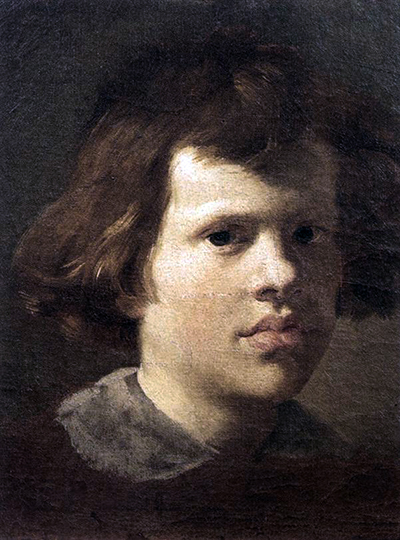
In the Galleria Borghese’s Portrait of a Young Boy, light falls across one side of the face and leaves the other in shadow. The boy’s look holds the centre of a small canvas, while the collar and garment are suggested in broader strokes. The gallery attributes the picture to Gian Lorenzo Bernini and dates it to about 1623–25. The sitter’s name remains unknown. The painting offers two different kinds of evidence to consider: the handling of the face and the brushwork, which can be compared with other paintings, and the records of ownership, which establish where the canvas was much later. [1]
At a Glance
- Datec. 1623–25
- Location or statusGalleria Borghese, Rome
- WorkPainting of an unidentified sitter, attributed to Bernini by the gallery
The work in Bernini’s career
Apollo and Daphne
1622–25David
1623–24Portrait of a Boy
c. 1623–25St Peter’s Baldachin
1624–33A face at close range
The canvas is 33 centimetres high and 28 wide. There is little room around the head for furnishings or other objects. Light coming from the left picks out the forehead and cheek, and the face turns into a much darker passage on the other side. The placing of those tones gives the head volume within a tight space. The eyes and lips have enough definition to hold attention, while the movement of the hair against the background makes the outline less settled. What might have taken a much larger canvas to describe in a formal portrait is carried here by a few closely related areas of light and colour. [1]
The collar helps make the difference in the handling apparent. Its light colour marks out a space beneath the face, but its edges and folds have less definition than the features above. The upper part of the garment merges quickly into the surrounding tones. The result is a portrait with a strong centre and a loosely worked perimeter. The painter can direct the viewer back to the face each time the eye moves out to the collar or the shoulder. The greenish backdrop, which the gallery also notes in Bernini’s Borghese self-portraits, gives the head a setting without suggesting a particular room. [1][2][3]
The museum describes dense, quick brushwork and draws attention to the abrupt changes between light and shadow. Painted tone gives the face some of the volume a sculptor would have to produce in relief. The comparison has limits worth seeing in the object itself. On canvas the shadow remains where it was painted, and a change in the viewer’s position cannot disclose the far side of the face. An emphatic dark passage can therefore fix the turn of the head with relatively few strokes. The apparent depth and the visible economy of the brushwork depend on the same decision. [1]
The Borghese catalogue also discusses a comparison proposed by Tomaso Montanari with Peter Paul Rubens’s painting of his daughter Clara Serena, dated about 1616 by the Liechtenstein collection. Rubens works within a similarly tight area and gives the eyes a vivid presence while leaving the light collar and dark clothes loosely arranged. In his picture the head almost meets the upper edge, reinforcing the impression of looking at someone close by. The relationship of one work to the other can be understood through their shared concentration on a young face. The family relationship recorded for the Rubens portrait is evidence about that painting alone. [1][5]
Sisinio Poli’s chalk portrait provides a comparison within Bernini’s work in a different medium. Poli’s expression is animated even though the Morgan drawing also gives his hands and the object he carries enough room to establish a broader pose. In the oil painting a closely cropped face has to carry that effect with very little assistance from gesture. Against the more exact dating of the chalk portrait, the comparison shows the range of formats in which Bernini could make a young sitter seem immediately present. [1][4]
What the frame and conservation records establish
The Borghese catalogue gives the frame as 71.3 by 65 centimetres, more than twice the height and width of the painted surface. The black outer moulding has an undulating profile, and the narrow gilt edge around the painting carries a pattern of lotus leaves. In a gallery this establishes a series of boundaries before the viewer reaches the face. The gold marks the edges of the small rectangle, and the larger dark surround gives it space on a wall. A close reproduction usually begins at the paint. It therefore makes the image seem larger in relation to its surroundings than the framed object does. The catalogue dates the frame to the seventeenth century. That date alone cannot establish when the two were fitted together. [6]
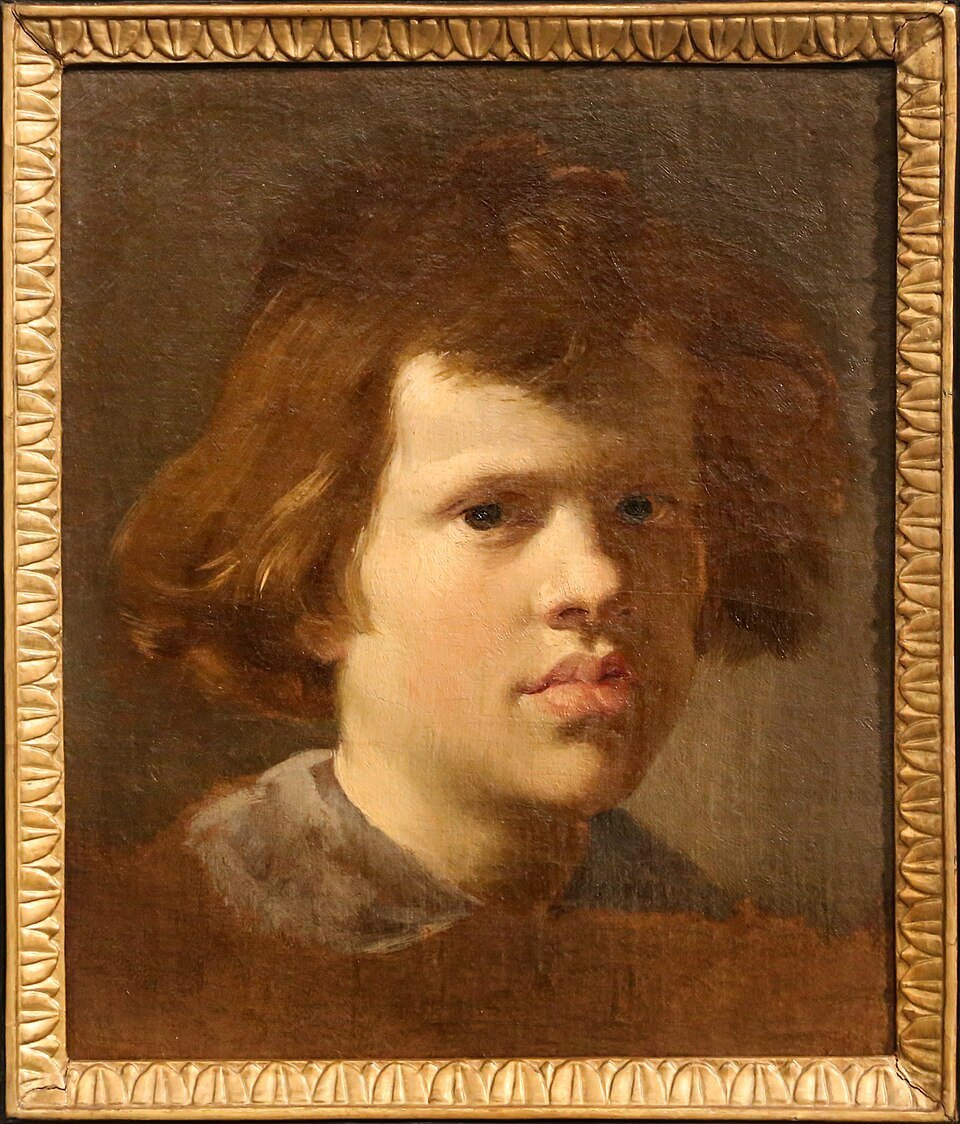
The museum names restorers for three campaigns, Carlo Matteucci in 1936, Alvaro Esposti in 1963 and Paola Tollo in 1996–97. Its exhibition history lists the picture at Palazzo Pitti in 1922 and the Louvre in 1965. These entries give the small canvas a history of being handled, examined and presented in different settings after its acquisition in 1919. The public record lists the interventions without giving a treatment report that could settle whether a particular edge or passage of paint has changed. Descriptions of the present outline and the loosely painted collar can be checked against the visible object, while questions about its initial dimensions and finish call for different evidence. [6]
Two portraits of Clara Serena
The German collection entry for the Rubens portrait in Liechtenstein supplies a useful historical comparison. Its provenance includes a probable reference in the estate of Jan Brant in 1639 and ownership by Archduke Leopold Wilhelm by 1656. The Borghese picture has a firm acquisition record from the Chigi collection in 1919. The routes by which the portraits reached their museums thus differ considerably. The relationship between Rubens and his sitter is recorded by the collection. The proposal that Bernini painted one of his brothers remains a hypothesis about a work whose early ownership is less clearly documented. [6][7]
Rubens also represented Clara Serena in a later drawing now at the Albertina. The museum dates it to around 1623 and records black and red chalk with white heightening on tinted paper, with touches of brown ink defining the eyes and mouth. The collar and upper body are set out with quicker strokes. The drawing gives a second case of a portrait in which the work on a young face is more concentrated than the description of clothes. It also shows how the effect can be reached in different materials. Broad patches of oil colour shape the cheek in the Borghese canvas. Rubens uses the warm paper and lightly blended chalk to model the face in the drawing, reserving the finer ink marks for a few features. [6][8]
The relationship between the two portraits of Clara Serena can be studied because both collections identify the model. The face painted by Bernini and the young man in York can also be compared across pictures, but a likeness between them supplies no equivalent documentary link. The value of the comparison lies in how precisely it prompts a viewer to look at the eyes, the proportion of the head to the visible body and the extent to which a collar establishes a turn. Those features can be discussed before deciding what relation, if any, the two sitters had to one another. [6][7][8]
How the attribution changed
The Italian state bought the canvas from Prince Chigi in 1919 for the Galleria Borghese. It was recorded as the work of an unknown seventeenth-century artist and was subsequently assigned to Pier Francesco Mola. The gallery traces the role of Corrado Ricci, who considered Bernini, and credits Antonio Muñoz with the first published attribution to him in 1920. Several later scholars accepted it, while Valentino Martinelli retained the Mola attribution in 1950. The current catalogue places the work under Bernini and preserves this earlier history. The presence of different names in older records reflects successive assessments of the same canvas. [1]
The date has also been inferred by comparison. The gallery gives particular weight to the similarities with Bernini’s Self-portrait as a Young Man, which it dates to about 1623. Each painting directs more attention to the face than to the clothes. The young self-portrait is a different object, inventory 554, and the boy is inventory 555. The gallery notes a later dating proposed by Kristina Herrmann Fiore, who compared the boy to the chalk portrait of Sisinio Poli. The Morgan’s record for that sheet preserves an inscription naming the sitter and supplying a precise date in 1638. The boy’s portrait has no equivalent dating evidence in the records cited here, which is why the catalogue gives an approximate range. [1][2][4]
Who might the boy have been?
Two suggestions discussed by the gallery are Bernini’s younger brothers Luigi and Domenico. Luigi’s work for the Chigi offers a possible route by which a family portrait could have entered that collection. A portrait identified as Domenico has also been traced in records of the works Bernini left at his death. Both arguments depend on an intermediate step. The fact that Luigi worked for the Chigi does not identify the face, and the reference to a portrait of Domenico would have to be linked to this specific canvas. The boy’s clothing supplies little evidence of family or social standing. The intensity of his look can suggest familiarity between sitter and painter, but it cannot establish a name. [1]
The two kinds of comparison lead to different questions. The face, background and distribution of brushwork can be assessed alongside pictures attributed to Bernini. Naming a sitter calls for evidence that connects the features, the object or its early ownership with a particular person. The Chigi provenance securely identifies the source of the 1919 purchase. Earlier ownership and the sitter’s identity remain open in the museum account. Those distinctions allow the boy to be considered alongside the self-portraits without turning the possible family likeness into part of his title. [1][2][3]
The gallery records several episodes of conservation and lists a seventeenth-century frame considerably larger than the painting. The dimensions of the canvas tell us how concentrated the image itself is. Looking at that smaller area, follow the light from the forehead towards the cheek and then back to the edge of the collar. The difference between the defined face and its more rapidly painted surroundings gives the boy a presence that does not depend on knowing who he was. [1]
Discussion
The boy’s expression is more sharply worked than parts of his clothing.
Reader Insights
Where do you see the transition between the two kinds of brushwork?
How does the light make you read the face across the small canvas?
What could support a proposed identification of the boy?
Join the Conversation
Share a detail, comparison or question about Portrait of a Boy by Gian Lorenzo Bernini below.
References
- Puddu, Pier Ludovico. Portrait of a Young Boy. Galleria Borghese, inv. 555. View source
- Galleria Borghese. Self-portrait as a Young Man, inv. 554. View source
- Galleria Borghese. Self-portrait at a Mature Age, inv. 545. View source
- Morgan Library & Museum. Portrait of Sisinio Poli, IV, 174. View source
- Liechtenstein Princely Collections. Portrait of Clara Serena Rubens, the Artist’s Daughter, Peter Paul Rubens, about 1616. View source
- Puddu, Pier Ludovico. Ritratto di fanciullo. Galleria Borghese, inv. 555. Italian catalogue entry, frame, exhibitions and treatments.
- Liechtenstein Princely Collections. Porträt der Clara Serena Rubens, der Tochter des Künstlers. German catalogue and provenance of the oil portrait.
- Albertina. Rubens’ Tochter Clara Serena. German-language object description and materials of the chalk drawing.








