


 by Tom Gurney
Tom Gurney BSc (Hons) is an art history expert with over 20 years experience
Published on June 19, 2020 / Updated on November 18, 2026
Email: tomgurney1@gmail.com / Phone: +44 7429 011000
Quotes
Paul Fréart de Chantelou’s diary of Bernini’s 1665 visit to France records the sculptor talking about what makes a marble portrait look like a person, what happens when a form is seen against open space and how an artist chooses among early sketches. The diary also records the making of the bust of Louis XIV, so some of those remarks can be read alongside a work Bernini was actually making. Filippo Baldinucci and Domenico Bernini supply another kind of evidence in their early biographies. Their anecdotes show how the sculptor’s career was remembered and how memorable remarks acquired a place in that story. [1][2][3]
At a Glance
- Firsthand sourcePaul Fréart de Chantelou’s diary
- Diary settingFrance, 1665
- Early biographiesFilippo Baldinucci and Domenico Bernini
Likeness in a material of one colour
Chantelou reports Bernini saying that a face might become almost unrecognisable if the hair, eyebrows, pupils and lips were all whitened. He compares the effect with the sudden pallor of someone who has fainted. The features are still in place, but the usual contrasts that make the person recognisable have changed. The comparison gives some content to the problem that marble presents. A face seen in life has colour as well as shape. A sculptor working in pale stone must use light, shadow and the finish of the surface to recover some of those distinctions. [1]
This is the context for Bernini’s observation that a portrait sometimes needs “something that is not found in the model.” The example is the skin around an eye. A dark area visible in life can be represented by cutting more deeply into marble so that the recess holds shadow. What looks like an accurate feature to the viewer can involve a local departure from the sitter’s actual contours. The remark is about making a likeness in a particular material. The eye provides a test of the rule because even a small change in the depth of an eyelid or socket changes the way the face reads. [1]
A raised hand and the surrounding space
In the same discussion, Bernini considers a figure with one hand raised and the other held against its chest. He says the raised hand should be made fuller because its form appears diminished when seen against air. A hand resting against clothing has other carved surfaces behind it, while the raised hand has to maintain its shape in silhouette. The advice addresses the effect of presentation as well as the dimensions of the carved parts. It can be understood by looking at the same figure against backgrounds that give its hand different degrees of contrast. [1]
Chantelou records his own reservation. He thought nature would produce the same visual effect and questioned whether the sculptor therefore needed to compensate. He then remembered the account in Vitruvius of making corner columns thicker because their exposure makes them appear thinner. This is an instance in which the diarist records a disagreement and follows it through. The passage preserves a historical conversation about how an object looks from a particular position, including the point at which the person recording it remained unconvinced. [1]
How Bernini tested his first ideas
Bernini told Chantelou that he walked in a gallery at his house in Rome, drawing ideas in charcoal on the wall as they came to him. He described the tendency to prefer the latest design simply because it was new. If time permitted, the drawings could be left alone for a month or two and then considered together. Removing them from immediate attention gave the artist a chance to judge relations of shape and proportion that had been obscured by the excitement of finding a new solution. [1]
If a commission had to progress quickly, Bernini suggested changing the way the sketches were seen. Chantelou mentions lenses that altered colour or apparent size, as well as looking at the designs upside down. The exercise would leave the marks on the wall unchanged while altering their effect on the viewer. A sketch that depended on familiarity with the subject might look less persuasive once turned over. One that held together at a smaller apparent size might have the stronger arrangement of masses. The advice belongs to a discussion of choosing among designs before work fixes the composition in a less easily revised material. [1]
How a visitor judged the likeness
On 14 August 1665, Madame de La Baume told Chantelou how she tested the resemblance of the unfinished portrait to Louis XIV. She closed her eyes for a time, then looked again. In the first instant, she found the likeness especially convincing. Bernini approved of the experiment and connected it to a problem that faced anyone trying to judge their own work. Time away from the object gave the artist a fresh impression. When there was little time, lenses could change how large the work appeared or alter its colour. The remark about lenses therefore has a specific conversational setting. A visitor had described how she made a familiar likeness unfamiliar for a moment, and the sculptor explained how he used a related principle in the studio. [5]
The same entry describes a contrast between the way Madame de La Baume looked at the bust and the way Bernini looked at the king. At the sitting that followed, he studied Louis from below and to one side, then from close up and farther away. Some of the courtiers had difficulty keeping a straight face as he changed position. Their reaction gives the reader another view of the encounter. What the sculptor regarded as necessary observation looked unusual to people who had rarely seen a portrait being carved. The sequence puts the advice about looking afresh beside a recorded instance of a sculptor deliberately varying his angle and distance. It also preserves the visitor’s contribution in her own part of the conversation. [5]
How the diary reached its readers
Chantelou was assigned to accompany Bernini and liaise with the French court. Thomas Kirchner’s German study of the diary emphasises how that position allowed him to record the development of the bust, from choices made in the course of carving to the responses of the people who saw it. Kirchner also identifies several phases of revision. He proposes that the text may have been intended for readers in the royal administration and perhaps for later publication. The dated entries give close access to the work in progress, while their selection and arrangement tell us what Chantelou thought worth preserving. The way he presents Bernini’s artistic independence is part of the argument of the diary as a whole. [6]
The Versailles research centre traces the printed French edition to instalments edited by Ludovic Lalanne in the Gazette des Beaux-Arts between 1877 and 1885. They were collected in a single volume in 1885. Versailles also identifies the later English translation by Margery Corbett, annotated by George C. Bauer, and the French edition edited by Milovan Stanic. This publication history helps when two English quotations of a remark are worded differently. It is possible to trace a dated passage back to the French and then identify the translation being quoted. That distinction is especially useful where Chantelou reports a conversation with several speakers and only a short passage circulates on its own. [7]
Domenico Bernini’s biography has a separate chain of transmission. The copy recorded by Sir John Soane’s Museum was published in Rome in 1713, and Franco Mormando’s critical English edition translates the complete Italian text. A remark traced to Domenico therefore belongs to a family biography published long after the Paris sittings. A remark traced to one of Chantelou’s entries has a day and a conversational setting which the reader can identify in the French edition. Establishing who reported the words gives each kind of source a different use. An anecdote can show how the family understood the artist’s career. The diary can show how particular ideas about likeness entered a discussion while a commission was under way. [6][7][8][9]
A royal portrait in progress
On 19 August 1665 Chantelou describes Bernini working on the nose of Louis XIV’s bust. Courtiers gathered around the king, and Bernini joked that they scarcely left him time with his sitter. He threatened to make a caricature of one of them. Chantelou had to explain the kind of portrait he meant. The exchange is useful because it places the idea of caricature in the middle of a highly formal commission. The sculptor and his audience were discussing how resemblance could be pursued through emphasis, even while a marble intended to represent the monarch was taking shape. [1][4]
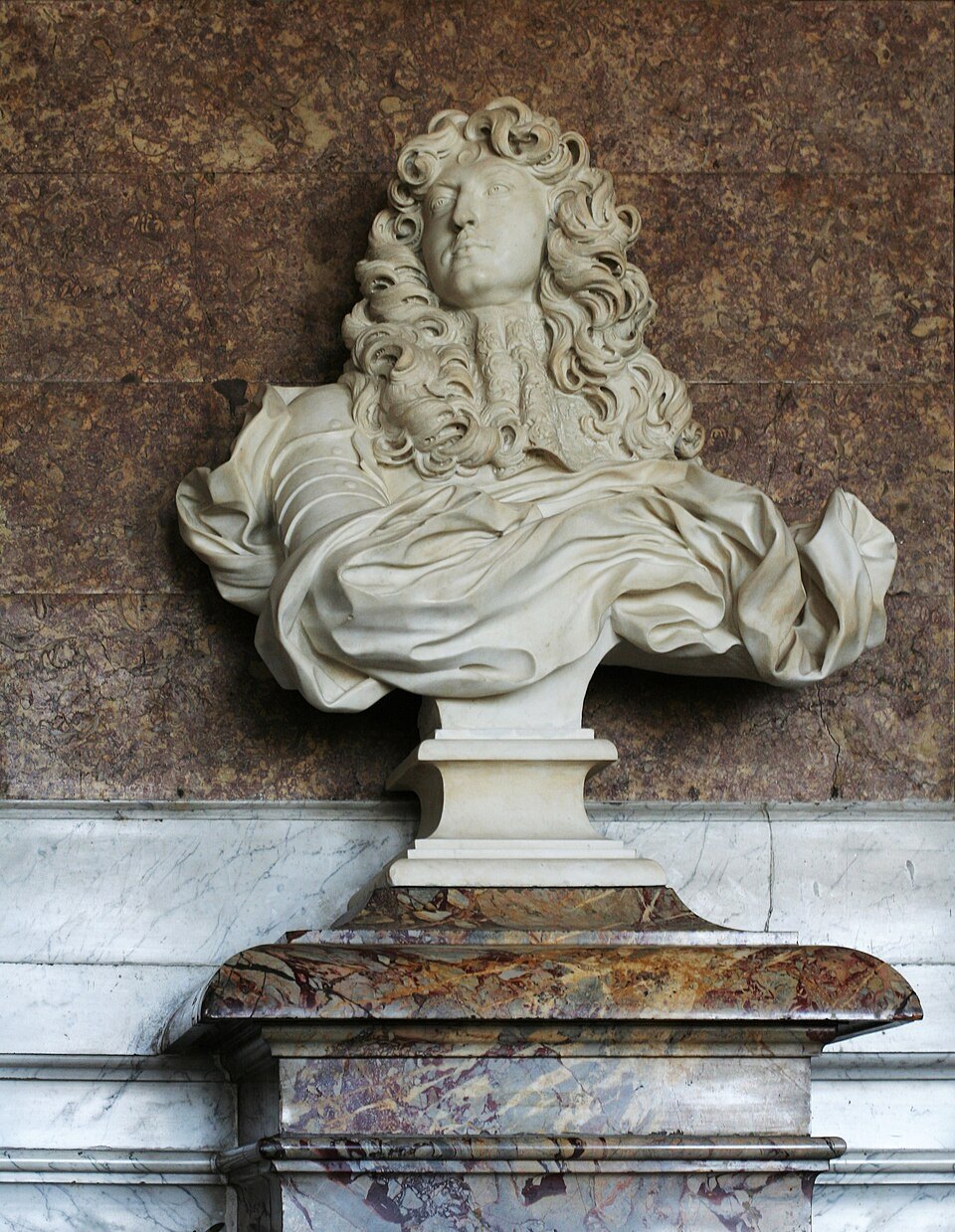
After the visit, Bernini told Chantelou that additional sittings could make the bust “a speaking image of him.” The remark sits alongside a different judgement from the sculptor Jean Varin, who thought too much marble had been removed from the forehead. Their comments show how the portrait could be assessed while it was still being made. One concerned the effect of more observation and the other the limits imposed by cutting stone. The later presentation of the completed bust on 5 October supplies a different point in the story from either judgement in August. [1][4]
The words of a father in a story told by a son
Chantelou also records Bernini recalling a visit by Cardinal Maffeo Barberini to the house of Pietro Bernini. According to the story, the cardinal warned Pietro that his young son would surpass him. Pietro answered that “in this game, he who loses wins.” The diarist gives the reply to the father, as recounted by Gian Lorenzo. It is a story about a sculptor benefiting from the achievements of a pupil and son, told by that son after he had become internationally famous. The transmission is part of the meaning of the remark. [1]
The early biographies have to be read with the same attention to the speaker and occasion. Baldinucci’s appeared in 1682, shortly after the artist’s death, and Domenico’s in 1713. Lavin prints passages from both accounts side by side in his study of Bernini’s last years. That comparison makes it possible to tell when a memorable detail is reported by one author alone or is differently expressed in each. For Bernini’s words about carving, the French diary offers a setting and, in many cases, a day on which the conversation was recorded. The biographies give access to the stories through which those who knew his career presented it to later readers. [1][2][3]
Related videos
These films provide wider context for Bernini’s expression, methods and career; they are not films devoted to this page’s subject.
The Dawn of Genius: Gian Lorenzo Bernini
A short introduction to Bernini’s early career and sculpture.
Watch on YouTubeDiscussion
Chantelou records remarks made while Bernini was preparing designs and portraits.
Reader Insights
Which observation about likeness is easiest to test against the bust of Louis XIV?
How does the occasion change the meaning of a reported remark?
What would you check before treating words in a later biography as an exact quotation?
Join the Conversation
Share a detail, comparison or question about Gian Lorenzo Bernini Quotes below.
References
- Chantelou, Paul Fréart de. Diary of the Cavaliere Bernini’s Visit to France, 1665. English excerpts hosted by Columbia University. View source
- Baldinucci, Filippo. The Life of Bernini. Originally published 1682, translated by Catherine Enggass. View source
- Lavin, Irving. Bernini’s Death. Reprinted in Visible Spirit, with passages from Baldinucci and Domenico Bernini’s Vita of 1713. View source
- Château de Versailles. Le génie et la majesté: Louis XIV par Le Bernin. Exhibition dossier on the portrait and Chantelou’s record of its presentation. View source
- Molière21, CNRS and Sorbonne Université. Éphéméride 1665, pp. 97–98. Transcription of Chantelou’s entry for 14 August.
- Kirchner, Thomas. Die Lesbarkeit der Bilder: Paul Fréart de Chantelou und das Schreiben über Kunstwerke in Frankreich. In Bernini in Paris, 2006. The diarist’s position, revisions and account of the bust.
- Centre de recherche du château de Versailles. Journal du voyage du cavalier Bernin en France. Publication history and access to the 1885 French text.
- Sir John Soane’s Museum. Vita del Cavalier Gio. Lorenzo Bernino, descritta da Domenico Bernino suo figlio. Catalogue record for the 1713 Roman edition.
- Bernini, Domenico. The Life of Gian Lorenzo Bernini. Critical edition and English translation by Franco Mormando.








