


 by Tom Gurney
Tom Gurney BSc (Hons) is an art history expert with over 20 years experience
Published on June 19, 2020 / Updated on November 18, 2026
Email: tomgurney1@gmail.com / Phone: +44 7429 011000
Drawings
Gian Lorenzo Bernini used paper to work out how a figure would move, how a fold would catch light and how a sitter might appear to speak. Some sheets preserve quick decisions for sculpture. Others are finished portraits that reward sustained attention in their own right. The difference is visible in the marks. A red chalk study for the Triton Fountain spends its energy on an upward movement through the arms, while the chalk portrait of Sisinio Poli gives the young man’s face a quiet range of tones. Drawings also survive by people around Bernini. Those sheets can tell us a great deal about his commissions, provided we distinguish the author of the drawing from the person responsible for the project it depicts. [1][2][3][4]
At a Glance
- Media includeChalk and ink
- UsesPreparatory studies and independent portraits
- ExamplesStudies for the Triton Fountain and the portrait of Scipione Borghese
The pose of the Triton
The Metropolitan Museum of Art’s Study for a Triton, dated 1642–43, is the only known drawing by Bernini himself for the Triton Fountain. The figure supports a shell high above his shoulders. One arm lifts farther than the other, and the torso turns beneath them. Bernini sets down the contour of the body in red chalk and indicates the fingers in short parallel marks. Relatively little of the lower body is worked out. Ian Wardropper relates that emphasis to the view of the finished figure from Piazza Barberini, where the torso and arms are particularly prominent. The sheet makes sense as a working decision about the part of the design the public would read most readily. [1][3]
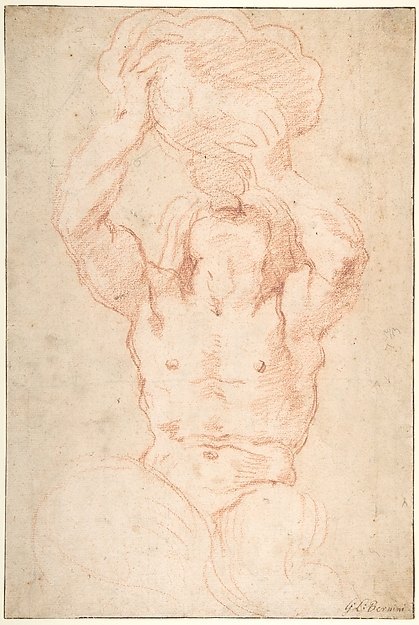
The gesture already corresponds closely to the one carved for the fountain. The shell changes shape between paper and stone, and the finished face acquires a more conspicuous moustache. The drawn torso and its lifted arms therefore give a clear instance of what could be settled early while particulars remained open. At the fountain, intertwined dolphins support an open shell beneath Triton. Water passes through the raised conch and falls into the basin below. Those elements give physical meaning to the direction Bernini worked out on paper. The sketch lets us follow the lift of the figure by itself, while the fountain puts that motion in contact with the falling water. [1][3]
Working out folds on paper
A sheet connected with Blessed Ludovica Albertoni takes a different part of a sculpture as its subject. Two ink studies concentrate on the folds lying along the side of the recumbent figure. In the earlier study Ludovica’s left arm crosses over the right, while the finished marble reverses their positions. The marks around the face are almost absent. Wardropper follows the way Bernini returned to the contours around the arms and the side of the body, trying a separation between the folds before adopting a more continuous course. That preference survives in a terracotta model and in the marble. [3]
This is an instance where apparently sparse drawing contains evidence of a sustained choice. The garment had to make the figure’s position legible even where it covered the body. By repeating curves with the pen, Bernini could test whether a fold pulled attention towards the arm or carried it farther down the bed. As a model or carved surface, the same fold takes on depth and casts an actual shadow. Reading the sheet alongside the later stages shows how a line can suggest the disposition of cloth before its full thickness has been decided. [3]
A chalk portrait as a finished work
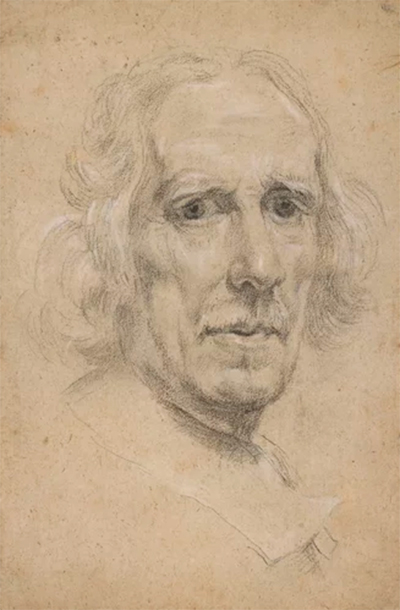
The Morgan Library & Museum’s Portrait of Sisinio Poli uses black, red and white chalk on light brown laid paper. An old inscription associated with the mount names the young man and gives the date as 28 April 1638, when he was eighteen. Poli holds what the Morgan identifies as probably a broad-brimmed hat. The hand and the object command space in the lower part of the drawing, while the lighter tones on the face keep the expression prominent. His lips almost part. The sitter appears to have paused at the point where he might address the person in front of him. [2]
Where Bernini needed the Triton’s fingers only to indicate a grip, his treatment of Poli’s face depends on looking at smaller transitions. The different chalks let him introduce warmth, light and shadow against the middle tone of the paper. The description can be precise without requiring a hard outline around every feature. The Morgan presents the portrait among finished chalk likenesses intended to stand on their own. Its carefully sustained surface has a different purpose from the rapid drawing of a figure that was destined for stone and water. [1][2]
The Morgan also holds Bernini’s Portrait of Cardinal Borghese, a red chalk drawing over graphite dated about 1632. Its catalogue describes it as a possible study for the marble portrait. Both the drawing and the two marble busts present the same sitter, but the exact function of the sheet is a separate question. The two Morgan portraits are useful to compare because one has a possible connection to a particular commission in marble and the other shows the degree of finish Bernini could give a portrait on paper. [2][5]
Studying ancient marble in red chalk
In a study dated around 1620, Bernini drew the upper body of Laocoön, the central figure of the ancient group rediscovered in Rome in 1506. The sheet in Leipzig records an earlier appearance of the statue, with its restored upper arm. The choice of crop concentrates attention on the chest and abdomen. Firm lines establish the outline, small hatch marks and rubbed red chalk describe the transitions between muscles, and white heightening picks out areas catching the light. The sequence of marks allows the paper to carry some of the changes a viewer can see across a carved surface. [6]
The example helps explain the place of drawing in the sculptor’s training. Studying a cast or a statue slows down decisions that can pass almost unnoticed before a finished group. The draughtsman has to choose where to turn an edge into a line, how far to carry a shadow, and which parts of the body to leave outside the frame. Before considering any resemblance to a marble of Bernini’s own, the Leipzig drawing can be read as evidence of his attention to how the torso of a known work was built and lit. It also records the arrangement in which he saw the antiquity, making the sheet a witness to the history of restoration as well as to his own practice. [6]
How workshop sheets reached Leipzig and the Vatican
The Leipzig collection now holds more than 200 drawings by Bernini and his school. The Laocoön sheet came from albums formerly owned by Christina of Sweden. The Roman dealer Francesco Antonio Renzi offered the group to Leipzig in 1713, and the city’s ownership brought it into the council library. The study of that collection by Heinrich Brauer and Rudolf Wittkower, published in 1931, made it possible to examine sheets grouped by commission. The museum’s holdings include work for the Baldachin, the tomb of Urban VIII, the Cathedra Petri and the colonnades. Those groups allow a comparison of the kinds of drawing used in successive St Peter’s projects, from early trials to the development of particular figures. [6][7]
Drawings associated with the Chigi family followed a different route. The Vatican Library records that papers and drawings were taken to the family palace at Ariccia in 1918 after the sale of Palazzo Chigi in Rome. Its published catalogue by Manuela Gobbi and Barbara Jatta includes sheets by Bernini and his school. The wording is important for an architectural project with several participants. A sheet can belong to the family’s record of a commission and preserve an approved combination of forms even when the marks were made by a member of the office. Family and collection provenance can establish a context that stylistic resemblance alone leaves open. [8][9]
Evidence on both sides of a sheet
The Louvre catalogues the reverse of one sheet under the broad title Esquisse and lists the drawing as attributed to Bernini. It identifies the object by the inventory number and the side of the paper, INV 9581 verso. The entry makes it possible to refer to the drawing specifically even though both its name and attribution are provisional. Photographs of drawings can circulate detached from those details, and the sides may be illustrated at different scales or in separate publications. Keeping the inventory number and the side in the citation also makes it easier to check whether two records refer to one piece of paper or two. [10]
For work in progress, the paper can preserve experiments with very different levels of finish. A line on one side may be enough to test a turn or a silhouette while the other carries a more sustained study. In a large body of drawings it is useful to compare the purpose of the marks before comparing their freedom or finish. The Laocoön study represents the sustained observation of a known object. A quickly made study attributed to Bernini poses a different question about execution. Another artist’s fully worked view of the basilica, discussed below, can document the circumstances in which Bernini’s project took shape. Together these objects show why a drawing’s value to the history of a design can extend beyond the identity of the hand that drew it. [6][8][10]
A drawing of Bernini’s project by another hand
A view of St Peter’s in the Morgan shows the wooden model of the Baldachin inside the basilica. The museum attributes the drawing to Agostino Ciampelli. It records a stage when the height and position of the canopy could be seen at its intended site while the building and the permanent undertaking were still in progress. The eye can compare the height of the provisional structure with the architecture around it. That is evidence for the development of Bernini’s project and for how it was seen, even though the attribution of the sheet is to another artist. [4]
The distinction matters when a collection or exhibition brings together several kinds of material. A drawing for the Triton shows Bernini making decisions about the figure. A drawing of the Baldachin model shows what a project looked like in the basilica at a particular stage. A finished portrait of Poli offers an encounter with a sitter entirely on paper. Read the museum’s maker and medium fields alongside the subject of the image. Then the amount of finish, the scale of the paper and the parts Bernini chose to draw can help explain what the sheet was made to do. [1][2][4]
Discussion
A quick fountain study and a finished portrait use the marks of chalk differently.
Reader Insights
Which lines in a fountain study describe where the body carries its weight?
What does the portrait of Scipione Borghese gain from the marks visible at close range?
Which decisions on paper would matter most to a sculptor working in stone?
Join the Conversation
Share a detail, comparison or question about Gian Lorenzo Bernini’s Drawings below.
References
- Metropolitan Museum of Art. Study for a Triton (recto); Anatomical Studies? (verso), 1973.265. View source
- Morgan Library & Museum. Portrait of Sisinio Poli, IV, 174. View source
- Wardropper, Ian. “Sketching on Paper and in Clay,” in Bernini: Sculpting in Clay. Metropolitan Museum of Art, 2012. Figs. 38–39 and 54, cat. D.15 and cat. 20. View source
- Morgan Library & Museum. Interior of St. Peter’s, with the Wooden Model of Bernini’s Baldachin, attributed to Agostino Ciampelli. View source
- Morgan Library & Museum. Portrait of Cardinal Borghese, IV, 176. View source
- Jeannette Stoschek. Studie nach dem Laokoon, Museum der bildenden Künste Leipzig, collection record NI. 7903.
- Heinrich Brauer and Rudolf Wittkower. Die Zeichnungen des Gianlorenzo Bernini, Berlin, 1931, digitised by Heidelberg University Library.
- Biblioteca Apostolica Vaticana. Sezione Archivi, history of the Chigi papers and drawings.
- Manuela Gobbi and Barbara Jatta, eds. I disegni di Bernini e della sua scuola nella Biblioteca Apostolica Vaticana, Vatican City, 2015.
- Musée du Louvre. Esquisse, Département des Arts graphiques, INV 9581 verso.







