


 by Tom Gurney
Tom Gurney BSc (Hons) is an art history expert with over 20 years experience
Published on June 19, 2020 / Updated on November 18, 2026
Email: tomgurney1@gmail.com / Phone: +44 7429 011000
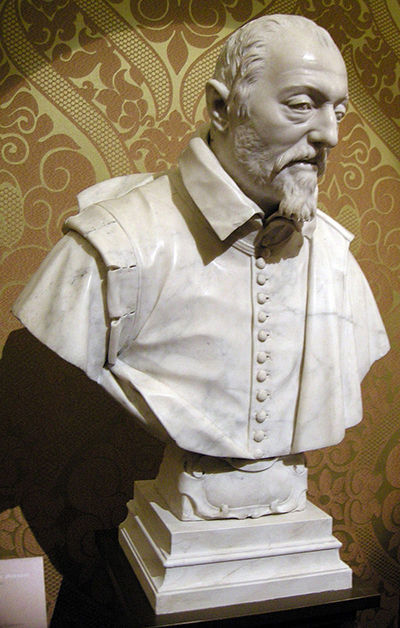
Bust of Antonio Cepparelli
Antonio Cepparelli’s head turns above a broad collar, while the folds of his cape cut diagonally across the outline of his shoulders. Gian Lorenzo Bernini made this marble after the Florentine benefactor’s death in 1622. The Confraternity of the Pietà ordered it for the hospital attached to San Giovanni dei Fiorentini in Rome, where it was to commemorate Cepparelli’s support. A payment order addressed to Gian Lorenzo survives with Pietro Bernini’s receipt on the reverse. The two sides of that document help explain how the work was commissioned and why the bust was long associated with the father. [1][2][3]
At a Glance
- DateAfter 1622
- Location or statusMade for the hospital of San Giovanni dei Fiorentini, Rome
- WorkPosthumous marble portrait
The work in Bernini’s career
Apollo and Daphne
1622–25Ecstasy of Saint Teresa
1647–52St Peter’s Square
1656–67Bust of Antonio Cepparelli
After 1622The two hospital portraits and their attributions
The instruction to follow the earlier memorial of Antonio Coppola establishes the precedent for Cepparelli’s bust. The authorship of that earlier portrait is disputed. Irving Lavin attributed both busts to Gian Lorenzo, an attribution still reflected in Rome’s German-language visitor guide. The 2017 Borghese exhibition, however, exhibited the 1622 Cepparelli as Gian Lorenzo’s and the 1612 Coppola as Pietro’s. In her French review of Maria Grazia Bernardini’s catalogue, Anne-Lise Desmas explains that the catalogue gives Pietro the principal role in the Coppola and leaves Gian Lorenzo’s participation uncertain. The older portrait remains central to the history of the commission regardless of how the work on it was divided. [4][5][6]
The Borghese checklist puts a scale on the difference between the two portraits. With its support, Cepparelli’s bust measures 70 centimetres high and 60.5 wide. The Coppola is only three centimetres shorter but more than twelve centimetres narrower. The comparison shows where Cepparelli’s bust gained much of its scale, across the shoulders and garment. The wider silhouette lets the line of the cape rise behind one shoulder and fall across the opposite side of the chest. The earlier bust brings the folds into a smaller space and includes fingertips emerging from the drapery, a feature discussed in the Italian heritage catalogue. The confraternity asked for a comparable memorial, leaving scope for a different treatment of the body. [4][7]
Reading the two sides of the payment order
The early records offer a more precise attribution for Cepparelli. In his later study with Marilyn Aronberg Lavin, Irving Lavin revisited Cesare D’Onofrio’s proposal that Pietro made the bust. D’Onofrio had interpreted the forty-five scudi in the closing entry as the price of the work and compared it with the fifty recorded for Coppola. The twenty-five scudi advanced earlier bring the total for Cepparelli to seventy. The payment order names Gian Lorenzo, with the title Cavaliere, as the person responsible for making the marble. Pietro’s signature on the back acknowledges receipt of the money. Keeping the order and receipt together identifies who was commissioned and who collected part of the payment. [8]
The proximity of Pompeo Caccini’s painted commission still leaves a question about the likeness. The marble was ordered within days of the sitter’s death, and the painting enters the accounts before the August advance for the sculpture. A painter working in the same period may have had access to earlier likenesses or people who knew the benefactor. For Coppola there is a separate record of a wax likeness, which some scholars interpret as a death mask. The accounts describe distinct circumstances for the two commissions. The documented wax for Coppola and the payment for Caccini’s painting give clues to the material available to portrait makers, while the immediate model for the Cepparelli remains unidentified. [8][9]
The memorials above the balcony door
The antiquarian Giovanni Antonio Bruzio recorded the three memorials on the side of the hospital facing the Tiber, above the door to a balcony. In his description Coppola occupied the middle, with Cepparelli on the right and Pietro Cambi on the left. The group therefore formed a sequence viewed partly from below. The broad outline and cape of the Cepparelli would have been easier to see from the room than the smaller passages around the eyes. The same record connects busts and inscriptions as parts of a shared display. A later arrangement on separate supports preserves the marbles and allows different viewing angles. The rediscovery account from the Institute for Advanced Study describes the pencilled identification on the Coppola bust and the Cepparelli found nearby, details that show how the objects could be identified independently of their original inscriptions. [9][10]
A portrait for the Florentine hospital
On 23 April 1622, five days after Cepparelli’s death, the confraternity decided to commission a marble likeness and an inscription for its hospital. The decision referred explicitly to the earlier memorial of Antonio Coppola, another benefactor. It also asked Girolamo Ticci to speak to Bernini and arrange for the work to proceed quickly. The two Antonios were remembered through the same kind of commission. In each case the carved likeness would give the hospital a visible reminder of someone who had helped sustain it. [1][2]
The comparison with Coppola supplied a precedent for the choice of material, the setting and the use of an inscription. It still left room for a different arrangement of the shoulders and clothing. Bernini had made Coppola’s bust ten years earlier, in 1612. The two works therefore give a basis for examining how his portraiture changed across a decade for patrons who were asking for related kinds of memorials. Cepparelli’s cape brings more movement into the outline, particularly where it rises behind one shoulder and falls forward over the other. [1][2]
The hospital setting also gives the inscription a particular role. The face and the clothing give substance to the memory of one man. A written dedication establishes the grounds on which the institution wished to remember him. The final payment explicitly describes Cepparelli as a benefactor and refers to the work as placed in the hospital. That description comes from the people who commissioned it, rather than from a later admirer of the sculpture. The portrait’s earliest audience would have encountered the likeness in the institution named in the record. [1]
What the payments establish
The confraternity also paid Pompeo Caccini for a painted portrait in June 1622. The existence of that commission shows that its members sought more than one form of likeness soon after Cepparelli’s death. Caccini’s son collected the money and signed the receipt. The timing makes the painting relevant to the circumstances in which the marble was made, but the payment alone cannot establish how the sculptor obtained his information about the sitter’s face or whether he worked from that picture. [1]
A payment order for twenty-five scudi dated 7 August 1622 names Gian Lorenzo as the sculptor engaged to make the marble head. Pietro signed for the money on 13 August. Lavin read the record as evidence that Pietro was acting on his son’s behalf. In December 1623 the accounts record a further forty-five scudi as the balance for the marble installed at the hospital. The Fondazione Federico Zeri dates the bust 1622–23. The accounts provide dates for the advance and the balance, giving a more precise history of the commission than the appearance of the marble by itself. [1][2][3]
How the cape turns around the figure
The buttons descend in a nearly straight line through the centre of the chest. The collar sits well above the first one, and the cloak falls in broad folds to either side. The relatively regular progression of the buttons gives the eye a stable reference for following the uneven drop of the cloth. One end of the cape gathers near the lower chest. The other appears above a shoulder, where a short raised edge breaks the outline against the background. The cloth appears to shift around the torso without losing the sense of weight suggested by the broader folds. [1][2]
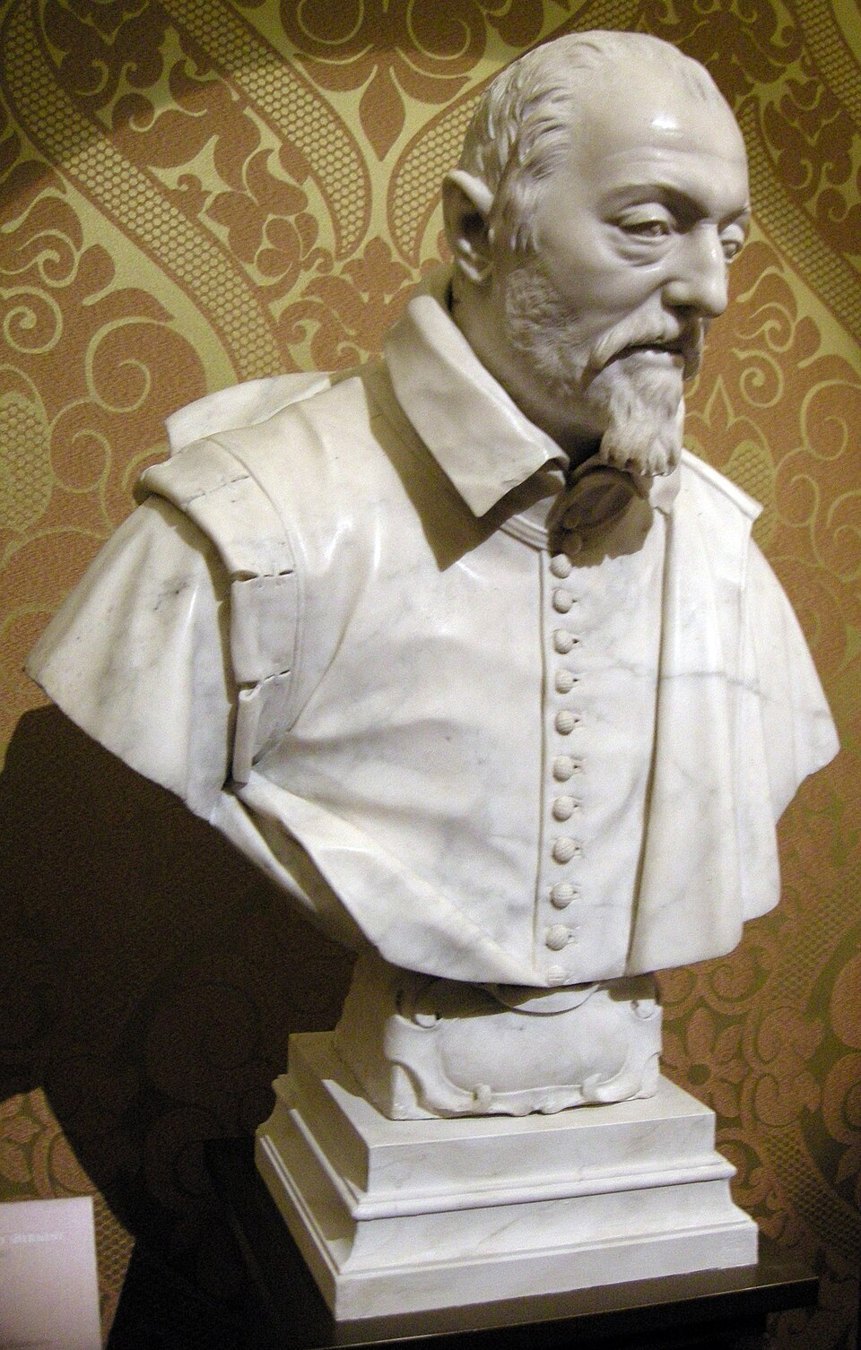
The face is turned enough for light to collect on the brow and nose while leaving a small shadow underneath the cheek. The beard comes to a narrow point below the chin. Bernini broke that area into smaller ridges and channels, giving it an outline that reads against the smooth planes of the collar. The carefully worked eye and the narrow opening at the lips add detail where a change in expression can be conveyed with a shallow cut. The arrangement gives the face a quieter kind of movement than that of the cape below it. [1][2]
Lavin compared the cape with that in a portrait attributed to Nicolas Cordier in the Aldobrandini chapel of Santa Maria sopra Minerva. Both introduce a diagonal across the chest while sending part of the garment towards the back of the opposite shoulder. In Cepparelli’s bust, the broad stretches of cloth give the diagonals room to register separately. Lavin also related those folds to details in Bernini’s portraits of Montoya and Francesco Barberini. Cepparelli’s clothing carries the asymmetry farther around the torso, where it can be followed by a viewer moving past the bust. [1]
The bust’s broad lower edge projects either side of the narrow base. Seen from below, the base gives a more stable point from which to judge the displacement of the shoulders and the diagonal crossing the chest. From the side, the most exposed part of the collar stands clear of the neck, while the cape rises behind it as a separate contour. The portrait would have offered changing views to someone walking past a wall display. That distinction between the silhouette and the details within it helps explain why the movement remains readable when the face is seen at a distance. [1][2]
Rediscovery at San Giovanni dei Fiorentini
The bust’s documented location in the hospital was no longer its location by the twentieth century. Lavin’s investigation in 1966 drew on the confraternity archive, where the payments and the reference to the earlier Coppola memorial helped him trace the two works. Both marbles were found in storage in the basement, along with a portrait of another benefactor, Giovanni Battista Cambi. The recovery brought the surviving sculptures back into the evidentiary chain that linked them to the confraternity. Earlier payment records could then be read alongside the actual carvings. [1][3]
After cleaning, the busts of Coppola and Cepparelli were placed on piers near the entrance to the sacristy in January 1967. Lavin records that the consoles used then were found in storage and differed from the original supports. Cepparelli’s inscription was reproduced from a published transcription, while Coppola’s surviving inscription could be placed with his portrait. The archival record thus helps reconstruct the original relation between image and dedication even where parts of the hospital memorial have been lost. The Zeri photographs document Cepparelli’s marble at San Giovanni dei Fiorentini and make the closely related handling of the head and cape available for comparison with Bernini’s other early portraits. [1][2]
Discussion
The cape’s diagonal folds lead up towards the turning head.
Reader Insights
Which part of the face gives the portrait a sense of movement?
How might placement at a hospital influence this public likeness?
What does a payment order tell you about the family workshop?
Join the Conversation
Share a detail, comparison or question about Bust of Antonio Cepparelli by Gian Lorenzo Bernini below.
References
- Lavin, Irving. Five New Youthful Sculptures by Gianlorenzo Bernini and a Revised Chronology of His Early Works. Reprinted in Visible Spirit, 2007. See the Cepparelli discussion and documents 20–23. View source
- Fondazione Federico Zeri. Ritratto di Antonio Cepparelli. Catalogue record 81566 and photographs. View source
- Ministero della Cultura. Busto di Antonio Cepperello. Italian cultural-property record, with the variant spelling Cepperello. View source
- Galleria Borghese. Bernini, 2017–18 exhibition dossier. Checklist items 50 and 51, dimensions and the attributions used at the exhibition.
- Turismo Roma. Basilika San Giovanni Battista dei Fiorentini. German guide and location of the two portraits.
- Anne-Lise Desmas. “Un nouveau catalogue des sculptures du Bernin”. French review of Bernardini’s catalogue and its attribution of the Coppola bust.
- Ministero della Cultura. Antonio Coppola. Coppola bust, costume and attribution history.
- Irving Lavin with Marilyn Aronberg Lavin. “Bernini’s Bust of Prospero Farinacci”. Reassessment and transcriptions of the Cepparelli payments.
- Irving Lavin. Five New Youthful Sculptures, early installation and documents. Bruzio’s account, wax likeness and related commissions.
- Institute for Advanced Study. “A Tale of Three Busts”. The archival search and discovery of the hospital portraits.








