


 by Tom Gurney
Tom Gurney BSc (Hons) is an art history expert with over 20 years experience
Published on June 19, 2020 / Updated on November 18, 2026
Email: tomgurney1@gmail.com / Phone: +44 7429 011000
Portrait of a Young Gentleman
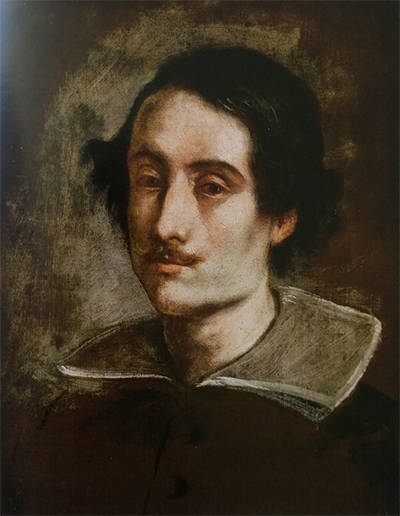
A dark-haired young man wears a broad, pale-edged collar over a dark garment. His face turns slightly and the light picks out the line of the nose, one cheek and the side of the neck. The closest published candidate for the painting illustrated here is the privately held Portrait of a Young Man discussed in entry VI.12 of the 2017 Borghese catalogue. The identification remains provisional pending comparison with the catalogue plate. The sitter’s name is unknown and the attribution has been disputed. The portrait’s handling of the face and the abbreviated clothing can be studied directly, while its place in Bernini’s painted work depends on comparisons and on the history of the attribution. [1][2][3]
At a Glance
- Location or statusPrivate collection for the proposed match
- WorkThe identification with the published Borghese catalogue entry remains provisional.
The work in Bernini’s career
Apollo and Daphne
1622–25Ecstasy of Saint Teresa
1647–52St Peter’s Square
1656–67Portrait of a Young Gentleman
Date discussed in the articleThe head and collar
The collar is widest on the right of the picture, where it rises behind the neck and runs to a firm corner. Its opposite edge has a shallower turn and approaches the background at a lower angle. The difference gives the shoulders a direction. It also provides a broad shape against which the small turns of the face can be judged. The neck is relatively bright on one side and passes into shade on the other. The line of the collar below it picks up the turn of the body, while the eyes hold the viewer’s attention above it. [1]
The side of the face closest to the light is marked by a long interval from the temple to the jaw. Around the nose and upper lip the intervals are much shorter. The thin moustache interrupts the light crossing the middle of the face and gives the closed mouth a distinct position. A line defining the whole outline of the head would have made these internal changes less important. Here they carry much of the modelling. The cheek and jaw stand out through differences in light and shade, while the ear and hair are partly absorbed into the area around them. [1]
The background has a visibly worked surface. The warmer, lighter strokes around the head are freer than the paint that describes the nose and mouth. The dark hair has a more distinct edge where it meets those strokes, then loses definition lower down. The buttoned coat likewise remains close to the value of the background. The few places where it separates from it give enough information to see how the figure fills the lower part of the picture. The eye can move from those broad, loosely described surfaces towards the smaller forms at the centre. [1]
The attribution in print and in the exhibition
Luigi Grassi published the painting in 1951 as an autograph work by Bernini. The article announcing the reappearance of the Costa Portrait of a Young Man in Prospettiva describes how little opportunity scholars subsequently had to examine it, pointing to the absence of a colour photograph or public exhibition at that time. Its author argued in favour of Bernini and proposed a date around 1635, relating the work to a period of stylistic affinity with Diego Velázquez. This is a proposed chronology drawn from examination and comparison. The portrait has no dated inscription cited in that account. [2]
The 2017–18 Borghese exhibition presented the private-collection portrait under Bernini’s name. Luigi Ficacci discussed it in the painting section of the exhibition catalogue, entry VI.12. Kristina Herrmann Fiore questioned the attribution in her review, finding the handling of the paint distant from works she accepted as Bernini’s and suggesting the possibility of a later date. The disagreement concerns how the visible handling should be interpreted. Both scholars were considering the picture in the context of Bernini’s painting, but an exhibition attribution does not settle the force of the comparison for every reader. [1][3]
Access to the original matters when a large part of the argument is about how paint was laid on the canvas. A reproduction can show the direction of the strokes around the head and the difference between the more finished face and loosely indicated coat. It is harder to use it to judge how the grains of the surface, layers of paint and changes of colour relate at close range. Grassi’s publication, renewed examination and the exhibition each gave the painting a different kind of exposure. The succession of records helps explain why scholarship could return to a name that had already been proposed decades earlier. [1][2][3]
What the publications establish about the canvas
Tomaso Montanari’s bibliography identifies him as the author of the article on the Costa portrait in Prospettiva, pages 184–85. The journal’s abstract describes his inspection of a painting previously published by Luigi Grassi, then largely absent from the literature. The Borghese’s later exhibition checklist supplies a different kind of reference. Item 74 is an oil on canvas called Ritratto di giovane, lent by a London private collection, for which the checklist gives three dimensions: 44 by 50 by 6 centimetres. Its third measurement is a reminder that the checklist describes the exhibited object, while the proportions of a reproduction can reflect a crop. Taken with Ficacci’s catalogue entry and the reference to Grassi in the exhibition review, these details give specific points to check when matching the online illustration against the published plate. [6][7][8]
The argument from character and the argument from the painted surface deserve separate attention. The sitter appears alert because the eyes meet the viewer while the shoulders and collar imply a turn. To judge the handling, it is more useful to look at which strokes define the turn and how they meet. The near cheek appears to grade into the shadow, while the thin moustache is made with more definite marks. Around the forehead the dark mass of hair defines one side of a mostly pale area. These are features a catalogue photograph can help a reader locate. Direct examination can establish whether what appears as a single dark passage in the reproduction actually contains separate layers, transparent paint or later retouching. [6][8][9]
How a comparison with Velázquez can be tested
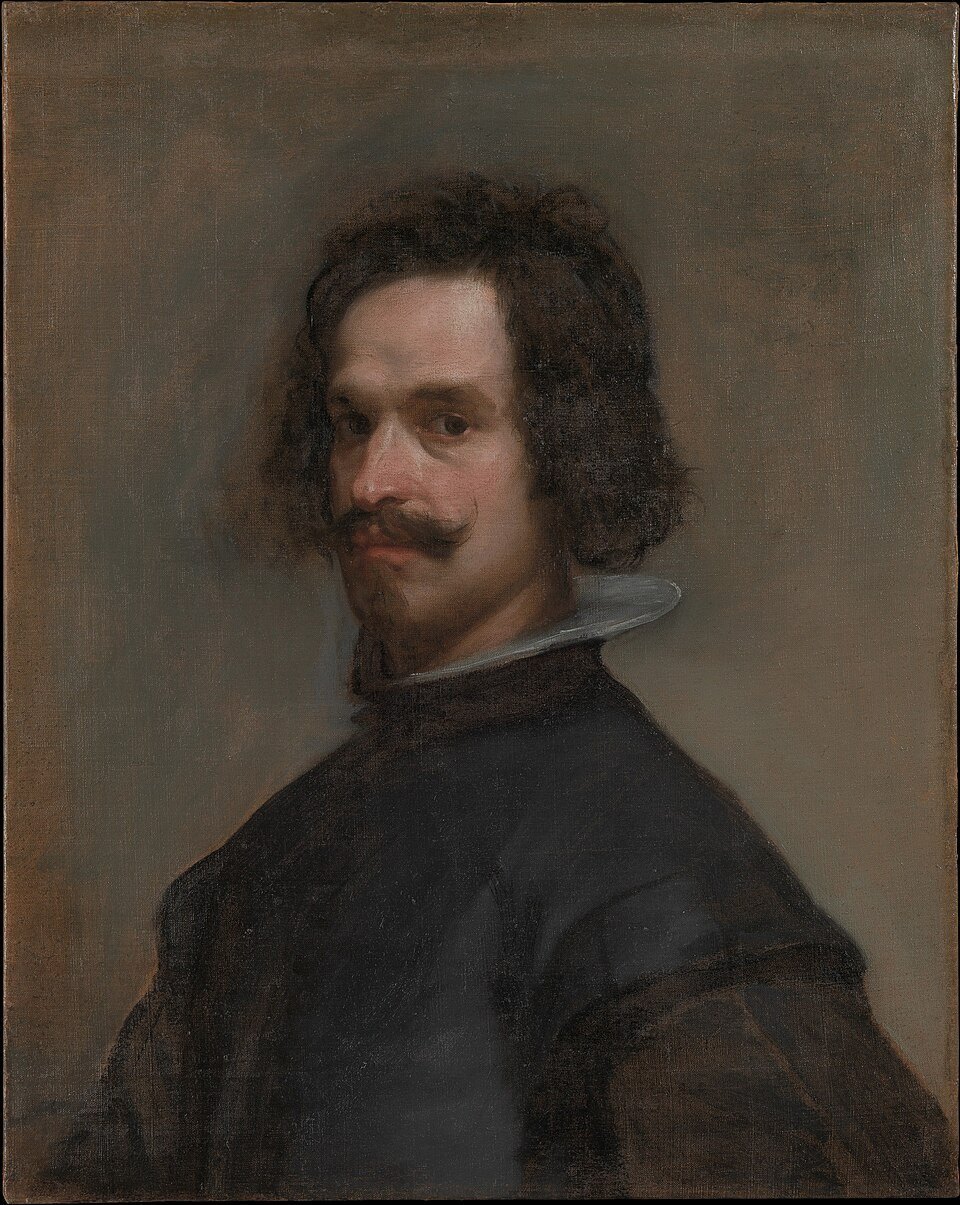
The Metropolitan Museum’s account of conserving Velázquez’s Portrait of a Man, Possibly a Self-Portrait shows how those distinctions affect a comparison. Before treatment, degraded varnish and earlier restoration obscured the range of tones. After treatment, the museum could describe strokes of black that indicate the tailoring and buttons, a cool grey at the neck, and a few slim touches of white that establish the stiff collar. The object therefore gives a concrete example of how an abbreviated costume can be carefully built. For the portrait illustrated here, the dark buttons and the pale edge around the neck invite a similar inspection of how the costume is constructed. The Met’s results describe its own canvas, and the comparison with the Costa painting remains a stylistic proposal. [6][9][10]
A portrait in Berlin gives another indication of how widely these comparisons can range. The Gemäldegalerie’s Bildnis eines Mannes is a full-length Baroque portrait. Its German catalogue reviews an early attribution to Velázquez and a subsequent one to Andrea Sacchi, and records that affinities with Bernini and Pietro da Cortona had also been noted. In that painting the wall and column help frame the figure’s social presence. In the small portrait illustrated here, the head, collar and gaze have to carry the encounter almost unaided. The Berlin catalogue shows how a resemblance may point to a shared vocabulary of portraiture even where the handling, scale and staging of two works differ. [11]
Close framing in paint and chalk
The Städel’s German catalogue describes Bernini’s drawing of a man in three-quarter view as black, red and white chalk on brown prepared paper. The brown surface can serve as a middle tone between the pale chalk accents and the stronger dark strokes. The red chalk introduces warmth without requiring a separate layer of paint. In the oil portrait the shadow beside the cheek and the pale collar make comparable distinctions of value, though the pale fabric forms a broader and firmer boundary than the smaller accents in the drawing. A comparison across media is most precise when it follows a particular passage, such as the junction of neck and collar, and takes account of what each surface contributes. [12]
The Musée Fabre’s French catalogue records a similarly close painted view of an unknown man, presented as a possible self-portrait and currently catalogued in Bernini’s circle. It points to the brisk handling and the force of the gaze even as it qualifies the attribution. There is room to study that direct address alongside the expression of the young gentleman. With the sitter’s identity open in both works, the most secure comparison lies in the distribution of light around the face and the small amount of space allowed for any setting. [13]
Comparing portraits with similar titles
The Borghese Self-portrait as a Young Man, inventory 554, offers a defined point for comparison. That painting is dated to around 1623 and has a separate provenance from the Alvise De Ruggieri collection. The sitter has wavy hair and a moustache, and the dark clothing allows the gaze to carry much of the expression. These correspondences illuminate a way of structuring a head. They are also features that several painters could use. The relative size of the collar and the manner in which each face emerges against the ground are more useful to the comparison than the age suggested by either title. [1][4]
The National Gallery of Art in Washington has a Portrait of a Young Man by Bernini in chalk, from a different collection and in a different medium. On paper the strokes describe the head, clothing and contours through the marks themselves. The dark coat of the painted gentleman can merge into a similarly dark background while the edges of the collar give the figure its width. The titles bring two works within the same broad portrait type. The medium and the configuration of the sitter make it possible to refer to either object precisely. [1][5]
On the canvas, the contrast between the fairly stable collar and the three-quarter face is what makes the likeness seem responsive. That visual result can be described without assigning the sitter an occupation, temperament or place in Bernini’s family. The dark buttons give the viewer a further point of reference below the collar. They establish the front of the garment with only small differences in tone and keep it from reading as an undifferentiated shadow. Against that understated vertical, the spread of the collar and the angle of the face can each be read independently. The surviving evidence is most specific where it names the object in an exhibition or a publication. The identity of the sitter and the interpretation of the brushwork remain separate questions for anyone comparing the painting with other portraits. [1][2][3]
Discussion
A broad collar and a small turn of the face give this young man’s portrait much of its form.
Reader Insights
Which features would be most distinctive in a comparison with a catalogue plate?
How does the indistinct clothing shift attention towards the sitter’s expression?
What can a provisional match tell you about attribution?
Join the Conversation
Share a detail, comparison or question about Portrait of a Young Gentleman, Attributed to Gian Lorenzo Bernini below.
References
- Galleria Borghese. Bernini, 2017–18 exhibition dossier. Checklist entry for the privately held Ritratto di giovane. View source
- Prospettiva. “Bernini the painter: the reappearance of the Costa ‘Portrait of a Young Man’”. Nos. 163–64, pp. 184–85, publisher’s abstract. View source
- Herrmann Fiore, Kristina. “La mostra di Bernini: le luci e le ombre”. Discussion of Ficacci’s catalogue entry VI.12 and the disputed attribution. View source
- Galleria Borghese. Self-portrait as a Young Man. Inventory 554, date and provenance. View source
- National Gallery of Art, Washington. Portrait of a Young Man. Collection record for the separate chalk drawing. View source
- Tomaso Montanari. “Bernini the painter: the reappearance of the Costa ‘Portrait of a Young Man’”. Prospettiva, nos. 163–64, pp. 184–85, publisher’s abstract.
- Università per Stranieri di Siena. Tomaso Montanari bibliography. Author’s listing of the Costa portrait article.
- Galleria Borghese. 2017 Bernini exhibition checklist, item 74. Dimensions, medium and private lender.
- Metropolitan Museum of Art. Velázquez Rediscovered, conservation gallery. Paint handling and changes visible before and after treatment.
- Metropolitan Museum of Art. Velázquez, Portrait of a Man, Possibly a Self-Portrait. Catalogue entry for the separate Spanish painting.
- Staatliche Museen zu Berlin. Bildnis eines Mannes. Gemäldegalerie inventory 413A and attribution history.
- Städel Museum. Männliches Porträt im Dreiviertelprofil nach rechts. Bernini drawing and its materials.
- Musée Fabre. Portrait d’homme (Autoportrait?). French catalogue for the separate painted portrait.








