


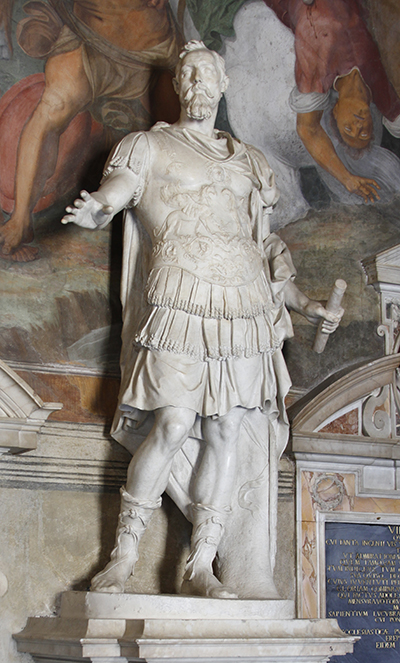
 by Tom Gurney
Tom Gurney BSc (Hons) is an art history expert with over 20 years experience
Published on June 19, 2020 / Updated on November 18, 2026
Email: tomgurney1@gmail.com / Phone: +44 7429 011000
Memorial for Carlo Barberini
On the entrance wall of Santa Maria in Aracoeli in Rome, two allegorical figures sit around a memorial inscription. Gian Lorenzo Bernini designed the plaque after the death of Carlo Barberini, brother of Pope Urban VIII and commander of the papal forces, in 1630. The plaque was one of three related commemorations. A temporary catafalque stood in the church for the funeral ceremonies, while a separate statue was installed in the Palazzo dei Conservatori. The greater part of the plaque is devoted to an inscription. Bernini’s figures and shields give the words an architectural and sculptural setting suited to public commemoration on the Capitoline Hill. [1][2]
At a Glance
- DateAfter 1630
- Location or statusSanta Maria in Aracoeli, Rome
- WorkFunerary plaque designed by Bernini
The work in Bernini’s career
Apollo and Daphne
1622–25Ecstasy of Saint Teresa
1647–52St Peter’s Square
1656–67Memorial for Carlo Barberini
After 1630Three forms of commemoration
After Carlo died while on a mission to Bologna, the Roman Senate voted to honour him. The Metropolitan Museum’s catalogue records a payment to Bernini for the plaque on 30 September 1630. The choice of Aracoeli followed a practice of honouring commanders connected with Rome and the papacy in that church. Irving Lavin traces precedents in the ceremonies and monuments for Marcantonio Colonna, Alessandro Farnese and Gian Francesco Aldobrandini. The initial proposal specifically invoked Aldobrandini. The examples supplied positions for both words and sculpture. The church held the inscriptions, while statues of the commanders in ancient military guise stood in the Capitoline palace. [1][2]
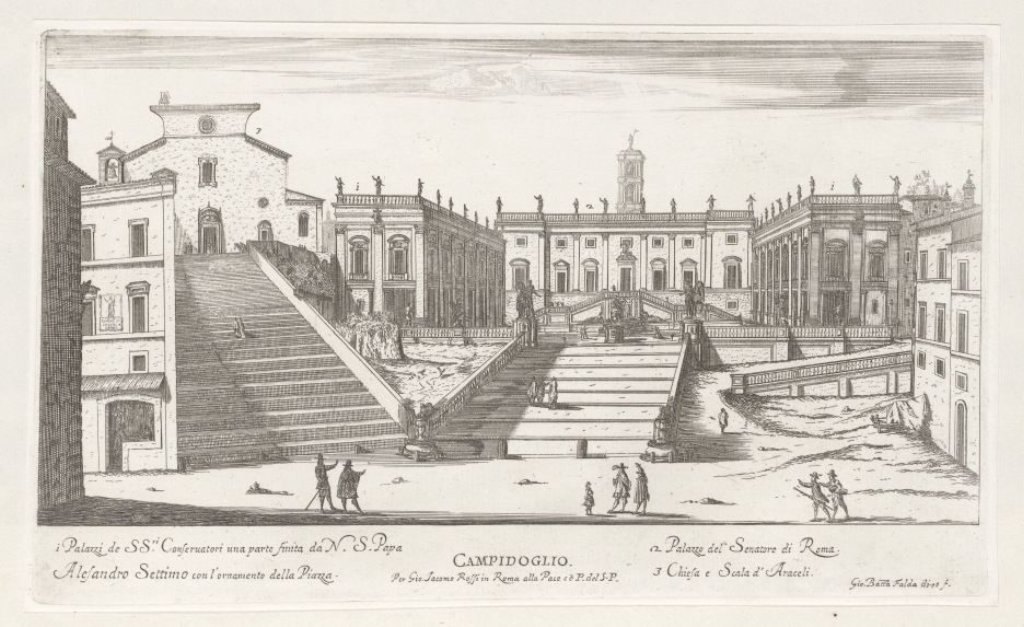
The works for Carlo had different tasks. The catafalque belonged to the funeral ceremony held on 3 August. Its architectural scale and place in the church gave the ceremony a temporary focus. The wall plaque remained after the occasion and could be encountered by anyone moving through the church. The standing figure in the Sala dei Capitani made Carlo part of a civic group of leaders. Bernini carved its portrait head, and Lavin credits him and Alessandro Algardi with the work of adapting the ancient torso. The head is the subject of a separate article in this cluster. The plaque commemorates Carlo through a written account surrounded by figures that stand for qualities and institutions. [1][2][3]
The inscription and its attendants
The two seated figures bring distinct attributes into view. Lavin identifies the one on the left as the Church, following early accounts. She carries a shield with papal arms, and a large snake lies beneath her foot. Lavin also notes the remains of a thin rod between her fingers and proposes that it belonged to a staff. On the other side, a shield bears a laurel wreath and a lightning bolt. Lavin relates those devices to Cesare Ripa’s account of unconquerable virtue. The figures flank the words with signs of the institution Carlo served and the qualities for which the memorial honoured him. [1]
The wall location determines the way the parts can be read. The inscription has to keep a clear area within its frame for the lines of text. The figures gather around that area and act through their placement on its edges. Their gestures and shields can be picked out before the words can be read, especially from a distance. Moving closer reverses the emphasis. The stone takes on the scale of writing and of individual details such as the remaining fragment of the rod. The relationship between those scales gives the monument a presence in the church and a reason for a person to stop before it. [1]
The older memorials also help explain the shape Bernini gave his plaque. Lavin observes that the Farnese and Aldobrandini inscriptions had elaborate surrounds and figures seated on pediments above them. Bernini retained the idea of complementary allegories but placed them in a closer relation to the inscription. The serpent beneath the Church curls around the front of the plaque, for example, so that a form associated with one of the figures crosses into the space occupied by the text. The monument’s relation to its predecessors can thus be traced in where the figures sit and in the points where they depart from the regular boundaries of a tablet. [1]
From a drawing to a terracotta
A preparatory drawing in Leipzig shows one of the alternatives Bernini considered. The tablet is rectangular and winged figures of Fame appear at its sides. Their position gives the impression that they might lift the writing into the air. Lavin compares this version with elements of the earlier Farnese plaque. In the finished memorial the seated allegories carry different meanings and the writing has a more settled position. The sketch therefore preserves more than a rougher account of the finished form. It preserves a decision about what the figures would do and how their action would relate to the inscription. [1][2]
A terracotta at Harvard Art Museums shows another stage. The Metropolitan Museum’s exhibition catalogue identifies it as a study for an allegorical figure on the plaque. Bernini adjusted the shield by adding a larger outline over an earlier, smaller one. The clay retains traces of the change, allowing the two positions to be compared. The size of a shield determines how much of a figure can be seen behind it and how strongly that figure marks the edge of the whole design. The evidence in the clay is therefore about the organisation of a large monument, even though the model presents only part of it. [1][2]
A date recovered during restoration
The Italian state catalogue records that restoration exposed Andrea Bolgi’s signature and the date 1633 on the right-hand figure. This changed the chronology of the surviving plaque. The payment to Bernini in September 1630 establishes his involvement early in the commission, while the date on the figure fixes a later stage in the execution. The funeral ceremony of August 1630 belongs to a separate work, the temporary catafalque. Read together, the dates show how a ceremony, a design and the final carving could proceed on different schedules even within the same programme of commemoration. [4][5]
The inscription and the signature also identify the work in different ways. The large text names the man honoured, identifies him as Urban VIII’s brother and praises his protection of Rome and the papal territories. It describes his journey to Bologna in terms of defence and maintaining peace. The small signature identifies a sculptor who worked on the monument. The public declaration of Carlo’s service and the evidence of the workshop thus survive on different parts of the same object. Bolgi’s name establishes his part in the right-hand figure. The identity of everyone responsible for the other figure, the tablet and the remaining carving has to be established from other evidence. [4]
Allegory between Ferrara and Rome
Lavin also compares the Roman plaque with the catafalque erected in Ferrara Cathedral for the obsequies of 13 May 1630. The temporary ensemble in Ferrara included a personification of the Church carrying a papal tiara and staff. Lavin treats that figure as a precedent for the allegorical language of the permanent plaque. The comparison makes it possible to see how a figure used for one funeral could help give an identity to quite a different object in Rome. A catafalque had to organise a ceremony in space for a short time. The permanent plaque retained a written account which could continue to be read once the ceremonies were over. [5][6]
Carlo also received a marble bust by Francesco Mochi in the year of his death, now in the Museo di Roma. The museum identifies the sitter through his office as well as his appearance. The bust and the Aracoeli memorial provide distinct ways to see the same military career. In the bust, the head and body supply the likeness. In the plaque, the inscription and the allegorical shields recount the offices and achievements through words and signs. The presence of a separate portrait by Mochi also shows how civic and family commemoration could involve several sculptors even while Bernini directed the design of specific monuments. [4][7]
The temporary design
The Royal Collection catalogues a sheet for the catafalque from Bernini’s studio, dated 1630. It shows an open circular structure with paired columns and an upper level carrying an inscription, reliefs and sculpture. The attribution applies to the sheet. The design of the temporary monument is credited to Bernini in Lavin’s account. The drawing helps explain what the church would have held during the ceremony. An open structure allows views through its lower level and up towards the parts above, while the wall plaque brings its elements close to a surface that can be approached for reading. [1][3]
The temporary structure, the plaque and the statue can thus be followed through different surviving records. The drawing shows how an occasion could temporarily change the church interior. The clay and the Leipzig drawing show decisions made for a permanent tablet on its entrance wall. The civic figure places Carlo among earlier commanders through its pose and ancient body. Seen together, the works show how the same commission of public remembrance could use a written inscription, a ceremonial structure and a portrait in different ways. [1][2][3]
Discussion
The wall plaque belonged to a wider set of commemorations for Carlo Barberini.
Reader Insights
How do the allegorical figures guide attention towards the inscription?
How would the temporary catafalque have served a different audience?
What can you learn by comparing the plaque with the Capitoline portrait head?
Join the Conversation
Share a detail, comparison or question about Memorial for Carlo Barberini by Gian Lorenzo Bernini below.
References
- Lavin, Irving. “Bernini’s Memorial Plaque for Carlo Barberini”, figs. 1–4 and discussion of the commission. View source
- Dickerson, C. D. III, Anthony Sigel and Ian Wardropper. Bernini: Sculpting in Clay. Metropolitan Museum of Art, 2012. Catalogue entry 2 and the discussion of the Leipzig drawing and Harvard terracotta. View source
- Royal Collection Trust. A Design for the Catafalque of Carlo Barberini, studio of Gian Lorenzo Bernini, RCIN 905612. View source
- Ministero della Cultura. Memoria di Carlo Barberini. Italian catalogue 1200248307, transcription and signature recovered in restoration.
- Lavin, Irving. Bernini’s Memorial Plaque for Carlo Barberini, 1983. The three works and the Ferrara comparison.
- CNRS/INIST. Bernini’s memorial plaque for Carlo Barberini. Bibliographic record and summary of Lavin’s Ferrara comparison.
- Museo di Roma. Busto di Carlo Barberini. Italian collection record of the portrait by Francesco Mochi.







