


 by Tom Gurney
Tom Gurney BSc (Hons) is an art history expert with over 20 years experience
Published on June 19, 2020 / Updated on November 18, 2026
Email: tomgurney1@gmail.com / Phone: +44 7429 011000
Bust of Francesco Barberini
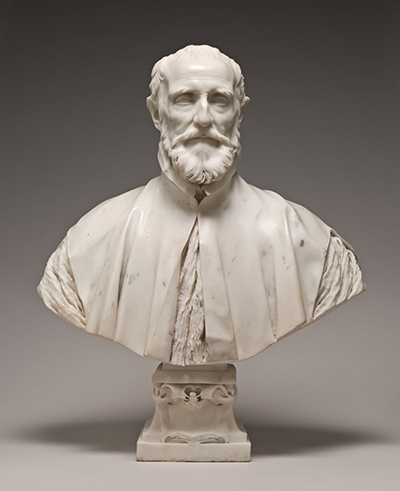
Gian Lorenzo Bernini’s marble portrait of Monsignor Francesco Barberini shows an elderly churchman in a cape that opens in a narrow V below his beard. The long, relatively smooth planes of cloth frame a face whose creases and shadows are strongly marked. Dated to about 1623 by the National Gallery of Art in Washington, the bust depicts the uncle of Maffeo Barberini, who became Pope Urban VIII that year. Francesco had died in 1600. Bernini therefore had to take an existing portrait and work out how the sitter’s face, bearing and clerical dress would read in three dimensions. [1][2]
At a Glance
- Datec. 1623
- Location or statusNational Gallery of Art, Washington
- WorkPosthumous marble portrait
The work in Bernini’s career
Apollo and Daphne
1622–25Bust of Francesco Barberini
c. 1623David
1623–24St Peter’s Baldachin
1624–33The uncle of Urban VIII
Born in 1528, Francesco Barberini belonged to a generation of the family that had already built a position in Rome before Maffeo became pope. The Kress catalogue records that Francesco helped guide the younger Maffeo and left him his estate. In this context, a portrait of the monsignor could commemorate a family benefactor as well as show what he looked like. A visitor familiar with Maffeo’s career might have understood the bust as a record of support that he received earlier in life. The plain, wide cape and the absence of a hat leave the sitter’s face prominent, while the clothing and the marble format suit the public dignity of the portrait. [1][2]
Another Francesco Barberini, born in 1597, was Maffeo’s nephew and became a cardinal in 1623. The younger Francesco owned the bust of his older namesake. That distinction explains why a seventeenth-century record can name Francesco as both the portrait’s subject and its owner. Between the period when the elder Francesco helped Maffeo and the period when the younger Francesco kept the marble, the family’s position in Rome had changed considerably. The bust remained in Barberini hands long after its first appearance in an inventory. [1][2]
From a painted likeness to marble
The National Gallery of Art describes Bernini as working from a painting. The Kress catalogue discusses a painted portrait of the monsignor that could have provided the model. An existing image could establish the proportions of the sitter’s face, the shape of his hairline and beard, and the broad arrangement of his clothes. It still left the sculptor to decide how far the brow should project, where to place the cheeks in relation to the nose and how to give the beard a distinct outer edge. Those choices determine what a viewer sees as they move to one side, where a painted likeness can offer less direct guidance. [1][2]
The face is strongly articulated even in an evenly lit photograph. The forehead slopes into a raised brow, leaving the eyes in shadow. The bridge of the nose and the upper cheeks carry the light back down into the middle of the face. Under the nose, the two halves of the moustache sweep outward across the beard. Bernini has given the skin sufficient continuity for the expression to hold together across those separate ridges and hollows. The brow and the comparatively small opening between the lips can look more severe in some lighting than in others, a variation built into the relief of the marble. [1]
The face is also worth considering alongside the early portrait of Pedro de Foix Montoya. Irving Lavin placed the Barberini bust near Bernini’s portrait of Montoya on stylistic grounds. Both show elderly clerics, and the comparison directs attention to the carving of flesh and hair, especially around the eyes and mouth. Montoya’s bust belongs to a funerary monument. The Barberini marble had a place in a family collection, and its base and rounded lower edge allow it to stand as an independent portrait. The uses of the two busts help explain why related treatment of the head can be combined with different arrangements below the neck. [1][3]
Beard, cape and base
The beard contains some of the deepest cuts on the front of the bust. The National Gallery draws attention to Bernini’s drill work there. Narrow channels break up what would otherwise be a continuous surface below the cheeks. Longer ridges carry the eye down to the point of the beard, and the more broken marks around the mouth distinguish the moustache from the hair behind it. Depth creates dark intervals that a shallow scratch would lose under the same light. The sculptor uses the contrast between those intervals and the brighter edges of the locks to make the beard legible at a distance. [1]
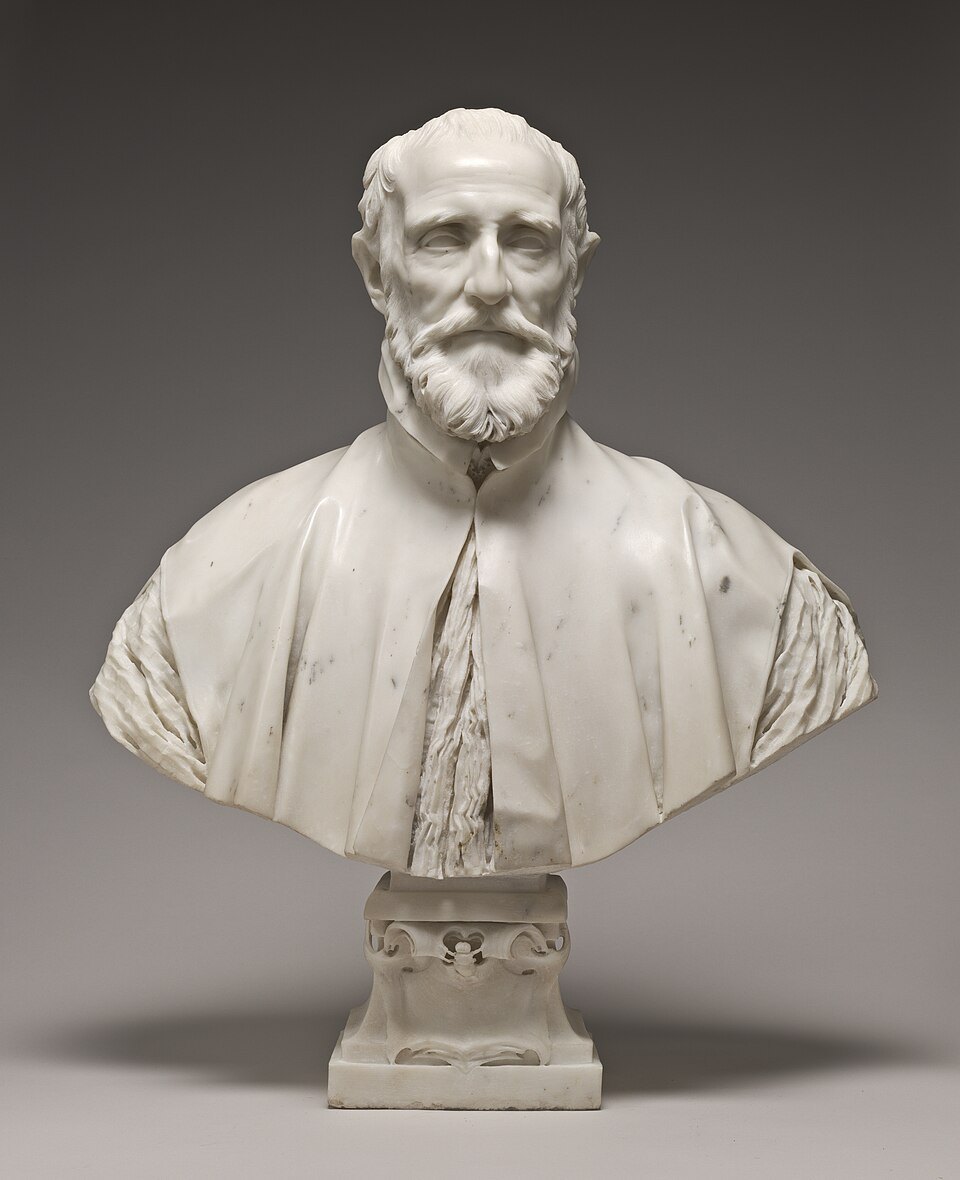
Bernini gives the cape a different scale of detail. Broad folds descend from the shoulders, with longer stretches of smooth marble between them. Underneath, the material visible at the sleeves and through the opening has a dense texture. That difference helps a viewer following the outline of the shoulders distinguish the outer cape from the garment beneath it. From the front, the curve at the bottom sweeps inward towards the support. The fullest part of the torso sits well above the narrow pedestal, giving the chest room to spread without a rectangular block beneath it. With its base, the bust stands just over eighty centimetres high. [1]
The crease of the cape immediately below the beard continues into the opening down the front. From a few steps away, the folds lead the eye back towards the face. Up close, the carved lines in the beard and garment pull attention in several directions, while the central seam still provides a clear point of orientation. Looking from the side makes the overall depth of the bust easier to judge, especially where the projecting face and chest meet the edges of the cape. Its width in the frontal view is one of the reasons the head, raised well above the shoulders, feels so exposed. [1]
An office passed from uncle to nephew
The potential painted source for the bust belongs to a pair of portraits in the Corsini collection in Florence. Clovis Whitfield connects the paintings of Francesco and his nephew Maffeo to the transfer of the office of apostolic protonotary in October 1593. The two wear the robes associated with that office. Whitfield also notes that a Barberini inventory of 1844 attributed both paintings to Scipione Pulzone and proposes retaining the attribution. The date and authorship of the pair are scholarly proposals. The inscription on the letter held by the older man is the detail the Kress catalogue uses to identify him as Francesco. [4][5]
The painted portrait supplies information that Bernini could carry over into marble, including the outline of the beard, the angle of the face and the fall of the cape. The seated figure also has room to hold the inscribed letter, which anchors his identity in a way the shortened marble format could dispense with. The letter is absent from the bust. Instead, Bernini put a Barberini bee at the base, where it identifies the family while leaving the figure’s hands outside the composition. The surviving sculpture thus preserves the association of face and office through dress and likeness, and makes the family connection visible on the support. The similarity makes the Corsini painting a strong candidate for the model. A record of Bernini receiving or using that particular painting has yet to be established. [4][5]
Painted ecclesiastical likenesses could continue to pass between Roman collections long after they were made. In his German study of Cardinal Girolamo Bernerio’s patronage, Sebastian Schütze traces a possible example by Pulzone, a painted portrait of Cardinal Michele Bonelli, into the younger Cardinal Francesco Barberini’s collection in 1642. It came from the estate of Clemente Merlini together with a portrait of Pope Pius V. This is a separate picture, identified through a chain of ownership. Its passage into the younger Francesco’s collection illustrates the continuing interest in earlier clerical images. The evidence for each painting’s movement belongs to its own records. [6]
The Louvre’s French catalogue supplies a later case with a documented painted guide. It identifies a triple portrait by Philippe de Champaigne as the source Bernini used in Rome to carve Cardinal Richelieu. Multiple views could make the turn of the head and the profile of the nose more determinate for a sculptor. In the Corsini painting the comparison is with a single view. The depth of the brow, the arrangement of the far shoulder and the finish of the back of Francesco’s bust are features the sculptor had to resolve in the round. [5][7]
The bee, the cartouche and the insert in the beard
The Kress catalogue records that the base and bust were carved from the same piece of marble. The empty cartouche on its front sits below a small bee set between the scrolls. Irving Lavin compared it with related bases on early Barberini busts and with the narrower cartouche on the Montalto portrait in Hamburg. He reconsidered his earlier dating of the Washington marble in light of those comparisons. Lavin’s measurements also show that without the base the bust is wider than it is tall, an unusually broad proportion within his group of early works. From the front the span of cloth draws attention back towards the face. From the sides the base helps the widely cut shoulders read as part of one freestanding object. [5][8]
The shape of the support is also one reason Ulrich Middeldorf proposed a date around 1625. He compared its cartouche with the one on the base of Apollo and Daphne. The Zeri catalogue allows a broader interval, about 1622–27. The 1627 inventory supplies the secure point by which the bust was present in the family’s collection. The proposed earlier dates place different weight on comparisons of carving, overall proportion and ornament. [5][8][9]
At the tip of the beard, the Kress catalogue identifies a triangular insert of marble containing a few strands of carved hair. Middeldorf suggested that it might repair a fault in the stone or correct a carving error. Across the insert, the carefully cut ridges continue the direction of the surrounding hair, making the join difficult to detect from normal viewing distance. The detail records a local adjustment in workmanship. Its cause remains open. [5]
From the Barberini collection to Washington
The National Gallery traces the sculpture to a Barberini inventory of 1627. It records a move to the Palazzo della Cancelleria in 1635 and a later return to the Palazzo Barberini alle Quattro Fontane. The early inventory also supports the attribution to Bernini, which appears in the subsequent biographical tradition. The records give the portrait a documented home soon after it was made. They also help distinguish it from other portraits of the family, especially those associated with the younger cardinal. [1][2]
The bust was still in the Barberini collection in the twentieth century. It passed through the hands of Alessandro Contini Bonacossi before the Samuel H. Kress Foundation bought it in July 1950. The foundation gave it to the National Gallery of Art in 1961, where it is catalogued as accession 1961.9.102. Its museum display allows a close look at surfaces that would register differently depending on the bust’s height and lighting in a palace interior. The carved openings around the beard, the broad fall of the cape and the curve of its lower edge show how Bernini built a freestanding presence from a likeness inherited from an earlier generation. [1][2]
Discussion
The long folds of the cape frame the elderly sitter’s face.
Reader Insights
Which part of the face shows the deepest contrasts?
What evidence could help explain how Bernini worked on a posthumous likeness?
How does the portrait distinguish a churchman from other members of the Barberini family?
Join the Conversation
Share a detail, comparison or question about Bust of Francesco Barberini by Gian Lorenzo Bernini below.
References
- National Gallery of Art. Monsignor Francesco Barberini. Object record, image, dimensions and provenance. View source
- Middeldorf, Ulrich. Sculptures from the Samuel H. Kress Collection: European Schools, XIV–XIX Century. Kress sculpture catalogue, entry on Monsignor Francesco Barberini. View source
- Lavin, Irving. Five Youthful Sculptures by Gianlorenzo Bernini and a Revised Chronology of His Early Works. The Art Bulletin, 1968. Comparison of Bernini’s early portraits. View source
- Clovis Whitfield. Study of the Barberini inventories and portraits. Reproduces the Corsini portraits of Francesco and Maffeo and discusses the 1593 office transfer and 1844 attribution.
- Ulrich Middeldorf. Sculptures from the Samuel H. Kress Collection, pp. 80–81. Corsini likeness, dimensions of the base, beard insert and dating argument.
- Sebastian Schütze. “Die Cappella di S. Giacinto in S. Sabina und Kardinal Girolamo Bernerio”. The Bonelli portrait and its proposed identification, pp. 257–58.
- Musée du Louvre. Le cardinal de Richelieu. French catalogue entry on Bernini’s documented use of a painted triple likeness.
- Irving Lavin. Bernini’s Bust of Cardinal Montalto. Visible Spirit, pp. 505–06, comparison and measurements of the busts.
- Fondazione Federico Zeri. Ritratto di Francesco Barberini. Italian catalogue record and date range.








