


 by Tom Gurney
Tom Gurney BSc (Hons) is an art history expert with over 20 years experience
Published on June 19, 2020 / Updated on November 18, 2026
Email: tomgurney1@gmail.com / Phone: +44 7429 011000
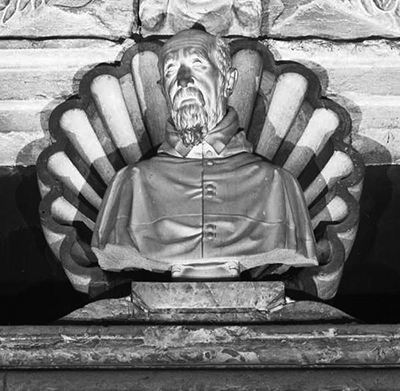
Bust of Cardinal Giovanni Dolfin
Cardinal Giovanni Dolfin looks up from a shell-shaped recess in his tomb at San Michele in Isola, Venice. The white marble head rises above a broad buttoned cape, its beard carved in pointed locks that stand out against the collar. The portrait belongs to an ensemble associated with both Pietro and Gian Lorenzo Bernini, and the allocation of the work between them has been disputed. Irving Lavin discussed the bust as an early work by Gian Lorenzo. Italy’s cultural-property catalogue lists Pietro as the sculptor. The agreement about the sitter and monument is firmer than the agreement about the hand that carved the portrait. [1][2][3]
At a Glance
- Location or statusSan Michele in Isola, Venice
- WorkMarble tomb bust. The division of work between Pietro and Gian Lorenzo is disputed.
The work in Bernini’s career
Apollo and Daphne
1622–25Ecstasy of Saint Teresa
1647–52St Peter’s Square
1656–67Bust of Cardinal Giovanni Dolfin
Date discussed in the articleA burial chosen by the cardinal
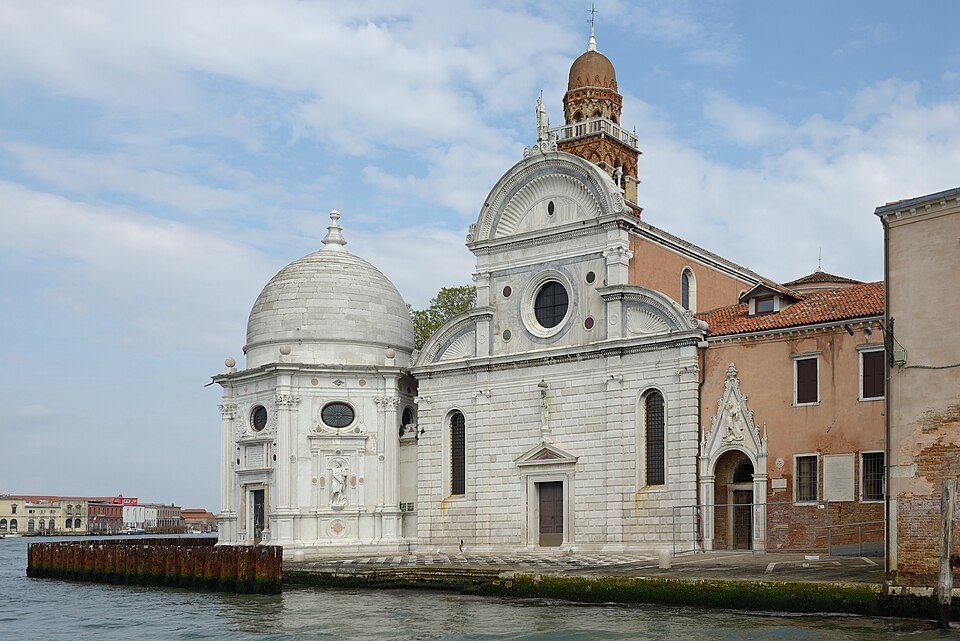
Dolfin died in Venice in November 1622. He had specified burial at San Michele in Isola, the church of the Camaldolese monastery between Venice and Murano. A will of 1612 published by Lavin required his heir to provide a wall tomb between columns. Dolfin referred specifically to the monuments of the Contarini family in the Venetian church of the Madonna dell’Orto. The instruction establishes that he had considered the arrangement of the tomb years before his death. It also shows why comparison with other Venetian funerary monuments can explain features of a project that involved sculptors working in Rome. [2][3]
Dolfin’s nephew saw to the erection of the monument. The likeness occupies one part of a larger commission that includes the Virtues of Faith and Prudence. The Fondazione Federico Zeri records the figure of Faith under Pietro Bernini and associates it with the Dolfin tomb. The portrait’s authorship needs to be considered separately from the other figures. The fact that both works form part of one monument provides evidence about the commission, but each sculpture can preserve a different aspect of the collaboration. [2][3][4]
The instructions in the wills and the shipping agreement
Elisabetta Francescutti’s study of the Dolfin tomb traces a sequence of decisions that began with the choice of a site. In 1611 the cardinal called for a wall tomb near his family chapel and left the detailed form to his executors. In 1612 he specified that it should stand between two columns and named the Contarini monuments in the Madonna dell’Orto as models. His testament of 3 February 1620 describes the tomb at San Michele as already under construction. It instructs his heir to finish it according to the design already begun if it was still incomplete at his death. The three documents take the commission from an approximate location to a design the patron had seen sufficiently developed to insist it be carried through. [6]
A separate agreement made in Rome on 30 July 1621 gives unusually concrete evidence of how the sculpture was to reach Venice. Dolfin contracted with Pietro Pennoni to send three marble figures from Ancona to Venice the following month. The two standing figures were Faith and Prudence. The third represented Dolfin from the waist up. The document ties the half-length portrait to the two allegories before they were installed and shows that the sculptures were handled as a group. It gives the planned point of embarkation and the expected month of transport. The account of the agreement does not establish the date of delivery or identify the hands that carved the stone. [6]
The completion of the memorial also involved a second generation. Francescutti identifies Nicolò Dolfin, the cardinal’s nephew and testamentary executor, as the person who saw the project through. By 1663 Giustiniano Martinioni described its four Corinthian columns, the two virtues, the family’s gilded arms and the portrait above the sarcophagus. His description shows that the main components were already read as a single composition by the middle of the century. It also distinguishes the arms, which announced the family, from the carved likeness through which the cardinal could be recognised. [6][7]
A portrait over the threshold
The memorial occupies the inner face of the church’s entrance wall. Paired Corinthian columns organise three parts, with the standing personifications in side niches and the portrait above the centre. The chapel monuments that Dolfin named in his will offered a precedent for a framed bust over a base. At San Michele the motif is expanded to span the entrance. The portrait sits high enough to address the nave, while the rest of the ensemble extends to either side of the door. A visitor turning back towards the entrance can see the wings of architecture and sculpture together. From near the doorway, the high placement brings the underside of the cape and the radiating shell into a more pronounced view. [6]
The sculptural roles can be separated even when the projecting figures, the stone frame and the shell are seen together. Faith and Prudence stand on either side. The state catalogue describes the arms as a shield with three dolphins below a cardinal’s hat. The family emblem and the ecclesiastical insignia give a heraldic identity to the man whose face is set above the central bay. Francescutti reads the architecture as the work of an unidentified Venetian designer familiar with the triumphal arch, while assigning the portrait to Gian Lorenzo and proposing a possible contribution by Giuliano Finelli. The latter suggestion remains an attribution. It illustrates the different questions raised by the monument, where the design of the wall, the carving of the two standing figures and the execution of the portrait may each have a different history. [6][7]
The face within the shell
The head projects in front of the radial pattern of the shell. Near the face, the ribs of the recess create alternating bands of light and dark. They fan out behind the shoulders and give the portrait a wider outline than the bust alone would have. The nose and the ridges of the brow take up small areas of light against the radiating surfaces. The sitter looks above the level of the cape, and his gaze can be read even when the deep shell is the first thing the viewer notices. The setting makes the act of looking out one of the strongest features of the composition. [1][2]
The hair and beard form angular ridges. The locks of the beard converge below the mouth and descend towards the collar. They have a visibly different scale from the broad folds below the neck. Lavin compared the pointed locks with those in the portrait of Giovanni Vigevano and distinguished them from the fine parallel cuts in the beard of François de Sourdis. The comparison is specific to the carving. It suggests one way of placing the bust within a sequence of related clerical portraits, even though the argument begins with the judgement that Gian Lorenzo was responsible for it. [2]
The sweep of the cape
The garment’s lower outer corners sit higher than the centre. The lower edge curves down between them and leaves narrow intervals of shadow above the support. A line of buttons anchors the middle of the chest. The surrounding folds move across it in shallow curves and gather where the edges of the cape are drawn together. The outer corners project into the space bounded by the shell, making the garment seem to continue around the shoulders. What is visible is only part of a torso, but the arch of the garment gives that part enough breadth to suggest more of the body. [1][2]
Lavin drew attention to that outline and to a possible Venetian precedent. The bust of Gaspare Contarini at the Madonna dell’Orto, which he discusses under its attribution to Alessandro Vittoria, has a comparable sweep at the lower edge. The comparison matters because the Contarini monuments were named in Dolfin’s will. It connects a formal feature of the carved torso with a preference recorded by the patron. The will describes the intended model for the tomb as a whole. The more specific suggestion that the Contarini bust informed the shape of Dolfin’s cape rests on visual comparison. [2]
The support below the marble forms a short horizontal interruption between the shell and the architectural ledge. Its flat upper edge helps make the arc of the cloak visible. The shell has its own lower curve, which can be followed beyond the shoulders on both sides. These contours run at different heights, giving the portrait a place within the frame without making the garment appear to be part of the surrounding masonry. From the lower angle in the historical photograph, the wide casing seems to hold back the fan of the shell while the front of the cape appears to extend towards the viewer. The two sorts of projection help distinguish the sitter from the carved ornament even at the scale of the tomb. [1][2]
The attribution to Pietro or Gian Lorenzo
The national catalogue assigns the portrait to Pietro and uses the broad date range 1600–1624. The biographical entry in Treccani also favours Pietro for the bust and assigns the surrounding Virtues to him. Lavin took a different view, treating the marble portrait as Gian Lorenzo’s contribution to a project in which both father and son were involved. He drew on the early account of the younger artist’s works as well as the handling of the beard, shoulders and lower outline. The resulting difference concerns the authorship of the carved likeness. The sources agree on its identification as Giovanni Dolfin and its relationship to the tomb. [1][2][3]
Andrea Bacchi’s study of Bernini’s portraiture places the bust around 1621 when comparing it with the later portrait of Pietro Valier. Such comparisons give the carving a more specific place in the history of portrait sculpture than the broad field in the national record. The date of Dolfin’s death, the chronology of the carving and the installation of the ensemble remain distinct. The evidence that Dolfin planned the tomb during his lifetime helps explain how work associated with the monument could have begun before his burial. [1][2][3][5]
The church setting keeps those questions tied to the object. The shell, portrait and surrounding figures participate in a single view, and the pale face remains the point of attention even when seen as one part of the monument. At a closer distance the eye can follow the edges of the hair and the folds that run beneath the buttons. Those details are the basis of some of the arguments for Gian Lorenzo, while the institutional records make Pietro’s attribution visible. The tomb preserves the visual evidence that both readings seek to explain. [1][2][4]
Discussion
The shell-shaped recess frames Dolfin’s face against the darker tomb setting.
Reader Insights
Where does the sculpture use deeply cut shadows to separate the beard from the collar?
How would you weigh an attribution to Pietro against one to Gian Lorenzo?
Which parts of the monument could have been made by different hands?
Join the Conversation
Share a detail, comparison or question about Bust of Cardinal Giovanni Dolfin below.
References
- Ministero della Cultura. Cardinale Giovanni Dolfin. State catalogue entry for the bust, 0500122880. View source
- Lavin, Irving. Five New Youthful Sculptures by Gianlorenzo Bernini and a Revised Chronology of His Early Works. Reprinted in Visible Spirit, 2007. Dolfin’s will, the comparison with Contarini and the attribution to Gian Lorenzo. View source
- Istituto della Enciclopedia Italiana. Dolfin, Giovanni. Dizionario Biografico degli Italiani. Burial, commission and the attribution to Pietro. View source
- Fondazione Federico Zeri. Allegoria della Fede. Record 79638 for the related figure at San Michele. View source
- Bacchi, Andrea. Creating a New Likeness: Bernini’s Transformation of the Portrait Bust. In Bernini and the Birth of Baroque Portrait Sculpture, 2008. View source
- Francescutti, Elisabetta, and Francesca Frucco. Le sepolture e le ‘memorie’ funebri a Venezia e nel dominio di terraferma, pp. 221–23. Francescutti’s Dolfin section transcribes the wills and the shipping agreement and discusses the architecture and attributions.
- Ministero della Cultura. Stemma gentilizio del cardinale Giovanni Dolfin. State catalogue of the heraldic relief.








