


 by Tom Gurney
Tom Gurney BSc (Hons) is an art history expert with over 20 years experience
Published on June 19, 2020 / Updated on November 18, 2026
Email: tomgurney1@gmail.com / Phone: +44 7429 011000
Carlo Barberini’s Portrait Head
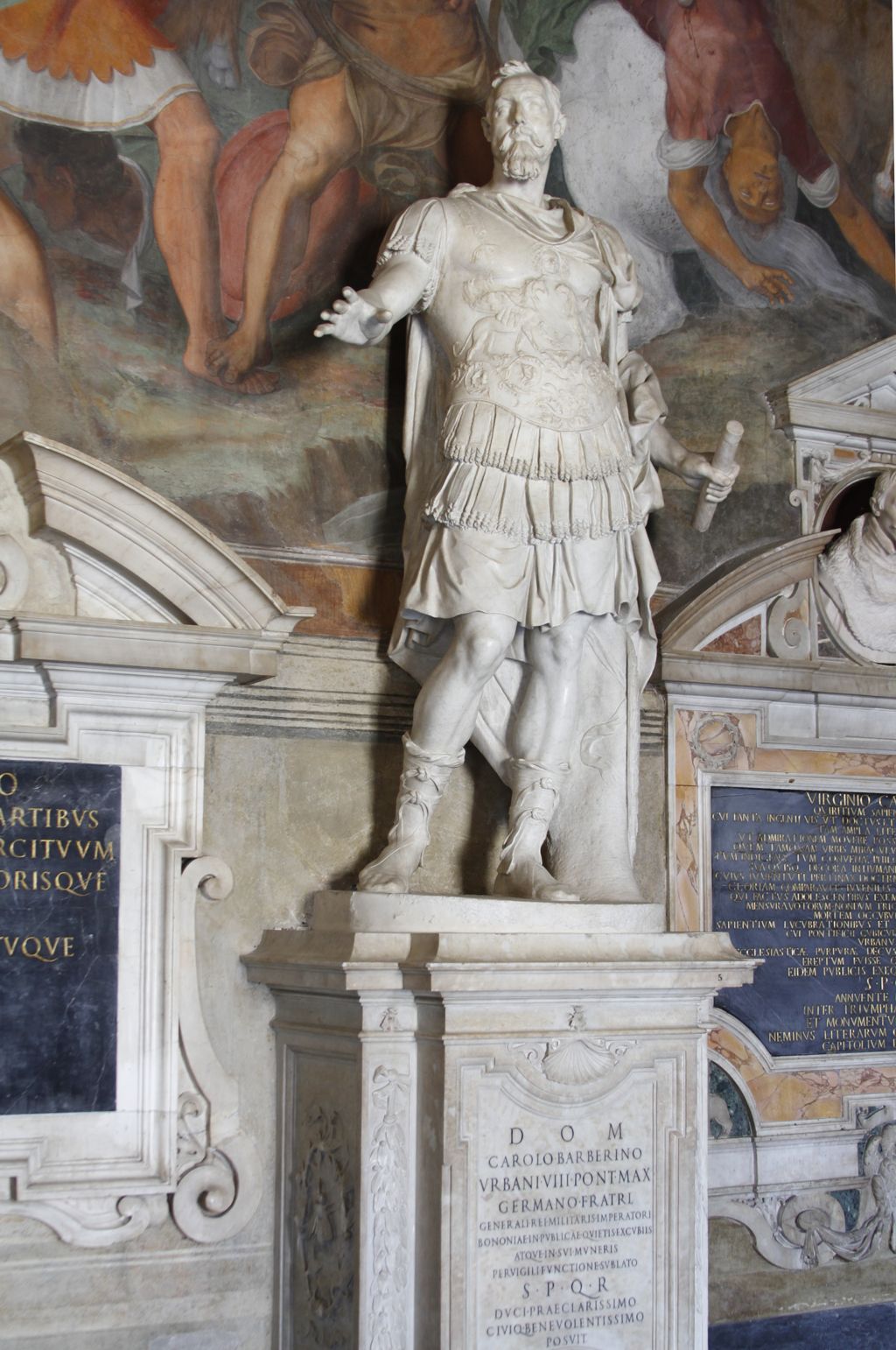
Carlo Barberini stands in Roman armour, but the face above it belongs to the seventeenth century. The turned head, swept hair, moustache and pointed beard give a personal identity to a body shaped by an older tradition of military command. Gian Lorenzo Bernini carved this portrait head for a commemorative statue completed in 1630. Alessandro Algardi restored the ancient torso for the same project. Understanding their different contributions makes the encounter between the individual man and the Roman hero much more interesting. [1] [2]
The complete marble statue belongs to the Capitoline Museums in Rome, where it is recorded as inventory MC1195, with a height of 230 centimetres. It is associated with the Hall of the Captains in the Palazzo dei Conservatori. Bernini’s head is therefore part of a standing public monument, rather than an independent portrait bust. Its meaning grows out of the figure below it and the company it keeps. [1]
At a Glance
The sculpture in Bernini’s career
Contents
A face above armour
Begin with the head, then allow your eye to travel downwards. In the museum’s photograph, Barberini turns towards the side of his outstretched arm. His face does not simply repeat the frontal presentation of the breastplate. This small divergence gives the figure a sense of attention extending beyond its immediate position. The body addresses the room through its broad outline; the head makes that address seem to come from a particular person. [1]
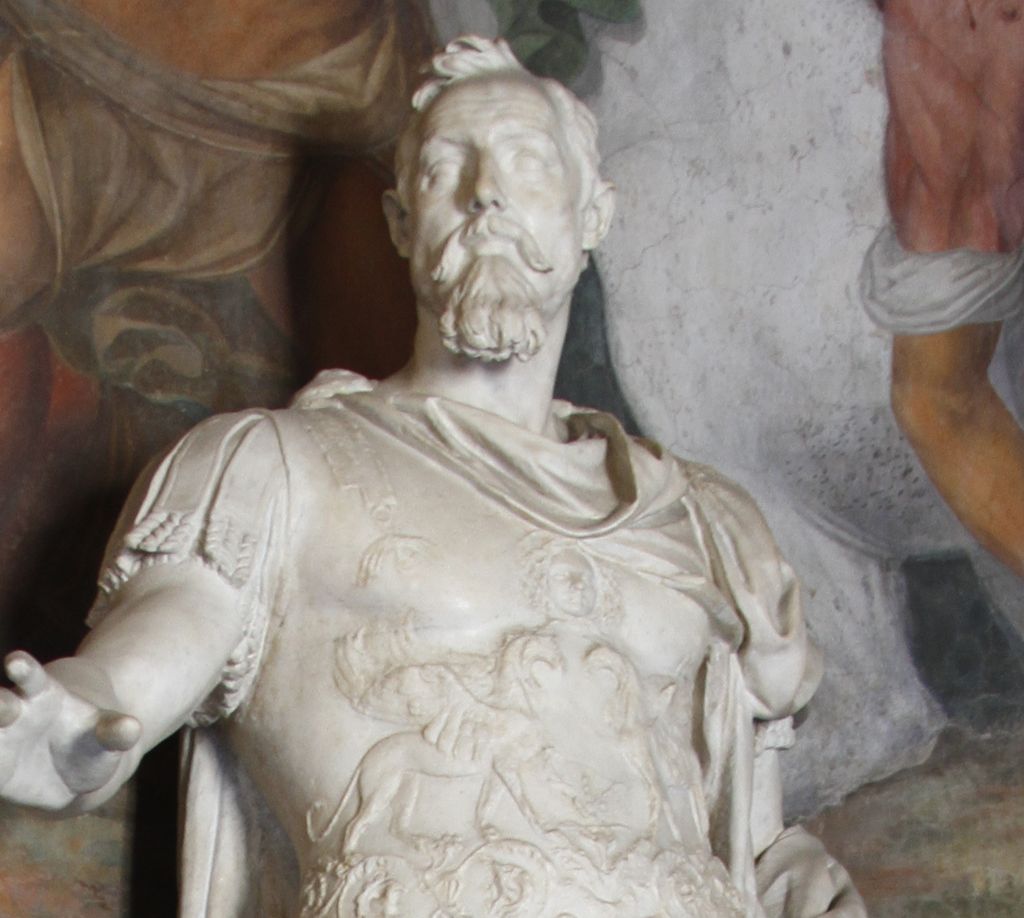
Hair and facial hair help establish that individuality. In his early study of the work, Stanislao Fraschetti drew attention to the waved hair, the lock above the forehead, the prominent nose, the curled moustache and the pointed beard. These are useful details to look for because they break up the large, relatively continuous surfaces of the face. The moustache interrupts the line of the mouth, while the beard carries the face down towards the neck without dissolving its outline into the chest. [3]
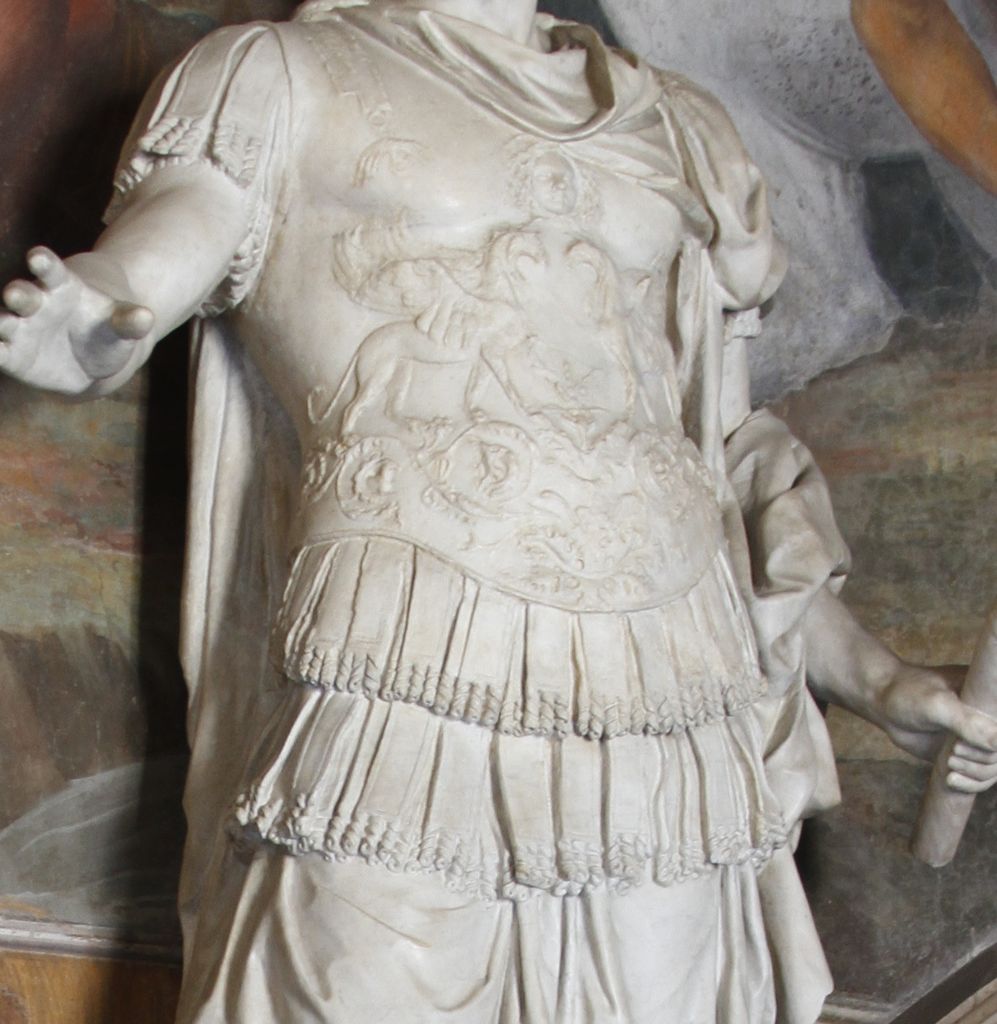
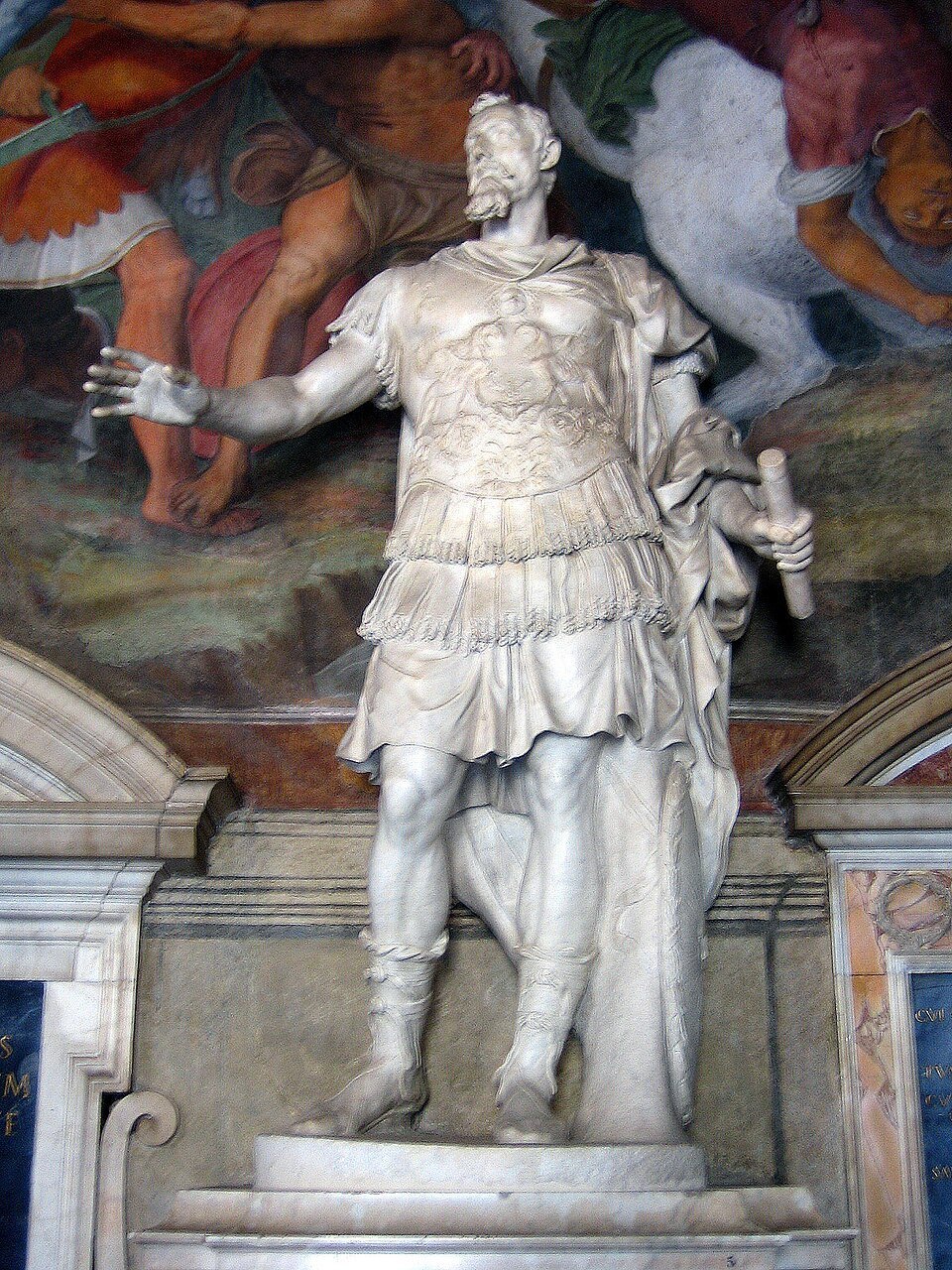
Below this concentrated portrait, the armour presents a different kind of richness. The breastplate is covered with ornament, and a layered fringe marks its lower edge. Drapery gathers across the shoulders and falls along one side. Bare knees, boots and the extended arm make the figure readable at a distance. Seen as a whole, the statue combines a strongly articulated silhouette with much smaller passages of carved decoration. The head has to hold its own within that busy setting. [1]
Fraschetti found the head disproportionately small in relation to the torso. He also disliked the contrast between the ancient body and the livelier modern face, even while admiring the portrait itself. His response identifies a tension that remains worth examining. A viewer can recognise the joined histories of the object without treating their difference as a failure. The slightly uneasy meeting of portrait and heroic body is part of what makes this particular memorial distinctive. [3]
Annotated Details from Carlo Barberini’s Memorial Statue
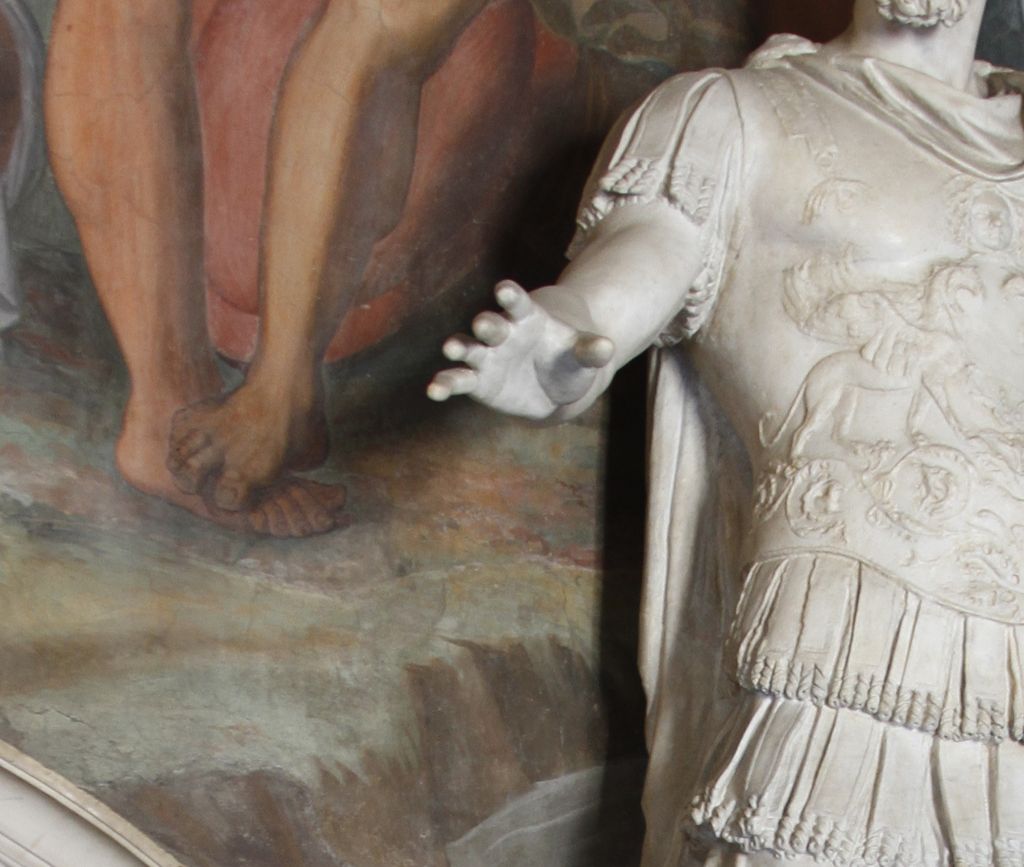
Look from the portrait head to the armoured torso and the extended restored limb, keeping the contributions of different makers distinct.
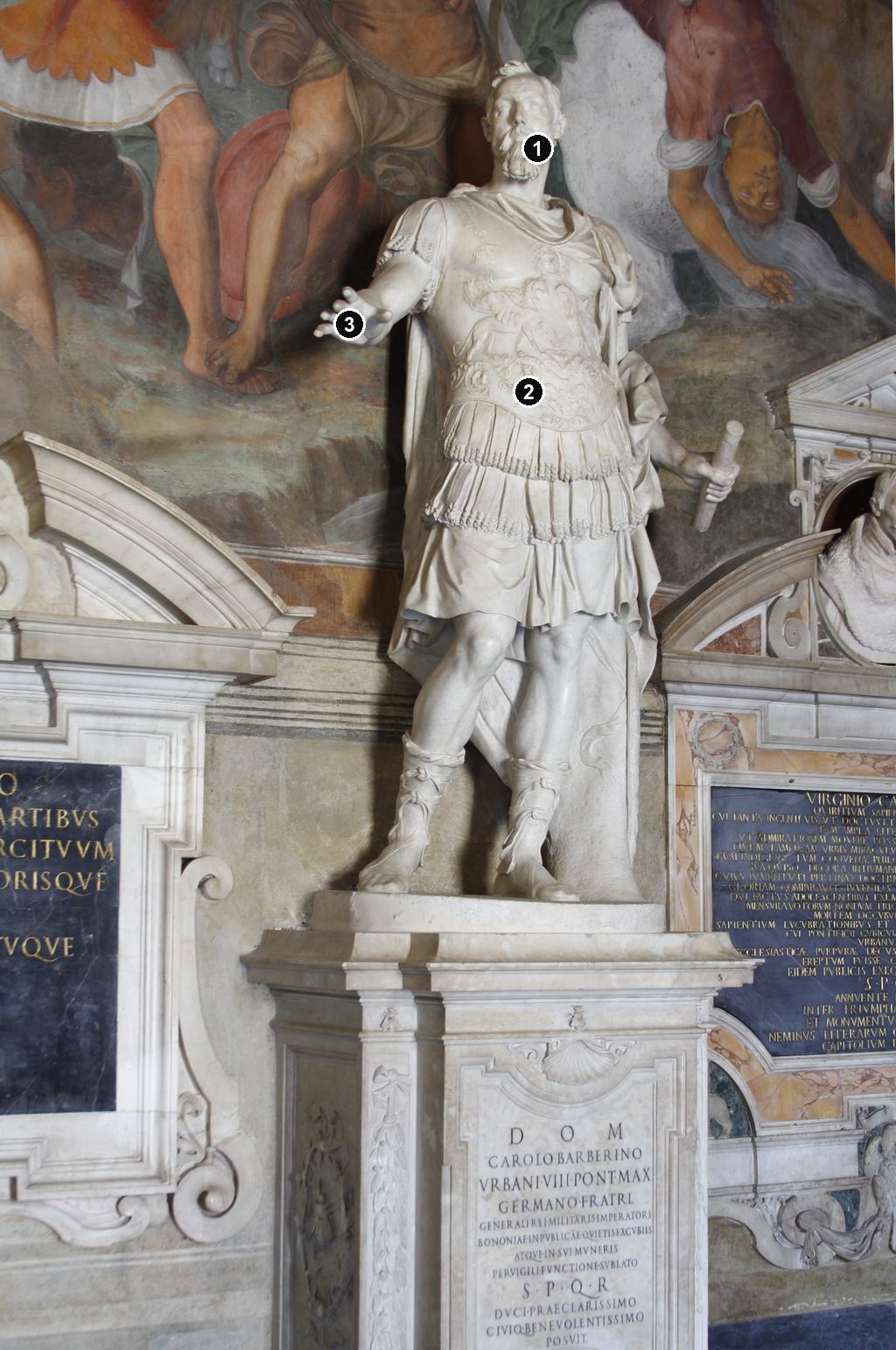
Details from CARLO BARBERINI’S MEMORIAL STATUE
Photograph by José Luiz, CC BY-SA 4.0. Overview annotated and details cropped and resized from the unchanged photograph.
The portrait above the armour
The turned head gives a particular man’s identity to the standing monument. Bernini’s portrait contribution should be distinguished from the body below. [2][3]
The decorated ancient torso
Ornament covers the breastplate, with a layered fringe below. The ancient torso supplies a different kind of presence from the seventeenth-century portrait head. [2]
An arm opening into the room
The extended arm opens the figure’s outline towards the visitor. Algardi’s contribution included restoration of the statue’s arms and legs. [4]
A commander remembered
Carlo was the brother of Pope Urban VIII and commander of the papal armies. He died in Bologna on 25 February 1630. As Irving Lavin explains, his commemoration involved three separate projects: the standing statue in the Palazzo dei Conservatori, a memorial plaque in Santa Maria in Aracoeli, and a temporary catafalque for the funeral ceremonies held in that church on 3 August. [2]
Lavin places these works within an existing civic tradition. Marcantonio Colonna, Alessandro Farnese and Gian Francesco Aldobrandini had already received comparable honours. The proposal for Carlo’s commemoration specifically invoked Aldobrandini’s example. The Roman military figure was consequently a familiar public language, allowing a recent commander to enter a lineage of honoured predecessors. [2]
The distinction between commemoration and burial matters here. The standing figure presents Barberini to a civic audience; the church plaque belongs to another setting and another sculptural form. Neither should be mistaken for a detached version of this head. Nor should the temporary funeral structure be treated as a surviving marble monument. The shared name connects these works, but each performed a different task. [2]
Between two workshops
The division of work is unusually tangible because published payment records describe both making and transport. Fraschetti transcribed an advance to Algardi dated 19 July 1630 for work on the statue intended for the Capitol. A further entry, dated 12 September, records the balance of a total of 160 scudi for restoring the torso. These documents support Algardi’s role as a substantial contributor to the monument, rather than someone who merely touched up a statue wholly carved by Bernini. [3]
Another entry pays a porter named Giovannino and fifteen companions for carrying the torso from Algardi’s premises to Bernini’s so that the head could be made. A later payment concerns sixteen porters taking the completed marble statue from Bernini’s premises to the Capitol on 27 September. Finally, an entry of 28 September records 150 scudi as the balance and full settlement for Bernini’s marble head. This last sum is a settlement payment; it should not automatically be read as the complete cost of his contribution. [3]
These are transcriptions published in 1900, rather than newly examined archival originals, but their practical detail is valuable. They distinguish the restored torso from the newly carved head and show the heavy object passing between workplaces. A finished monument can look like one act of creation. Here the account books allow us to imagine a more physical sequence: a torso prepared in one studio, moved by a team of men, completed in another, and finally installed in public. [3]
The pedestal had its own maker. Fraschetti also prints a payment to the stoneworker Battista Castelli for the marble base, with its work assessed by the named architects in the account. This further contribution matters because the pedestal establishes the statue’s elevation and carries its civic address. The monument’s authorship extends beyond the name attached to its most expressive feature. [3]
Algardi’s contribution
The sculptor Alessandro Algardi brought experience of restoring ancient sculpture to the project. Antonia Nava Cellini’s biography describes his early Roman work on classical statues in the Ludovisi collection, before identifying his additions of arms and legs to the ancient torso used for Carlo Barberini’s honorary figure. Bernini supplied the head. That distinction provides a clearer account than assigning the entire standing figure to either sculptor alone. [4]
Restoration here involved giving a fragment a new, usable identity. The ancient torso supplied the armoured centre; new extremities and a modern portrait completed a commemorative person. This was a creative reconstruction serving a seventeenth-century purpose. Looking at the finished figure, the viewer encounters an antique body made capable of honouring someone who had only recently died. [3] [4]
Fraschetti turned the transfer between studios into a story of professional injury, speculating that Algardi’s work had failed to please or that he was insufficiently valued. The payments establish the movement and the separate tasks, but they do not establish those motives. The collaboration is compelling enough without assuming that every practical decision concealed a personal confrontation. [3]
Fraschetti went further in his stylistic assessment, extending Bernini’s contribution to the fastening of the mantle high on the chest. That is a more particular judgement than the documented payment for the head. It is best understood as his reading of the carving, rather than as another instruction recovered from the accounts. For a visitor, it offers a reason to examine the transition between neck, shoulder and garment closely. [3]
Reading the whole figure
The complete statue rewards a slower movement between detail and distance. From afar, the extended arm opens the composition into the room, while the drapery falling on the opposite side gives weight to its vertical outline. Closer looking brings the ornaments of the breastplate into view. Higher up, the narrower head and its directional turn change the rhythm again. The face is a small part of the marble surface, yet it determines whose presence the whole figure announces. [1]
The portrait’s individuality does not erase the borrowed identity of the Roman commander. Instead, the two remain legible together. Barberini’s moustache and beard belong to the image of a modern man; armour and stance present him through a heroic type. The result invites a question that is easy to overlook when studying a head in isolation: how much of an official portrait belongs to its sitter, and how much belongs to the role that the monument asks him to occupy?
That question also explains why a photograph of the head alone can be both revealing and incomplete. It can bring the modelling of the face closer, but it removes the large armoured body against which Fraschetti judged its proportions. It also removes the outstretched gesture and the pedestal. To understand Bernini’s portrait here, the most useful comparison is between the concentrated expression of the head and the full memorial that gives it scale. [3]
What the catalogue can attribute
The Fondazione Federico Zeri records the complete object as a commemorative portrait of Carlo Barberini dressed as a Roman general. Its catalogue assigns the statue to three contributors, including an anonymous Roman sculptor of the first century, Alessandro Algardi and Gian Lorenzo Bernini. That dating applies to the reused ancient material. It cannot date the head with which Carlo entered the Capitoline display. Starting with the whole statue and then distinguishing its parts makes it easier to reconcile the catalogue with the workshop payments. The payments document seventeenth-century work on an object that was already partly made. [6]
The catalogue photographs also provide a check on how a close view can affect attribution. A photograph framed around the face makes the portrait look self-contained. At room distance, the turn of the head is seen in relation to the extended arm, and the ornament across the body can carry as much visual weight as the face. These are different ways of seeing the same display. Looking from the close view to the full figure does not require attributing the gesture of the arm to the person who made the head. It does help explain why a head carved separately can look as though it belongs to the action of the rest of the figure. [6]
A general among examples of Roman courage
The room already had a programme before the statue was made. The Capitoline Museums dates Tommaso Laureti’s frescoes to 1587–94. Its account identifies Horatius Cocles defending the Sublician bridge and Mucius Scaevola holding his hand in the fire among the stories painted there. The paintings give viewers episodes in which the defence of Rome turns on a particular act. Carlo’s statue uses a different format. It offers a single modern commander in ancient military dress, with no battle unfolding around him. The older paintings furnish a setting in which the armour can evoke Roman service without requiring the viewer to identify the wearer with a particular hero. [7]
There is another useful comparison within the room. The museum lists the statue of Marcantonio Colonna, dated 1595, among the works displayed with Carlo. A visitor comparing them can move from the faces to the arms and dress, asking which features convey a particular likeness and which help both figures read as commanders. The official inventory also records carved wooden doors from 1643 and ceiling paintings transferred into the palace after 1930. Seeing the room today is therefore a way to study how these works are presented together. It cannot establish that everything now around Carlo was there at the moment of installation. [7]
A different sort of portrait survives on paper
The Royal Collection catalogues a drawing for Carlo’s catafalque at Santa Maria in Aracoeli under Bernini’s studio. Here the object that survives is a design for a temporary structure. Its attribution needs to be kept separate from the evidence assigning the marble head to Bernini. The sheet lets us compare the forms of public attention the two projects called for. A funeral structure organised a ceremony in the church, while the portrait on the Capitol could be encountered as part of a continuing civic display. Their difference also affects what can be said about collaboration. A surviving project drawing helps document the planning of the funeral. It gives no reason to reassign the parts of the statue for which the records already distinguish the sculptors. [6][8]
In the Hall of the Captains
The museum places the statue in a room whose late sixteenth-century frescoes by Tommaso Laureti depict exemplary episodes of Roman courage. Portrait statues and inscriptions also commemorate distinguished men and commanders of the papal militia. The setting brings painted ancient examples and more recent public lives into the same field of view. [1]
Against the room’s coloured narrative painting, the pale standing figure has a particularly distinct presence. Its projecting arm belongs to the visitor’s space, while the fresco figures remain on the wall behind it. The head’s sideways attention becomes one element in a larger encounter between sculpture, painting and the people moving through the room. Seen there, Bernini’s contribution can be admired as a portrait without losing the ancient material, Algardi’s additions and the civic purpose that made the portrait necessary.
Bernini works directory
Frequently Asked Questions
It belongs to the Capitoline Museums in Rome and is listed with the Hall of the Captains in the Palazzo dei Conservatori, inventory MC1195. [1]
The standing statue is a different work. Bernini also designed a memorial plaque and a temporary funeral catafalque associated with Carlo Barberini’s commemoration at Aracoeli. [2]
Discussion
Look at the relation between the turned portrait head and the armoured body, keeping the different contributions in view.
Does the contrast between the individual face and the ancient armoured body make the portrait more convincing, or more formal?
Reader Insights
How does the turned head affect the whole figure?
Where do the armour and drapery create different rhythms?
How does collaborative making change your reading of the statue?
Join the Conversation
Share a detail, comparison or question about Carlo Barberini’s Portrait Head below.
References
- Musei Capitolini, Statue of Carlo Barberini, MC1195. English collection record, object photograph and associated Hall of the Captains description. Date, material, height, inventory and room context. Consulted 28 October 2026. View source.Splash image: Carlo Barberini’s memorial: Bernini’s portrait head on an ancient torso restored by Algardi. The full statue is shown. Photograph: José Luiz, via Wikimedia Commons; resized · CC BY-SA 4.0
- Irving Lavin, “Bernini’s Memorial Plaque for Carlo Barberini”, in Visible Spirit: The Art of Gianlorenzo Bernini, vol. I (London: Pindar Press, 2007), pp. 469–479, especially pp. 469–470 and notes 1–5. English; revised reprint of the 1983 article in Journal of the Society of Architectural Historians 42, no. 1, pp. 6–10. Full revised chapter consulted 28 October 2026. View source.
- Stanislao Fraschetti, Il Bernini: la sua vita, la sua opera, il suo tempo (Milan: Ulrico Hoepli, 1900), pp. 96–98, especially p. 96, notes 1–5, and p. 97 with its photograph and pedestal-payment continuation. Italian; digitised volume provided by the Warburg Institute. Relevant text, published account transcriptions and illustration consulted 28 October 2026. View source.
- Antonia Nava Cellini, “Algardi, Alessandro”, Dizionario Biografico degli Italiani, vol. 2 (1960). Italian; paragraphs on early restoration work for Ludovisi and the 1630 Carlo Barberini statue. Consulted 28 October 2026. View source.
- Musei Capitolini, Statue of Pope Urban VIII, 1635–40, MC1201, Bernini and assistants. Accessed 28 October 2026. View source.
- Fondazione Federico Zeri. Ritratto commemorativo di Carlo Barberini in veste di generale romano. Object record and photographic documentation.
- Musei Capitolini. Sala dei Capitani. Frescoes, room fittings and display of the statues of Carlo Barberini and Marcantonio Colonna.
- Royal Collection Trust. A design for the Catafalque of Carlo Barberini, Santa Maria in Aracoeli, Rome, RCIN 905612. Drawing attributed to Bernini’s studio.









