


 by Tom Gurney
Tom Gurney BSc (Hons) is an art history expert with over 20 years experience
Published on June 19, 2020 / Updated on November 18, 2026
Email: tomgurney1@gmail.com / Phone: +44 7429 011000
Saint Longinus
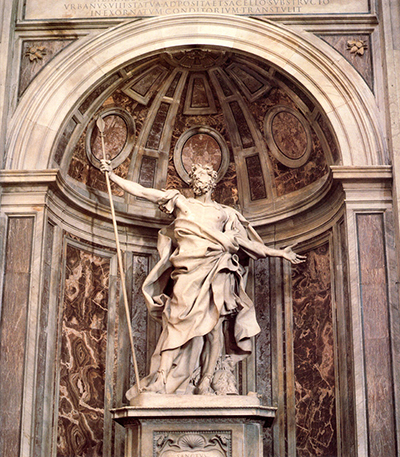
Under the dome of St Peter’s Basilica, Bernini’s Saint Longinus opens his arms and looks upwards. The lance at his side identifies him as the soldier traditionally associated with the piercing of Christ’s side. The distance between his hands makes his reaction visible from across the crossing. Closer in, the raised face and the folds gathered around his body make it possible to see the pose as a response to something he has just recognised. Bernini made the marble under Urban VIII as part of a programme that linked four statues with relics housed in the piers. Its relationship to the building is part of the subject. [1][2]
At a Glance
- Date1635–38, marble
- Location or statusCrossing of St Peter’s Basilica
- WorkColossal marble statue with a lance
The work in Bernini’s career
David
1623–24St Peter’s Baldachin
1624–33Saint Longinus
1635–38, marbleThe soldier and the lance
John’s Gospel describes a soldier piercing Jesus’s side after his death. The soldier is unnamed in that passage. In Mark, a centurion sees how Jesus dies and declares him to be the Son of God. The tradition of Longinus brought the lance and the soldier’s recognition together in a single figure. Bernini can therefore identify the soldier by the weapon while making the change in his understanding visible through a gesture. The lance is held to the side. The central action belongs to the open arms and the turn of the face. [1][3]
Irving Lavin reads the pose as though Longinus were standing at the foot of the Cross. The outstretched arms recall the form of the Crucifixion from the position of someone looking up at it. The figure lifts the eye without putting the object of his attention in his own niche. That gives the spectator a part in interpreting the pose. The weapon and the setting supply the subject, while the space above the figure gives its attention somewhere to go. [1]
The four piers
Longinus stands in a lower niche of one of the massive piers supporting the dome. The other statues are François Duquesnoy’s Saint Andrew, Francesco Mochi’s Saint Veronica and Andrea Bolgi’s Saint Helen. Each figure gave a human presence to a relic associated with the crossing. The lance belonged to Longinus, the head to Andrew, the Holy Face to Veronica and the fragment of the True Cross to Helen. The figures and the upper displays gave the pier walls a devotional role close to the altar and the tomb of Peter. The programme was shared among sculptors, with Bernini responsible for his figure and involved in the wider design. [1]
The association extended below the floor. The Fabbrica di San Pietro records four small oratories at the bases of the dome piers, linked with the basilica by spiral stairs. Bernini designed the chapels and their approaches to the grottoes, and a team of painters decorated the interiors. Standing in the crossing, a visitor sees the lower figures and the upper niches together. The oratories add a level that cannot be seen in that view. The programme coordinated several kinds of space, from rooms for approaching the relics and their histories to the open crossing where the marble figures could be seen at a distance. [1][2]
The positions were still changing as the sculptures neared completion. Lavin traces two decrees in 1638 that changed the arrangement of relics and their associated figures. The decisions involved the order in which the relics of the Passion were to be displayed. In the original scheme Andrew and Longinus would have faced one another diagonally across the Baldachin. In the final arrangement, Lavin notes that the glance and movement of Longinus lead outwards from the centre. The records give a reason for the difference between the relations imagined at the start of the project and those people can observe in the basilica today. [1]
Above the statues, the pier faces had their own architectural treatment. Lavin traces the use of ancient spiral columns from the presbytery of Old St Peter’s in the upper niches. Their shafts frame reliefs in which angels and putti display images of the relics. A person looking up from the lance thus sees two ways in which the object is made present. The statue gives it to a monumental figure in the action of the story, and the upper relief shows it in the context of display and veneration. The columns give that upper scene a material link to the basilica that preceded the present building. The distinction between the two levels becomes clearer when seen beside the corresponding arrangement on another pier. The repetition marks out the crossing as a coordinated space under the dome, while the separate emblems let each pier retain its subject. [1]
From model to marble
Lavin records that Urban VIII saw a completed model for Longinus in February 1632. Work on the marble began in June 1635, and the statue was installed by June 1638. The dates give different answers to the question of when Bernini made the work. The model was a stage at which the figure could be judged before it had to be resolved in marble. The start of carving and the installation mark later decisions within a coordinated project whose other figures were also proceeding from models to stone. [1]
An early view of the planned pier helps explain why one pose should not be assumed from the date of the commission alone. Lavin identifies a scene painted in the vault of the grotto chapel first intended for Longinus that preserves an earlier conception. Its painted architecture and the figure belong to a stage before the programme took its final form. Evidence like this makes it possible to compare an intended arrangement with the sculpture in place. It also explains why a record of a design can remain informative even after the location or gesture it shows has changed. [1]
The models Sandrart saw
Joachim von Sandrart claimed that Bernini showed him as many as twenty-two models for Longinus. In the account he published in 1675, he describes them as wax and says they were three spans high. He sets that number beside the one or two models he thought other sculptors would ordinarily make. The comparison is part of his praise of Bernini, and it gives some idea of what a visit to the studio could reveal about the amount of work behind a single figure. The German critical edition’s note treats the models that Sandrart saw as lost. The Met catalogue leaves open whether the two principal surviving terracottas were among the studies shown. The discrepancy in material matters. Sandrart’s account attests to many trials, without letting us match each object now known to one he handled or saw. [4][5][6]
The early model at the Fogg Museum is a little over half a metre high. It is terracotta with gilding over gesso. Its conservators distinguished two gilding methods. The exposed skin was oil gilded to a matte finish. The armour, clothes and base were water gilded and could be burnished to a higher gloss. Small punched marks decorate the cuirass. The Met compares this contrast with the finished marble, where narrow, shallow tool marks on the flesh differ from the deeper grooves on the armour and mantle. It remains possible that the gilding was applied for decorative effect, so the parallel does not settle the original purpose of the surface. [6][7]
X-rays also give a view into how the Harvard figure was assembled. The study suggests that the torso was built from small masses of clay. The head and arms were made separately and attached, and small strips and sheets were applied to make the drapery. The choices of assembly help explain how the figure could extend an arm beyond the torso while carrying a heavy-looking mantle. The clay study gives the folds a sequence of attachment that the uninterrupted-looking surfaces of the marble no longer show. [6]
A terracotta recovered near the Colosseum
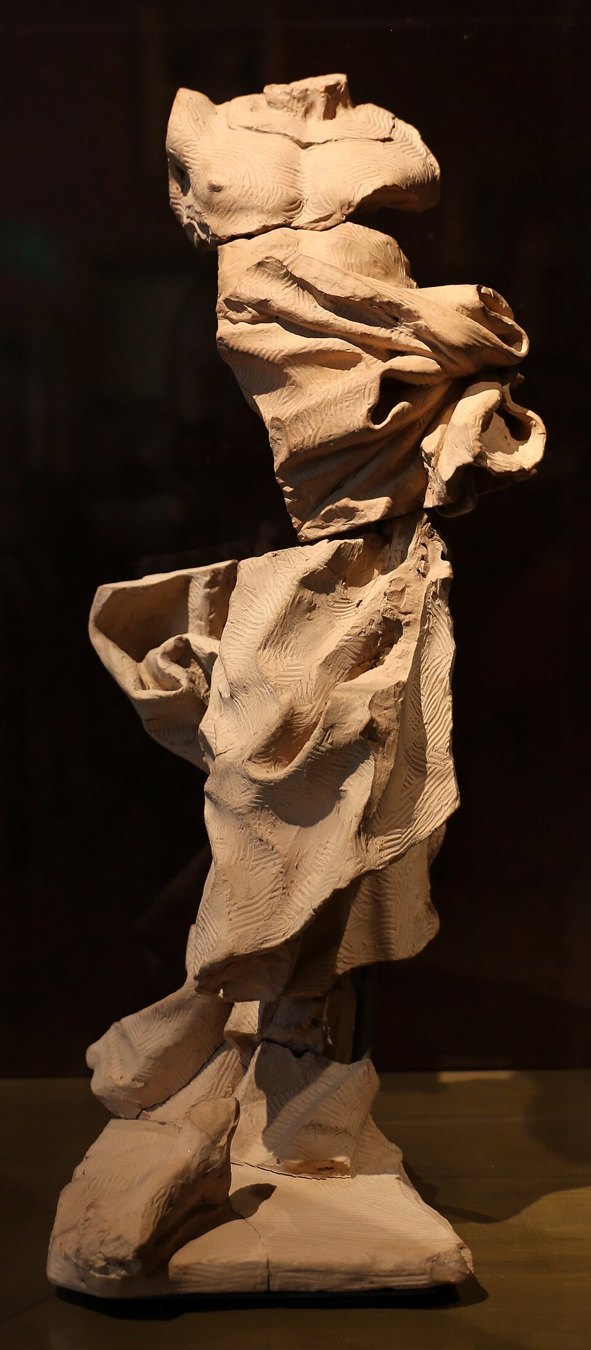
The Museo di Roma’s terracotta came to the museum in 1982 after excavations on the site of the house and studio of the sculptor and restorer Francesco Antonio Fontana on Via del Colosseo. Six fragments could be reassembled into two principal sections. Much of the head, torso and limbs is lost, but the drapery survives well enough to compare with the finished marble. The knot at the left hip and the arrangement of the surrounding folds bring this model much closer to the completed statue than the Harvard study. The Met’s catalogue places it late in the sequence of surviving designs. The knot provides a comparison that can be made even where the figure’s gesture can no longer be traced through both arms. [6][8]
The break surfaces also preserve marks of manufacture. The Met’s technical illustrations document a series of grooves left by cutting clay with a wire, and trace the divisions on a photograph of the reconstructed figure. Breakage makes some parts of the form unreadable and exposes surfaces that would have been hidden while the model was whole. The place of discovery adds a distinct question. Elena Bianca Di Gioia, whose work the Met discusses, proposed that Fontana kept lightly finished terracottas for use as studio models. That explanation concerns the later value of the object to a sculptor who preserved it. The closer relation of its folds to the marble is evidence about Bernini’s design. [6][8]
Changing light and a drawing in red chalk
Frank Fehrenbach’s German study connects the move to the northeast niche with the southern and southwesterly light admitted by the drum of the dome. From the front, the chest, arms and head receive that light while the recess around the eyes gives the brightest areas a dark surround. He also places the cross at the summit of the Baldachin in the direction towards which the figure looks. This is a reading of the figure in its built setting. It depends on the route of daylight and what lies between the niche and the source, and it helps explain why the same gesture has a different force here than it would have in a row of independently lit statues. [9]
Edme Bouchardon studied the installed sculpture in red chalk. The Louvre dates the sheet to about 1723–32 and lists a counterproof held by the National Library of Sweden in Stockholm. The chalk sheet is just over forty-three centimetres high, roughly comparable in scale to the surviving clay studies. That comparison brings out the different purposes of the objects. The Louvre sheet records a choice of view of the finished marble. The clay objects preserve changes to the form that could be assessed by turning the model or viewing it from different heights. The drawing’s date also gives a point of reference for the reception of the installed statue, independent of the surviving fragments from Fontana’s house. [6][8][10]
What the drapery does at a distance
The drapery runs through the pose. Closely gathered folds give one part of the body a dense area of shadow. Longer ridges carry the eye through the central mass and towards the arms. Those changes help the figure hold together inside the niche. A spectator can read the opening of its arms across the space, then see more of the smaller transitions in the cloth when nearer. The stone behind and around the figure presents a steadier outline against which those variations remain legible. [1]
Take the lance as a starting point and look across to the other hand. The arms have enough room to spread, though the figure remains bounded by the pier and niche. Follow the head upwards and the architectural setting comes back into view. That sequence gives some sense of the scale Bernini had to work with. The sculpture’s expression begins with the face, extends through the spread of the hands and continues through the space in which a person looks for the reason the soldier has raised his eyes. [1][2]
Discussion
The saint’s open arms remain legible from across the crossing.
Reader Insights
How does the lance help identify the figure at a distance?
Where do the drapery and face give the broad pose a more specific emotion?
How do the statue and the relic balcony above it divide the work of interpretation?
Join the Conversation
Share a detail, comparison or question about Saint Longinus by Gian Lorenzo Bernini below.
References
- Lavin, Irving. Bernini and the Crossing of Saint Peter’s, especially pp. 123–24, 134–35 and 140, and figs. 49–56 and 65–66. View source
- Fabbrica di San Pietro. The Vatican Grottoes. View source
- United States Conference of Catholic Bishops. John 19, verses 31–37, and Mark 15, verse 39. View source: John 19 View source: Mark 15
- Sandrart, Joachim von. Teutsche Academie, 1675, part II, book 2, p. 200.
- Sandrart.net. Commentary on the Longinus models. Critical edition, note 2741.
- Dickerson, C. D. III, Anthony Sigel and Ian Wardropper. Bernini: Sculpting in Clay. Metropolitan Museum of Art, 2012, catalogue entries 3–4 and figs. 178–79.
- Harvard Art Museums. Saint Longinus, Fogg Museum terracotta. Museum record on Google Arts & Culture.
- Museo di Roma. San Longino. Terracotta, MR 35746.
- Fehrenbach, Frank. Colpi vitali. Berninis Beseelungen, pp. 114–16 and fig. 7.
- Musée du Louvre. Saint Longin le Centurion, Edme Bouchardon. Drawings catalogue.








