


 by Tom Gurney
Tom Gurney BSc (Hons) is an art history expert with over 20 years experience
Published on June 19, 2020 / Updated on November 18, 2026
Email: tomgurney1@gmail.com / Phone: +44 7429 011000
Sleeping Hermaphroditus
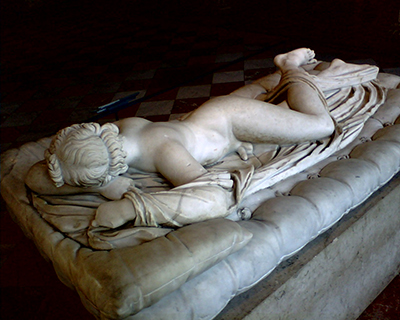
At first the Sleeping Hermaphroditus looks like a figure who has turned away in sleep. The head rests on a pillow and the body presses into a mattress. Moving to the other side changes what can be seen of the figure’s anatomy. It also makes the support easier to examine. The body is an ancient Roman sculpture. The pillow and mattress are marble too, made by Gian Lorenzo Bernini in 1620, nearly fifteen centuries after the figure was carved. The Louvre’s record distinguishes Bernini’s work from that of D. Larique, who repaired parts of the ancient body in the same year. The sculpture visitors know today is the result of both its ancient design and its seventeenth-century remounting. [1][2]
At a Glance
- Date1620, mattress and pillow
- Location or statusLouvre, Paris
- WorkAncient marble figure on Bernini’s marble support
The work in Bernini’s career
Sleeping Hermaphroditus
1620, mattress and pillowThe Rape of Proserpina
1621–22Apollo and Daphne
1622–25David
1623–24The ancient figure and its discovery
The Louvre dates the figure to the first half of the second century CE, during the Roman Imperial period. It lists the possibility that the design goes back to a Greek bronze of about 150–140 BCE and gives Polykles as a tentative name for its sculptor. Those possibilities concern the origin of the composition and are different from the date assigned to the surviving Roman stone. The surviving figure was found in Rome in 1618 at the Baths of Diocletian. In the years that followed, collectors and sculptors had a new opportunity to decide how it would be repaired and presented. [1]
The reclining body still retains a sense of movement. The back describes a broad curve, followed by the bend and slight overlap of the legs. The head is lowered and the hair gathered close. Portions of drapery interrupt the long stretches of exposed stone. These details give the figure a sequence of resting points, from the pillow to the lower body. As the viewer moves around the group, the width of the mattress makes those changing views part of the experience. It gives the body a consistent setting while the forms visible above it change. [1][2]
The story of Hermaphroditus and Salmacis
Hermaphroditus is the child of Mercury and Venus in the account told in the fourth book of Ovid’s Metamorphoses. The young traveller stops at a pool where the nymph Salmacis lives. After Hermaphroditus rejects her, she watches from concealment, enters the pool and seizes him. She asks the gods to keep them together, and they are joined in a single body. Ovid uses the image of a graft, where growth from two sources becomes one form. The poem tells the story as a bodily change brought about against Hermaphroditus’s will. [3]
The Roman sculpture depicts the resulting figure asleep. There is no second body for the eye to follow into the first. Instead, the change associated with the myth becomes apparent as the viewer discovers different aspects of the same figure from different positions. The Rijksmuseum drew attention to this relation between movement and discovery in its Metamorphoses exhibition. The narrative can be told in words as a sequence of events at a pool. The recumbent sculpture makes recognition happen across the time it takes someone to look at the marble from more than one side. [1][2][3]
What was added in 1620
The Louvre assigns the mattress and pillow to Bernini and dates the mounting of the figure on them to 1620. It separately credits D. Larique with marble replacement work at the tip of the nose, the left foot and part of the right foot. The catalogue also records reattached sections and missing fingers. It mentions four surviving modern sphinx busts that formerly served as feet of the bed. Each detail belongs to a different part of the object’s history. The distinction lets us consider the mattress as a designed addition with its own visual purpose while accounting for repairs to the ancient carving. [1]
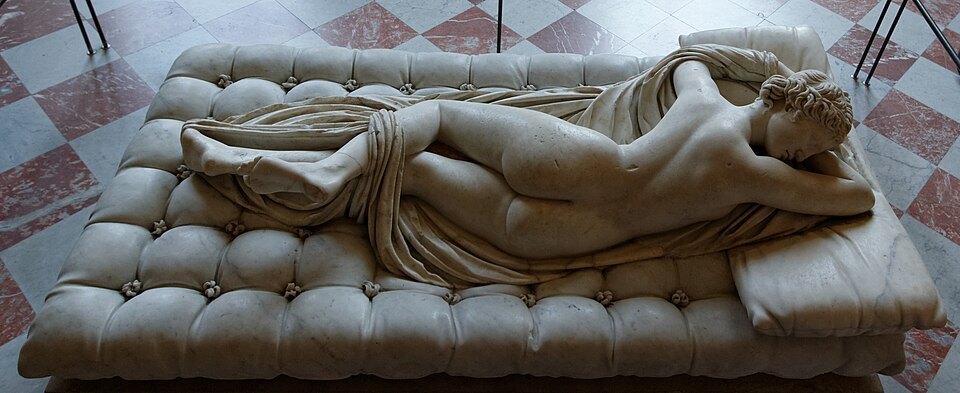
The mattress appears to yield under the sleeper. The pillow changes shape beneath the head, and the rise along the edges of the bedding supplies a softer outline beneath the body. The illusion depends on the way the carving describes pressure. Near the places where the body touches the bedding, the marble suggests a small depression. Along the freer margins the surface seems able to rise again. The support gives the figure weight by showing what that weight appears to do. Since the body and the bedding are both stone, the distinction has to be achieved through the movement of the surfaces. [1][2]
The mattress also adds a broad horizontal form that can be understood from either side. It gives a viewer time to look before the details of the body come into focus. From one position the edge of the bed and the sleeper’s back run along much the same line. Move towards the other side and the contours of the body come apart from the outline of the support. The mattress thereby contributes to the unfolding view, while its apparent softness makes it plausible that the sleeper might have settled into this position and stayed there. [1][2]
The surviving sphinx busts also change how we can imagine the early modern display. A bed with feet presents a piece of furniture, even when all the apparent softness above it comes from stone. A modern view cropped to the mattress can obscure this lower part of the design history. The Louvre’s condition notes preserve the distinction between detached elements of the bed and losses or repairs on the body. [1]
How the mattress changed in bronze
In 1639 Giovanni Francesco Susini dated a small bronze of the sleeper now in the Metropolitan Museum of Art. The Met’s catalogue compares the support directly with the Borghese marble. Susini used twenty-one tufts where Bernini’s mattress had fifty. Beneath the bedding he designed a high ornamental base that accounts for more than a third of the height of the whole bronze. The two decisions work together. The tufting remains legible on a much smaller object, and the raised base establishes a clear interval between the sleeper and the surface on which the bronze stood. At close range, the viewer reads the mattress as part of a piece of furniture with an architecture of its own. [5]
A full-sized bronze dated 1652 took the work into a different setting. Matteo Bonuccelli made it for the Spanish royal collection in connection with the works ordered by Diego Velázquez in Italy for Philip IV. The Prado’s education dossier names Bonuccelli, and the Real Academia de Bellas Artes de San Fernando’s exhibition catalogue gives the sculpture a length of 160 centimetres. Compare that scale with the small bronze by Susini. The Madrid figure carries the reclining pose across almost the length of a person, while the Met bronze concentrates the figure, tufting and base in an object that can be taken in at close quarters. The two bronzes show the range of formats in which artists transmitted the marble after Bernini had made the bedding part of its design. [5][6][7]
The second Borghese sleeper
The Galleria Borghese in Rome preserves a second ancient marble of the same type. Its mattress was made by Andrea Bergondi in 1774. The gallery traces this figure from storage at the villa to the family palace in Campo Marzio. It later took the place of the figure acquired for France. The resemblance between the two sleepers now extends below the body because both were mounted on marble bedding. The sculptors and installation dates distinguish them. The Borghese catalogue also leaves the second figure’s findspot open. Ennio Quirino Visconti suggested that it could have come from the same area as the Louvre figure. The hypothesis grew out of his understanding that Roman patrons displayed matching sculptures, and the gallery’s record gives no excavated context that would confirm the pair. [8]
The German writer Wilhelm Heinse complicates the history of looking at the two figures. The Borghese catalogue reports that he saw the second marble in 1783 and preferred its workmanship. German scholarship on his Italian notes also reproduces a description of a Borghese Hermaphroditus in which Heinse reflects on the ability of stone to suggest living flesh. The collection name alone can cause confusion in accounts of his travels. The gallery identifies the figure in the Campo Marzio palace through its own history, which can be followed independently of the modern shorthand title. [8][9]
Choosing a viewpoint on paper
François Perrier’s 1638 series of prints places the sleeper in a landscape. The Italian print collection catalogues plate 90 under the Borghese name. The Met reads the print as combining elements of two antique versions. It observes that the body lies on the ground as in the Ludovisi version, while the pillow recalls the Borghese marble. The plate preserves the pose while making a new setting for it. In the context of an album of Roman statues, a reader could encounter the curve of the back and the resting head without seeing Bernini’s elaborate mattress. [5][10][11]
Jacques-Louis David’s drawing at the Met begins with a different choice. He took a low view near the foot, shortening the figure in perspective and giving the muscles more definition than they have in the marble. The museum leaves open whether he saw the figure in Rome or in Paris. Either way, the angle puts one view of the ancient carving into circulation. Between Perrier’s landscape, David’s study and the bronzes, the features artists carried forward depended on whether they were making a landscape print, studying the body or remaking the support. [5][10][12]
From the Borghese collection to the Louvre
The Louvre records Camille Borghèse as the previous owner and dates its acquisition to 1807. A print of the group now held by the Rijksmuseum preserves a settled view of the recumbent figure on the mattress. The print is evidence of the reception of the combined work, since it reproduces the ancient body with Bernini’s bedding already underneath it. A printmaker has to settle the question of viewpoint on the page. The sculpture leaves that choice with the viewer, whose route determines when the figure’s characteristic details become apparent. [1][4]
More recently, the Rijksmuseum displayed the Louvre sculpture in its exhibition on Ovid’s transformations. The exhibition brought the ancient figure and seventeenth-century mounting into the same discussion about how artists give change a visible form. In the sculpture the represented body holds still. The mattress supplies the impression that something happened just before that stillness, as the surfaces appear to settle under the sleeper’s weight. Recognising which parts were made in each period lets both contributions be seen. The ancient figure offers a shifting view of the sleeper, and the support Bernini made gives that sleeper a place with its own texture, scale and weight. [1][2]
Discussion
Bernini carved the mattress and pillow on which the ancient figure rests.
Reader Insights
Which marks make the surface look as if it gives under the figure’s weight?
How does changing sides change your interpretation of the figure?
Where do the carving styles of the ancient figure and later support meet?
Join the Conversation
Share a detail, comparison or question about Sleeping Hermaphroditus and Bernini’s Marble Mattress below.
References
- Musée du Louvre. Hermaphrodite endormi, Ma 231 and Ma 231.1. Object, condition and acquisition record. View source
- Rijksmuseum. Sleeping Hermaphroditus. Exhibition interpretation for Metamorphoses. View source
- Ovid. Metamorphoses, book IV, lines 285–388. Translated by A. S. Kline. View source
- Rijksmuseum. Hermaphroditus, liggend naar rechts. Collection record for the print. View source
- Metropolitan Museum of Art. Hermaphrodite, Giovanni Francesco Susini. Catalogue discussion of the tufts, base and Perrier print.
- Museo Nacional del Prado. El Prado inesperado. Entry for Matteo Bonuccelli’s bronze.
- Real Academia de Bellas Artes de San Fernando. Velázquez en Italia, p. 74.
- Galleria Borghese. Ermafrodito addormentato. Collection record for the marble with Andrea Bergondi’s mattress.
- Deubner, Sarah. Die Poetik des Übergangs: Funktionen unbelebter Frauenfiguren bei Heinrich Heine, section 2.1, p. 21, quoting Heinse’s notes.
- Istituto Centrale per la Grafica. Ermafrodita Borghese, François Perrier. Print catalogue, plate 90.
- Paris Musées. Segmenta Nobilium Signorum et Statuarum. Collection record for Perrier’s album.
- Metropolitan Museum of Art. Hermaphrodite, Jacques-Louis David. Drawing and catalogue note.








