


 by Tom Gurney
Tom Gurney BSc (Hons) is an art history expert with over 20 years experience
Published on June 19, 2020 / Updated on November 18, 2026
Email: tomgurney1@gmail.com / Phone: +44 7429 011000
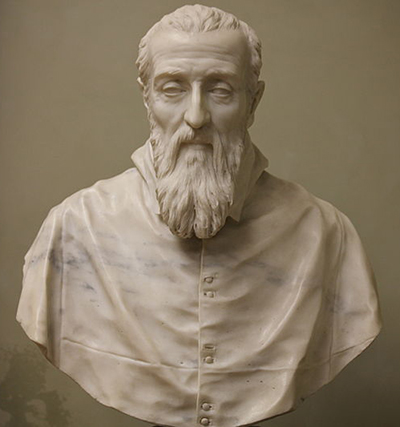
Bust of Cardinal Agostino Valier
Agostino Valier’s long beard falls across the top of a buttoned cape. His head is held almost frontally, with a slight inclination that brings his eyes down towards the viewer. The marble is associated with Gian Lorenzo Bernini and was made as a companion to the portrait of Agostino’s nephew, Cardinal Pietro Valier. The Fondazione Federico Zeri dates it to about 1626–27. Agostino had died in 1606, while Pietro lived until 1629. That difference makes the two portraits evidence of two kinds of likeness within a single family commission. [1][2][3]
At a Glance
- Datec. 1626–27
- WorkPosthumous marble portrait, paired with the bust of Pietro Valier
The work in Bernini’s career
Apollo and Daphne
1622–25David
1623–24St Peter’s Baldachin
1624–33Bust of Cardinal Agostino Valier
c. 1626–27Agostino and the two Valier portraits
Agostino became Bishop of Verona in 1565 and remained in that office until his death. Records of his episcopate in the diocesan archive include acts of his chancery and papers from pastoral visitations. His career brought the reforms of the Council of Trent into practical contact with diocesan administration. The public acts behind that career help explain the prominence given to his ecclesiastical rank when his nephew commemorated him. The stone presents that rank through his clothing, while the individual features and the long beard distinguish him from the other cardinal in the pair. [1][3][4]
Pietro was Agostino’s nephew and became a cardinal in his own right. The biographical account in Treccani connects the portrait commission with Pietro’s stay in Rome in 1626 and places the marbles on the Venetian lagoon island of Santa Maria delle Grazie. Their installation together gave the patron a way of commemorating his uncle within the same chapel as his own likeness. Agostino’s death twenty years before Pietro’s stay rules out a sitting with Bernini. Features carried across from an earlier likeness could therefore be revised to fit the format and scale of the new companion portrait. The surviving collection record and the date of the commission give a firmer basis for discussion than a claim about which visual model the sculptors used. [1][2][3]
A painted likeness translated into marble
Giustiniano Martinioni’s 1663 description of the Valier chapel reports that Agostino’s marble was derived from a painted likeness. His account, transcribed in Gabriele Tonizzo’s study of Venetian altarpieces, treats the origin of the two portraits separately. It names a painting as the source for Agostino and describes the portrait of Pietro as made in the sitter’s lifetime. The source therefore narrows the question of how the sculptor knew Agostino’s face. Martinioni gives neither the painter’s name nor a description precise enough to identify the particular picture. His notice records what was said about the memorial decades after it was commissioned. [8]
There are surviving paintings against which that account can be tested. Alessandra Zamperini identifies a portrait of Agostino dated 1564 by Domenico Brusasorci, in a private collection. It belongs to a year before Agostino became Bishop of Verona and represents a much earlier stage in his life than the one suggested by the marble. The Accademia Tadini also preserves an oil on canvas catalogued by the Italian state as a seventeenth-century portrait of the cardinal by the Venetian school. Its broad dating leaves the sequence between canvas and bust unresolved. These records establish the circulation of more than one painted likeness and give different reasons to be cautious about choosing a model. In the first case the portrait predates the rank the bust commemorates. In the second the date is too broad to establish that the picture was already available when the marble was carved. [9][10]
Working from a picture also posed a practical problem once the marble had to occupy the space of the chapel. A painted head could supply the contour of the nose and beard, the arrangement of the hair and the weight of the eyelids as seen from one angle. The carver had to decide how far the beard should project over the collar and how the lines of the cheeks should continue around the sides of the head. The portrait’s relatively frontal bearing kept its most recognisable features in view across the room. Giving those features depth also changed what a viewer would see from below or from either side. The carving could therefore preserve an earlier likeness while adapting it to the particular position of an elevated bust. [8][9]
Agostino’s place in two churches
Martinioni records an inscription in gold letters on dark stone below the Venetian portrait. It identified Agostino by his cardinal’s title and as Bishop of Verona. It also named him as protector of the Fiesolan congregation, whose members were then associated with the island church. Those words provided a reason to recall Agostino at Santa Maria delle Grazie that belonged to the institution as well as to the Valier family. The Venetian likeness thus brought the bishop’s name and his responsibilities into a room used by people with a connection to his office. [8]
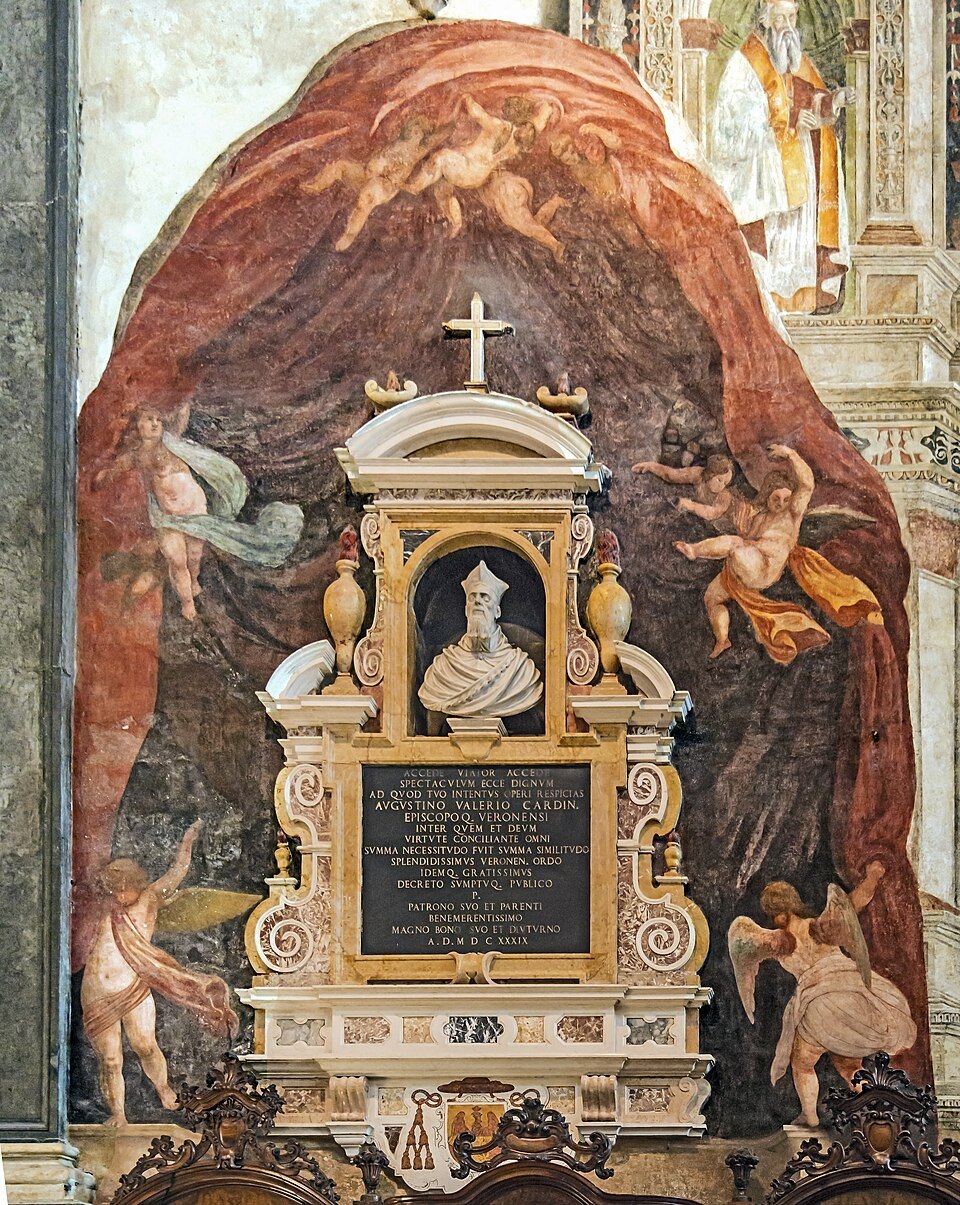
In Verona, a separate memorial eventually placed Agostino’s bust above a dark inscribed tablet near the entrance to the cathedral’s chapel of the Sacrament. Francescutti and Frucco trace the transfer of Agostino’s remains from San Marco in Rome to Verona in 1609 and distinguish that burial from the later memorial decided on by the cathedral chapter in 1639. The Veronese monument used painted putti and a curtain to frame the stone ensemble. The Venetian chapel, by comparison, brought the bishop into a pair with his nephew, with corresponding inscriptions on opposite walls. The monuments commemorate different ties to the same man. One belongs to the cathedral where he was buried. The other places him beside a relative who held the same cardinal’s title and also protected the Fiesolan congregation. [8][11]
The beard and the front of the cape
The beard is the main vertical form in the upper part of the portrait. Its separate strands emerge below either cheek, gather in the middle and spread slightly where they end. Deep narrow cuts break up the lower outline of the hair. Above it, the moustache lies close to the skin and makes the line of the mouth recede. Below it, the plain surface of the cape gives the texture of the beard room to register. Even when the face is seen at a distance, the narrow projection of the hair helps separate the chin from the upper chest. [1][5]
The forehead and cheeks depend on broader modelling. Shallow lines interrupt the forehead, and the cheekbones stand out above a slightly recessed area beside the mouth. The eyes sit low beneath a gently marked brow. The apparent direction of the gaze depends in part on where a viewer stands in relation to the lowered lids. These decisions give the head a reflective bearing without requiring a pronounced turn. The shoulders still spread broadly on both sides, so that small differences of depth near the face can register against a comparatively steady torso. [1][2]
The garment has a shallow curve across the front and a series of softer folds beneath it. Their rhythm is held in check by the upright line of small fastenings. Two sides of the cape meet there, with the more abrupt folds concentrated near the line of buttons. Where the beard overlaps the upper part of the closure, it obscures the top of that line. The eye can pick it up again below and follow it to the lower edge. This meeting of hair and cloth gives the portrait a centre even where the sculptor disperses the folds towards both shoulders. [1][5]
Bernini and Finelli
The Fondazione Federico Zeri catalogues the sculpture under Gian Lorenzo Bernini. Irving Lavin considered the two Valier portraits together and took their date to be around 1627, relating it to correspondence that places Pietro in Rome in September 1626. In that reconstruction the two busts mark one moment in the development of the portrait format. It leaves a question about the extent to which their carving was shared with another sculptor. [1][2]
Damian Dombrowski discusses work by Giuliano Finelli on the pair and considers Agostino’s bust largely Finelli’s own carving. He retains Bernini’s attribution for Pietro while allowing a role for Finelli in that work as well. The difference between that argument and the Zeri catalogue affects how highly finished details such as the beard, hair and fastening are interpreted. They can be studied as part of a design associated with Bernini and as evidence in the effort to identify an individual hand. The pairing and the chapel history are useful points of agreement even where the distribution of labour remains debated. [1][5]
The chapel and the collection records
The portraits were installed in Pietro’s chapel on Santa Maria delle Grazie. Treccani records the dismantling of the chapel in 1810. Earlier photographs catalogued by the Zeri archive identify the bust with the Venetian seminary, while the current object record associates it with the Galleria Giorgio Franchetti at the Ca’ d’Oro. These records identify the same sitter across successive settings. The seminary label on a photograph can therefore be read as part of its documentation rather than as evidence that the picture shows a different version. [1][3][6]
In the chapel, the ensemble placed the two churchmen in relation to one another. The shoulder line and lower edges let the busts read as a pair, while the faces distinguish two people of different generations. Close museum viewing makes the outline of Agostino’s unbroken beard particularly clear. At the scale of the original chapel, the beard also gave the eye a simple way to identify him alongside the younger sitter. A common costume and related proportions establish the connection between them. The portrait’s most individual feature supplies the distinction on which that connection depends. [1][2][5]
The chapel arrangement can be recovered in outline from a description transcribed in the scholarship on the Venetian memorials. It places the two dedications on the side walls, with Agostino on the right. The portraits thus answered one another across the chapel. Each had its own position and dedicatory text, and the paired arrangement brought them within the same view of the room. The cape and shoulders provide enough breadth for Agostino’s portrait to hold its place against a wall, while the downward cast of the eyes becomes especially effective if seen from below. This relationship between the format and the position of the viewer is easier to grasp from the description of the chapel than from a catalogue photograph of the isolated marble. [1][7]
The front edge of the cloak falls into a shallow arc above the support, leaving weight in the middle and lifting towards the outer shoulders. The longest folds taper before they reach those outer edges. This makes the line of the silhouette easy to read independently of the folds carved within it. Similar edges can be seen elsewhere in the portrait series Lavin discusses, though the fabric here falls away from the beard in a way particular to Agostino’s bust. [1][2]
Discussion
Agostino Valier’s long beard makes his head conspicuous above the buttoned cape.
Reader Insights
What changes between this bust and the portrait of Pietro Valier?
What could a sculptor use as a source for a posthumous likeness?
Which similarities suggest that the marbles were planned as companions?
Join the Conversation
Share a detail, comparison or question about Bust of Cardinal Agostino Valier below.
References
- Fondazione Federico Zeri. Ritratto del cardinale Agostino Valier. Object record 102508. View source
- Lavin, Irving. Five New Youthful Sculptures by Gianlorenzo Bernini and a Revised Chronology of His Early Works. Reprinted in Visible Spirit, 2007. Discussion of the Valier busts and correspondence. View source
- Istituto della Enciclopedia Italiana. Valier, Pietro. The commission and the chapel. View source
- Archivio Storico Diocesano di Verona. Atti della cancelleria e visite pastorali di Agostino Valier (1565–1606). Records of Agostino’s episcopate. View source
- Dombrowski, Damian. Aggiunte all’attività di Andrea Bolgi e revisione critica delle sue opere. Discussion of Finelli and the Valier portraits. View source
- Fondazione Federico Zeri. Ritratto Card. Agostino Valier. Venezia, Seminario. Photograph record 170860. View source
- Rossi, Paola. Le sepolture e le memorie funebri a Venezia e nel dominio di terraferma. Discussion of the Valier chapel, dedications and attribution. View source
- Tonizzo, Gabriele. La pala d’altare a Venezia tra Tiziano e Tiepolo (1580–1720), pp. 132–34. Transcription and discussion of Martinioni’s 1663 description.
- Zamperini, Alessandra. In competizione con l’antico e la natura: il ritratto a Verona nel Quattro e Cinquecento. Discussion of Brusasorci’s 1564 portrait.
- Ministero della Cultura. Ritratto del cardinale Agostino Valier. Accademia Tadini canvas, record S0010-00396_R03.
- Francescutti, Elisabetta, and Francesca Frucco. Le sepolture e le ‘memorie’ funebri a Venezia e nel dominio di terraferma, pp. 223–25. Agostino’s burial in Verona and the two memorial settings.








