


 by Tom Gurney
Tom Gurney BSc (Hons) is an art history expert with over 20 years experience
Published on June 19, 2020 / Updated on November 18, 2026
Email: tomgurney1@gmail.com / Phone: +44 7429 011000
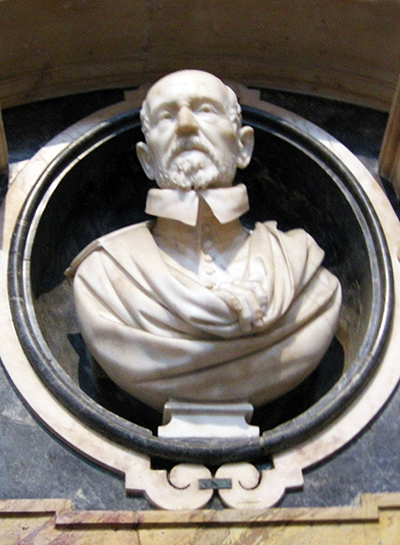
Bust of Giovanni Vigevano
Giovanni Vigevano looks up from an oval niche in his funerary monument at Santa Maria sopra Minerva in Rome. One hand emerges from the heavy folds of his cloak and gathers them across his chest. The action is small enough to belong to a formal portrait, but it gives the cloth a direction and weight that a viewer can read from below. Bernini made the white marble during Vigevano’s lifetime. The Italian cultural-property catalogue dates it to about 1616–18, while Irving Lavin proposed about 1620. The inscription beneath the bust records Vigevano’s death in December 1630. [1][2][3]
At a Glance
- Datec. 1616–18, Italian catalogue dating
- Location or statusSanta Maria sopra Minerva, Rome
- WorkWhite marble funerary portrait made during Vigevano’s lifetime
The work in Bernini’s career
Bust of Giovanni Vigevano
c. 1616–18, Italian catalogue datingThe Rape of Proserpina
1621–22Apollo and Daphne
1622–25David
1623–24Vigevano and his burial at the Minerva
The Latin dedication identifies Giovanni Vigevano as a native of Piacenza. It praises his devotion to his friends and associates his standing at court with the integrity of his conduct. It gives his age as eighty-nine years, ten months and twenty-one days and names Girolamo, his son and heir, as the person who set up the memorial. The inscription’s account of his age belongs to the time of his death. The likeness above it records the appearance of an elderly man at an earlier point in his life. [2][3]
By May 1622 Vigevano was making provision for burial in the Minerva. Lavin cites his will, which refers to a newly made tomb in the church. That document helps place the commission because it establishes that Vigevano had a burial place there well before his death. The state catalogue records the portrait and the larger monument separately. Its entry for the bust explicitly describes it as an early work made while the sitter was alive and subsequently employed in the funerary ensemble. The will and the dedication therefore provide different evidence about the memorial’s development. [1][2][3]
Dating the portrait
The proposed date of about 1616–18 in the official catalogue and Lavin’s date around 1620 both put the portrait among Bernini’s early marbles. Lavin compared Vigevano’s moustache and beard with the treatment of the head of Aeneas in the Borghese group of the flight from Troy. He also considered the relation of the drapery to portraits for the Barberini family. The May 1622 will provided an upper limit in his reconstruction. The argument depends on the combination of close visual comparisons and an archival date for the tomb. The document gives a point by which Vigevano was referring to his tomb as already made. It supplies no exact date for the carving of the bust. [1][3]
The date of death had led some earlier writers to assign the work to around 1630–31. The separate dating of the carving matters for understanding Bernini’s portraiture. In the late 1610s and early 1620s he was developing ways of giving the torso movement while keeping the likeness within a compact stone outline. The Vigevano bust provides evidence of that process even though its present architectural setting also belongs to the later commemoration of the sitter. [1][3][4]
The hand within the folds
The face rises above a collar whose projecting points catch the light on either side of the throat. The forehead and cheeks receive light broadly, while the hairs about the mouth create smaller interruptions. The head is lifted, leaving the chin visibly separate from the collar. From below, that angle brings the open planes at the front of the face into view. The head sits above a larger mass of folds, so the direction of the gaze can be read independently of the action across the chest. [1][3]
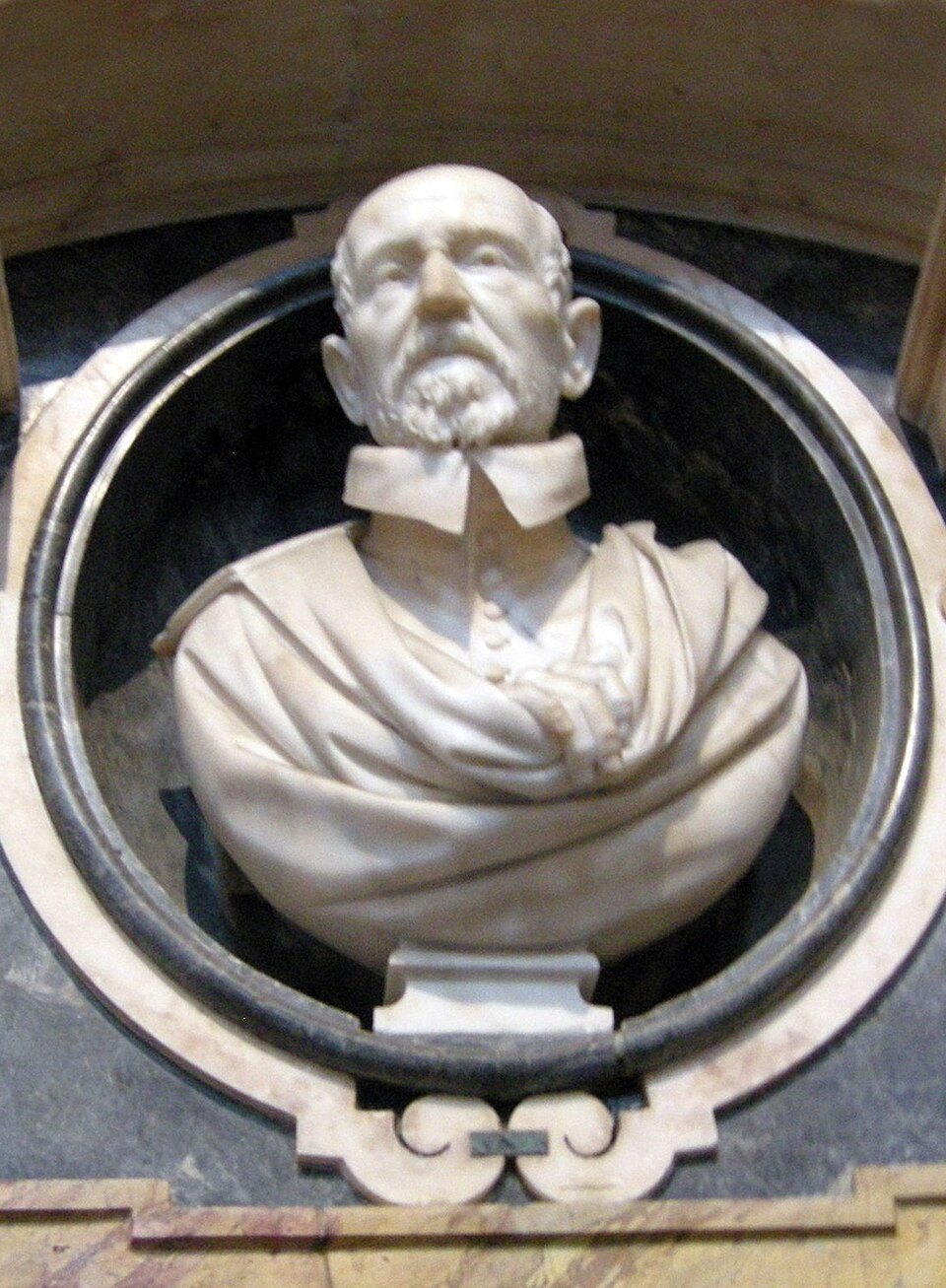
The visible hand is set close to the upper chest, with the fingers pressing the fabric into sharper folds. Those smaller creases accumulate where the fingers meet, then spread out into longer curves towards the shoulders and the lower edge. The heavy folds can thus be read as the result of the grasp. One fold runs almost uninterrupted across the lower front. The cloth supplies most of the outline of the torso, while the hand gives the viewer a point from which to follow its changing depth and direction. [1][3]
Lavin compared the gesture with Bernini’s earlier Antonio Coppola, which also shows a hand emerging from a wrap. He noted that Vigevano’s torso ends higher and that the route of the arm beneath the cloth is harder to trace. The grasp is made visible through what it does to the garment. The composition lets the marble describe that action without requiring the artist to show the length of the forearm. Inside an oval frame, the folds fan out from the hand and then return the eye towards the outline, giving the drapery something of the shape of the recess. [3]
The portrait between two chapels
The monument occupies a wall between two chapels along the left aisle of Santa Maria sopra Minerva. Andrea Bacchi and Catherine Hess identify it as one of the relatively few early portraits for which a visit still gives a sense of the viewing conditions Bernini worked with. They discuss height, light and the spectator’s position as part of the design of his portraits. Here the aisle allows an approach from the side before the visitor faces the wall. From that oblique angle, the distinction between the projecting face and the recessed oval is more apparent than it is in a frontal photograph. The chapel wall also gives the monument a finite width, within which the architecture can be read as a whole. [5]
In his early study of Roman Baroque architecture, Konrad Escher described the monument as a composition in two main levels with a low intermediate zone for the sarcophagus. He drew attention to the scrolls connecting the narrower, pedimented upper part to the broader section below. That account helps locate the bust within a sequence of changes in width and depth. The base spreads across the wall. Higher up, the scrolls draw the outline inward to the setting for the portrait. Within the recess, the marble projects again. The figure gains its prominence partly from this change of scale, which can be followed before the sitter’s expression becomes legible. [6]
Escher dated the architectural memorial to 1631 and discussed it before the 1639 Valtrini epitaph in San Lorenzo in Damaso, where a large suspended drapery takes the place of much of the stone architectural framework. Both works use folds to direct attention, at very different scales. In the Vigevano monument the cloth belongs to the sitter’s body and stays within the oval. In the Valtrini epitaph the drapery spreads across the wall and shapes the field in which the commemoration appears. The comparison places a relatively early experiment with animated cloth inside a durable architectural form that Bernini would later handle more freely. [6]
A likeness compared with Frumenti
Steven F. Ostrow used Vigevano as a comparison in his study of the marble bust of Giovanni Angelo Frumenti at Santa Maria Maggiore. He singled out the trapezoidal outline of the torso and the sculptor’s definition of the bone beneath the skin. The hollow cheeks, pronounced cheekbones and lines across the forehead make it possible to compare the handling of two faces even where their clothing and architectural settings differ. Ostrow also noticed similarities in such particulars as the collar and buttons, the curve of the ears and the shape of the nose. The comparison places the sitter’s age in the carving itself, where the transitions between skin, bone and shadow can be inspected alongside those of a second portrait. [7]
Ostrow proposed that Frumenti’s marble began as an independent portrait and was subsequently adapted to his memorial. To support this reading he pointed to the relatively abrupt lower and side edges and to the way the head sits above the bust. He also set out the disagreement over Vigevano. Rudolf Wittkower considered the Vigevano portrait an earlier carving adapted to the monument. Tomaso Montanari rejected that explanation. The fitting of the Vigevano bust to the oval makes a strong visual case for studying the ensemble together, while the distinction between the carving and the later memorial leaves room for different accounts of how that fit came about. The published comparison supplies evidence for the debate without fixing the date of the installation. [7]
The eye is an especially useful point of comparison across the early portraits. Ostrow records shallow hollows marked with black chalk in Frumenti, a projecting form within a recess in Montoya and concentric circles in Cepparelli and Bellarmine. The contrast helps explain how viewers can read a direction of attention from a work in white marble. A sculptor could articulate the eye by changing the depth and edge of the surface in which light collects. The face seen from the Minerva aisle also depends on the inclination of the head and the shadow of the opening around it. The surrounding stone is therefore part of the conditions under which the portrait’s smaller decisions become visible. [5][7]
The marble and its architectural frame
The upper part of the monument combines the oval niche and the inscription in a wall composition marked by pilasters and a broken curved pediment. A dark surround defines the opening and gives the pale marble a distinct edge. The head rises close to the top of that opening. The shoulders and the falling drapery spread through the widest part, leaving darker areas still visible around the sides. The rounded form of the bust consequently has room to project while remaining clearly tied to the architecture around it. [1][2]
The inscription below has a separate frame and can be read without following the movement of the figure. That division allows the engraved tribute and the carved likeness to address the same person in different ways. The text records public esteem, family responsibility and the end of a long life. The portrait presents a man who seems momentarily to hold his cloak and look out from a recess. The side-by-side evidence of dedication and figure is particularly valuable at the Minerva because the sculpture survives within the wall monument that gives the direction and scale of those gestures meaning. [1][2][3]
Bernini’s portrait of Pedro de Foix Montoya, also made during the sitter’s lifetime, offers another example of a bust seen inside an oval opening. Montoya’s buttoned front supplies a vertical line that holds the torso steady beneath the turn of the face. In Vigevano’s portrait, visible buttons occupy a much more limited space above the gathered cloth. The hand and sweeping fold carry the eye across that centre. The comparison shows how much can vary within the similar constraints of a wall monument. In Vigevano, the hand is as important to the balance of the bust as the turn or inclination of the head. [3]
The arrangement has another consequence for close looking. A photograph centred on the figure makes the hand readily visible, but a person standing at the monument first encounters the larger division between pale marble and dark aperture. The folds across the front are broad enough to carry from that distance. On approaching, the definition of the knuckles, the beard and the edges of the collar make the sitter more particular. The placement of the bust enables both views, giving the memorial a clear outline at church scale and a closely observed likeness within it. [1][2][3]
Discussion
Vigevano’s hand gathers his cloak within the oval frame of a wall monument.
Reader Insights
Which parts of the gesture remain legible from below?
How do the dates proposed for the marble compare with the death date in the inscription?
How does the portrait use its recess differently from the bust of Montoya?
Join the Conversation
Share a detail, comparison or question about Bust of Giovanni Vigevano by Gian Lorenzo Bernini below.
References
- Ministero della Cultura. Ritratto di Giovanni Vigevano. State catalogue entry for the marble bust, 1200219132-1. View source
- Ministero della Cultura. Monumento funebre di Giovanni Vigevano. State catalogue entry for the wall monument, 1200219132-0, including the inscription. View source
- Lavin, Irving. Five New Youthful Sculptures by Gianlorenzo Bernini and a Revised Chronology of His Early Works. Reprinted in Visible Spirit, 2007. Discussion of Vigevano, his will and the comparison with Coppola. View source
- Istituto Nazionale di Studi Romani. Studi Romani, year 3, no. 1, 1955. Discussion of the proposed dates. View source
- Bacchi, Andrea, and Catherine Hess. Creating a New Likeness: Bernini’s Transformation of the Portrait Bust. In Bernini and the Birth of Baroque Portrait Sculpture, 2008, pp. 15–16.
- Escher, Konrad. Barock und Klassizismus: Studien zur Geschichte der Architektur Roms, 1910. Vigevano and Valtrini monuments.
- Ostrow, Steven F. Giovanni Angelo Frumenti and His Tomb in S. Maria Maggiore: A Proposed New Work by Gian Lorenzo Bernini. The Burlington Magazine 158, 2016, pp. 524–27.








