


 by Tom Gurney
Tom Gurney BSc (Hons) is an art history expert with over 20 years experience
Published on June 19, 2020 / Updated on November 18, 2026
Email: tomgurney1@gmail.com / Phone: +44 7429 011000
Bust of Thomas Baker
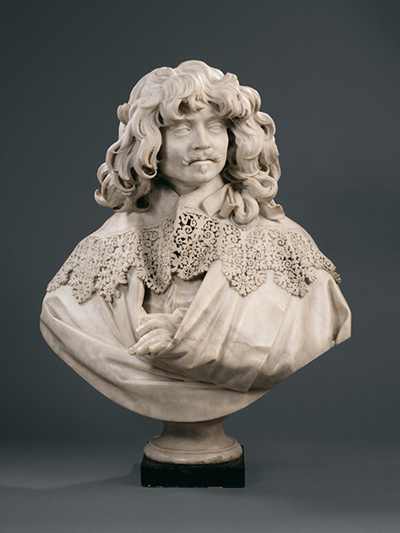
Thomas Baker turns his head above a broad lace collar, his lips parted as if he is about to speak. The shoulders and the visible hand are held within the slower folds of a mantle. The marble bust was made in Rome around 1638 and is now in the Victoria and Albert Museum in London. The V&A catalogues it under Gian Lorenzo Bernini and notes the apparent involvement of an assistant. An English visitor to Rome described an intervention by Pope Urban VIII that prevented Bernini from proceeding with a private commission. The survival of the marble has led scholars to ask who carried the design into stone. [1][2]
At a Glance
- Datec. 1638
- Location or statusVictoria and Albert Museum, London
- WorkMarble bust with probable assistant involvement
The work in Bernini’s career
Bust of Thomas Baker
c. 1638Ecstasy of Saint Teresa
1647–52Fountain of the Four Rivers
1648–51The turn of the head
Look first at how far the head turns in relation to the chest. The front of the mantle gives the lower part of the figure a relatively settled position. Above it the face takes a different direction. The slight opening of the mouth completes the impression that Baker has heard something or is preparing to answer. The sculpture supplies enough information to suggest the moment without establishing what has caused it. From a point directly in front of the shoulders the turn is immediately apparent. Move towards the side the sitter faces and the expression takes on greater prominence while the turn becomes less pronounced. [1][2]
The hair makes the movement more legible. Locks descend to either side of the face and overlap the collar. Part of the collar disappears under the curls, while elsewhere its outer border runs across the shoulders as a single shallow band. That overlap makes it possible to follow two directions at once. The hair accompanies the turn of the head and the lace establishes the breadth of the shoulders below it. The mantle introduces still larger intervals between its folds. Within the small compass of a portrait bust the sculptor could thus use the different sizes of curls, lace openings and folds to give each part of the figure its own pace. [1][2][3]
Lace and tool marks
The collar is important evidence of dress as well as a prominent feature of the carving. Rudolf Wittkower compared Baker’s hair, moustache and expansive collar with fashionable portraits by Anthony van Dyck from the late 1630s. In a painting a passage of lace can be built out of differences in colour and tone. Here its pattern emerges through the shadows in recesses made in a single pale stone. The repeated openings draw attention to the thin bridges of material between them. The V&A’s account of carved lace also places Baker’s collar in a tradition that later sculptors in wood could look to when fashioning similarly delicate work. [1][2][3]
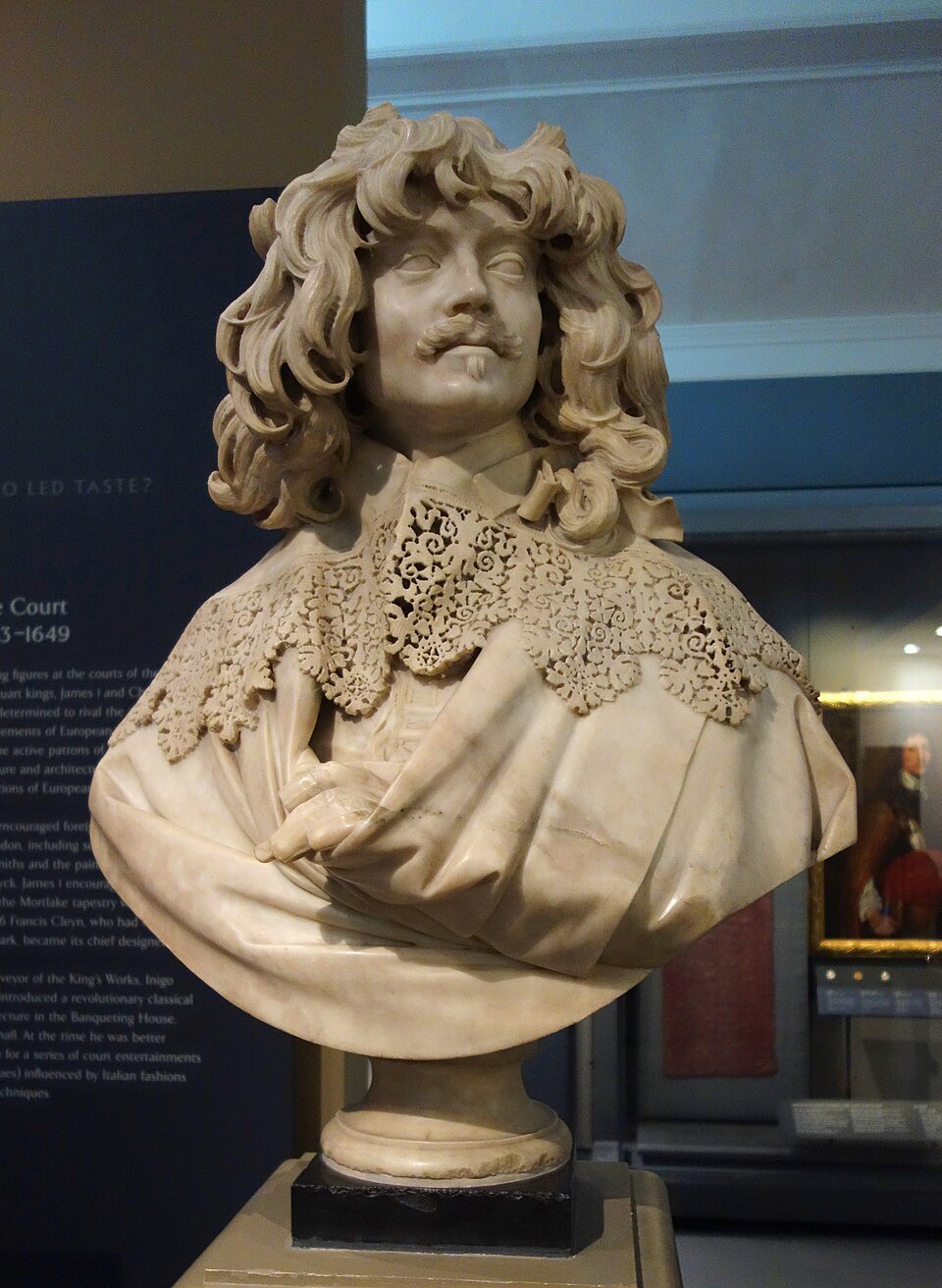
The marks in the hair have a different structure. Deep drilling separates locks or gives a curl space to project. Finer marks divide the broad surface of a lock into strands. The V&A points out the visibility of the tools in both the hair and collar. A ridge of marble can describe hair by carrying narrow grooves along its length. In the lace, closely spaced recesses have to preserve a pattern across the surface. The sculptor could change the scale and spacing of marks to make the same light fall differently on the two materials. A detailed view of the bust therefore records some of the carving decisions that make it possible to distinguish them at a distance. [1][2][3]
An English commission in Rome
In October 1638 the sculptor Nicholas Stone visited Bernini in Rome. According to the diary transcribed by Wittkower, Bernini told Stone of an Englishman who had pressed him to undertake a portrait. Bernini wanted to show an English audience the results of working with a sitter who could be observed in person. His recent portrait of Charles I offered the obvious point of comparison. Van Dyck’s painting of the king in three positions had been sent to Rome to furnish views of the sitter for Bernini’s royal bust. The marble of Charles was destroyed in the Whitehall Palace fire of 1698, while the painting survives in the Royal Collection. The three painted views gave Bernini evidence for the shape of the king’s head as well as for his expression. Baker’s sitting offered the opportunity to see a turn of the head in motion. [2][4]
The V&A reports the belief that Baker delivered Van Dyck’s painting to Rome. Stone’s account, as published by Wittkower, leaves the English patron unnamed. It gives more specific evidence about the interruption of the work. Bernini told Stone he had prepared a model and that the pope intervened through Cardinal Francesco Barberini before the marble was begun. According to Stone, Bernini concealed the reason from the sitter and damaged the model. Wittkower interpreted the order in the context of the royal portrait as a papal gift. A privately commissioned portrait sent to England had the potential to lessen its distinction. [1][2]
When a damaged model was supposed to end a commission
Tomaso Montanari reads Nicholas Stone’s story as evidence for the standing of a model in Bernini’s workshop. According to Stone, when Baker returned to sit the following day, Bernini turned to the damaged model to show that the project was over. The unfinished or altered object could communicate a decision to the patron before a chisel had been set to the marble. That makes the episode more than a story about a patron paying for access to a celebrated artist. It records what a sitter was shown while the design was under consideration and how Bernini used a physical object to make a refusal credible. [5]
The marble ultimately came into being. Montanari infers that the original model was repaired or another was made, two routes that would have left different physical evidence had the model survived. Stone’s account does not establish which route the workshop took. The distinction matters because a likeness, an arrangement of the body and a set of instructions for carving could all be carried forward without preserving the specific object that Baker saw. It also helps explain why the episode can be documented more closely than the division of work on the surviving stone. [5]
Clothing, movement and the case for Bolgi
Damian Dombrowski’s Italian study approaches Bolgi’s carving through a comparison between Laura Frangipani and the bust of Virginia Primi. He singles out the stiff lace, pearls and the alternation of rough and polished surfaces used to give embroidery a pattern. He takes Bolgi’s ability to render such ornament as a reason for Bernini to employ him on Baker. Alexandra Zigomalas has argued instead for Bernini’s involvement in carving the collar itself, on the grounds that the lace contributes substantially to the effect of the portrait and to the way it addresses an English audience. Neither interpretation supplies a document allocating the collar to one sculptor. They show how the same technical detail can enter an attribution through different routes, as a recurring feature across works or as part of the design of one bust. [6][7]
The Kunsthistorisches Museum displayed the portrait in a group that explored vivacità, the impression of life in early Baroque art. Its German account draws attention to the visible marks of the drill and contrasts the hair and collar with the ways painters indicate changes of material through colour. Giuliano Finelli’s portrait of Scipione Borghese gave that discussion another example of a marble face poised to speak. The Met’s catalogue also draws attention to the drilling in Finelli’s beard and lace. In Baker’s portrait the lace opens out into a broader shape. Seeing both approaches makes it easier to describe the particular placement of ornament and the way it catches the eye, even though drill marks by themselves leave the identity of the carver open. [8][9]
From Lely’s collection to the museum
George Vertue’s notebook entry of August 1713 adds a detail missing from Stone’s account. He names Baker as the man who carried Van Dyck’s painting to Rome and associates the portrait with Sir Peter Lely’s collection. Zigomalas distinguishes this testimony, recorded decades after the commission, from the earlier inventory that names Baker as the sitter. The notebook documents a story in circulation in the early eighteenth century. The inventory gives earlier evidence for the identity of the bust, without telling us how Van Dyck’s painting was delivered. [7]
The Victoria and Albert Museum bought the portrait in 1921 from the estate sale of Lord Anglesey. The Zeri catalogue dates it about 1637–38 and records its appearance in the 2026 exhibition catalogue devoted to Bernini and the Barberini. The exhibition context placed a private likeness within the same period as large papal commissions. The relation is visible in the documents even before the visitor looks closely at the carving, since papal authority enters Stone’s account at the point when the future of an Englishman’s portrait was still being decided. [5][7][10]
From the model to the surviving marble
In France in 1665 Bernini recalled an Englishman asking for a portrait after seeing the bust of Charles. Wittkower read this recollection alongside Stone’s account, and linked both to the surviving marble. The evidence for the name Baker comes from the 1680 catalogue of the collection of Sir Peter Lely. The description there identifies the sitter and gives the bust to Bernini. The catalogue places the object in England with its name attached by that date. A later recollection and an early collection catalogue tell different parts of the story, and the manner in which the commission was resumed still has to be inferred. [2]
Wittkower proposed that Andrea Bolgi carried out part of the work under Bernini’s supervision. He compared the collar and the way the drill was used in the hair with Bolgi’s signed portrait of Laura Frangipani in San Francesco a Ripa, dated 1637. The comparison is particularly revealing where repeated holes are left visible in a groove. A resemblance of this kind suggests a way to connect the marble to a workshop practice. It also has to be weighed against the ability of trained assistants to share techniques. Wittkower recognised the force of the turn and expression as closely related to Bernini’s portraiture of the period. The V&A describes the assistant’s contribution as apparent, leaving the exact division of the carving open. [1][2]
The left hand emerging from the mantle gives the workshop question a further dimension. It works as a continuation of the body below the face by closing the arrangement of cloth around the front of the figure. The visible arm reaches the edge of the bust before the viewer has seen a whole limb. Wittkower compared the gesture with ancient figure sculpture and with Bernini’s portrait of Giovanni Vigevano, in which cloth likewise frames a hand. A gesture available to several sculptors could pass from antique example to workshop practice. The particular way a fold ends at the margin or carries the eye to the hand provides more specific evidence for comparison. [2]
Seen together, the deep curls, the spread collar and the contained hand show how much of Baker’s appearance depended on the relation of the portrait to his clothes. The glance and mouth sustain the impression of a man turning to speak, while the detail on the stone shows the sustained work required to make that brief movement legible. Stone’s account and Lely’s catalogue trace the bust from the circumstances of a private commission to a collection in England. The pattern of the carving allows a further inquiry into how the design survived a break in the work. [1][2]
Discussion
A broad lace collar separates the sitter’s turning head from the heavier mantle.
Reader Insights
Where does the alternation of shadow and light make the lace legible?
How does the visible hand affect the sense of movement?
What evidence could help distinguish Bernini’s work from an assistant’s contribution?
Join the Conversation
Share a detail, comparison or question about Bust of Thomas Baker by Gian Lorenzo Bernini below.
References
- Victoria and Albert Museum. Bernini and the Baroque. Portraiture section, museum no. A.63:1, 2-1921, and account of workshop involvement. See also the object record. View source: Bernini and the Baroque View source: object record
- Wittkower, Rudolf. “Bernini Studies II: The ‘Bust of Mr Baker’”. The Burlington Magazine, pp. 19–22. Includes Nicholas Stone’s account, the Lely inventory and the argument for Bolgi’s participation. View source
- Victoria and Albert Museum. “‘Even to Deception’ – lace and fashion in Gibbons’ carving”. Discussion of Baker’s lace collar within the tradition of carving lace. View source
- Royal Collection Trust. Charles I in Three Positions. Anthony van Dyck, RCIN 404420, and history of the lost royal bust. View source
- Montanari, Tomaso. Creating an Eye for Models, in Bernini: Sculpting in Clay, pp. 68–69 and note 40.
- Dombrowski, Damian. Aggiunte all’attività di Andrea Bolgi e revisione critica delle sue opere, p. 303.
- Zigomalas, Alexandra. The Other Englishman: Bernini’s Bust of Thomas Baker (1638). Emory University, discussion of the early documents, collecting and attribution.
- Kunsthistorisches Museum Wien. Vivacità. Caravaggio & Bernini exhibition, nos. 1 and 4.
- Metropolitan Museum of Art. Cardinal Scipione Borghese, Giuliano Finelli, 53.201.
- Fondazione Federico Zeri. Ritratto di Thomas Baker. Object and exhibition bibliography.








