


 by Tom Gurney
Tom Gurney BSc (Hons) is an art history expert with over 20 years experience
Published on June 19, 2020 / Updated on November 18, 2026
Email: tomgurney1@gmail.com / Phone: +44 7429 011000
Saint Bibiana
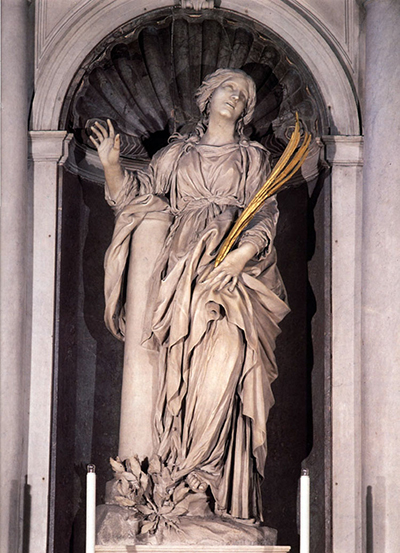
Saint Bibiana stands above the high altar of the church dedicated to her on Rome’s Esquiline Hill. She leans towards a short column and holds a palm, the sign of her martyrdom. Her face turns upward while her free hand opens above the column. Gian Lorenzo Bernini made the statue in 1624–26 for Pope Urban VIII during the renewal of the church associated with the Jubilee of 1625. Bernini also worked on the building and designed the architectural setting for the figure. The sculpture can be read from the nave, where the pale figure emerges against a dark niche, or at close range, where small variations in the finish of the marble come into view. [1][2][3]
At a Glance
- Date1624–26
- Location or statusChurch of Santa Bibiana, Rome
- WorkMarble statue for the high altar
The work in Bernini’s career
Apollo and Daphne
1622–25David
1623–24Saint Bibiana
1624–26St Peter’s Baldachin
1624–33The figure above the altar
The column is both a support in the composition and a reference to the saint’s story. According to the account commemorated in the church, Bibiana was bound to a column when she suffered martyrdom. A separate column near the entrance, protected by a grille designed by Bernini, is traditionally associated with that event. The one beside the figure condenses the story into a feature that the visitor can recognise from a distance. Her palm identifies the figure as a martyr even before the relationship between her arm and the column becomes clear. [2][3]
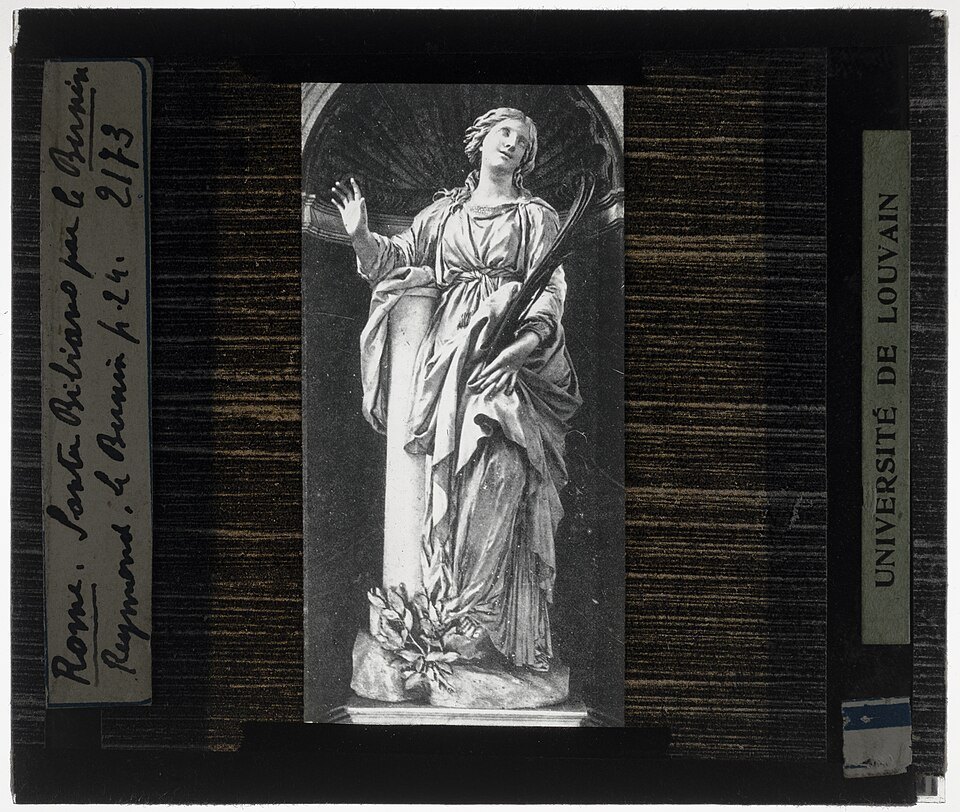
The statue suggests Bibiana’s response to martyrdom through her upward gaze and open hand. The weight of the clothing gathers around her legs, while the turn of the face carries the movement up and away from the column. Look at where the forms begin to separate. At the bottom, broad folds establish the figure’s footing. Above, the arm and hand open out from the body, giving the gesture a visible outline in front of the niche. The face is turned farther still. These successive changes make the rise of the gaze intelligible even from a position where the expression itself is difficult to see. [2][3]
Drapery, polish and directional light
Bernini gives the garments a series of surfaces that behave differently under light. The outer mantle has large ridges and valleys. Nearby there are narrower folds, and the edge of the garment at the neck carries decoration that can be missed from the nave. The broad ridges are easier to distinguish at a distance. A closer position reveals the smaller changes in the lines of the clothing and its relation to the face and neck. The variety is especially apparent where a large fold crosses another piece of cloth and the two forms take different angles to the available light. [3]
The restoration study examined where Bernini gave selected parts of the marble a polished surface. It records polishing on part of the face and neck, the column, certain ridges of the folds and parts of the hands. The authors relate this distribution to light coming from the east. A smoother surface can return a stronger highlight where it meets the light at a favourable angle. A neighbouring surface can remain quieter even though it belongs to the same block. This helps explain why the figure has an illuminated side that can be read across the distance of the nave. The sculptor could reinforce the effect of the window by changing the finish on some of the parts on which the light would fall. [3]
Marble, metal and paint
The palm shows that the sculpture’s appearance also depended on material added to the marble. The conservation team describes copper elements joined together and held in a recess made in the left hand. Examination found a dark green layer beneath later gilded finishes. The team retained the gilding for devotional reasons. A visitor today sees the palm as it developed through that history of use. Its thin leaves occupy a much smaller volume than the drapery, but the change in material makes them legible beside it. The recess in the hand makes the attachment part of the sculpture’s physical evidence as well as part of the story told at the altar. [3]
Colour also shapes the space behind Bibiana. Bernini designed a tall marble aedicule with a pediment, and Bernardino Radi carried out the architectural stonework. The lining of the niche uses dark grey marble, giving the white figure a different background from the lighter architectural members around it. A glazed lunette above the aedicule bears the Barberini arms. The niche gathers different materials around the figure in an order that is visible from the entrance. The area of darkness makes the outside edge of the saint easier to read, while the light catches details within the outline. [1][3]
A church renewed for the Jubilee
The altar was moved back from its earlier isolated position into the apse during the renovation. The account cited by the restorers explains that this made more room for clergy and people gathering for the saint’s feast. It also established a place where the statue could be seen against a permanent architectural background. Bernini’s work on the façade belongs to the same renewal but has a different place in the approach to the church. A visitor first encounters the front from the street and then sees the high altar across the interior. The scale of the figure and its visible gestures suit that second view. [1][2][3]
The walls of the nave show other aspects of Bibiana’s commemoration. Pietro da Cortona painted episodes associated with her and her family, including the scourging, while Agostino Ciampelli’s contributions include angels and decorative passages. The painted episodes make room for multiple figures, including those whose actions lead to the martyrdom. Bernini’s statue gives the visitor one figure to see from down the length of the church. Her column and palm recall the events represented elsewhere while her posture gives the devotion at the altar its own focus. [2][3]
The older columns dividing the three aisles survived the renovation. From the central aisle they give the viewer successive points of reference on the way towards the altar. The walls carry episodes which can be seen by turning to either side. The statue remains ahead on the same axis. Its upright pose and the frame rising around it make that axis legible even when the congregation is gathered between the visitor and the sanctuary. The new setting gave the figure a clear position within an interior that retained elements of the earlier church. [2][3]
The church on the Esquiline in architectural prints
The church occupied a different kind of site in Bernini’s day. Research at the University of Rome Tor Vergata situates the seventeenth-century façade among kitchen gardens, vineyards, villas and remains of ancient Rome. In that setting a portico offered a clearly marked place to approach and enter the church. Its three openings establish a broad front, while the upper storey gives extra height to the central bay. After passing into the nave, a visitor encounters another point of emphasis in the centre, where the figure of Bibiana stands within a tall frame. The façade organises the approach from outside and the altar fixes its direction inside. [4][5]
A print in Hessen Kassel Heritage preserves a way of studying the front in more than one view. It identifies Bernini as the architect and shows the façade alongside a section and plan of the portico. A scale in Roman palms allows comparison between the parts. The façade view makes the alignment of upper and lower openings apparent. The plan and section show the depth of the portico that an elevation flattens out. These records help explain why someone standing outside saw a façade with weight and shadow before coming into the long, columned interior. The plate records the architecture as an object of study and gives no equivalent description of the altar sculpture. [5]
Bibiana’s story on the walls and on paper
A drawing attributed to Pietro da Cortona in the Musée des Beaux-Arts in Rennes records work on the fresco cycle in pen, brown wash and black chalk. It shows Bibiana refusing to worship idols. The French catalogue identifies an idol, an altar and a colonnaded setting. The scene asks the viewer to follow a refusal directed at a particular object in front of other people. Bernini’s figure draws attention to a different relation between the saint and what surrounds her. Her face turns away from the column of her martyrdom and toward the space above her. Across the two works, the placement of the body in relation to a column or an altar helps give shape to a choice. [6]
The Louvre holds a drawing after Cortona’s fresco of Bibiana’s martyrdom. Its attribution identifies it as a copy, while the Rennes sheet relates to the making of the cycle. The Louvre copy uses red chalk with white heightening. Its existence shows how someone could study the episode away from the fresco and carry a record of the composition elsewhere. The statue keeps the palm and column where they can be seen from the main aisle. With those objects visible there, a person who had just looked at the painted story could recognise the saint again even before approaching close enough to see her face. [6][7]
What an eighteenth-century plaster preserves
In the 1750s Abbot Filippo Farsetti obtained permission to have casts made for his collection. Irving Lavin recounts that Charles-Joseph Natoire, director of the French Academy in Rome, arranged to acquire a cast of Saint Bibiana. The agreement with Pope Benedict XIV also provided material for the Accademia Clementina in Bologna. The statue could thus serve as an example for study in settings without its altar, coloured marble surround or the church’s light. The cast reproduced much of the form that a person could inspect at close range, while the location and function of the original remained tied to the high altar. [8][9]
Comparison with the Bologna plaster helped the 2017 conservation team interpret marks and losses on the original. They observed a fine horizontal cut on the marble column and found that its position matches the join between two mould sections visible in the plaster. They read the line in the stone as a trace of the knife used in separating the pieces of the mould. The plaster also preserves an intact lower detail that helped the team assess when damage to the marble might have occurred, possibly during eighteenth-century reinstallation. A seam in a reproduction and a line on the original can record the same operation. The match gives the cast value as evidence for what happened to the marble after Bernini’s lifetime as well as for features that have since changed. [9]
The 2017 conservation project
For the Galleria Borghese’s Bernini exhibition the statue was taken from the church to be conserved and shown at the museum. The gallery described it as the first departure from its home church and opened the work in its portico to visitors from September to October 2017. The opportunity to examine the statue away from the altar allowed conservators to document the palm’s attachment and inspect surfaces normally difficult to see. The published project also studied the altar and the marble aedicule. Those records make it possible to relate close observations about the finish of the marble to the direction and distance from which Bernini designed it to be seen. [1][3]
Discussion
The marble stands above the high altar, leaning beside a short column.
Reader Insights
How do the palm and column help identify Bibiana?
Which part of the pose is clearest from below?
What might disappear from view if the sculpture were shown on a museum pedestal?
Join the Conversation
Share a detail, comparison or question about Saint Bibiana by Gian Lorenzo Bernini below.
References
- Galleria Borghese. La Santa Bibiana di Bernini. Restauro a cantiere aperto. Exhibition and conservation announcement, 30 October 2017. View source
- Turismo Roma. The Church of Santa Bibiana. Church history, column, high altar and frescoes. View source
- Porfiri, Roberta, Maria Grazia Chilosi and Francesca Bencetti. Barocco in nuce. Il recupero critico della Santa Bibiana di Gian Lorenzo Bernini. Bollettino d’Arte 35–36, 2017. Conservation, marble finish, aedicule and associated documents. View source
- Università degli Studi di Roma Tor Vergata. Tra Orti, Ville e Ruderi. Research record on the historical setting of the façade.
- Hessen Kassel Heritage. Fassade und Portikus der Kirche Santa Bibiana. German catalogue of the elevation, section and plan.
- Ministère de la Culture and Musée des Beaux-Arts de Rennes. Sainte Bibiane refusant d’adorer les idoles. French drawings record.
- Musée du Louvre. Martyre de sainte Bibiane. INV 14039, recto. French drawings catalogue.
- Lavin, Irving. Bernini Bozzetti. In Visible Spirit, on Farsetti and Natoire.
- Chilosi, Maria Grazia. Considerazioni a margine del restauro. In Barocco in nuce, pp. 214, 224–25, on the marble and Bologna plaster.








