


 by Tom Gurney
Tom Gurney BSc (Hons) is an art history expert with over 20 years experience
Published on June 19, 2020 / Updated on November 18, 2026
Email: tomgurney1@gmail.com / Phone: +44 7429 011000
Bust of Cardinal Escoubleau de Sourdis
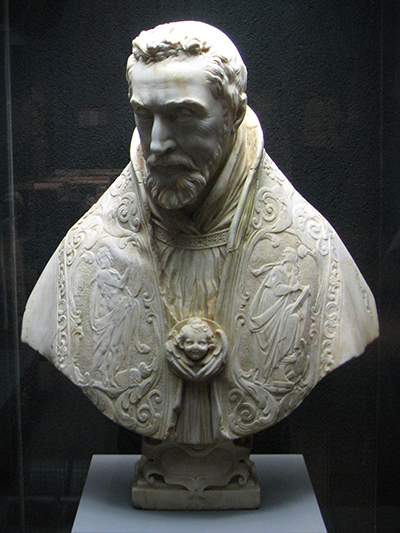
Gian Lorenzo Bernini’s portrait of François d’Escoubleau de Sourdis sets a slightly lowered head above the broad expanse of a decorated cope. Carved figures stand on either side of the fastening, where a small face looks out beneath the cardinal’s own. The Musée d’Aquitaine in Bordeaux dates the commission to about 1620–22. Its account links the marble to the church of Saint-Bruno, another of the cardinal’s projects. The bust shows how Bernini could bring the detail of ecclesiastical clothing into a portrait while keeping attention on the person wearing it. [1][2]
At a Glance
- Datec. 1620–22
- Location or statusMusée d’Aquitaine, Bordeaux
- WorkMarble bust of François d’Escoubleau de Sourdis
The work in Bernini’s career
Bust of Cardinal Escoubleau de Sourdis
c. 1620–22The Rape of Proserpina
1621–22Apollo and Daphne
1622–25David
1623–24François de Sourdis and his work in Bordeaux
François de Sourdis served as Archbishop of Bordeaux from 1599 until his death in 1628. The Musée d’Aquitaine describes his career in terms of Catholic reform, including a reorganisation of the clergy and the introduction of houses for new religious orders. His involvement in the city also extended to the renovation of the archiepiscopal palace and work to improve marshy areas around the suburbs. Those activities give some sense of the position he occupied in Bordeaux when the portrait was made. He was responsible for institutions and buildings as well as for public worship. [1]
His commissions drew on connections he developed during journeys to Italy. The Institut national d’histoire de l’art records a painting collection associated with him in Bordeaux from around 1614. Among the linked records is a version of the Christ Carrying the Cross after Scipione Pulzone. A devotional painting and a carved portrait served different purposes, but their presence in his circle helps explain how Italian models and workmanship came to be seen in Bordeaux. Sculpture for Saint-Bruno extended those connections to a building the cardinal had commissioned in his own diocese. [1][3][4]
The cardinal’s face and vestments
The hair bunches in small curls across the forehead and continues in tighter waves around the ear. The face emerges as a series of broader planes below it. A pronounced brow shades the eyes, and the line of the nose draws the gaze down to a mouth partly covered by the moustache. The beard narrows towards the neck, where its edge meets the folds at the collar. The turn is slight enough for the shoulders and the upper body to read almost symmetrically from the front, while the head offers a visibly different outline from each side. Under light from above, that difference is particularly clear around the eye sockets and the cheek. [1][2]
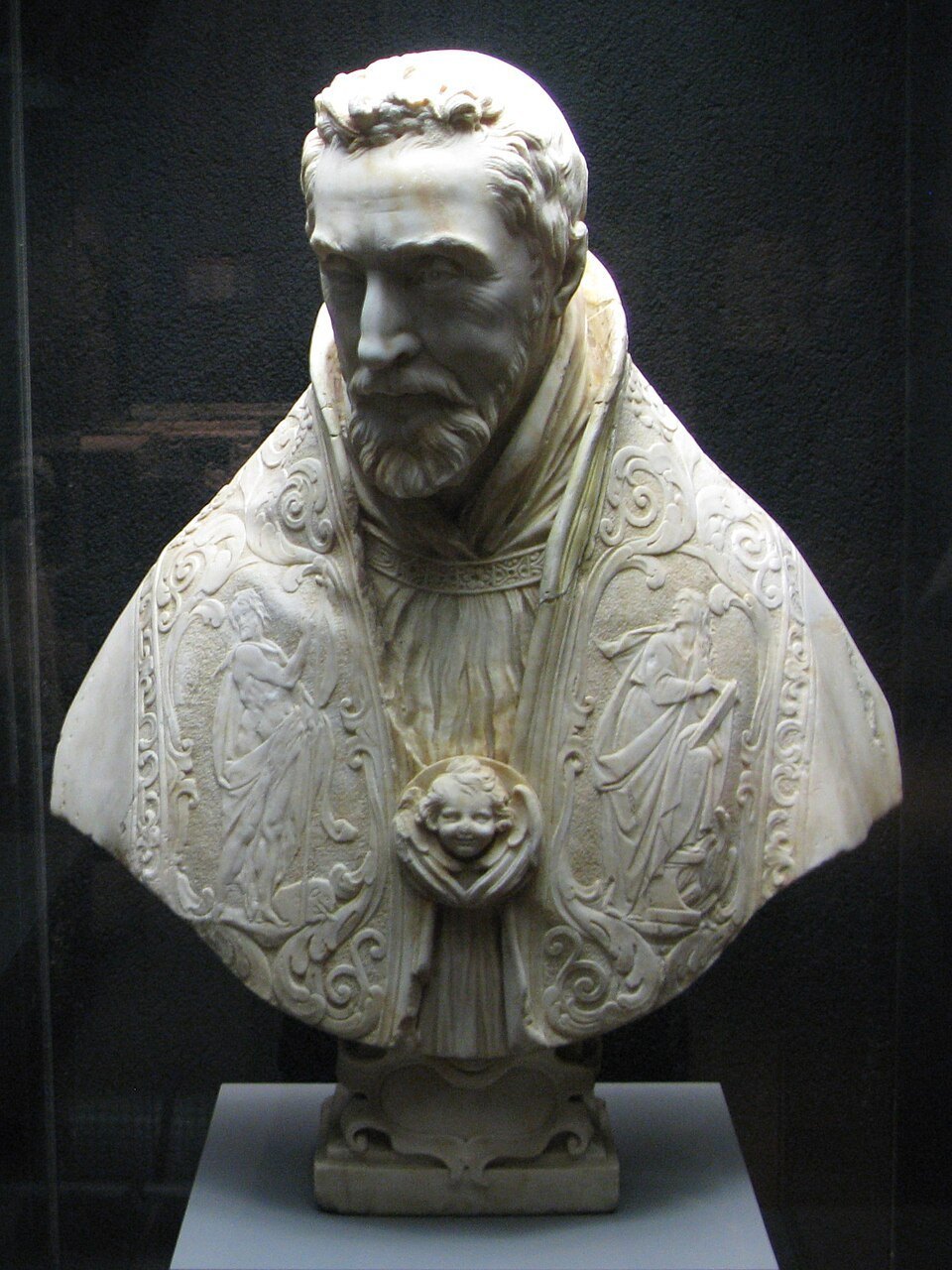
The cope has a patterned band on each side of the front opening. Bernini carved standing figures into these bands, with ornamental scrolls filling the space around them. The miniature folds on the figures sit inside the much larger fall of the cope itself. The outside edge of the garment is comparatively quiet, so that the patterns register as decoration on the front of an object with a clear outline. Beneath the opening, thinner vertical folds carry the eye down to the base and suggest a lighter fabric. The portrait gives its clothing several different scales of detail, from the spread of the shoulders to the shallow carving that evokes embroidery. [1][2]
The central clasp brings the two halves together. Its small relief head sits above the lower ends of the patterned bands and roughly below the cardinal’s chin. Viewed straight on, those two faces establish successive points of attention. From the side the clasp projects just enough to cast a shadow across the folds below it. The patterned areas of the cope do much of the work of identifying the kind of garment, while the clasp explains how it sits on the body. The portrait can be read at a distance through the mass of the stone and at close range through the incised linework. [1][2]
The base is narrow relative to the torso. Its stepped sides and carved front make a distinct boundary beneath the wrinkles of the lighter garment. The outer contour of the shoulders reaches well beyond the support, then curves down towards the centre. That outline helps the cope retain a sense of breadth even though the bust ends partway down the chest. In a frontal view, the narrower base also leaves the two lower ends of the patterned bands visible on either side. The decoration can therefore be followed almost to the ends of the cloth. The deepest shadows fall under the outer slopes of the shoulders and around the base. This lets the narrow grooves in the vestment remain visible on the broad front surface without breaking up the larger outline. [1][2]
The Bernini commission for Saint-Bruno
A surviving contract places another commission from Sourdis on 1 May 1621. Published by Sabina Maniello Cardone, it names both Pietro Bernini and his son Gian Lorenzo as the sculptors engaged to make the Virgin and angel of an Annunciation for the Bordeaux church now called Saint-Bruno. A note added in May 1622 records settlement of the payment, with Pietro acting for Gian Lorenzo as well as for himself. The contract documents the cardinal’s access to both sculptors and clarifies how commissions could be handled by a father and son working together. [4]
The Annunciation contract gives firmer dates for the two figures than for the portrait itself. It also leaves an open question about the group’s intended position. Cardone discusses the possibility of a setting connected to the cardinal’s grave or a place in the choir. Either would have involved a different relationship between the figures, their audience and the building. The contract concerns the figures of Mary and the angel. The Musée d’Aquitaine catalogues the portrait separately under Gian Lorenzo’s name and gives the wider date range for its commission. The shared patronage ties both works to the same period of exchanges between Rome and Bordeaux. [1][4]
The cardinal’s stay in Rome
Irving Lavin narrowed the likely period for the portrait using the cardinal’s movements. Sourdis came to Rome in early spring 1621 and was on his way back to France by July 1622. Lavin favoured the latter part of that stay for the bust. The German annotated edition of Paul Fréart de Chantelou’s diary similarly dates it to 1621–22. These dates overlap the documented work on the Annunciation and identify a period when the cardinal and the sculptors were in the same city. They offer a narrower working chronology within the date range used in Bordeaux. The contract for the two figures supplies a date for that commission, while the timing of the portrait still depends on reconstructing the cardinal’s visit. [8][9]
Chantelou’s diary offers a different kind of evidence. On 12 June 1665 it records Bernini recalling a visit from Pope Urban VIII and Sourdis after the completion of Apollo and Daphne. In the story, Sourdis objected to displaying the nude Daphne, and Urban responded with a moralising epigram about the pursuit of fleeting beauty. The German editors identify the French prelate in a note and connect him with the Bordeaux marble. The story shows how Bernini remembered the cardinal as a viewer and critic of sculpture decades later. It concerns the Borghese group and supplies no date for a sitting for the portrait. [9]
The attribution also has a history. Lavin records that Charles Perrault in 1669 assigned the bust and the Annunciation figures to Pietro Bernini. Later scholarship distinguished Gian Lorenzo’s portrait from the two figures, and Bordeaux now catalogues the bust as Gian Lorenzo’s work. The Italian publication of the Annunciation contract establishes that both Berninis were engaged for the figures. The older attribution is therefore evidence of how the Bordeaux works were once described together, while the roles of the sculptors need to be assessed for each commission individually. [8][10]
A cardinal in a format associated with popes
Andrea Bacchi sets the Sourdis bust beside Bernini’s early portraits of Paul V and Gregory XV. He identifies the decorated cope as part of a papal portrait formula established by Guglielmo della Porta and describes its use for Sourdis as exceptional for a cardinal. The presence of the cope therefore carries a more specific meaning than a general indication of rank. It places the portrait in a tradition of presenting high ecclesiastical authority. Bernini adapts the format by letting the broad vestment and its nearly symmetrical decoration frame a head that is slightly turned and lowered. The order of the garment makes the small change of direction in the face more visible. [11]
Lavin also compared the outline at the bottom of the torso across Bernini’s portraits of this period. In Sourdis it runs in a shallow double curve towards the central support. This contour sets up a transition from the weight of the cope to the narrower plinth and leaves the ornament clear above the point where the stone narrows. The figure can look firmly frontal at first, while the falling edge, breaks in the folds and turn of the head give the two sides slightly different rhythms. That is part of the distinction between a portrait adapted to the conventions of liturgical dress and a flat rendering of the vestment’s pattern. [8][11]
A second image of Sourdis at Saint-Bruno
The French heritage inventory records a separate painting commemorating the founding of the Bordeaux Charterhouse. It formerly belonged to the archiepiscopal palace and then to the seminary, and Cardinal Donnet gave it to Saint-Bruno in 1857. The painting identifies Sourdis by his arms and an inscription that the heritage catalogue considers likely to have been added after the work was painted. In that image, name, title and heraldry carry the identification explicitly. The sculpture gives the face and vestment greater prominence. Both came to be associated with the same church, but the documented donation belongs to the painting. It cannot establish when the bust arrived or where the cardinal first intended it to stand. [12]
The bust in church and museum records
The Musée d’Aquitaine identifies the sculpture as inventory 12 563, and the Bordeaux fine arts catalogue lists it as Bx M 12563 and gives its height as eighty-four centimetres. Both Bordeaux catalogues describe the stone as marble. The national Joconde entry with the same inventory number gives alabaster. The marble designation follows the two local catalogues and is also used in the separate national heritage listing for the bust associated with Saint-Bruno. [1][2][5][6]
The records also reflect the different institutions involved in caring for the bust. In 2009 the city council considered an agreement for the portrait’s loan to the Bargello in Florence for an exhibition on Bernini and Baroque portraiture. The agreement names the City of Bordeaux through the Musée d’Aquitaine, the regional heritage authorities and the priest responsible for Saint-Bruno. It records the bust’s historical monument classification in 1902 and describes an onward journey from the National Gallery of Canada in Ottawa. The sculpture thus appeared in the context of an exhibition on portraiture as well as in accounts of Saint-Bruno. In that wider company its characteristic combination of a reserved expression and an elaborately worked garment was available for comparison with other early Bernini portraits. [2][7]
Discussion
Carved figures on the cope flank the fastening below the sitter’s face.
Reader Insights
How does the elaborate garment affect your reading of the head?
What would differ if you first saw the bust in a church?
How does the cardinal’s patronage connect the two objects?
Join the Conversation
Share a detail, comparison or question about Bust of Cardinal Escoubleau de Sourdis by Gian Lorenzo Bernini below.
References
- Musée d’Aquitaine. Buste du cardinal de Sourdis. Museum attribution, approximate date, sitter and church. View source
- Musée des Beaux-Arts de Bordeaux. Buste de François d’Escoubleau, cardinal de Sourdis. Collection image, dimensions and exhibition references. View source
- Institut national d’histoire de l’art and Musée du Louvre. Galerie de peintures de François d’Escoubleau de Sourdis. Bordeaux collection record. View source
- Maniello Cardone, Sabina. Nuovi documenti per il gruppo dell’Annunciazione a Bordeaux e la bottega di Pietro e Gian Lorenzo Bernini. Bollettino d’Arte 37–38, 2018. View source
- Ministère de la Culture. Buste du cardinal Escoubleau de Sourdis. Joconde record 000SC021337. View source
- Ministère de la Culture. Buste : cardinal de Sourdis. Palissy heritage record PM33000244. View source
- Ville de Bordeaux. Séance du lundi 2 mars 2009. Council resolution D-20090089 and loan agreement. View source
- Irving Lavin. Five New Youthful Sculptures by Gianlorenzo Bernini and a Revised Chronology of His Early Works. Reprinted in Visible Spirit, discussion of the Roman visit, the early attribution and the shape of the bust.
- Paul Fréart de Chantelou. Bernini in Paris. German edition edited by Pablo Schneider and Philipp Zitzlsperger, with note 50 on Sourdis.
- Sabina Maniello Cardone. “Nuovi documenti per il gruppo dell’Annunciazione a Bordeaux”. Italian account of the reattribution and the contract.
- Andrea Bacchi. “Creating a New Likeness: Bernini’s Transformation of the Portrait Bust”. Comparative discussion of the cope format.
- Ministère de la Culture. Palissy record IM33002121. The Charterhouse foundation painting, its inscription and its transfer to Saint-Bruno.








