


 by Tom Gurney
Tom Gurney BSc (Hons) is an art history expert with over 20 years experience
Published on June 19, 2020 / Updated on November 18, 2026
Email: tomgurney1@gmail.com / Phone: +44 7429 011000
Saint Sebastian Painting
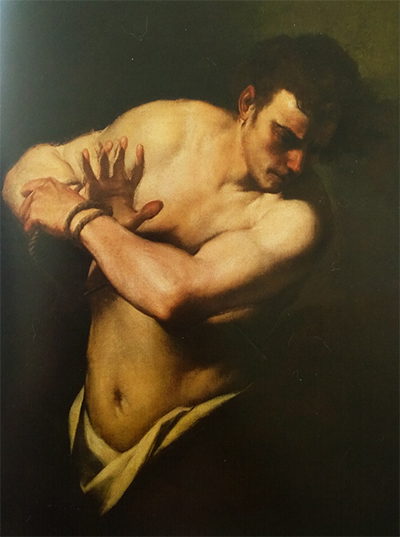
Saint Sebastian turns his head down towards one shoulder as his bound wrists cross in front of his chest. Light strikes his bare torso and the arms, leaving much of the face in shadow. The catalogue for the 2023 exhibition Bernini privato dates this oil on canvas to about 1635–40 and records it in the Forti Bernini collection in Rome. It measures 96 by 72 centimetres. Scholars have identified the canvas with a painting listed under Gian Lorenzo Bernini’s name in the 1649 inventory of Cardinal Francesco Barberini. The work also has a counterpart in subject in Bernini’s much earlier marble Saint Sebastian, now on deposit at the Museo Nacional Thyssen-Bornemisza. [1][2][3]
At a Glance
- Datec. 1635–40
- Location or statusForti Bernini collection, Rome
- WorkOil on canvas, 96 × 72 cm
The work in Bernini’s career
David
1623–24St Peter’s Baldachin
1624–33Saint Sebastian Painting
c. 1635–40The crossed arms and lowered head
The prominent line through the centre of the canvas starts at the wrist and runs along the forearm towards the elbow. Its turn brings the eye back up to the opposite shoulder. One hand opens with the fingers spread, while the other is drawn close to the arm. At their meeting point the bindings show that the position has been imposed on the body. These details allow the arms to occupy a large part of the picture without becoming a single block of light. The shafts of the forearms, the spaces between the fingers and the darker gaps among the overlapping forms keep their separate directions visible. [1]
The head turns away from the hands and dips towards the darker side of the canvas. Its placement gives the viewer a more difficult view of the expression than of the posture. Light reaches the temple, part of the nose and the upper edge of a cheek. A viewer can still infer the inclination of the head from those passages. The weight of the composition falls on the relationship between the face and the body. The arms come forward and catch the light, while the face recedes. A large movement of the torso can thus be apparent even where the precise expression is hard to read. [1]
Below the arms, the light travels down the abdomen before reaching the pale cloth at the waist. The cloth gives another clear edge to a body that otherwise merges with the dark surrounding it. The brightest areas form a connected path from the shoulder through the arms to the torso, with local breaks where one form casts a shadow over another. This is how the painter makes the overlap understandable. The viewer can see where an arm crosses the chest because the shadow changes at the crossing, then follow the outward curve of muscle where the light resumes. The composition gives depth to a tightly framed figure without broadening the view to include the place of punishment. [1]
The Barberini inventory and the surviving canvas
Luigi Ficacci published the canvas in the catalogue of the Borghese exhibition of 2017–18. Francesco Petrucci included it in the catalogue for La luce del barocco at Palazzo Chigi in Ariccia in 2020–21. The 2023 catalogue discusses the case made by both scholars for identifying the work with an entry in the 1649 inventory of Cardinal Francesco Barberini. The entry describes a half-length nude Saint Sebastian by Bernini with a gilded frame. That combination of subject, format and named artist is more specific than a reference to a Sebastian alone. [1]
The measurements in the inventory are larger than those of the existing canvas. The 2023 catalogue explains that the inventory could have counted the frame, which the entry describes along with the picture. The discrepancy is worth keeping in view because the two sets of numbers describe the work at different points in its history and may refer to different outer edges. The catalogue also records Francesco Barberini’s seal on the back of the original canvas. It reports that the seal was transferred to the lining during restoration in 2016. The entry and seal offer separate grounds for associating this painting with the cardinal’s collection. [1]
Franco Mormando distinguishes the picture from a Saint Sebastian listed in Bernini’s own household inventory after his death. The dimensions given for that other image suggest a substantially narrower proportion. An inventory can preserve a record of a work even where its later whereabouts are unknown, and the presence of the same subject in two inventories does not make them descriptions of one object. The proportions and the Barberini seal matter because they tie the discussion to physical features of the painting shown in the exhibition. [1][4]
The 2023 catalogue also records a period in a Spanish private collection before the painting returned to private ownership in Rome. This part of the provenance helps distinguish the modern history of the canvas from that of the sculpture. The two works have each had a connection with Spain, but the Thyssen catalogue traces the marble through the Barberini family until its sale in 1935. The painting’s catalogue instead relies on the seal and inventory to establish its earlier Barberini association. The shared subject and the two Spanish connections are less specific than those physical and documentary records. [1][3]
What the inventory can establish about the date
The Barberini inventory gives the height as five Roman palmi and the width as four. It also specifies that the frame was made of white poplar and entirely gilded. The catalogue’s approximate conversion of the inventory measurements, 112 by 90 centimetres, would leave room for a frame around the surviving canvas, which measures 96 by 72 centimetres. That is a plausible explanation for the difference, though it cannot recover the precise profile or appearance of the frame. In a seventeenth-century room the gilding would have set a bright edge around a picture whose outer passages are largely dark. The record describes a framed object as the inventory taker encountered it. The modern catalogue gives the dimensions of the canvas. [5]
The archival and stylistic evidence lead to different proposed dates. Francesco Petrucci proposed 1648–49, taking account of the painting’s absence from the earlier Barberini inventory and of Francesco Barberini’s stay in France between 1644 and 1648. Steven F. Ostrow favoured the second half of the 1630s. He compared the subtle transitions of tone and colour with Bernini’s mature Borghese self-portrait and the privately held Mocking of Christ. The Borghese catalogue itself dates the self-portrait to about 1635–40 on stylistic grounds and on the apparent age of the artist. These comparisons explain the date used in the 2023 exhibition, while the 1649 entry supplies a documentary date by which the painting was in the collection. The earlier inventory’s silence leaves room for a later acquisition of a picture already painted. [5][6]
The separate painting in Bernini’s household appears with a markedly different shape in the later family records. In his reconstruction of the collection, Franco Mormando gives the dimensions as six by two and a half palmi, about 134 by 56 centimetres. He traces it through the inventories of 1706, 1731 and 1771 and records a note in the 1706 inventory that it had been omitted in 1681. Mormando leaves its authorship open. That recorded omission provides a concrete example of how a picture’s first surviving entry can postdate its arrival in a collection. [7]
Reading the arrows and the saint’s gaze
Ostrow points out two arrows embedded in Sebastian’s flesh. They are easy to pass over on a first look because the arms, their bindings and the lowered face draw more attention. The arrows make the saint recognisable even though the setting gives little indication of where the punishment took place. The direction of the head also affects how the viewer interprets the pose. Ostrow reads the saint’s movement as an effort to wrench his hands free. The pull of the foreground arm and the turn of the torso give that interpretation visible support. The same posture leaves the viewer with an uncertain view of the face, where some of the more delicate changes in colour survive despite the surface abrasions noted in the catalogue. [5]
Earlier paintings show how much an artist could communicate through the place of punishment. In Andrea Mantegna’s Vienna panel, exhibited in Berlin as Der Heilige Sebastian, the upright figure stands against a column amid ruins. The column gives the body a vertical axis, and the arrows interrupt that stillness with short diagonal lines. In Perugino’s painting in the Louvre, a colonnade and open landscape give depth to the space around the standing saint. The Louvre traces the Perugino through Barberini inventories from 1648–49 onward. Thus a more expansive rendering of the same subject was recorded among Barberini possessions at around the time of the inventory naming Bernini’s canvas. Those collection records establish the presence of both kinds of image in the family’s holdings, while leaving their original relationship and display open. [8][9][10]
In Guido Reni’s Louvre canvas the upward gaze and the tree establish directions that carry the viewer beyond the figure. Bernini’s composition directs the eye back across the body. The head turns down towards the shoulder while the forearms travel across the chest, leaving the indications of the arrows to be discovered inside that compact arrangement. The bodies in both works are brightly lit. The direction of the gaze, the treatment of the wrists and the distance to the edge of the picture change what that light asks the viewer to follow. [5][11]
Two ways of depicting the saint
According to the martyr legend, Sebastian was bound and shot with arrows and survived that ordeal. Bernini’s marble in Madrid is dated 1616–17 by the Thyssen catalogue, which connects it with a payment from Maffeo Barberini. The sculpture shows Sebastian seated on a rock, supported by the trunk behind him, in the interval before Irene finds him alive. His arms and legs reveal different degrees of support and collapse. In the later painting the pose is concentrated into the upper body, and the bindings and crossed arms take on the role of identifying what has happened to the figure. [1][3]
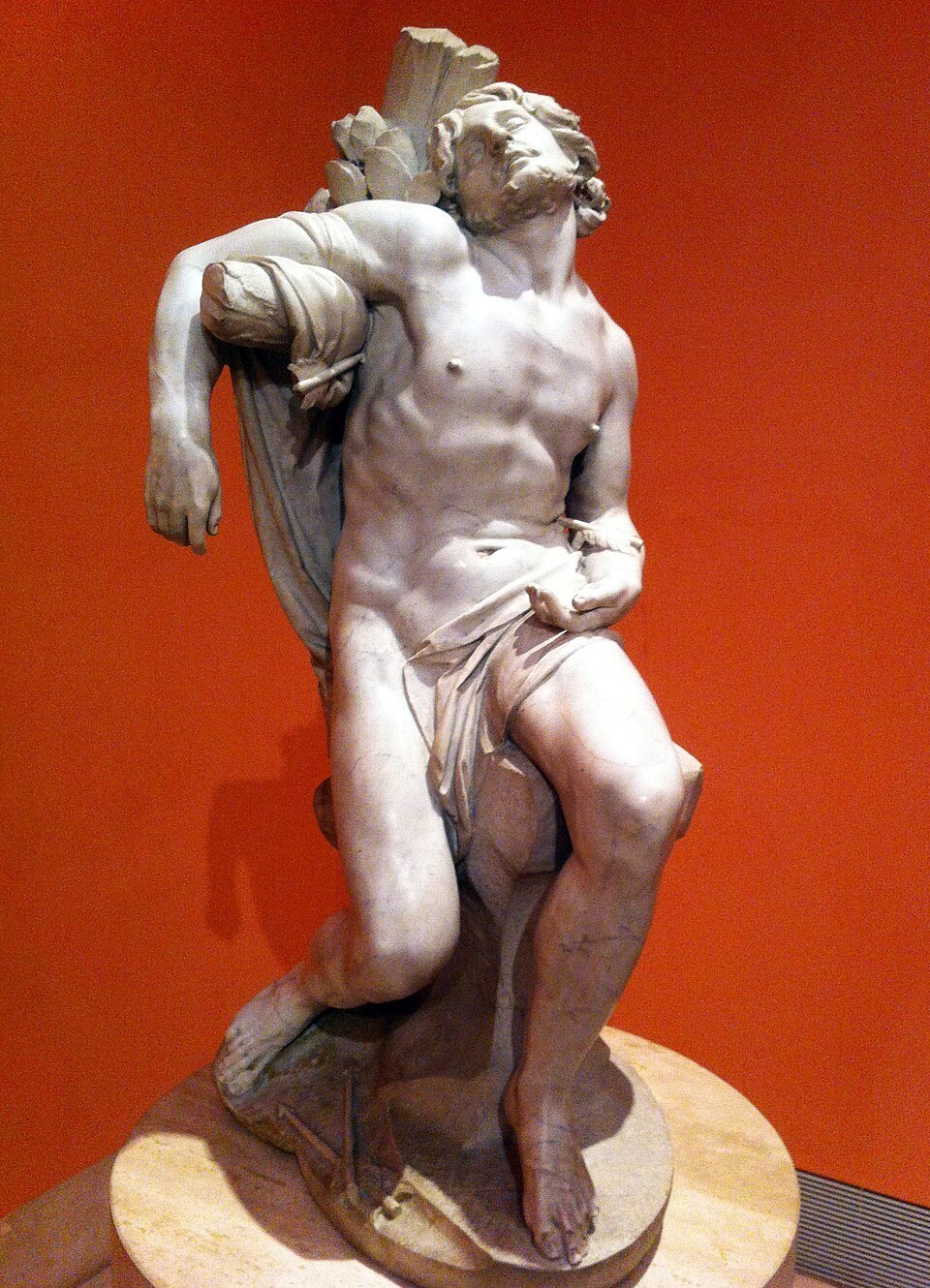
The difference is also a matter of viewpoint. As a viewer moves around the marble, the branch, rock and supporting leg come into different relations. The painting fixes one view in which the bound wrists partly conceal the chest and the bowed head is set off to the side. The shadows are part of that selected arrangement. They can keep the eyes obscure while the arms remain sharply modelled. Working on canvas thus gives Bernini a way to make the viewer recognise Sebastian’s bodily situation before reading the face. [1][3]
The Zani exhibition placed the painting beside other works from private collections and a bronze version of Bernini’s David. Seeing the painting in a discussion of his work in several media gives a reason to look closely at how it establishes the figure’s weight. The restrained setting leaves the pose to carry much of the subject. The relationship of wrists, shoulder and face can be followed directly in the picture, while the Barberini record explains how that particular canvas was named and preserved in a seventeenth-century collection. [1][2]
Discussion
The bound arms catch the light while much of Sebastian’s face remains dark.
Reader Insights
Which feature carries the strongest impression of strain?
How does this close view differ from the marble statue of Sebastian?
What would make a description in an inventory specific enough to identify this canvas?
Join the Conversation
Share a detail, comparison or question about Saint Sebastian Painting by Gian Lorenzo Bernini below.
References
- Ostrow, Steven F. San Sebastiano, in Bernini privato. La forza e l’inquietudine. 2023 exhibition catalogue, entry beginning on p. 113, with reproduction, measurements and discussion of the Barberini provenance. View source
- Fondazione Paolo e Carolina Zani. Bernini privato. La forza e l’inquietudine. Exhibition context. View source
- Museo Nacional Thyssen-Bornemisza. San Sebastian. Object record K35 for the separate marble. View source
- Mormando, Franco. Bernini Updates 3. Note 36 discusses the Zani exhibition and distinguishes the Saint Sebastian in Bernini’s household inventory. View source
- Steven F. Ostrow. San Sebastiano, catalogue entry, pp. 113–14. Transcription of the 1649 inventory and discussion of dating and iconography.
- Galleria Borghese. Autoritratto in età matura. Inventory 545, proposed dating and critical history.
- Franco Mormando. “Bernini’s painting collection: A reconstructed catalogue raisonné”. Entry 44 for the distinct Sebastian painting in Bernini’s household collection.
- Staatliche Museen zu Berlin. Mantegna und Bellini, exhibition checklist. German-language record of the Vienna panel, inventory GG 301.
- Musée du Louvre. Andrea Mantegna, Saint Sebastian. Vienna panel and its architectural setting.
- Musée du Louvre. Perugino, Saint Sébastien. Painting and Barberini inventory references.
- Musée du Louvre. Guido Reni, Saint Sébastien martyr. Inventory INV 532 and reproduction.








