


 by Tom Gurney
Tom Gurney BSc (Hons) is an art history expert with over 20 years experience
Published on June 19, 2020 / Updated on November 18, 2026
Email: tomgurney1@gmail.com / Phone: +44 7429 011000
Memorial to Alessandro Valtrini
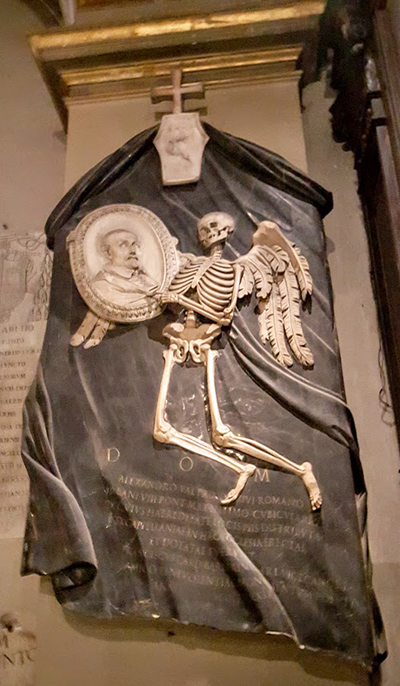
A winged skeleton lifts an oval portrait in the Roman church of San Lorenzo in Damaso. Its finger directs attention to the face of Alessandro Valtrini, while an inscription follows the folds of a dark marble drapery below. Cardinal Francesco Barberini commissioned the memorial, which was designed by Gian Lorenzo Bernini and carried out with workshop participation. The Fondazione Zeri dates it to about 1639–41, and surviving payments record work in 1640. Valtrini was buried elsewhere, at the Gesù. At San Lorenzo the portrait, inscription and figure of Death form a wall monument commemorating his generosity to the church. [1][2][3]
At a Glance
- Datec. 1639–41
- Location or statusSan Lorenzo in Damaso, Rome
- WorkBernini design executed with workshop participation
The work in Bernini’s career
Memorial to Alessandro Valtrini
c. 1639–41Ecstasy of Saint Teresa
1647–52Fountain of the Four Rivers
1648–51A portrait presented by Death
Death is easy to recognise from the skeleton and the wings. The figure’s action gives it a particular role here. One hand supports or raises the oval, while the other sends the eye back towards the relief portrait. The head of Valtrini occupies a framed area within the larger arrangement and can be read at close range. The hands make the location of that smaller image intelligible before its details can be seen. The figure that signifies the end of life is also the one that arranges for the dead man’s likeness to be seen. Judith Bernstock discusses this double function and relates it to interpretations of Death assuming some of the work traditionally given to Fame. [1][2]
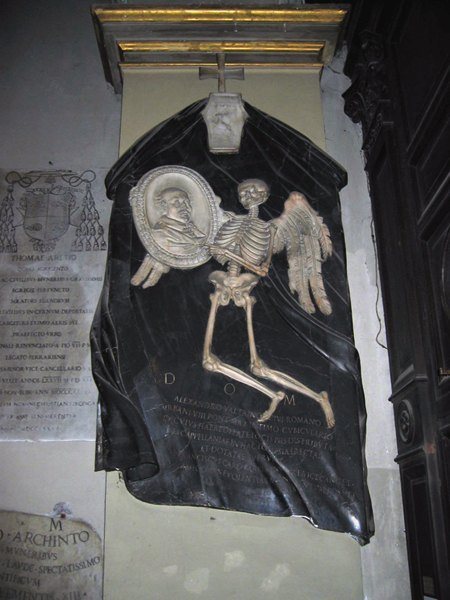
The effigy gains definition from the dark area behind it. One can distinguish the oval border and the relief inside it from the freer course of the folds. Those folds gather around the skeleton and run away from it towards the inscription. The viewer follows two kinds of line. The contour of the oval provides a stable boundary for the face. The shadow along a fold can continue past one portion of the text and reappear farther down, suggesting the movement of cloth. The design allows precision around the likeness and irregularity around the parts meant to appear in motion. [1][2][3]
At a distance, the skeleton and portrait can be distinguished by their placement and colour. Reading the words requires coming nearer and attending to the changes in the writing surface. The composition anticipates that change of distance. The skeleton’s gesture works across the larger space of the church. Within the narrower field of the epitaph, the lines move with the drapery and require the eye to follow their altered direction. The inscription retains its purpose as a record, and its support gives it a continued relation to the action above. [1][2]
Valtrini’s burial and bequests
Valtrini was a Roman member of Urban VIII’s household. He died in 1633. The history of his burial, reconstructed by Bernstock from church and Jesuit records, involved both the Gesù and San Lorenzo in Damaso. His remains were taken to the Gesù. A dispute arose because of his relation to the parish of San Lorenzo. Cardinal Francesco Barberini, who held San Lorenzo as his titular church, intervened with the authority of Urban VIII. The arrangement kept the burial at the Gesù and ensured support for chaplaincies at San Lorenzo through the beneficiaries of Valtrini’s estate. The memorial at San Lorenzo belongs to that history of obligations and commemoration. [2][3]
A third remembrance stands at Santa Maria sopra Minerva. The confraternity of the Annunciation erected it in 1637 and its inscription thanks Valtrini for a bequest providing dowries for poor women. That monument has a bust in an oval niche above a tablet, adapting the composition to a pillar across from the confraternity’s chapel. The relationship between a likeness and a text is present there too. In San Lorenzo the portrait is placed in the hands of Death and the text becomes part of a cloth. Comparing the two helps explain why the same person could have recognisable but distinct monuments at different institutions. The Gesù memorial, associated with his burial, has its own pavement tablet. [2][4]
Bernini’s design and the work of the carvers
The Zeri catalogue records the allegory under Bernini’s name. The archival material discussed by Damian Dombrowski also makes the execution a matter of workshop history. Payments in 1640 name Jacomo Razzinello and Niccolò Sale for work carried out under Bernini’s direction. Another payment to Lorenzo Fiori covered sculpture, carving, stone and sums due to other workers. These records identify people involved and the range of work the monument required. They give a different kind of evidence from a comparison of the carving of the medallion with other portraits. Dombrowski proposes Sale as the maker of the portrait relief. The identification of the particular carver is an attribution, while Sale’s involvement in the monument as a whole is documented. [1][3]
There is a formal reason to distinguish the execution of the portrait from the invention of the monument. The carver of the medallion had to establish the sitter’s likeness within a small area whose depth was limited. The figure of Death required sharply separated forms that could read outside it, and the dark stone surface needed sufficiently broad areas for the lettering. The design coordinates these tasks. A visitor reads the oval as something carried, the gesture as an invitation to look and the inscription as a surface below it. Those relations belong to the overall conception whether the same or different carvers made the individual parts. [1][2][3]
The two portraits of Valtrini have also been treated differently in attribution studies. Dombrowski proposes Andrea Bolgi for the Minerva bust, citing the rounded modelling of the head and the handling of the beard and collar. For the San Lorenzo medallion he proposes Sale, taking account of both the different treatment of the face and the recorded payments. Together these proposals show why one name attached to the sitter cannot be carried automatically from a bust to a relief. Each likeness has to be considered against its own commission, material and documentary record. [3][4]
A portrait that is being carried
Konrad Escher placed the Valtrini memorial in a sequence that begins with Bernini’s earlier wall monuments. His comparison with Giovanni Vigevano’s tomb at Santa Maria sopra Minerva brings out a change in the work done by the frame. There the upper architecture encloses the bust and supports the horizontal divisions of the monument. At San Lorenzo the hanging drapery takes over much of that work. The oval still keeps the face within a fixed border, but the position of the skeleton’s hands and the descent of the cloth explain how the portrait hangs before the viewer. The change concerns the way the wall monument is held together as well as the addition of Death to its imagery. [5]
Mateusz Kapustka identifies Valtrini and Merenda as precedents for the figure of Death lifting a drapery in Bernini’s later tomb of Alexander VII. Valtrini’s scale makes a particular feature of the design clear. The skeleton presents a small, framed likeness rather than carrying the monumental figure of the deceased. The object in its hand can be recognised as an image within the work, just as the lettering below it appears on a separate surface. In the later papal tomb the kneeling figure of Alexander stands above the drapery and Death raises an hourglass. The active skeleton connects the two designs, while the thing it displays changes the action the visitor sees. [5][6]
The medallion and drapery in later designs
Sebastiano Roberto compares the Valtrini and Merenda memorials with a proposal for the commemoration of Étienne Gueffier in the Trinità dei Monti. In the design he discusses, Gueffier’s white marble portrait medallion would have stood against a dark drapery beneath a skeleton. It was intended for the rear wall of the choir, above the stalls. The comparison with Valtrini is especially close in the use of a pale likeness set against a dark field. By moving the device to the end of a choir, the project would have placed the figure of Death and the portrait in a different architectural relationship to the congregation. The drawing or print of a project records a proposed arrangement. It provides evidence of reception even where the ensemble was never built as shown. [7]
Krzysztof J. Czyżewski and Marek Walczak discuss how the Roman language of funerary fabric and portrait relief passed into monuments in Poland. In Giovanni Battista Gisleni’s memorial to Remigiusz Zaleski, formerly in the collegiate church of St John in Warsaw, a folded cloth with gilded letters was held in the teeth of two skulls flanking the portrait. The monument was destroyed in 1944. The description still shows one way the design could be reassembled. Valtrini’s single figure lifts the medallion and directs the eye towards it. The Warsaw design distributes the grip on the cloth to either side of a likeness. The recurrence of the device shows the range of compositions it could generate, while the order of transmission between individual works remains a matter of scholarly reconstruction. [6][8]
A related memorial in another Roman church
Bernini also used a winged skeleton in his memorial to Ippolito Merenda at San Giacomo alla Lungara. There the skeleton makes a written commemoration visible by displaying an inscribed cloth. In the Valtrini monument it directs the visitor more explicitly towards a face within an oval. The comparison shows what can change between two works using related figures and the same suggestion of moving fabric. A cloth can be the principal object presented, or it can provide a surface for the words that accompany a separately framed portrait. [2]
The two devices are combined in a single view at San Lorenzo. The portrait gives a visitor a face to remember and the inscription names the beneficiary relationship that brought the memorial into the church. Death’s gesture keeps the whole arrangement from appearing to be a set of objects hung separately on a wall. Following the gesture and then the writing reveals how Bernini made distinct kinds of remembrance part of one action. [1][2]
Discussion
A winged skeleton lifts the sitter’s likeness above a dark drapery.
Reader Insights
Where does the skeleton’s pointing hand lead your eye?
How does the movement of the portrait change your reading of the inscription?
What could a payment record establish about the workshop’s contribution?
Join the Conversation
Share a detail, comparison or question about Memorial to Alessandro Valtrini by Gian Lorenzo Bernini and Workshop below.
References
- Fondazione Federico Zeri. Allegoria della Morte recante un medaglione col ritratto di Alessandro Valtrini. Object record, attribution, chronology and photographs. View source
- Bernstock, Judith E. “Bernini’s Memorials to Ippolito Merenda and Alessandro Valtrini”. The Art Bulletin 63, no. 2, 1981, pp. 210–232. Accessible transcription. View source: “Bernini’s Memorials to Ippolito Merenda and Alessandro Valtrini” View source: Accessible transcription
- Dombrowski, Damian. “Aggiunte all’attività di Andrea Bolgi e revisione critica delle sue opere”. Discussion of both Valtrini portraits and the workshop payments, p. 275 and notes 69–71. View source
- Ministero della Cultura. Monumento funebre, Santa Maria sopra Minerva. Object record for the separate 1637 Valtrini memorial. View source
- Escher, Konrad. Barock und Klassizismus: Studien zur Geschichte der Architektur Roms, 1910, pp. 113–14. The Vigevano and Valtrini monuments.
- Kapustka, Mateusz. Der Körper des Künstlers als Bild, p. 164 n. 11. German discussion of the active skeleton and the later papal tomb.
- Roberto, Sebastiano. L’église et le couvent de la Trinité-des-Monts, pp. 116–17. The French study of the projected Gueffier monument.
- Czyżewski, Krzysztof J., and Marek Walczak. The Monuments with Portrait Busts of the Bishops of Cracow: On the History of the Reception of Roman Baroque Models of Sepulchral Art in Poland, p. 196. The Zaleski memorial and Roman precedents.








